
The dream of holding a European passport-with its promise of visa-free travel, world-class healthcare, and the right to live and work across 27 countries-often feels just out of reach. The journey can seem like a confusing maze of legal jargon, and the fear of making a costly mistake can be paralyzing. If you’re overwhelmed by the complexity of how to get a european passport, you’ve come to the right place to find clarity and confidence.
This guide is your definitive roadmap for 2026. We will demystify the entire process by breaking down the five primary legal pathways to EU citizenship: through your ancestry (descent), by living in a country (naturalization), via strategic investment, through marriage, and even based on exceptional merit. By the end of this article, you will have a clear understanding of all your options, a realistic picture of the timelines and costs involved, and the assurance you need to take that crucial first step toward making your European dream a reality.
Understanding the Power of a European Passport
An EU passport is far more than a travel document; it’s a key that unlocks a life of unparalleled freedom, opportunity, and security. Holding one signifies that you are a citizen of a European Union member state, granting you the right to live, work, and study in any of the 27 countries in the bloc-from the sunny coasts of Portugal to the bustling cities of Germany-without needing a visa or work permit.
For a practical look at one of the most sought-after pathways, this video offers valuable insights:
Beyond the continent, this powerful passport enhances your global mobility, offering visa-free or visa-on-arrival access to over 170 countries worldwide. It also opens doors to some of the world’s best public healthcare and education systems, often at the same subsidized rates available to locals. Understanding these life-changing benefits is the first critical step on your journey of learning how to get a european passport and building a stable, prosperous future for yourself and your family.
Why an EU Passport is a Game-Changer
The advantages of EU citizenship extend into every aspect of your professional and personal life. It provides a unique set of rights that fundamentally change your global standing:
- Unrestricted Work & Business: You can accept a job or start a company anywhere in the EU’s single market without bureaucratic hurdles.
- Global Consular Protection: If you’re in a country without an embassy from your home nation, you can seek help from any other EU member state’s embassy or consulate.
- Generational Legacy: In most cases, you can automatically pass your citizenship on to your children, securing their future and opportunities for generations to come.
Key Differences: EU Citizenship vs. Permanent Residency
It’s crucial to distinguish between permanent residency and full citizenship. While residency grants you the right to live and work long-term in a specific country, it comes with limitations. Citizenship, on the other hand, is the ultimate goal. Residency can often be revoked and does not grant you a passport or the right to vote in national elections. True European Union citizenship is a permanent status that solidifies your identity and provides you with the passport that unlocks all the benefits mentioned above. For many, permanent residency is a necessary and valuable step on the path to citizenship.
Pathway 1: Citizenship by Descent (Jus Sanguinis) – The Ancestry Route
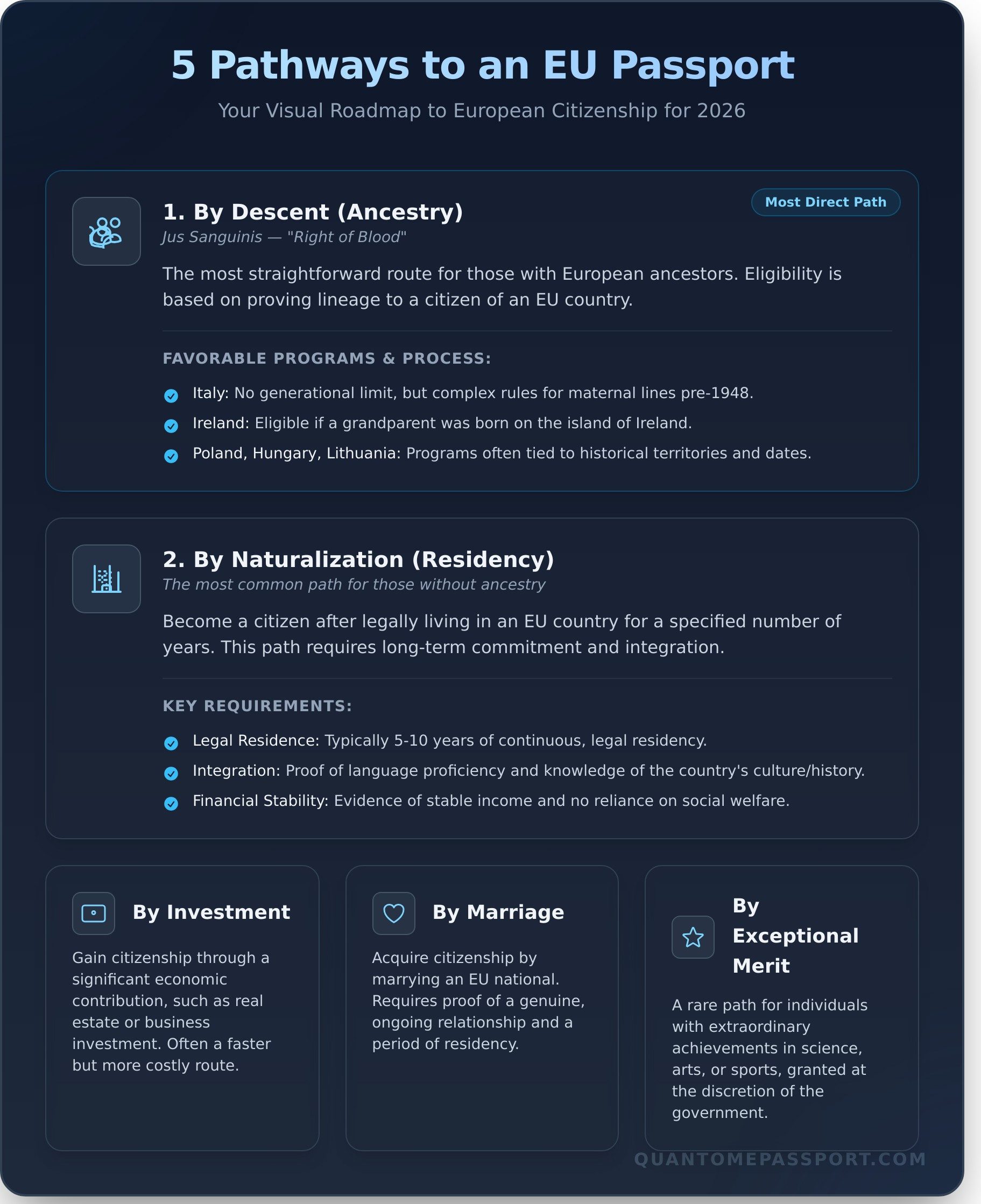
For many individuals wondering how to get a European passport, the most direct path doesn’t involve residency or investment-it lies within their family tree. This route is based on the legal principle of Jus Sanguinis, or “right of blood.” It means you may be eligible for citizenship if you can prove you are a descendant of a citizen of an EU country, even if you were born elsewhere. As this is often the most straightforward option, it should be the very first avenue you investigate.
The power of this pathway is that it connects you directly to the heritage and legal status of your ancestors, granting you the full spectrum of official EU citizenship rights. However, the rules vary dramatically from one nation to another. Some countries allow claims through a parent, while others extend eligibility to grandparents or, in some cases, even great-grandparents.
How Citizenship by Descent Works
The core requirement is to establish an unbroken lineage to an ancestor who was a citizen of an EU country. This process requires meticulous documentation. You will need to gather official records, such as birth certificates, marriage certificates, and death certificates, for every generation linking you to your European ancestor. Critically, you must prove that your ancestor held their citizenship at the time your next-of-kin parent or grandparent was born. Be aware that some countries have complex rules, including historical gender-based restrictions or specific date-based cut-offs that can affect eligibility.
Which Countries Offer Favorable Ancestry Programs?
While many EU nations have provisions for Jus Sanguinis, some are particularly well-known for their accessible ancestry programs. It is vital to check the specific rules with each country’s consulate, but here are a few key examples:
- Ireland: Eligibility is often possible if one of your grandparents was born on the island of Ireland. You may also qualify through a parent who was an Irish citizen at the time of your birth, even if they were not born in Ireland.
- Italy: Italy has one of the most generous ancestry programs, with no generational limit. However, there are important rules regarding the maternal line for ancestors born before January 1, 1948.
- Poland: You may be eligible if you can prove an ancestor was a Polish citizen after the country was re-established in 1918 and did not lose their citizenship.
- Hungary & Lithuania: These nations often have programs for descendants of former citizens, sometimes tied to specific historical territories and time periods.
First Steps to Proving Your Ancestry
Beginning this journey requires a structured approach. Start by gathering all existing family documents and speaking with older relatives to map out your family tree. Once you have identified a potential link, your next step should be to contact the embassy or consulate of that specific country to get their official, up-to-date list of requirements and application forms. For complex cases, consider hiring a professional genealogist or an immigration lawyer specializing in citizenship by descent to ensure your application is accurate and complete.
Pathway 2: Citizenship by Naturalization – The Residency Route
For individuals without European ancestry, citizenship by naturalization is the most common and accessible path. This route is based on legally residing within an EU country for a set number of years, integrating into the local culture, and ultimately earning the right to apply for citizenship. It’s crucial to view this as a long-term commitment rather than a quick solution. If you’re exploring how to get a european passport through this method, patience and careful planning are your greatest assets.
The Standard Naturalization Process Explained
The journey to citizenship via residency follows a structured, multi-year process. It typically begins with obtaining a long-term residence permit, often tied to work, study, or family reunification. You must then maintain continuous, legal residence for the period mandated by your host country. During this time, you’ll work towards meeting integration requirements, such as achieving language proficiency and passing a cultural or history exam. The final step is submitting your formal citizenship application with all necessary documentation.
Common Requirements Across EU Countries
While specific laws vary, most EU nations share a core set of requirements for naturalization. Before you can apply, you will almost certainly need to provide:
- Minimum Residency: A proven record of living in the country for a specific duration, typically between 5 and 10 years.
- Financial Stability: Evidence of a stable income and the ability to support yourself (and any dependents) without relying on social welfare.
- Clean Criminal Record: A background check showing no significant criminal history in your home country or your EU host country.
- Language Proficiency: Demonstrable knowledge of the official national language(s), usually proven through a standardized test.
How Long Does Naturalization Typically Take?
The total timeline is heavily influenced by the minimum residency period, which only begins once you have established legal residency. Below are a few examples of standard residency requirements before you are eligible to apply for citizenship:
- Portugal: 5 years
- Belgium: 5 years
- Spain: 10 years (reduced in certain cases, such as for nationals of former Spanish colonies)
After meeting the residency requirement and submitting your application, be prepared for an additional processing period. It can often take another 1 to 2 years for the government to review your case and grant a final decision.
Pathway 3: Citizenship by Investment (CBI) – The Accelerated Route
For individuals with significant capital, investment offers a streamlined and accelerated path to European residency and, ultimately, citizenship. While direct Citizenship by Investment (CBI) programs are rare within the EU, many countries offer Residency by Investment (RBI) programs, often called “Golden Visas.” These are designed to attract foreign capital by granting residency rights in exchange for a substantial economic contribution.
This route is not an instant purchase of a passport but a strategic investment that significantly shortens the naturalization timeline. Instead of waiting a decade or more, an RBI program can pave the way to citizenship in as little as five to seven years. It is a powerful answer to the question of how to get a european passport for serious investors and entrepreneurs seeking mobility, security, and access to the EU market.
How Investment Programs Accelerate the Process
Investment programs provide a clear, legally defined framework that fast-tracks your application. By making a qualifying investment-such as in real estate, business creation, or government bonds-you can often bypass the lengthy standard residency requirements. These routes are specifically structured to attract talent and capital, providing a predictable and efficient journey toward your goal. Explore how investment can fast-track your EU goals.
Key Considerations Before Choosing a Program
Embarking on an investment pathway requires careful planning and due diligence. Before committing, it is essential to conduct thorough research and work with trusted advisors. Key factors include:
- Legitimacy: Ensure the program is officially sanctioned by the government and has a proven track record.
- Total Cost: Understand the full financial commitment, including the investment, government fees, legal costs, and taxes.
- Investment Risk: Assess the potential for return on your investment, whether it’s in property or a business venture.
- Professional Guidance: Only work with reputable, government-approved agents to navigate the complex application process.
Example Pathway: The Slovenian Residency Program
Slovenia offers a prime example of a strategic residency-to-citizenship route. Located at the heart of Europe, it is a business-friendly nation with a robust economy. The program allows you to gain residency by establishing a business and making a minimum capital investment (typically starting around €50,000 in fixed assets). This active investment provides a direct path to permanent residency and, after meeting the requirements, eligibility for citizenship, making it a highly practical option for entrepreneurs.
Pathways 4 & 5: Other Routes to an EU Passport
While ancestry, naturalization, and investment are the most common routes, the journey to EU citizenship has other, more situational pathways. These options depend entirely on unique personal circumstances and are not applicable to everyone. However, they represent valid, legal methods for acquiring an EU passport and complete the picture of available opportunities.
Acquiring Citizenship Through Marriage
Marrying an EU citizen can significantly shorten the timeline for naturalization, but it is not an automatic grant of citizenship. This is a common misconception for those researching how to get a european passport. The applicant must prove the marriage is genuine and subsisting, not a union of convenience. Countries have strict vetting processes to prevent fraud.
Typically, you will still need to:
- Legally reside in your spouse’s EU country for a specified period (e.g., 1-3 years instead of the standard 5-10).
- Demonstrate social and linguistic integration.
- Provide extensive proof of your shared life, such as joint bank accounts, property deeds, and family photos.
Warning: Engaging in marriage fraud is a serious crime with severe consequences, including fines, imprisonment, deportation, and a permanent ban from entering the EU.
Citizenship for Exceptional Merit or Talent
A few EU nations, such as Austria and Malta, have provisions to grant citizenship to individuals of “exceptional merit” in fields like science, arts, sports, or culture. This is a highly exclusive and discretionary route. It is reserved for world-class individuals whose contributions are deemed to be of significant interest to the state-think Nobel laureates, Olympic medalists, or globally acclaimed artists.
This pathway does not involve a standard application process. Instead, it is often initiated by a government body and is not a predictable or accessible option for the vast majority of people. It exists to attract extraordinary talent that can bring prestige and value to the country.
These specialized routes underscore the diverse criteria for EU citizenship. Understanding which path aligns with your personal history and circumstances is the first step. Navigating the complexities of how to get a european passport is our expertise. Contact Quantome Passport to assess your eligibility across all available pathways.
Your Next Steps: How to Start Your EU Passport Journey
You’ve explored the life-changing benefits and the diverse routes to securing European citizenship. The dream of holding an EU passport is closer than you think, but turning it into a reality requires a clear and deliberate plan. We’ve covered the primary pathways available:
- Citizenship by Descent: Leveraging your European ancestry.
- Citizenship by Naturalization: Earning citizenship through legal residency.
- Citizenship by Investment: Gaining a passport through a significant economic contribution.
- Citizenship by Marriage: Acquiring citizenship through your spouse.
- Exceptional Merit: For outstanding contributions in fields like arts, science, or sports.
The most effective route is entirely unique to your background, goals, and resources. The key is to move from general knowledge to specific, actionable steps tailored to your situation.
Creating Your Personal EU Passport Strategy
Your first step is a thorough self-assessment. Begin by investigating your family tree for any European lineage; citizenship by descent is often the most direct path. If ancestry isn’t an option, evaluate your timeline and financial capacity to determine if naturalization or investment is more viable. The next crucial step in figuring out how to get a european passport is researching the specific requirements of your target country, as laws vary significantly. Be prepared: this is a marathon, not a sprint, involving extensive documentation and patience.
How Expert Guidance Can Secure Your Success
Navigating the complex legal and bureaucratic landscape of EU immigration alone can be daunting. A single mistake on an application can lead to costly delays or even outright rejection. Immigration experts provide the clarity and strategic direction needed to avoid these pitfalls. At quantomepassport.com, we analyze your unique profile to identify the optimal pathway and create a precise, step-by-step plan. Don’t leave your future to chance. Book a Private Strategy Call to build your personalized roadmap.
Your Journey to European Citizenship Starts Now
As we’ve explored, the dream of holding a European passport is more accessible than ever, with multiple legal pathways available. Whether through your ancestral roots, long-term residency and naturalization, or a strategic investment, the right option depends entirely on your unique circumstances. Successfully navigating the complexities of how to get a european passport begins with identifying the single best strategy for your goals, timeline, and personal history.
But a map is only useful if you have an expert guide. At Quantome Passport, we specialize in creating these personalized roadmaps for non-EU citizens. With deep expertise in routes like the Slovenian Residency Program and global offices in London and Dubai, our team provides the clarity and support needed to turn ambition into reality. Don’t leave your future to guesswork. Book a Private Strategy Call to Assess Your EU Passport Options and gain the confidence of a professionally crafted plan.
The door to Europe is open. Let us help you walk through it.
Frequently Asked Questions
Which is the easiest EU country to get a passport from?
The term “easiest” depends on your circumstances. For those with European ancestry, countries like Ireland, Italy, and Poland may offer a straightforward path. For residency, Portugal has been popular due to its flexible requirements and a five-year path to citizenship. Meanwhile, Malta provides a route through significant investment. Each country has unique criteria, so the best option is the one that aligns with your personal background and financial situation.
Can I buy a European passport directly?
You cannot “buy” a passport as a simple transaction. However, some EU countries offer Citizenship by Investment (CBI) programs. Malta, for example, has a process for granting citizenship for exceptional services by direct investment. This requires a substantial non-refundable contribution, a property investment, and a donation. These are highly regulated legal pathways that grant citizenship based on significant economic contributions, not a direct sale.
How long do I need to live in Europe to get citizenship by naturalization?
The residency period for naturalization varies widely across the EU, typically ranging from five to ten years of continuous legal residence. For instance, Portugal and Belgium require five years, while Germany requires eight. Countries like Austria and Spain generally demand ten years of residency. Some nations may offer shorter timelines for spouses of citizens or other specific circumstances, so it is crucial to research each country’s individual laws.
Do I have to give up my current citizenship to get an EU passport?
This depends entirely on the laws of the EU country granting citizenship and your home country. Many EU nations, including Ireland, France, Italy, and Sweden, permit dual citizenship. However, others like Spain, the Netherlands, and Austria often have restrictions and may require you to renounce your previous nationality. It is essential to verify the regulations for both countries involved to understand the implications for your status.
What are the main differences between an EU Blue Card and full citizenship?
An EU Blue Card is a work and residence permit for highly-qualified non-EU professionals, tying your right to reside to your employment. It grants mobility within the Schengen Area but does not provide voting rights or a passport. Full citizenship is permanent and grants you all the rights of a natural-born citizen. This includes the right to an EU passport, unrestricted freedom of movement, and full political participation in your new country.
Can my family get EU passports along with me?
Yes, most pathways to EU citizenship allow for the inclusion of immediate family members. This typically covers your spouse or registered partner and dependent children under 18. When you learn how to get a european passport via naturalization or investment, the process often allows you to apply for your family simultaneously or have them join you later. The specific rules and eligibility for dependents vary by country and program.