
Ever dreamt of seamlessly living, working, or retiring anywhere from the sunny coasts of Portugal to the historic streets of Rome? For many, an EU passport represents the ultimate key to freedom and opportunity. Yet, the journey often feels blocked by a wall of confusing legal jargon, leaving you unsure where to even begin. The core of this confusion usually boils down to one fundamental question: what is an EU citizen, and how is it different from simply being a resident?
This guide is your clear and simple answer. We’re here to demystify the entire concept, breaking down exactly what EU citizenship means in practical, real-world terms. You will discover the powerful rights and day-to-day benefits you gain, from unrestricted movement across 27 countries to accessing top-tier healthcare and education. We’ll also illuminate the various pathways-from ancestry to naturalization-that could make this status a reality for you, helping you set the right goals for your European future.
Defining EU Citizenship: More Than Just a Passport
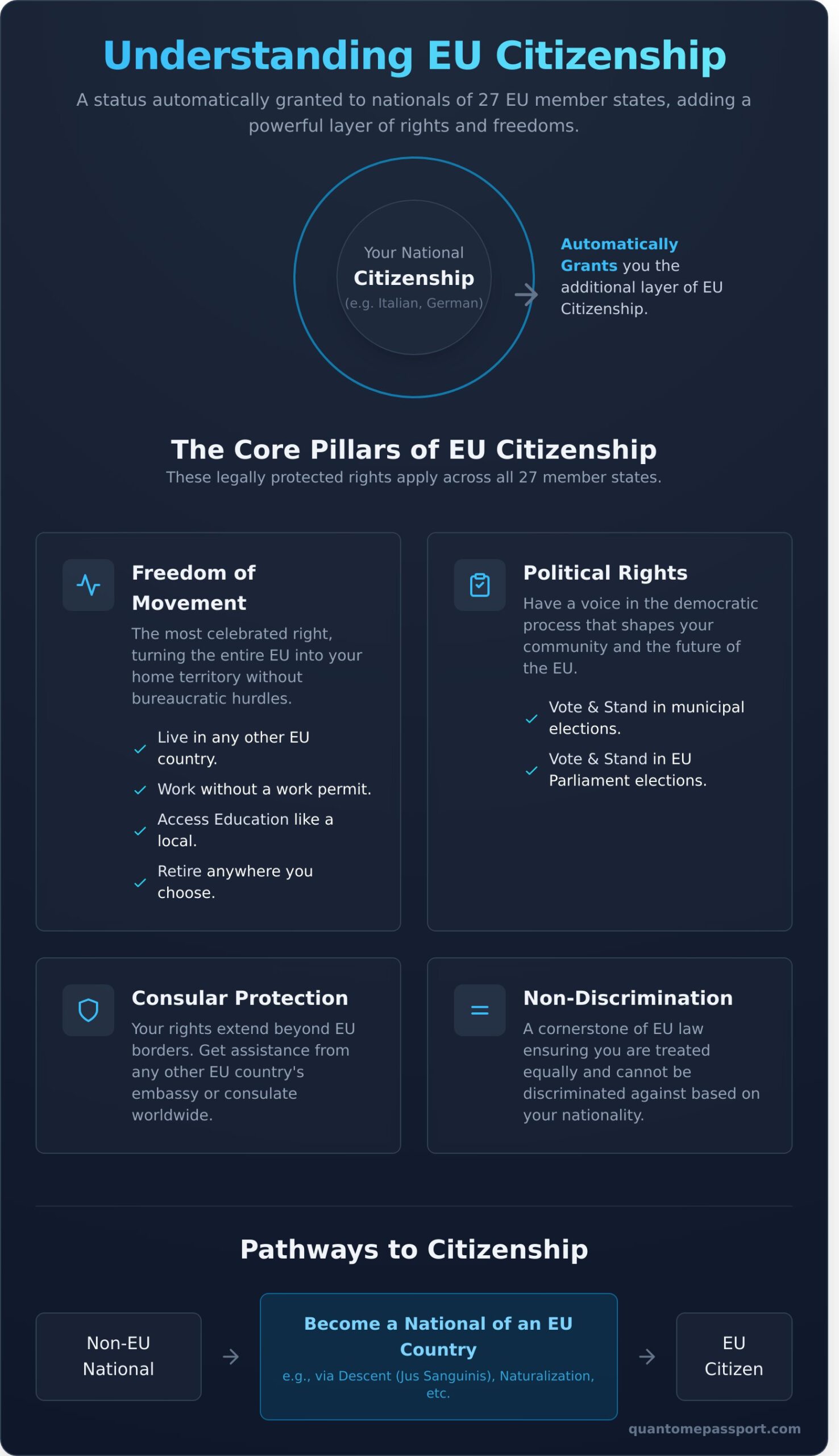
An EU citizen is any person who holds the nationality of a European Union member state. This status is not a replacement for your national citizenship but an additional layer that grants you specific rights, freedoms, and legal protections within the entire EU. To understand the benefits, we must first answer the core question: what is an eu citizen from a practical and legal standpoint?
Established by the Maastricht Treaty in 1992, EU citizenship automatically applies to you if you are a national of any of the 27 member countries. You do not apply for it separately. For a visual explanation of this concept, see the video below.
National Citizenship vs. EU Citizenship
Think of it this way: your national citizenship (e.g., German, Spanish, or Polish) is your primary identity. EU citizenship is a supplementary status that comes with it. If you hold an Italian passport, you are an Italian national first and an EU citizen second. This dual status is the key to unlocking rights like freedom of movement and the ability to work in any other member state.
Who is an EU Citizen? The Official Answer
The legal basis for this status is found in Article 20 of the Treaty on the Functioning of the European Union (TFEU). It states that any person holding the nationality of a member state is a citizen of the Union. This principle forms the bedrock of modern Citizenship of the European Union, linking individual national identities to a wider European community. However, it’s worth noting that some overseas territories of member states, like the Faroe Islands, are excluded.
As of today, citizens of the following 27 countries are also EU citizens:
- Austria
- Belgium
- Bulgaria
- Croatia
- Cyprus
- Czechia (Czech Republic)
- Denmark
- Estonia
- Finland
- France
- Germany
- Greece
- Hungary
- Ireland
- Italy
- Latvia
- Lithuania
- Luxembourg
- Malta
- Netherlands
- Poland
- Portugal
- Romania
- Slovakia
- Slovenia
- Spain
- Sweden
The Core Rights and Freedoms of an EU Citizen
Beyond a travel document, EU citizenship grants a powerful, legally protected set of rights that can be life-changing for individuals and their families. These entitlements are not merely suggestions; they are enforceable across all 27 member states, creating a unified space of opportunity. To truly grasp what is an eu citizen, we must explore these fundamental freedoms that form the very foundation of the European Union.
At the heart of this status are the ‘Four Freedoms’: the free movement of goods, services, capital, and people. For individuals, the freedom of movement for people is the most tangible benefit, transforming the entire continent into a home territory.
Freedom of Movement: Live, Work, and Retire Anywhere
This is perhaps the most celebrated right of EU citizenship. It unlocks the entire European Union, allowing you to build a life wherever you choose without the bureaucratic hurdles faced by non-EU nationals. This freedom includes:
- The right to live in any other EU country for more than three months (subject to certain conditions, such as having sufficient resources).
- The right to work anywhere in the EU without needing a work permit.
- Access to education, including universities, under the same conditions and tuition fees as local citizens.
- The right to retire in another member state, enjoying the culture and climate of your choice.
Political Rights: Participate in Democratic Life
EU citizenship also means you have a voice in the democratic process that shapes your community and the continent. As an EU citizen living in another member state, you have the right to vote and stand as a candidate in both municipal (local) elections and European Parliament elections in your country of residence. This ensures you can participate in decisions that directly affect your daily life and the future direction of the EU.
Consular Protection and Non-Discrimination
Your rights extend even beyond the EU’s borders. If you are in a non-EU country where your own member state has no embassy or consulate, you are entitled to protection from the diplomatic authorities of any other EU country. Imagine losing your passport in Thailand; you can go to the German or French embassy for assistance. This principle of equal treatment is a cornerstone of the legally defined rights of EU citizens and is enshrined in law, ensuring you cannot be discriminated against based on your nationality within the scope of the EU treaties.
Pathways to Becoming an EU Citizen for Non-EU Nationals
Now that we’ve explored the rights and benefits that come with the status, the practical question becomes: how does a non-EU national acquire it? Understanding what is an EU citizen in theory is one thing, but achieving it is a structured, long-term legal process. There is no single “EU passport” application; you must first become a citizen of an individual member country.
For most people, this journey follows one of three primary routes. Each pathway has distinct requirements, timelines, and complexities that vary significantly from one country to another.
Citizenship by Descent (Jus Sanguinis)
Often the most direct route, jus sanguinis (“right of blood”) allows you to claim citizenship based on your ancestry. If you have a parent, grandparent, or in some cases, a more distant ancestor from an EU country, you may be eligible. Nations like Ireland, Italy, Poland, and Greece have well-established programs for this. However, the rules are strict, with varying limits on how many generations back you can go to make a claim.
Citizenship by Naturalization
This is the most common pathway for non-EU nationals. Naturalization is the process of becoming a citizen of a country after living there as a legal resident for a specified number of years. While the exact timeline varies (typically 5-10 years), the core requirements are often similar across the EU and include:
- Demonstrating proficiency in the national language.
- Passing a test on the country’s history and civic values.
- Proving financial self-sufficiency and integration.
- Maintaining a clean criminal record.
Citizenship by Investment or Exceptional Merit
For high-net-worth individuals, some EU countries offer an accelerated path to residency, which can eventually lead to citizenship. These “golden visa” or residency-by-investment programs require a significant economic contribution, such as a real estate purchase, business investment, or capital transfer. While not an instant passport, this route can shorten the timeline considerably. Navigating these complex financial and legal frameworks often requires expert guidance. Explore your options with a private strategy call.
EU Citizenship vs. EU Residency: Understanding the Crucial Difference
One of the most common points of confusion for individuals moving to Europe is the distinction between residency and citizenship. While both grant you the right to live in an EU country, their legal implications and the scope of benefits they provide are vastly different. Understanding this is fundamental to knowing what is an EU citizen and the powerful rights that come with the title.
In simple terms, residency is a permit that allows a non-EU national to live legally within the borders of a specific EU country. It’s a foundational step, but it’s geographically limited. Citizenship, on the other hand, is the ultimate status. It signifies full legal membership in a country, granting you an EU passport and all the associated rights and privileges across the entire European Union.
What is EU Permanent Residency?
EU Permanent Residency is a long-term status available to non-EU nationals who have lived legally in an EU country for five continuous years. It grants the holder rights nearly equal to citizens within that one host country, including access to employment, education, and social benefits. However, it does not confer an EU passport, the right to vote in national elections, or the absolute freedom to live and work in any other member state without additional permissions.
Comparison Table: Residency vs. Citizenship
The table below offers a clear, side-by-side comparison of the key rights associated with each status. The advantages of full citizenship quickly become apparent.
| Right or Benefit | EU Permanent Resident | EU Citizen |
|---|---|---|
| EU Passport | No | Yes, granting global travel and consular protection. |
| Voting Rights | Limited to local/European elections in the host country only. | Yes, in local, national, and European elections. |
| Freedom of Movement | Right to live, work, and study in the host country. Moving to another EU state requires a new process. | Yes, the unconditional right to live, work, study, and retire in any of the 27 EU member states. |
While permanent residency is a secure and valuable status, it is citizenship that unlocks the full potential of the European Union. The answer to “what is an EU citizen?” lies in these unrestricted freedoms. If your goal is complete mobility and full political and social integration, pursuing citizenship is the definitive path. To understand your eligibility and begin your journey, explore the pathways to EU citizenship today.
Your European Future: From Understanding to Action
As we’ve explored, understanding what is an EU citizen goes far beyond a simple definition. It’s about embracing a powerful set of rights, from the freedom to live and work anywhere in the Union to the security of consular protection abroad. We’ve also seen that while the distinction between residency and full citizenship is crucial, there are defined, strategic pathways for non-EU nationals to achieve this coveted status.
Navigating these pathways requires expert knowledge. The journey can be complex, but you don’t have to do it alone. At Quantome Passport, our teams in our global offices in London and Dubai provide personalized strategies for individuals and families. We offer expert guidance on the most effective EU residency and citizenship programs to match your unique goals.
If you’re ready to turn your European dream into a tangible plan, we invite you to take the next step. Ready to explore your path to Europe? Book a private strategy call. Your future in the European Union is closer than you think.
Frequently Asked Questions
Can I lose my EU citizenship?
EU citizenship is directly linked to your nationality in a member state. You cannot lose it unless you renounce or are deprived of your national citizenship, which is rare. This typically only occurs in specific situations, such as acquiring citizenship by fraudulent means or committing acts of serious disloyalty to the state. Therefore, as long as you remain a citizen of an EU country like Spain or Poland, you remain an EU citizen with all associated rights.
Can my family members also get EU citizenship with me?
Your family members do not automatically receive EU citizenship when you do. However, your status grants them significant rights, such as the right to live, work, and study with you in another EU country. After residing in an EU country for a specific period (often five years), they may become eligible to apply for permanent residency and, eventually, citizenship through their own naturalization process, which has its own requirements like language tests.
Is an EU passport the same as a Schengen passport?
No, there is no such thing as a “Schengen passport.” The Schengen Area is a travel zone of European countries with no internal border controls. An EU passport from a member country like France or Germany grants you the right to travel freely within this zone. However, some non-EU countries like Switzerland and Norway are also part of Schengen, while some EU countries like Ireland are not. The concepts are related but distinct.
Which EU country is the easiest to get citizenship in?
The “easiest” country depends on your personal situation. For those with ancestral ties, Ireland can be a straightforward option. For investors, Portugal’s Golden Visa program has historically been a popular route leading to citizenship after five years. Malta offers a path through direct investment. Each country has different requirements regarding residency duration, language skills, and financial means, so it is crucial to research which program best fits your profile.
Do I have to give up my original citizenship to become an EU citizen?
This depends on the laws of both your current country and the EU country where you are seeking citizenship. Many EU member states, including Ireland, Italy, and Sweden, widely permit dual citizenship. However, other countries like Austria and the Netherlands have stricter rules and may require you to renounce your original nationality. It is essential to verify the specific policies of both nations involved before beginning the application process to avoid any unwelcome surprises.
What are the tax implications of becoming an EU citizen?
Your tax obligations are determined by tax residency, not citizenship itself. Typically, you are a tax resident in the country where you spend more than 183 days a year. Understanding this distinction is a key part of learning what is an EU citizen in a practical sense. As an EU citizen, you can live in any member state, but you will pay taxes according to the laws of your country of residence, which has its own tax treaties and regulations.