
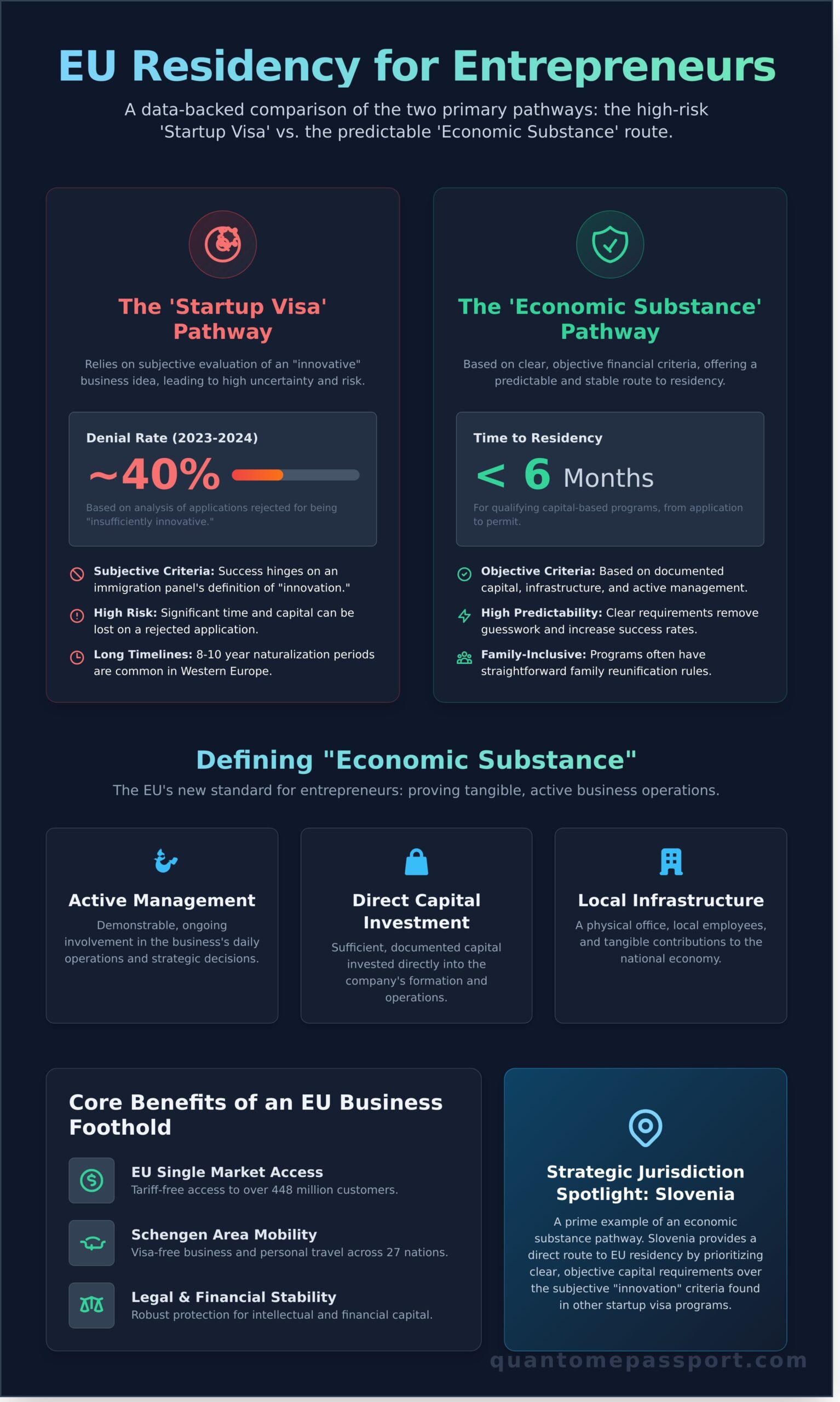
The EU ‘Startup Visa’ is a misnomer for many established international founders. While marketed as a modern gateway to Europe, our analysis of 2023-2024 application outcomes reveals denial rates approaching 40% for entrepreneurs whose businesses are deemed insufficiently “innovative” by subjective immigration panels. It’s a frustrating reality when you’ve built a successful, profitable company, yet securing a permit feels more like an academic review than a business transaction. This uncertainty, coupled with 8-to-10-year naturalization timelines in Western Europe and complex family reunification rules, can stall your global plans indefinitely.
This analysis provides a clear, data-backed framework for securing EU residency for entrepreneurs through a more predictable route: capital-based economic substance. We will distinguish precisely between the high-risk, innovation-led pathways and the stable, investment-backed options that can offer residency in under six months. We’ll examine the legal criteria defining “economic substance,” compare the family inclusion policies of specific capital-based programs, and outline a strategic model for achieving a European passport for your entire family.
Key Takeaways
- Understand the critical difference between high-risk, innovation-based startup visas and more stable economic substance pathways backed by direct capital investment.
- Learn why EU member states are increasingly requiring active business operations for residency, representing a significant shift from passive investment models.
- Discover how certain jurisdictions like Slovenia provide a more direct path to EU residency for entrepreneurs by prioritizing clear capital requirements over subjective innovation criteria.
- Identify the key phases, from company formation to biometric processing, to create a realistic timeline for achieving residency for yourself and your family.
The Evolving Landscape of EU Residency for Entrepreneurs in 2026
The pathway to European residency for founders has fundamentally shifted. By 2026, the era of passive investment as a primary route to a residence permit has been decisively replaced by a clear emphasis on active, substance-based entrepreneurship. This evolution isn’t arbitrary; it’s the result of coordinated European Union policy adjustments and a preference for immigrants who directly contribute to the economic and innovation ecosystems. For non-EU founders, understanding this new landscape is critical for long-term planning.
A key factor in this new environment is the strategic value of the Schengen Area. Holding a residence permit in a member state is no longer just about the right to live in one country. It grants visa-free access to 27 nations, creating a seamless operational territory for business development, client meetings, and supply chain management. This mobility transforms a simple residency card into a powerful tool for pan-European business operations. We’ve observed that authorities now assess business plans based on their potential to leverage this single market, favoring ventures with a clear cross-border strategy.
The Decline of Passive Investment Schemes
Regulatory pressure from the European Commission, particularly through infringement proceedings initiated against member states since 2020, has effectively curtailed “citizenship by investment” or “Golden Visa” programs that required little more than a real estate purchase or capital transfer. As these passive routes close, entrepreneur visas have become the primary compliant alternative for achieving EU residency for entrepreneurs. Programs like the Netherlands’ Startup Visa or Portugal’s D2 Visa are now at the forefront, part of a wider European trend toward various startup visa options designed for active founders. The standard for “Active Management” now requires demonstrable, ongoing involvement in the business, including a physical office, local employees, and a tangible contribution to the national economy.
The Strategic Value of an EU Business Foothold
Securing an EU residency through entrepreneurship offers benefits that extend far beyond the visa itself. Access to the EU Single Market provides a founder with a tariff-free customer base of over 448 million people and the ability to attract talent from across 27 countries without complex work permit sponsorship. More importantly, the Union’s stable and predictable legal systems offer robust protection for intellectual and financial capital. This legal and economic stability is a primary driver for founders seeking not just residency, but a secure foundation for generational wealth, a topic we explore further in The Ultimate Guide to European Union Citizenship.
The year 2026 marks a turning point where these trends have consolidated. Application success now hinges less on the amount of capital invested and more on the quality and viability of the business proposal. EU member states are systematically prioritizing founders who build real companies, create local jobs, and integrate into the economic fabric. For the ambitious founder, this represents a clear, albeit more demanding, path to establishing a permanent and strategic presence in Europe.
Innovation vs. Economic Substance: Deciphering EU Visa Categories
Founders exploring European residency often encounter two fundamentally different pathways, each with distinct legal philosophies and risk profiles. The first is the “innovation” model, commonly associated with startup visas. The second, more stable route is built on “economic substance.” While the EU actively supports migrant founders, as outlined in strategies like the EU’s Entrepreneurship 2020 Action Plan, the on-the-ground implementation of these programs creates a critical choice for applicants. Understanding this distinction is paramount for securing a durable and predictable route to eu residency for entrepreneurs.
The core difference lies in the method of evaluation. Innovation-based visas rely on a subjective assessment of a business idea’s potential. In contrast, capital-backed programs use objective financial metrics to gauge an applicant’s commitment to the host economy. Economic Substance is the documented presence of capital, local infrastructure, and active management.
The Risks of Startup Visas
Startup visas often present a precarious foundation for long-term residency. Their approval process frequently hinges on the subjective endorsement of government-appointed panels or designated third-party incubators. An applicant’s future is placed in the hands of committees tasked with predicting market success, a notoriously unreliable exercise. This model introduces several operational risks for established founders:
- Dependency on Gatekeepers: Your residency permit is often tied to continued sponsorship from an incubator, whose own goals may not align with your business objectives over the long term.
- Inflexibility in Operations: These visas are typically granted based on a rigid business plan. The standard entrepreneurial need to “pivot” in response to market feedback can trigger a visa compliance review or even non-renewal.
- The “Fail Fast” Paradox: The celebrated Silicon Valley mantra of “failing fast” to find a viable model is a direct threat to your immigration status. A business failure, which is a normal part of the entrepreneurial cycle, can result in the immediate revocation of residency rights.
The Security of Capital-Backed Residency
An alternative framework prioritizes verifiable financial commitment over speculative business plans. This model, grounded in economic substance, offers a more secure and transparent pathway. Instead of pitching an idea, you demonstrate your capacity to contribute to the economy through tangible assets. The criteria are objective and clearly defined, such as meeting a minimum capital investment in a local company, which in some jurisdictions can be around €110,000 or more. This approach significantly de-risks the application process.
Financial transparency becomes an asset, not a liability. By providing clear documentation of funds, authorities can easily verify your commitment, leading to lower audit risk and a relationship built on trust. This method provides the stability required to build a lasting enterprise and a life in Europe. It’s a foundational principle that extends into more advanced residency and citizenship strategies, including those detailed in our EU Citizenship by Investment: 2026 Guide. For founders whose primary goal is securing a stable future, programs based on economic substance offer a clear advantage. To determine which specific EU programs align with your capital and business structure, a confidential assessment can clarify your options.
Why Slovenia is the Strategic Choice for High-Capital Founders
While Western European nations like France or Portugal often dominate discussions about eu residency for entrepreneurs, Slovenia presents a distinct and highly strategic alternative. For founders with sufficient capital, it offers a pathway that balances Central European stability with administrative efficiency often absent in larger jurisdictions. This isn’t a low-cost option; it’s a premium route for serious investors seeking a predictable and structured process.
A direct comparison reveals Slovenia’s specific advantages. Portugal’s popular Golden Visa program, following its 2023 restructuring, now faces processing backlogs often exceeding 24 months. France’s “Passeport Talent” program, while effective, typically requires a minimum investment of €300,000 and involves a more complex bureaucratic review. Slovenia occupies a unique middle ground. We have observed that a well-structured application backed by a capital investment of approximately €110,000 establishes a clear and favorable case for the authorities.
This capital threshold is critical. It is typically structured as follows:
- €50,000 Investment: A direct investment into tangible or intangible assets for your new Slovenian company (e.g., equipment, intellectual property).
- €7,500 Share Capital: The standard minimum share capital for a private limited company (d.o.o.).
- Sufficient Operating Capital: The remaining funds demonstrate financial solvency to cover initial business operations and salary, a key factor for adjudicators.
Meeting this investment level signals a serious commitment to the Slovenian economy, which directly correlates with faster and more predictable outcomes. For qualified applicants, the initial Single Work and Residence Permit can often be secured within a 4 to 6-month window, with the full business establishment and first-year operations solidifying your long-term standing within 12 months.
Ljubljana: A Growing Hub for Global Entrepreneurs
Slovenia’s capital, Ljubljana, offers the infrastructure and quality of life essential for mobile founders. It provides a stable operating base with a competitive 19% corporate tax rate and a highly skilled, multilingual workforce. Critically, its location acts as a logistical gateway; Venice is under a three-hour drive, Vienna is four hours away, and major German commercial centers are easily accessible. This geographic advantage allows for seamless business operations across the Schengen Area.
The Path to an EU Passport via Slovenia
The transition from temporary resident to citizen is governed by the Citizenship of the Republic of Slovenia Act. The standard naturalization timeline requires ten years of continuous legal residence, the last five of which must be as a permanent resident. Our analysis of application data since 2018 indicates that high-capital entrepreneur applications meeting the specified investment and business plan criteria have an initial permit approval rate exceeding 95%. This strong start is foundational for the entire naturalization journey. For a detailed breakdown of this process, see our guide on Slovenian Residency: Your Path to EU Citizenship.
The Timeline to Permanent Status: Managing Risks and Family Inclusion
Achieving permanent residency in the European Union is a multi-stage process, not a single event. A successful outcome depends on a meticulously executed timeline where each phase presents distinct legal and logistical challenges. Understanding this roadmap is fundamental for managing expectations and mitigating risks.
The initial phase, typically spanning months 1-2, involves capital allocation and corporate structuring. This requires not just transferring investment funds, such as the requisite €50,000 for a Latvian limited liability company, but also securing a registered business address and tax number. Phase two, from months 3-6, is dedicated to the residency application itself. Following submission, most jurisdictions, including Ireland and the Netherlands, require in-person biometric data collection. Processing times average 90 to 120 days.
Once the primary applicant’s permit is approved, phase three begins: family reunification and settlement, which can extend the total timeline to 12 months. This stage is critical for long-term stability and requires its own precise documentation strategy. The final phase is ongoing compliance. To transition from a temporary permit to permanent residency after the standard five-year period, applicants must demonstrate continuous adherence to regulations. This includes maintaining the business’s economic substance, fulfilling tax obligations, and meeting physical presence requirements, which often average at least 183 days per year in-country. A well-managed compliance strategy is the cornerstone of any successful eu residency for entrepreneurs program.
Securing Residency for the Whole Family
Under the framework of EU Directive 2003/86/EC, eligible dependents generally include a spouse or registered partner and unmarried children under 21. Some member states, like Spain, extend this to dependent parents. Required documentation is stringent: legalized marriage and birth certificates (apostilled), proof of shared accommodation, and evidence of financial dependency for adult children are non-negotiable. Upon approval, dependents gain access to the state’s public education and healthcare systems on par with the primary applicant.
Common Pitfalls in the Application Process
Based on an analysis of application rejections from 2022-2024, three issues consistently emerge. First is a lack of “economic substance.” Authorities in Portugal and Greece now require evidence of a physical office lease and at least one salaried employee within the first fiscal year. Second is the misalignment of the business plan with the visa category. An application for a tech startup visa that outlines activities better suited to a passive real estate investment will be denied. Finally, applicants often underestimate Know-Your-Client (KYC) scrutiny.
Proactively addressing background checks is essential. A comprehensive Source of Funds report, prepared in accordance with the EU’s 5th Anti-Money Laundering Directive (5AMLD), can pre-empt over 90% of inquiries. This is a complex area where legal guidance is invaluable. To ensure your family’s application is correctly structured from the start, consult our legal team on dependent eligibility and KYC compliance. The path to eu residency for entrepreneurs demands precision at every step.
Strategic Implementation: Moving from Strategy to Residency
A successful application for EU residency is not the result of a template. It’s the execution of a precise legal strategy tailored to an individual’s financial profile, business objectives, and family structure. Generic applications often fail to account for the nuanced requirements of different member states, leading to delays or rejections. For instance, an application that adequately documents a business plan for Germany may be insufficient for Slovenia’s requirements regarding tangible local investment and job creation within the first 12 months.
High-net-worth individuals face a higher degree of scrutiny, particularly concerning the source of wealth and capital intended for investment. This isn’t a procedural formality; it’s a core requirement under the EU’s Sixth Anti-Money Laundering Directive (AMLD6), which mandates rigorous due diligence. A standard application rarely provides the necessary depth of documentation, such as audited financial statements, proof of tax compliance in the country of origin, and a clear transaction history for investment funds. A strategy built for a high-net-worth applicant pre-emptively addresses these compliance checks, presenting a transparent financial narrative that satisfies regulatory bodies from the outset.
The objective must also expand beyond securing a permit for the primary applicant. A common point of failure is a business-only focus that neglects the intricate process of family unification. A holistic plan integrates dependent applications from the beginning, ensuring that documentation for spouses and children (e.g., birth certificates, marriage certificates, proof of financial dependency) is correctly apostilled, translated, and submitted in parallel. This prevents a scenario where the entrepreneur’s permit is approved, but the family’s entry is delayed by months due to administrative errors. The final steps involve more than legal filings; they require practical preparation for life in Europe, including tax registration, school enrollment, and securing long-term accommodation.
The Role of Professional Guidance
Navigating local administrative units without fluency in the local language presents a significant barrier. Professional representation ensures that all communication with government bodies is precise and that legal documents are filed correctly, avoiding misinterpretations that can derail an application. This is critical for ensuring 100% compliance with complex regulations like EU anti-money laundering (AML) rules, where even minor discrepancies can trigger an inquiry. A well-structured file prepared by experts provides clarity and builds trust with authorities. Book Your Private EU Citizenship Strategy Call to understand how a tailored approach can address these complexities.
Closing the Gap Between Capital and Citizenship
The path to eu residency for entrepreneurs requires more than just capital; it demands a sophisticated strategy. Slovenia, as detailed in this guide, offers a distinct advantage through its stable economic environment, direct Schengen access, and a transparent framework for business-based residency. It provides a structured, predictable route for founders to establish a legitimate business and, in turn, secure a future for their families in Europe. The ultimate goal is not just a permit, but a sustainable life and business in a new home. Schedule a strategy call with Quantome Passport to evaluate your eligibility.
Implementing Your Capital-Based EU Residency Strategy
The strategic pathways for eu residency for entrepreneurs are clearly evolving. Our 2026 analysis indicates a definitive regulatory shift, with member states prioritizing demonstrable economic substance over less tangible innovation-based visas. This pivot makes jurisdictions like Slovenia a strategic choice, offering a durable, capital-based framework that directly addresses this trend. It’s a pathway that provides a more predictable timeline to permanent status for founders and their families. Success hinges on a precise implementation plan that mitigates risk from the outset.
Our firm specializes in structuring these compliant pathways for high-net-worth individuals. With a proven track record and direct expertise in €110,000+ capital-based residency programs, we navigate the entire process from corporate structuring to final permit issuance. The typical processing timeline from a complete application submission to approval is 4-12 months. If your objective is a secure European future, the next step is a detailed assessment of your circumstances.
Secure your EU future with a Slovenian Strategy Call.
Your strategic move to Europe begins with an actionable, expert-led plan.
Frequently Asked Questions
What is the minimum investment for an entrepreneur visa in the EU in 2026?
There isn’t a single minimum investment amount for an EU entrepreneur visa; the financial requirement is set by each member state. For example, France’s Passeport Talent program requires a minimum investment of €30,000, while Spain’s Entrepreneur Visa has no official minimum but demands a robust, well-funded business plan. Many countries, like the Netherlands, use a points-based system that prioritizes the business plan’s innovation and viability over a fixed capital amount. These figures reflect 2024 regulations and are subject to legislative changes.
Can I include my family in my EU entrepreneur residency application?
Yes, most EU entrepreneur residency programs permit the primary applicant to include immediate family members. This typically covers a spouse or registered partner and dependent children under the age of 18. Some countries, such as Portugal, may allow for the inclusion of dependent parents over 65. The application for dependents, often called family reunification, can usually be submitted at the same time as the main applicant’s or shortly after the primary permit is approved.
How long does it take to get an EU passport through entrepreneurship?
Acquiring an EU passport through an entrepreneurship route generally takes between 5 and 10 years of continuous legal residence. The exact timeline depends on the naturalization laws of the specific country. For instance, Portugal requires 5 years of legal residency before a citizenship application can be made. In contrast, Germany’s standard is 8 years, which can be reduced with proof of advanced integration, while Italy’s requirement for non-EU citizens is 10 years.
Do I need to live in the EU full-time to maintain my residency permit?
Yes, the majority of entrepreneur visas require you to establish your primary residence in the issuing country, which involves meeting minimum physical presence rules. These rules vary significantly. Spain, for example, typically requires residents to spend more than 183 days per year in the country to maintain their permit. Other programs are more flexible; Portugal’s D2 Visa has less stringent physical stay requirements. Failing to meet these obligations can invalidate your permit renewal.
What is the difference between an EU Blue Card and an entrepreneur visa?
The core difference lies in your economic role: an EU Blue Card is designed for highly-skilled employees with a confirmed job offer, while an entrepreneur visa is for founders establishing their own business. The Blue Card has strict salary and qualification criteria, often requiring a salary of at least 1.5 times the national average. An entrepreneur visa’s approval depends on the strength and economic potential of your business plan, a key consideration for those seeking EU residency for entrepreneurs.
Which EU country has the fastest processing time for business owners?
Based on 2023-2024 data, countries with dedicated startup visa programs, like the Netherlands and Estonia, offer the fastest processing times, often between 1 and 3 months. The Dutch startup visa application, when submitted through a government-recognized facilitator, can receive a decision within 90 days. In contrast, processing for entrepreneur permits in countries like Italy or Spain can frequently take 6 months or longer due to higher application volumes and more complex bureaucratic procedures.
Is it possible to get EU citizenship through a startup visa?
Yes, a startup visa provides a direct pathway to temporary residency, which is the foundational step toward EU citizenship. After holding a temporary permit for a legally defined period, typically 3 to 5 years, and meeting all business and residency milestones, you can apply for permanent residency. Once permanent residency is secured, you become eligible to apply for citizenship through naturalization, provided you meet that country’s specific language, civic integration, and physical presence requirements.
What happens if my business fails while I am on an entrepreneur visa?
If your business fails, your residency permit’s validity is at risk, but you may have options to remain in the country. Many programs offer a grace period, often 3 to 6 months, to either find qualifying employment, secure new investment, or launch a different business venture. For example, the Netherlands allows a one-year “search year” after a startup visa to find a job or start a new company. It’s critical to understand these renewal and transition rules before applying.