In a global landscape often clouded by ambiguous ‘Golden Visa’ claims and shifting regulations, discerning investors seek clarity and long-term stability. While many programs offer transactional residency, the strategic benefits of slovenian residency are rooted in a different proposition: a stable, compliant, and structured progression within the European Union. This guide provides an authoritative analysis of these advantages, moving beyond immediate Schengen Area access to examine the tangible business environment and its clear pathway to long-term settlement and eventual citizenship.
Here, we will dissect the legal framework governing Slovenia’s primary business immigration route-a topic frequently subject to misinterpretation-and clarify the procedural requirements for maintaining and upgrading resident status. By contextualizing its legal and economic stability, this article delivers a clear framework for investors to evaluate the program’s long-term return on investment and establish a secure, strategic foothold in Europe for 2026 and beyond.
Key Takeaways
- Understand how a Slovenian residence permit provides immediate visa-free mobility across the 27-country Schengen Area for business and personal travel.
- Learn why Slovenia’s political stability and strategic location at the crossroads of European trade routes create a secure hub for long-term investment.
- Clarify the legal distinction between residency and citizenship, and review the structured, compliant pathway from resident status to naturalization.
- Evaluate the comprehensive benefits of slovenian residency, positioning it as a reputable and balanced option compared to other EU investment migration programs.
Benefit 1: Full Mobility Within the Schengen Area and European Union
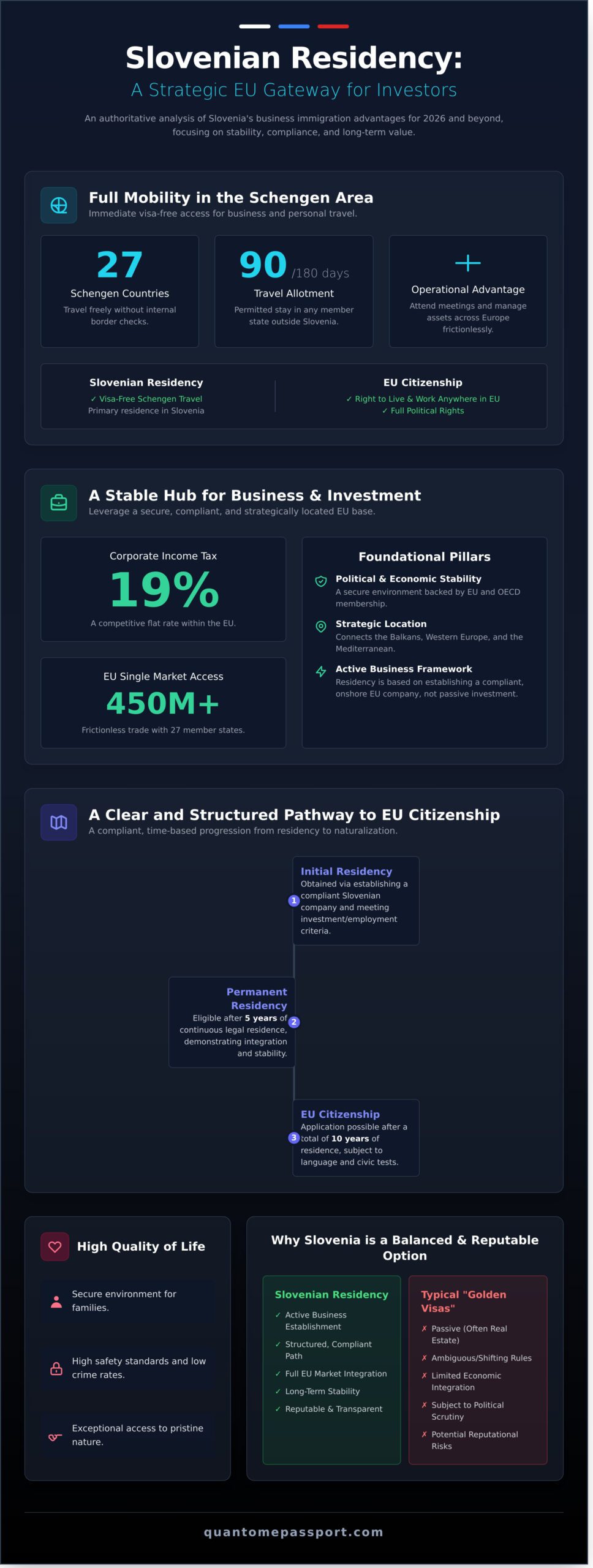
One of the most immediate and tangible benefits of Slovenian residency is the grant of visa-free travel throughout the Schengen Area. A valid Slovenian residence permit allows its holder to cross internal borders of the 27 member countries without routine checks, facilitating seamless movement for both business and leisure. This right is a cornerstone of European integration, enabling a level of mobility comparable to domestic travel within a single nation.
It is crucial, however, to distinguish this privilege from the rights of full EU citizenship. A residence permit holder can travel within the Schengen zone for up to 90 days in any 180-day period. This is distinct from the right of an EU citizen to live, work, and vote in any member state. The permit grants extensive travel freedom, but the holder’s primary country of residence remains Slovenia. Understanding the specifics of Schengen Area mobility is essential for compliance and leveraging this benefit effectively.
For a detailed perspective on the advantages of establishing a base in the country, the following analysis provides further context:
The Practical Advantage for Global Business
For globally mobile entrepreneurs and investors, visa-free Schengen access removes significant logistical friction. The ability to attend last-minute meetings in Frankfurt, manage assets in Zurich, or explore opportunities in Milan without pre-applying for a visa is a substantial operational advantage. This contrasts sharply with the time-consuming and uncertain process of securing multiple short-stay visas, saving invaluable time and administrative resources for frequent travellers.
Residency as a Gateway to the EU
Beyond travel, a Slovenian residence permit is the foundational legal step to establishing a legitimate presence within the European Union. It provides a stable base from which an individual can manage personal and business affairs across the continent. This status allows you to live legally in Slovenia, integrating into the European economic and social framework. All other benefits of Slovenian residency, from business incorporation to eventual citizenship pathways, are built upon this initial establishment of legal residence.
Benefit 2: A Stable Hub for Business and Investment
For globally-minded entrepreneurs and investors, one of the primary benefits of Slovenian residency is establishing a foothold in a politically and economically stable jurisdiction. As a member of the European Union (EU) and the Organisation for Economic Co-operation and Development (OECD), Slovenia offers a secure and predictable environment. Its strategic location at the crossroads of major European trade routes provides a logistical advantage, connecting the Balkans with Western Europe and the Mediterranean with Central Europe.
Direct Access to the EU Single Market
Establishing a company in Slovenia provides direct, frictionless access to the EU Single Market, an economic zone of over 450 million consumers. This is a critical advantage for businesses involved in import/export or cross-border services. Operating under harmonised EU regulations and trade agreements eliminates customs duties within the bloc and simplifies compliance, allowing businesses to scale efficiently across 27 member states without navigating disparate legal and tariff systems.
Slovenia’s Favourable Corporate Framework
Slovenia supports business activity with a competitive and transparent framework. The country maintains a flat corporate income tax rate of 19%, which is favourable compared to many Western European nations. The legal system provides robust protections for foreign investors and property rights, aligning with established EU standards. The stable macroeconomic environment is consistently affirmed by independent analysis, as detailed in the OECD economic outlook for Slovenia, providing valuable context for long-term investment planning.
A common misconception is that all European residency programs are structurally similar. However, Slovenia’s pathway is intrinsically linked to active business establishment, not passive investment. This means applicants create a fully compliant, onshore European company from the outset. This distinction is crucial for long-term planning, as it avoids the complexities and reputational risks associated with offshore structures. Understanding the specific requirements for company formation is a foundational step in leveraging the full scope of business-related benefits of Slovenian residency.
Benefit 3: High Quality of Life and Security for Families
Beyond its economic advantages, one of the core benefits of Slovenian residency is the exceptionally high quality of life and security it offers. For globally mobile families, establishing a base in a country known for its safety, low crime rates, and pristine natural environment is a strategic decision. This move transcends immediate lifestyle improvements, forming a foundational asset for long-term family well-being and legacy planning. Slovenia consistently ranks among the safest countries globally, providing a stable and predictable environment for raising children and securing a family’s future.
Education and Healthcare Systems
Legal residents in Slovenia gain access to a high-standard public education system, including state universities that operate under the EU’s Bologna Process. This is complemented by a growing number of reputable international schools catering to diverse curricula. Similarly, the healthcare system provides comprehensive coverage and is integrated within the wider European Health Insurance Card (EHIC) network, ensuring access to necessary medical care across the EU. This dual access provides critical peace of mind for long-term family health security.
A Secure Environment for Generational Wealth
Slovenia’s political stability and firm adherence to EU legal frameworks on property rights create a secure environment for asset protection. This stability is reinforced by positive long-term economic forecasts, as detailed in the OECD Slovenia Economic Snapshot, which project sustained growth. For high-net-worth individuals, establishing EU residency serves as a crucial ‘Plan B,’ diversifying jurisdictional risk and safeguarding wealth against volatility in their home countries. This is a fundamental component of a sophisticated wealth preservation strategy.
The combination of personal safety, robust social systems, and a stable legal framework makes Slovenian residency a powerful tool for building generational security. It is not merely a permit but an investment in a secure and prosperous future for one’s family, offering a tangible legacy beyond financial assets.
Benefit 4: A Clear and Structured Pathway to EU Citizenship
For many globally mobile individuals, temporary or permanent residency is not the final objective. It is a crucial, legally mandated step toward the ultimate goal: full EU citizenship. One of the most significant benefits of Slovenian residency is that it establishes a direct and legally codified pathway to naturalization. Under the Citizenship of the Republic of Slovenia Act, an individual who has maintained continuous legal residence for ten years-the final five of which must be as a permanent resident-is eligible to apply for citizenship. This provides a level of certainty often missing in other jurisdictions. It is essential to understand the distinction between permanent residency and citizenship, as each status confers a different set of rights and obligations.
The Value of a Predictable Naturalization Process
Unlike countries where naturalization criteria can be ambiguous or subject to frequent policy changes, Slovenia’s framework is transparent and governed by statute. This predictability allows applicants to formulate a clear, multi-year strategy. Our advisory is structured to ensure clients not only obtain residency but are also positioned to meet these future naturalization requirements, which typically include proven integration into Slovenian society, a basic proficiency in the Slovenian language, and a clean criminal record.
From Resident Rights to Citizen Privileges
Achieving Slovenian citizenship transforms your status from a resident of one country to a citizen of the entire European Union. This unlocks a new tier of privileges that far exceed those of a resident. The most profound of these is the full freedom of movement and establishment, granting the right to live, work, study, and retire in any EU member state, as well as in Switzerland, Iceland, Liechtenstein, and Norway.
- Political Rights: The right to vote and stand as a candidate in European Parliament elections.
- Consular Protection: Access to diplomatic and consular protection from any EU member state’s embassy when traveling abroad.
- Economic Access: Unrestricted access to the EU’s single market for business, employment, and investment.
This transition from residency to citizenship represents the culmination of a strategic, long-term plan, securing generational access to one of the world’s most stable and prosperous regions.
Benefit 5: A Balanced and Reputable EU Residency Option
In a landscape where many European residency programs face increasing regulatory scrutiny, Slovenia offers a distinct and stable alternative. Its framework is not a passive ‘Golden Visa’ but a residency-by-investment program rooted in active business engagement. This distinction is crucial. It positions Slovenia as a compliant, transparent, and sustainable option for global investors seeking long-term security within the European Union. The core of the benefits of slovenian residency lies in this very structure: it prioritizes genuine economic contribution over simple capital transfer, ensuring the program’s integrity and longevity.
Why Active Investment Matters
The requirement to establish and operate a business fosters substantive economic ties, integrating the resident into the local economy. This model is viewed more favourably by European governing bodies, as it demonstrates a tangible commitment to the host country. Unlike passive investment schemes, which are often criticized for their potential economic distortions, an active business investment contributes directly to growth. This robust framework enhances the long-term security and reputation of your Slovenian residency permit.
Assessing Your Eligibility and Next Steps
The path to Slovenian residency through business investment is structured and requires meticulous planning to meet all legal and commercial criteria. A successful application hinges on a well-defined business plan and a clear understanding of corporate compliance, as outlined in the Companies Act (ZGD-1). A preliminary assessment is an essential first step to verify eligibility and map out a viable strategy tailored to your objectives.
Ultimately, choosing Slovenia is a strategic decision for the discerning investor focused on a compliant and reputable EU foothold. To understand how these legal requirements apply to your specific circumstances and to begin a confidential evaluation, we recommend a private consultation.
Final Assessment: The Strategic Value of Slovenian Residency
As demonstrated, the benefits of slovenian residency extend far beyond mere mobility within the Schengen Area. The program presents a compelling synthesis: a stable, pro-business environment within the EU’s economic framework combined with a transparent, structured pathway toward potential EU citizenship. This balanced approach, which also encompasses a high quality of life, distinguishes it from other residency-by-investment options that may not offer such a comprehensive and reputable solution for discerning global investors.
Navigating the legal requirements of the Slovenian business investment program demands precise, expert guidance. Our legal teams, with global offices in London and Dubai, specialize in providing legally compliant EU residency solutions based on established procedural patterns. To understand the application intricacies, including necessary corporate structuring and due diligence protocols, we invite you to Book a Private Strategy Call to assess your eligibility for Slovenian residency.
This initial consultation is a critical first step in confidently advancing your long-term strategic objectives in Europe.
Frequently Asked Questions About Slovenian Residency
Can I work in other EU countries with a Slovenian residence permit?
A Slovenian residence permit grants the right to live and work exclusively in Slovenia. While it allows for visa-free travel throughout the Schengen Area for up to 90 days within a 180-day period, it does not confer automatic employment rights in other EU member states. To work in another EU country, you must typically secure a separate work permit from that specific nation, subject to its own immigration and labor laws.
How long must I live in Slovenia to maintain my residency?
To maintain a temporary residence permit, you must not be absent from Slovenia for more than six consecutive months or a total of ten non-consecutive months within the permit’s validity period. For permanent residency, continuous presence is a key criterion, and prolonged absences can jeopardize your status. Adherence to these physical presence requirements is crucial for renewal and for progressing towards permanent residency or citizenship, as detailed in Slovenia’s Aliens Act.
Does Slovenia allow dual citizenship once I naturalize?
Slovenia’s policy on dual citizenship is generally restrictive for naturalized citizens. The standard procedure requires an applicant to renounce their previous citizenship to acquire a Slovenian passport. However, specific exceptions exist, such as for individuals acquiring citizenship by descent or under other particular provisions outlined in the Citizenship of the Republic of Slovenia Act. Professional legal advice is recommended to assess eligibility for these exceptions based on individual circumstances.
What are the main requirements for renewing the Slovenian residence permit?
The renewal of a Slovenian temporary residence permit requires demonstrating that you continue to meet the original conditions of your stay. Key requirements include providing proof of sufficient financial means to support yourself, valid comprehensive health insurance, and a continued, verifiable purpose for residing in Slovenia (e.g., employment contract, business registration). The renewal application must be submitted to the appropriate administrative unit before the existing permit expires to ensure legal continuity.
Is knowledge of the Slovenian language required for the initial residency permit?
No, proficiency in the Slovenian language is not a requirement for the initial temporary residence permit application. However, demonstrating basic language skills becomes mandatory at later stages. Specifically, applicants for permanent residency, typically after five years of continuous legal stay, must pass a basic-level Slovenian language examination. This is a critical long-term consideration for individuals planning a pathway to permanent status or citizenship in Slovenia.
Can my family members (spouse and children) also get residency?
Yes, holders of a Slovenian residence permit can sponsor their immediate family members, including a spouse and minor children, through a process known as family reunification. The primary applicant must prove they have sufficient and regular financial resources to support the family, as well as adequate accommodation. The specific conditions and potential waiting periods for family members to join can vary based on the primary holder’s permit type and legal status.
What is the key difference between temporary and permanent residency in Slovenia?
Temporary residency is issued for a fixed term, typically one year, and is tied to a specific purpose like work or business. It must be regularly renewed. Permanent residency, usually available after five years of continuous temporary residence, is indefinite and provides greater security and rights, nearly equal to those of a citizen. Achieving this stable, long-term status is one of the primary benefits of Slovenian residency for those seeking a permanent base in Europe.
How does the taxation in Slovenia work for foreign residents?
Slovenia taxes its tax residents on their worldwide income. An individual typically becomes a tax resident if they have a permanent home in Slovenia or are present for more than 183 days in a tax year. Non-residents are taxed only on income sourced within Slovenia. The country has an extensive network of Double Taxation Treaties, which can mitigate tax liabilities for foreign nationals. A thorough analysis of your tax residency status is essential for compliance.