
The raw number of visa-free destinations is a common metric for passport strength, but for the discerning global citizen, it’s an incomplete measure. A simple list of eu passport visa free countries often fails to capture the nuanced value this access provides, leading to uncertainty when comparing it against other powerful travel documents. This guide moves beyond mere enumeration. We provide the complete, official 2026 list, but our primary focus is on a qualitative analysis of this freedom.
You will gain a clear understanding of not just where an EU passport can take you, but the quality of that access-distinguishing between key economic hubs, lifestyle destinations, and regions with complex entry protocols. This analysis offers a strategic framework for evaluating the true worth of European citizenship for your personal and professional objectives, a critical consideration when evaluating various long-term residency pathways.
Key Takeaways
- Understand the full scope of global mobility with our detailed 2026 list of eu passport visa free countries and key destinations.
- Learn the critical legal distinction between short-term visa-free travel and the comprehensive freedom of movement rights of an EU citizen.
- Discover the extensive privileges beyond travel, including the right to consular protection from any EU member state embassy worldwide.
- Clarify a common misconception by understanding why all EU passports grant identical rights for living and working within the European Union.
The Scope of Global Access: EU Passport Visa-Free Countries in 2026
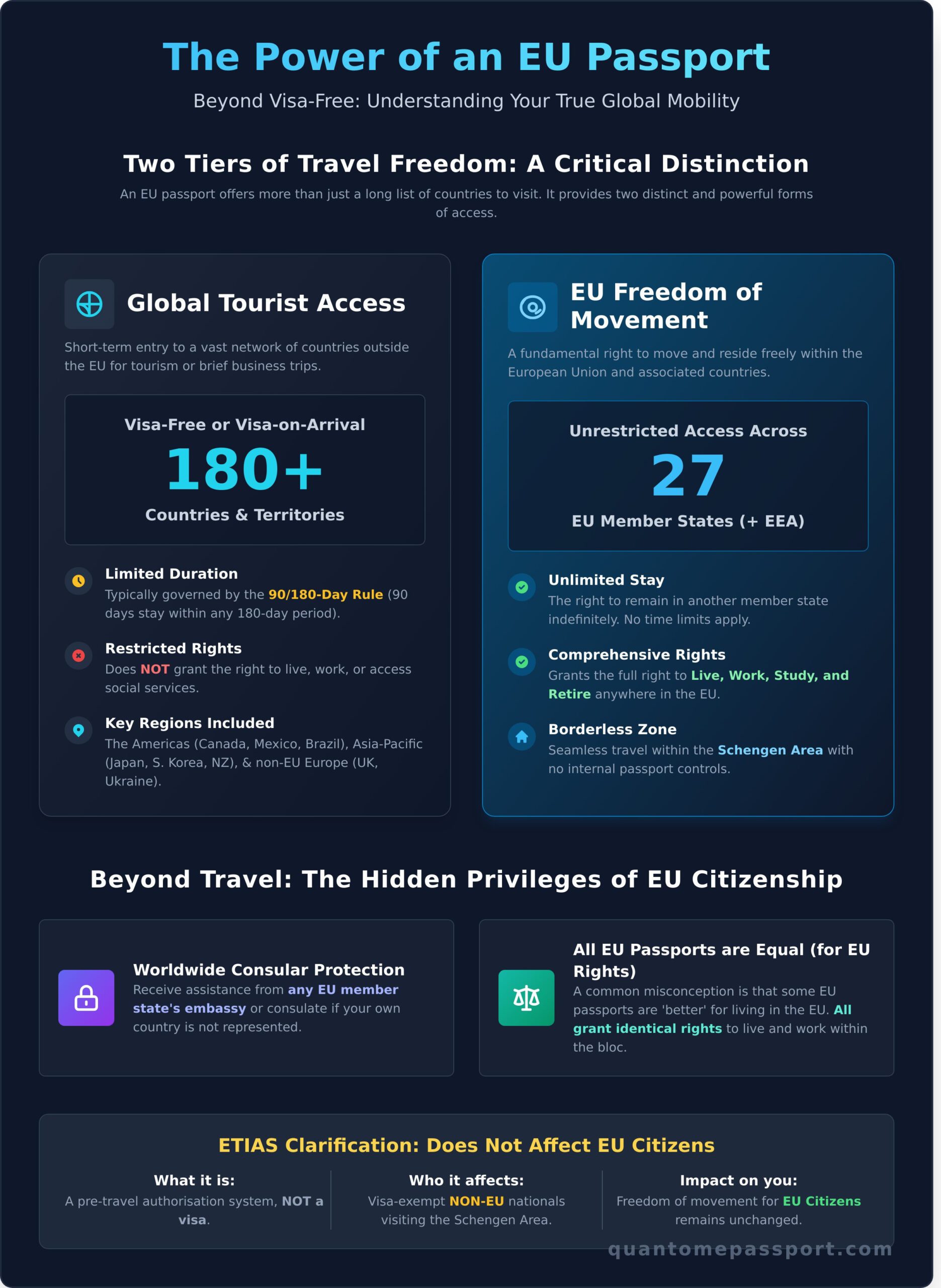
A European Union passport is one of the world’s most powerful travel documents, consistently granting its holder unparalleled global mobility. As of the mid-2020s, citizens of EU member states typically enjoy visa-free or visa-on-arrival access to over 180 countries and territories worldwide. This extensive network of agreements underscores the diplomatic strength of the bloc and provides significant advantages for business, leisure, and personal freedom. The list of eu passport visa free countries is a primary metric for assessing the value of a second citizenship.
For a visual overview of how global passports compare, the following video offers a concise summary of recent rankings:
It is crucial to understand that this access is dynamic and subject to change based on evolving bilateral and international agreements. Furthermore, a distinction exists between visa-free access, which allows entry without any prior application, and visa-on-arrival, where a visa is issued at the port of entry. While both facilitate ease of travel, procedural requirements can differ. A detailed, country-specific overview of visa-free travel for EU citizens illustrates the nuances of these arrangements across the globe.
Key Visa-Free Regions for EU Citizens
The extensive travel freedom afforded by an EU passport covers major economic and cultural hubs across every continent. Key regions include:
- The Americas: Unrestricted access to nearly all of North, Central, and South America, including key destinations like Canada, Mexico, Brazil, and Argentina.
- Asia-Pacific: Entry to major economies such as Japan, South Korea, Singapore, and Malaysia, as well as popular destinations like New Zealand and Thailand.
- Rest of Europe: Seamless travel to non-EU European nations, including the United Kingdom, Ukraine, Serbia, and other Balkan states.
This access to key economic hubs like Japan is a significant advantage. For those planning to utilize this freedom, having access to quality local information is crucial; travelers looking for in-depth guidance on Tokyo’s attractions can discover Jasumo, an online platform for visitors to Japan.
Understanding ETIAS and Future Changes
A common point of confusion is the European Travel Information and Authorisation System (ETIAS). It is essential to clarify that ETIAS is not a visa and does not affect EU citizens. Instead, it is a mandatory travel authorisation for visa-exempt non-EU nationals visiting the Schengen Area. This system, similar to the U.S. ESTA, enhances security screening and reflects a global trend towards digital pre-travel clearance. For holders of an EU passport, freedom of movement within the EU and Schengen Zone remains unchanged.
Deconstructing ‘Visa-Free’: Freedom of Movement vs. Tourist Access
When prospective citizens evaluate the benefits of an EU passport, the term ‘visa-free’ is often the main attraction. However, this term encompasses two legally distinct categories of travel rights that are frequently conflated. The true power of an EU passport is not merely the number of countries one can visit, but the profound difference between short-term tourist access and the fundamental right of Freedom of Movement within the European Union.
Understanding this distinction is critical for any individual pursuing European citizenship. While a long list of eu passport visa free countries provides global mobility, the unrestricted right to live, work, and establish a life across an entire continent is a benefit of an entirely different magnitude.
The Schengen Area: A Borderless Zone
The cornerstone of Freedom of Movement is the Schengen Agreement. This treaty created a borderless zone comprising 29 European nations, including major economies like Germany, France, Italy, and Spain. For an EU citizen, traveling within this area involves no internal border or passport controls. This is not simply a travel convenience; it is the practical application of the right to reside, work, study, or retire in any member state, a topic further detailed in our analysis of EU Establishment Rights.
Global Tourist Access: The 90/180-Day Rule
For destinations outside the EU/EEA, an EU passport typically grants visa-free access for tourism or short-term business. This access is almost universally governed by the 90/180-day rule, allowing a stay of up to 90 days within any 180-day period. It is this metric-the sheer number of countries offering such access-that informs rankings like the Henley Passport Index. Crucially, this status does not confer the right to work, claim public funds, or reside long-term. Strict compliance is essential, as overstaying can result in significant penalties.
The distinction is best illustrated with a direct comparison:
| Feature | Global Visa-Free Access (e.g., to Canada) | EU Freedom of Movement (e.g., in France) |
|---|---|---|
| Duration of Stay | Typically 90 days | Indefinite, subject to registration |
| Right to Work | Prohibited | Yes, without a work permit |
| Right to Reside | No | Yes, a fundamental right |
Therefore, while the extensive list of eu passport visa free countries demonstrates a passport’s global reach, the unparalleled rights conferred within the EU/EEA are its most substantive and life-altering benefit.
Beyond Travel: The Hidden Privileges of EU Citizenship
While the extensive list of eu passport visa free countries is a primary motivator for many applicants, the true value of EU citizenship extends far beyond simplified travel. It grants a comprehensive set of legally enshrined rights that provide security, opportunity, and mobility across 27 member states. These privileges, established under EU treaties, transform a passport into a platform for international living, business, and multi-generational planning.
Right to Consular Protection Explained
One of the most significant yet often overlooked rights is access to consular protection from any EU member state’s embassy or consulate. If you are a citizen of an EU country traveling abroad in a nation where your home country has no diplomatic representation, you are entitled to receive assistance from the embassy of any other EU member state under the same conditions as their own citizens. This critical safety net covers situations such as:
- Issuance of emergency travel documents if your passport is lost or stolen.
- Assistance in the event of a serious accident, illness, or death.
- Support for victims of violent crime.
- Relief and repatriation in case of a crisis.
- Guidance following an arrest or detention.
Economic and Social Rights within the Union
EU citizenship confers the fundamental freedom to live, work, and retire in any member state without the need for a work or residence permit. This right to free movement is a cornerstone of the Union, creating a unified economic area. It allows citizens to pursue professional opportunities, establish businesses, and own property under the same regulations as local nationals. Furthermore, it provides access to world-class education systems, often at the same preferential tuition rates available to domestic students, positioning EU citizenship as a powerful, long-term asset for family succession and development.
For a detailed analysis of residency requirements, please see our guide on the Freedom of Movement Directive.
Are All EU Passports Equal? A Common Misconception
A frequent question from prospective citizenship applicants is whether the passport of one EU member state is functionally identical to another. The answer depends entirely on the context: rights exercised within the EU versus travel privileges outside the EU. While the core value of an EU passport lies in its uniformity, minor external differences do exist.
Uniformity of Rights within the European Union
Within the borders of the European Union, all passports are absolutely equal. This is the foundational principle of EU citizenship. A citizen of Slovenia holds the exact same right to live, work, study, and retire in Germany as a citizen of France. This comprehensive access to the entire EU single market is the primary strategic advantage of holding the passport of any member state. For a deeper understanding of these rights, see our guide on Who Is Considered an EU Citizen?
Minor Differences in Non-EU Visa Policies
When examining the list of eu passport visa free countries, one can observe slight variations. These differences are not a reflection of a passport’s “strength” but are the result of historical bilateral agreements between an individual EU country and a non-EU nation that predate modern EU-wide policies. For example, a country in Oceania might have a unique visa-waiver treaty with Ireland due to historical ties, which it does not share with Malta.
These instances are statistical outliers and typically involve a very small number of less-traveled destinations. For the vast majority of global business and leisure hubs, visa policies are harmonized across the Schengen Area and the wider EU. Therefore, the choice of a citizenship program should be guided by more critical factors, not marginal differences in visa-free access.
We advise clients to base their decision on criteria such as:
- Eligibility requirements and family inclusion policies.
- The nature and timeline of the investment or contribution.
- The legal and procedural framework of the specific program.
Focusing on these fundamental aspects ensures a successful and strategically sound acquisition of European citizenship. To discuss which program aligns with your long-term objectives, please contact our advisory team.
Acquiring These Rights: The Strategic Path to an EU Passport
The extensive access detailed in this guide-the ability to travel to the full list of eu passport visa free countries-is not an off-the-shelf product. It is the end result of a structured, multi-year legal process. Acquiring an EU passport is therefore best understood as a strategic investment in global mobility and long-term security, one that secures rights and opportunities for generations. The process is governed by the national laws of each member state, which define the specific requirements for citizenship based on a substantive connection to the country.
Fundamentally, these requirements fall into three established legal categories, each with distinct procedural timelines and qualification criteria:
- Citizenship by Descent (Jus Sanguinis): Based on documented ancestry from a parent, grandparent, or in some cases, a more distant ancestor who was a citizen of an EU country.
- Citizenship by Naturalization: Acquired after fulfilling a statutory period of legal, continuous residency, which typically ranges from five to ten years depending on the member state.
- Residency-for-Investment Programs: A pathway where a significant, legally defined economic contribution leads to residency status, which subsequently serves as the basis for a future naturalization application.
Understanding Legitimate Pathways
Legitimate pathways to EU citizenship are always codified in national law and require an applicant to establish a genuine, demonstrable link to the country over time. This principle stands in stark contrast to fraudulent schemes promising immediate passports for a simple payment. Such offers lack legal foundation and expose applicants to severe legal and financial risks. While a few member states have offered direct routes like EU Citizenship by Investment, the most stable and legally secure options involve a period of established residency, demonstrating a tangible connection to the nation.
Your Next Step Towards European Citizenship
Navigating the legal and procedural complexities of EU naturalization requires specialized expertise. At Quantome Passport, we provide strategic counsel based on a deep understanding of these legal frameworks. To ensure clarity and a high probability of success for our clients, we focus exclusively on the Slovenian residency-to-citizenship program. This is a structured, transparent, and legally sound pathway within the European Union that offers a predictable timeline. Our focused approach allows us to manage the process with precision from start to finish. To understand if this strategic route aligns with your objectives and explore the benefits of the eu passport visa-free countries list, we invite you to book a private strategy call to assess your eligibility and chart a clear course forward.
Conclusion: Translating Visa-Free Access into Tangible Rights
As we have analyzed, the power of an EU passport is not merely defined by the extensive list of eu passport visa free countries. Its true value lies in the distinction between temporary tourist access and the comprehensive rights to live, work, and study afforded by full EU citizenship. Understanding that the path to these privileges is a strategic legal journey, not a simple transaction, is fundamental for any prospective applicant seeking long-term global mobility and security for their family.
For high-net-worth individuals seeking a legally compliant and structured route to these benefits, expert guidance is indispensable. We specialize in navigating the complexities of EU residency programs, offering a clear, structured process with a focus on Slovenian residency. Schedule a private consultation to assess your eligibility and map a secure path toward your European future.
Frequently Asked Questions
How many countries can I visit without a visa with an EU passport in 2026?
The number of visa-free destinations for EU passport holders fluctuates based on evolving international agreements. Currently, most EU passports grant access to over 180 countries. While the precise figure for 2026 cannot be guaranteed, the list of eu passport visa free countries consistently ranks among the most comprehensive globally. This stability reflects the strong diplomatic standing of the European Union and its member states, making it a reliable asset for global mobility.
Can I live and work in the UK with an EU passport after Brexit?
Following the United Kingdom’s withdrawal from the EU, an EU passport no longer grants the automatic right to live and work in the UK. EU citizens are now required to meet the criteria of the UK’s points-based immigration system, similar to other non-UK nationals. Rights are only protected for those who secured status under the EU Settlement Scheme before the deadline. New applicants must obtain a specific work, study, or family visa to reside in the UK.
Is a Slovenian EU passport as powerful as a German or French one?
In terms of travel freedom, the differences between passports from various EU member states are minimal. All EU citizens enjoy freedom of movement within the EU and Schengen Area. For global travel, most EU passports offer access to a nearly identical list of destinations. Minor variations may exist due to distinct bilateral treaties, but these seldom impact the practical mobility of a frequent international traveler. The core travel privileges are fundamentally uniform across the bloc.
Does an EU passport grant visa-free access to the USA, Canada, and Australia?
Yes, EU passports grant access to the USA, Canada, and Australia under their respective visa-waiver programs for short-term visits. However, entry requires a mandatory pre-travel authorization. Travelers must apply online for the Electronic System for Travel Authorization (ESTA) for the USA, the Electronic Travel Authorization (eTA) for Canada, or the Electronic Travel Authority (ETA) for Australia. These are security screenings, not visas, and must be approved before departure.
What is the difference between EU citizenship and permanent residency?
Permanent residency grants the right to live and work indefinitely in one specific EU country but does not confer an EU passport or EU-wide rights. A permanent resident travels on their original passport. Citizenship, in contrast, makes you a national of an EU member state, granting a passport and the right to live, work, and vote in any EU country. It also provides consular protection from any EU embassy or consulate worldwide.
How long does it take to get an EU passport through a residency program?
The timeline to obtain citizenship via a residency-by-investment program varies by jurisdiction, typically ranging from five to ten years. For example, Portugal’s program requires a minimum of five years of legal residency before an individual becomes eligible to apply for naturalization. It is essential to distinguish these residency-to-citizenship pathways from direct citizenship-by-investment programs, which are governed by different legal frameworks and timelines and are available in only a few select countries.
Are there any restrictions on traveling with an EU passport?
While an EU passport provides exceptional mobility, holders must adhere to standard international travel protocols. This includes ensuring the passport has at least six months of validity beyond your intended stay and complying with the local laws of the destination country. Furthermore, visa-free access does not guarantee entry; sovereign nations always retain the right to deny entry to any individual at their border for security, health, or other reasons, irrespective of their citizenship.