
Dreaming of a life in Europe-strolling through historic streets, savoring authentic cuisine-but hit a wall when you see the six-figure price tag on ‘Golden Visas’? It’s a common frustration that leaves many feeling like European residency is an unattainable luxury reserved for the ultra-wealthy. But what if we told you that multi-million euro investments aren’t the only path forward? The truth is, finding the cheapest way to get EU residency is entirely possible when you know where to look.
Forget the overwhelming complexity and the fear of hidden costs. In this comprehensive 2026 guide, we cut through the noise to reveal the legitimate, low-cost options available right now. We’ll break down practical pathways designed for digital nomads, skilled professionals, and those with a stable income-not just a massive bank account. You will discover a clear comparison of realistic routes, understand the true requirements, and find a trustworthy first step toward making your European dream an affordable reality.
Key Takeaways
- Define your budget by understanding the true costs of EU residency, which include application, legal, and processing fees even for the most affordable routes.
- The cheapest way to get eu residency often involves leveraging your professional skills or proving financial self-sufficiency as a remote worker or retiree.
- Explore lower-cost investment pathways that focus on actively creating a business rather than making a large, passive capital investment like a Golden Visa.
- Determine if you are eligible for highly affordable routes based on your personal circumstances, such as ancestry, family connections, or academic plans.
Redefining ‘Cheap’: Understanding the True Costs of EU Residency
When searching for the cheapest way to get EU residency, it’s crucial to understand that ‘cheap’ does not mean ‘free’. Every pathway, from student visas to digital nomad permits, involves a series of mandatory costs. The key is to look beyond the initial application fee and calculate the total financial commitment, including both one-time expenses and recurring obligations. A seemingly affordable visa can become expensive if you fail to account for legal assistance, document processing, and long-term living expenses.
To better understand the different pathways available, this video provides a helpful overview:
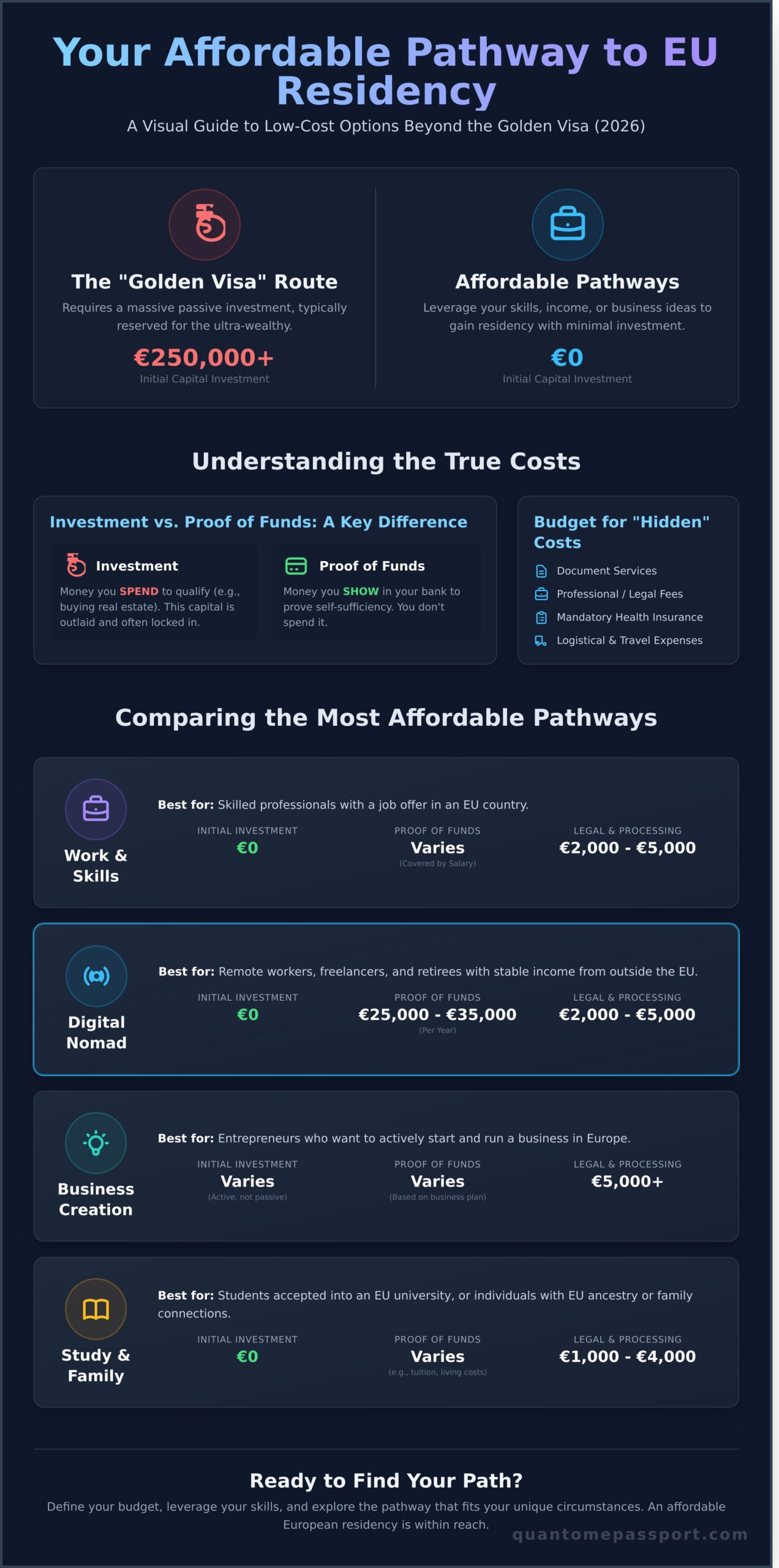
A common point of confusion is the difference between ‘proof of funds’ and ‘investment’. Proof of funds is money you must show in your bank account to prove you can support yourself; you don’t spend it. In contrast, an investment is a direct capital outlay, such as purchasing real estate for a Golden Visa, that you must spend to qualify. This distinction is fundamental when comparing the true cost of various residency programs.
Investment vs. Non-Investment Pathways: A Cost Overview
EU residency routes generally fall into two categories. Investment programs, or ‘Golden Visas’, require a significant capital outlay (often €250,000+) but can offer a faster, more direct path. Non-investment routes, like work, study, or family reunion visas, have much lower upfront costs and are based on your personal circumstances, skills, or purpose for moving.
| Cost Component | Non-Investment Visa (e.g., Digital Nomad) | Investment Visa (Golden Visa) |
|---|---|---|
| Initial Investment | €0 | €250,000+ |
| Proof of Funds (Typical) | €25,000 – €35,000 | Varies / Often Waived |
| Legal & Processing Fees | €2,000 – €5,000 | €15,000 – €50,000+ |
Hidden Costs to Budget For
Beyond the main fees, several smaller expenses can add up quickly. A realistic budget must account for these “hidden” costs to avoid surprises during the application process:
- Document Services: Fees for official translation, notarization, and apostille certification of documents like birth certificates and bank statements.
- Professional Fees: Costs for an immigration lawyer or consultant, which are highly recommended for navigating complex bureaucracy.
- Mandatory Health Insurance: All applicants must secure compliant health coverage for the duration of their stay, which is a recurring annual cost.
- Logistical Expenses: Travel and accommodation for embassy appointments or trips to the destination country to finalize paperwork.
Finally, remember that residency is an ongoing commitment. You will face recurring costs for permit renewals, taxes in your new country, and maintaining health insurance. Planning for these long-term expenses is essential for successfully maintaining your legal status and eventually qualifying for EU long-term residency status, which solidifies your right to live and work across the Union.
Pathway 1: Residency Through Work & In-Demand Skills
For many professionals, leveraging in-demand skills is the most direct and sustainable route to living in Europe. This pathway sidesteps the high capital requirements of investment visas, focusing instead on the value you bring to a country’s economy. Securing residency through employment is not just a temporary solution; it’s a stable foundation that often leads directly to permanent residency and, eventually, citizenship.
For those with the right qualifications, this is often the cheapest way to get EU residency because your primary contribution is your talent, not a large financial investment. Countries across the EU are actively seeking professionals to fill critical shortages, particularly in sectors like technology, healthcare, and engineering.
The EU Blue Card for Highly Skilled Workers
The EU Blue Card is a special work and residence permit designed for highly qualified non-EU/EEA citizens, streamlining the process across most member states. It provides a clear, merit-based path to residency with significant benefits.
- Key Requirements: You typically need a university degree (or equivalent professional experience) and a binding job offer with a salary that meets a specific national threshold.
- Major Benefits: Holders enjoy facilitated family reunification, greater mobility to work in other EU countries, and a faster track to permanent residency, often possible in under three years.
National Work Permits & Skilled Worker Visas
If you don’t qualify for the Blue Card, nearly every EU country offers its own national work permits. These visas are tailored to specific economic needs and can be an excellent alternative. Countries like Germany, the Netherlands, and Sweden have robust programs to attract talent. The crucial first step is finding an employer willing to sponsor your application-a common practice for companies struggling to find local candidates with the right skills.
Pathway 2: Digital Nomad & Independent Means Visas
If you have a stable income source from outside the EU, this pathway offers incredible flexibility and value. Designed for remote workers, freelancers, retirees, and online business owners, these visas focus on your ability to support yourself without taking a local job. For many applicants who already meet the income criteria, leveraging their existing earnings makes this the cheapest way to get eu residency, as it bypasses the need for large investments or business creation.
This category of visas has exploded in popularity, with many EU countries launching new programs to attract foreign talent and capital. While they provide an amazing lifestyle, it’s important to note that the rules for transitioning from a temporary visa to permanent residency can differ significantly from investment-based routes.
Digital Nomad Visas: Work Remotely from Europe
A Digital Nomad Visa grants legal residency to individuals who work remotely for companies or clients located outside of their host country. This is the perfect solution for modern professionals seeking a European base. Countries leading the way with attractive programs include Portugal, Spain, Croatia, Greece, and Hungary. While specifics vary, most applications require:
- Proof of consistent remote income (typically €2,500-€3,500+ per month)
- Comprehensive private health insurance
- A clean criminal record from your home country
- Proof of accommodation in the host country
Visas for Financially Independent Persons (Non-Lucrative)
Often called “passive income visas,” these are aimed at individuals who can live in the EU without working. This is an ideal route for retirees or those with substantial income from sources like rental properties, investments, dividends, or pensions. Spain’s Non-Lucrative Visa and Portugal’s D7 Visa are two of the most popular examples. The primary requirement is demonstrating sufficient, recurring passive income to comfortably support yourself and any dependents.
Pathway 3: Lower-Cost Investment & Business Creation
If you have capital to invest but want to avoid the seven-figure price tags of traditional “Golden Visas,” the business creation pathway offers a compelling middle ground. This route is not about passive investment; it’s about actively contributing to a country’s economy by launching and managing your own enterprise. It requires more hands-on effort, including a robust business plan and often a commitment to creating local jobs, but it demonstrates your value and long-term commitment to your new home country.
Startup Visas and Entrepreneur Programs
Designed to attract global talent and foster innovation, startup visas are an excellent option for entrepreneurs. These programs prioritize a strong, viable business concept over massive capital. Requirements typically include:
- A detailed and innovative business plan, sometimes endorsed by a local authority.
- Sufficient seed capital to launch and sustain the business.
- Proof of personal financial standing to support yourself during the initial phase.
Countries like the Netherlands (with its streamlined DAFT treaty for Americans), Portugal, Ireland, and Lithuania have popular and accessible entrepreneur programs that can be a cost-effective route to residency.
The Most Affordable ‘Golden Visas’
For those who prefer a more straightforward investment, a few lower-cost “Golden Visa” style options exist, representing the highest end of the affordable spectrum. These are still a significant investment but are a fraction of the cost of programs in Western Europe. Latvia, for instance, offers residency for an investment of €50,000 into the share capital of a Latvian company, plus state fees. This is an active investment in a business, but it can be more hands-off than a startup, making it an interesting hybrid option.
While not the absolute cheapest way to get eu residency on paper, the potential return on your business can offset initial costs, making it a financially sound long-term strategy. These pathways require careful planning to ensure your business and visa application are successful.
Confused about which path fits your business idea and budget? Book a private strategy call.
Pathway 4: Study, Ancestry, and Family Connections
Beyond investment or employment, some of the most profound and affordable paths to European residency are rooted in your personal circumstances. These routes-based on education, heritage, or family ties-are not quick fixes. They require extensive documentation and patience, but if you qualify, they are often the most direct and cost-effective strategies for securing long-term residency and eventual citizenship.
Student Visas as a Gateway to Residency
Pursuing higher education in Europe can be a strategic stepping stone to permanent residency. The process begins with acceptance into an accredited EU university and securing a student visa. After graduation, countries like Germany, the Netherlands, and Ireland offer post-study work permits, allowing you to seek employment. Successfully finding a skilled job can then transition your status from a temporary student to a long-term resident, all while gaining a world-class education.
Citizenship by Descent: Reclaiming Your Heritage
For individuals with European ancestry, citizenship by descent is often the absolute cheapest way to get eu residency, as it bypasses investment and employment requirements entirely. This “right of blood” allows you to claim citizenship based on your lineage. The key is meticulously proving your connection through vital records like birth, marriage, and naturalization certificates. Popular countries with favorable ancestry laws include:
- Ireland: If you have an Irish-born grandparent.
- Italy: With a direct line of Italian ancestry, often with no generational limit.
- Poland: For those with ancestors who were Polish citizens after 1920.
- Hungary & Lithuania: Available to descendants of former citizens.
Family and Spousal Visas
Marrying or entering a registered partnership with an EU citizen provides a direct, albeit highly scrutinized, path to residency. Authorities require substantial proof that the relationship is genuine and ongoing, not a “marriage of convenience.” You will need to provide evidence such as joint bank accounts, shared rental agreements, photographs, and communication records. While this route is low-cost financially, it demands a high degree of personal proof and commitment from both partners. Navigating the specific requirements can be complex, and expert guidance is often recommended to ensure a smooth application process. For a detailed assessment of your eligibility, explore the services at quantomepassport.com.
Your Affordable Path to Europe Awaits
As we’ve explored, securing a future in Europe doesn’t always require a golden visa. The journey involves looking beyond the price tag to consider pathways like skilled work, digital nomad visas, and even family connections. The truly cheapest way to get eu residency is the one that best fits your unique skills, finances, and long-term goals, saving you both time and money.
Navigating these options can be complex, but you don’t have to do it alone. Getting expert guidance on multiple residency pathways and a personalized assessment of your unique situation is the most critical next step. Our team provides clear advice on complex immigration requirements to help you move forward with confidence.
Your EU dream might be closer than you think. Book a Private Strategy Call to find your best path.
Frequently Asked Questions
Is it possible to get EU residency for free?
While no path is entirely free, you can avoid large investment costs. All applications involve unavoidable government processing fees, document translation, and potential legal costs. However, routes based on ancestry, skilled work, or study are significantly cheaper than Golden Visas, which require substantial investments. The focus of these affordable paths is on your personal qualifications or financial stability rather than a large capital outlay, making them accessible without a huge upfront payment.
Which single EU country is the absolute cheapest for residency?
The “cheapest” country depends on your specific situation and visa type. For those with passive income, Portugal’s D7 visa has one of the lowest annual income requirements. For digital nomads, countries like Romania or Hungary offer cost-effective options with a low cost of living. Ultimately, the cheapest way to get EU residency involves finding a program that aligns with your existing income or skills, minimizing both application costs and long-term financial requirements.
What is the difference between temporary residency, permanent residency, and citizenship?
Temporary residency is a permit to live in a country for a fixed period, typically one to two years, and is often tied to a specific purpose like work or study. Permanent residency grants you the right to live, work, and access social services indefinitely, usually after holding temporary residency for about five years. Citizenship is the final step, granting you a passport, voting rights, and the freedom to live and work anywhere in the EU.
How long does it take to get residency through these cheaper methods?
The timeline varies significantly by country and visa type. Generally, you should plan for a process that takes between 3 to 12 months from application submission to approval. Digital nomad visas can sometimes be processed more quickly, often within a few months. However, non-lucrative or passive income visas may take longer due to thorough financial checks. Proper document preparation is the most critical factor in avoiding unnecessary delays and speeding up your application.
Do I need an immigration lawyer to apply for these visas?
While not legally mandatory, hiring an immigration lawyer is highly recommended. The application process can be complex, with specific documentation and procedural requirements that vary by country. A lawyer helps prevent common mistakes that could lead to a costly rejection and significant delays. Their expertise ensures your application is complete and correctly submitted, increasing your chances of success and often saving you time and stress in the long run.
Can my family get residency permits along with me?
Yes, most residency programs allow the main applicant to include their family members. This typically covers a spouse or registered partner and dependent children. However, you will need to prove you have sufficient financial resources to support them. The minimum income or savings requirement will increase for each additional family member you include in your application. It is crucial to check the specific family reunification rules for the country you are applying to.
What are the minimum income requirements for Digital Nomad or Non-Lucrative visas?
Income requirements vary widely. For Spain’s Non-Lucrative Visa, a single applicant needs to show around €28,800 in annual passive income. Portugal’s D7 visa is lower, requiring just over €10,000 per year. For Digital Nomad visas, Croatia requires a monthly income of about €2,500, while Estonia’s is around €4,500 per month. These figures are for the primary applicant and increase with each dependent family member added to the application.