
Dreaming of a life in Europe, but feeling lost in a maze of complex paperwork and confusing terminology? The journey to securing eu residency for non-eu citizens can feel overwhelming. With terms like ‘Schengen Area,’ ‘residence permit,’ and ‘Golden Visa’ floating around, it’s easy to feel paralyzed by the fear of choosing the wrong path or missing a critical step. You’re not just looking for information; you’re looking for a clear, trustworthy roadmap to a new life, and the anxiety of making a costly mistake is very real.
This is that roadmap. In this ultimate 2025 guide, we cut through the bureaucracy to give you a straightforward comparison of the main residency pathways: work, investment, and family ties. You will gain a clear understanding of the requirements, timelines, and incredible benefits-like the freedom to live, work, and travel across 29 countries. By the end, you’ll have the clarity and confidence needed to take the first, decisive step toward making your European dream a reality.
Key Takeaways
- Discover the five primary pathways to residency-from work and study to investment-to identify the route that best aligns with your personal and professional goals.
- Understand the key factors for choosing the right EU country for you, including application costs, processing times, and long-term settlement opportunities.
- Learn how initial national permits are the crucial first step for securing eu residency for non-eu citizens, ultimately leading to a powerful EU long-term residence status.
- Master the application process with our expert checklist, designed to help you prepare your documentation meticulously and avoid common, costly mistakes.
Understanding EU Residency: The Foundation of Your European Journey
Embarking on a new life in Europe begins with one crucial document: an EU residence permit. More than just a piece of paper, it is the legal authorization that grants you the right to live in a specific European Union country for an extended period, typically longer than 90 days. For non-EU nationals, obtaining this permit is the foundational step towards long-term settlement, unlocking a life of new opportunities and experiences.
The most immediate and significant benefit is the freedom of movement it provides. With a valid residence permit from one member state, you can travel visa-free throughout the 27-country Schengen Area for short stays, making it easy to explore the continent’s rich and diverse cultures.
For a clearer visual breakdown of these concepts, the video below offers a great explanation:
Residency vs. Citizenship vs. Schengen Visa: Clearing the Confusion
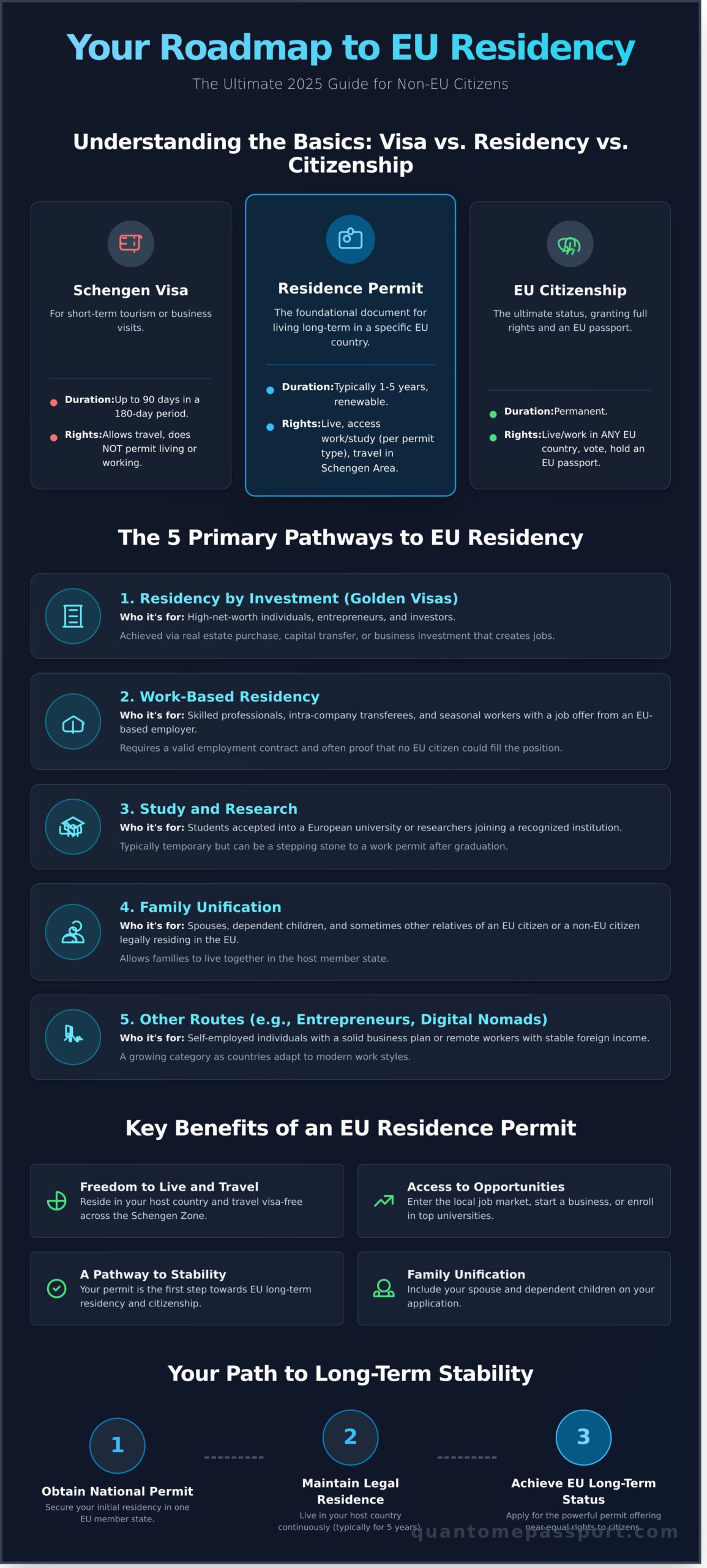
Understanding the differences between these key terms is essential. A Schengen Visa is for short-term tourism or business, allowing stays of up to 90 days within a 180-day period; it does not permit you to live or work in the EU. A Residence Permit is for long-term stays in a specific host country and is the primary focus of this guide. Finally, Citizenship is the ultimate status, granting you a passport, the right to vote, and the ability to live and work in any EU member state without restriction.
Key Benefits of Holding an EU Residence Permit
Securing a residence permit opens doors to a stable and integrated life in Europe. The advantages are substantial and form the basis for your long-term plans.
- Freedom to Live and Travel: You can legally reside in your host country and travel across the Schengen Zone without needing additional visas.
- Access to Opportunities: Depending on the permit type, you gain access to the local job market, can start a business, or enroll in world-class educational institutions.
- A Pathway to Stability: Your initial permit is the first step on a clear path. After several years of legal residence, you can often apply for an EU Long-Term Residence Permit, which offers more robust rights, and eventually, citizenship.
- Family Unification: Most residency programs allow you to include your spouse and dependent children in your application, allowing your family to join you on your European journey.
Who Qualifies as a ‘Non-EU Citizen’?
In EU terminology, a ‘non-EU citizen’ is often referred to as a ‘third-country national’-meaning anyone who is not a citizen of an EU member state or of the EFTA countries (Iceland, Liechtenstein, Norway, Switzerland). This includes citizens from countries like the United States, Canada, Australia, and, following Brexit, the United Kingdom. This guide is specifically designed to navigate the process of securing eu residency for non-eu citizens and third-country nationals looking to make Europe their home.
The 5 Main Pathways to EU Residency for Non-EU Nationals
Navigating the journey to EU residency for non-EU citizens begins with understanding your options. While each of the 27 member states has its own specific immigration laws and application procedures, the routes to legal residence generally fall into four main categories. For the most detailed and up-to-date information on national rules, the official EU Immigration Portal is an indispensable resource. As you explore the pathways below, consider which one aligns best with your professional background, financial capacity, and personal circumstances. For expert guidance on these complex pathways, consider consulting specialists like Quantome Passport.
1. Residency by Investment (Golden Visas)
Who it’s for: This route is designed for high-net-worth individuals, entrepreneurs, and investors who can make a significant financial contribution to a country’s economy. Historically popular programs in countries like Portugal, Spain, and Greece have offered residency in exchange for:
- Purchasing real estate above a certain value.
- Making a substantial capital transfer to a national bank.
- Investing in a local business that creates jobs.
These programs often provide a fast track to a residence permit with minimal physical presence requirements.
2. Skilled Worker Permits & The EU Blue Card
Who it’s for: Professionals who have secured a job offer from a company within the European Union. This is one of the most common pathways to long-term residency. A key initiative here is the EU Blue Card, a special work and residence permit for highly-qualified non-EU nationals. It provides benefits like geographic mobility between EU states and a clearer path to permanent residence. Typical requirements include a binding job offer or work contract, proof of professional qualifications, and meeting a minimum salary threshold set by the country.
3. Family & Ancestry Connections
Who it’s for: Individuals with direct family ties to an EU citizen or a non-EU national already residing legally in the EU. This includes spouses, registered partners, dependent children, and in some cases, dependent parents. The process, known as family reunification, allows eligible family members to join their relatives in the EU. Additionally, some countries offer residency (and even citizenship) by descent if you can prove that a parent or grandparent was a national of that country.
4. Student Visas & Research Permits
Who it’s for: Students accepted into a recognized EU educational institution or researchers joining a project. While a student visa is initially a temporary residence permit for the duration of your studies, it is a powerful stepping stone. Many EU countries allow graduates to stay for a period after graduation to seek employment. Securing a job can then enable you to switch to a skilled worker permit, creating a clear and viable pathway to long-term EU residency.
Achieving Stability: The EU Long-Term Residence Permit
After navigating the initial stages of securing a national residence permit, many individuals seek a more permanent and secure status. For those committed to building a life in Europe, the EU Long-Term Residence Permit represents the ultimate goal. This is not just another national visa; it is a unified EU status that grants you a level of freedom and security almost on par with EU citizens, fundamentally changing your relationship with the continent.
This permit transforms your residency from a temporary arrangement into a stable foundation, significantly enhancing your mobility and integration possibilities across the Union.
What is the EU Long-Term Residents Directive?
The EU Long-Term Residents Directive (2003/109/EC) was created to facilitate the full integration of non-EU nationals who have established deep roots in a member state. Its primary purpose is to standardize the status of long-term residents, ensuring they receive consistent rights and opportunities. This makes moving between EU countries for work, study, or retirement far more straightforward than with a standard national permit.
The 5-Year Rule: How to Qualify
The cornerstone of eligibility is the “5-year rule.” You must demonstrate five years of continuous, legal residence within a single EU country. A recent update to the directive now allows for the accumulation of residence periods from different EU states to meet this five-year requirement, offering greater flexibility. Beyond the time requirement, applicants must also prove they meet key conditions:
- Stable and Regular Income: You must have sufficient resources to support yourself and your family without relying on social assistance.
- Comprehensive Health Insurance: Proof of health coverage is mandatory for you and any dependents.
- No Threat to Public Security: A clean criminal record and a background check are standard parts of the application.
Your Rights as an EU Long-Term Resident
Obtaining this status is a significant milestone in the journey of eu residency for non-eu citizens, unlocking a powerful set of rights that solidify your place in Europe. Key benefits include:
- Equal Treatment: You gain the right to be treated equally with nationals in areas like employment conditions, access to education, and social security benefits.
- Enhanced Protection from Expulsion: The grounds for deporting an EU long-term resident are much stricter, providing greater personal security.
- Intra-EU Mobility: You acquire the right to move to, reside in, and work or study in other EU member states (some conditions apply), granting you true freedom of movement.
Navigating the specific rules and documentation for this permit can be complex, as each country has its own procedures. Get expert guidance today to ensure your application is seamless and successful.
Choosing Your Country: Key Factors for Non-EU Citizens
The “best” EU country is not a universal answer; it’s a personal one. Your ideal destination depends entirely on your unique goals, whether you seek investment growth, a new family home, or a strategic business base in Europe. Selecting the right nation is the most critical step in your journey to securing eu residency for non-eu citizens. To navigate this complex choice, we recommend creating a personal scorecard. Assign a weight to each factor below based on your priorities to compare countries objectively and make a confident, data-driven decision.
Economic & Investment Factors
Your financial strategy will heavily influence your choice. Investment thresholds for “Golden Visa” programs vary significantly, from Greece’s accessible €250,000 real estate option to other nations requiring more substantial capital. Beyond the initial cost, you must analyze the long-term financial landscape. Consider a country’s tax implications for residents, its overall business-friendliness, and the stability of its economy. For those pursuing a skilled worker visa, the demand for your profession and the strength of the local job market are paramount.
Lifestyle & Integration
A residency permit is just the beginning; true success means building a life where you and your family can thrive. Your decision should align with your personal and cultural preferences. Key lifestyle considerations include:
- Climate and Culture: Do you envision a life enjoying the Mediterranean sun of Malta or embracing the structured, alpine efficiency of Austria?
- Language Requirements: While English is common in business hubs, long-term integration and eventual citizenship almost always require proficiency in the local language. Some countries have stricter language tests than others.
- Family Services: For those with children, the quality and accessibility of international schools and world-class healthcare systems are non-negotiable factors.
Spotlight on an Emerging Option: Slovenia
While popular choices like Portugal and Spain get much of the attention, strategic alternatives offer compelling advantages. Slovenia, for instance, provides a clear and straightforward path to residency through business investment. Located at the crossroads of Europe, it boasts an exceptionally high quality of life, a stable economy, and full, unrestricted access to the Schengen Area. For entrepreneurs and investors looking for a practical and efficient route, its business-friendly framework makes it a powerful, often-overlooked option. This pathway is one of the most direct routes to eu residency for non-eu citizens seeking a strategic foothold in the region. To explore detailed program requirements for Slovenia, contact our experts.
Your Application Checklist: From Preparation to Approval
You’ve explored the benefits and chosen your destination. Now comes the most critical phase: the application itself. Success in securing EU residency for non-EU citizens hinges on meticulous preparation and flawless execution. A single missing document or missed deadline can lead to months of delays or even outright rejection. This checklist breaks down the process into manageable phases.
Working with an immigration expert can be invaluable, ensuring every detail is correct and aligned with the specific country’s latest requirements. Think of this as your roadmap from initial paperwork to final approval.
Phase 1: Research and Document Gathering
This foundational stage is where you build your case. Accuracy is paramount, as every document will be scrutinized. Ensure all paperwork is translated and legalized (e.g., with an Apostille) as required by your chosen country.
- Finalize Your Pathway: Confirm you meet all criteria for your chosen route, whether it’s a Golden Visa, work permit, or family reunification.
- Gather Essential Documents: Collect valid passports for all applicants, birth and marriage certificates, and detailed financial statements (bank records, investment portfolios, proof of income).
- Obtain Background Checks: Secure police clearance certificates from your country of origin and any other country where you have resided for more than six months in the last 10 years.
Phase 2: Submission and Follow-Up
With your documents in order, the next step is formal submission. This phase requires careful adherence to procedural rules and a proactive approach to communication.
- Submit to the Correct Authority: Lodge your completed application file with the designated consulate, embassy, or national immigration office.
- Prepare for an Interview: Some applications require a personal interview. Be ready to confidently answer questions about your background, your financial standing, and your reasons for moving.
- Track Your Progress: Understand the standard processing times and know how to check your application status. Be prepared to respond promptly to any requests for additional information.
Common Pitfalls and How to Avoid Them
Many applications falter due to simple, avoidable errors. The most frequent issues include incomplete forms, failing to adequately prove the legal source of funds for investment-based routes, and missing crucial deadlines for submission or responses. Double-checking every requirement against an official checklist is non-negotiable. An organized, systematic approach is the best way to prevent these common setbacks and ensure a smooth process for obtaining your EU residency.
Don’t risk a refusal over a preventable mistake. Ensure your application is perfect with our help.
Your European Future Awaits: Final Steps to EU Residency
Embarking on the path to European residency is a significant life decision. As we’ve explored, understanding the various pathways-from work and investment to family ties-is the critical first step. Choosing the right country and meticulously preparing your application are the pillars of a successful outcome, paving the way toward the stability of an EU long-term residence permit.
Navigating the complexities of securing eu residency for non-eu citizens can be daunting, but you don’t have to do it alone. At Quantome Passport, we provide expert guidance on legal pathways to European residency. With a global client base from Dubai to London and specialized expertise in the secure Slovenian business investment program, we transform a complex process into a clear, manageable plan.
Ready to turn your European dream into a reality? Book Your Private EU Strategy Call to find your best pathway.
Your new life in Europe is closer than you think. Take the first definitive step today.
Frequently Asked Questions About EU Residency
Can my family get EU residency with me?
Yes, most EU residency programs allow the main applicant to include their family. This typically covers a spouse or registered partner and dependent children. Some programs, such as investment visas, may also extend to dependent parents or grandparents. The specific rules for family reunification vary by country and the type of residence permit you are applying for, so it’s essential to check the national immigration laws of your chosen country for precise eligibility requirements.
How much does it cost to get EU residency?
The cost to obtain EU residency varies dramatically. Standard government processing fees for a work or study permit can be a few hundred euros. However, investment-based programs, often called “Golden Visas,” require a significant financial outlay, such as a real estate purchase starting from €250,000. Additional expenses always include legal assistance, document translation, and mandatory health insurance—which can be easily arranged online through services like Insurance VISA—adding several thousand euros to the total cost of your application.
Can I work in any EU country with a residence permit from one country?
Generally, a national residence permit from one EU country only grants you the right to live and work in that specific nation. To work in another member state, you would need to apply for a separate work permit there. The main exception is the EU Long-Term Residence Permit, which is obtained after five years of legal residence and grants holders enhanced mobility rights, making it easier to live and work in other EU countries.
How long does the EU residency application process take?
The timeline for an EU residency for non-EU citizens application can range from a few months to over a year. A straightforward application for a highly-skilled worker visa, like the EU Blue Card, might take 3 to 6 months. Investment-based residency programs often have similar processing times. Delays can occur due to the complexity of the case, the specific country’s backlog, or an incomplete application, so thorough preparation is key to a faster outcome.
What is the difference between permanent residency and long-term EU residency?
National permanent residency (PR) grants you the right to live indefinitely in the single EU country that issued it. It is governed purely by that country’s laws. In contrast, an EU long-term residence permit is a specific status granted after five years of continuous legal residence in an EU country. It not only allows you to stay indefinitely in the host country but also gives you the right to move, work, and study in other EU countries under more favorable conditions.
Do I need to learn the local language to get residency?
For an initial temporary residence permit, language skills are often not required, especially for investors, students, or highly-skilled professionals. However, when you apply for permanent residency or citizenship after several years, demonstrating a certain level of language proficiency is almost always mandatory. For example, Germany typically requires B1-level language skills for permanent settlement. This requirement is intended to prove your integration into the society of your host country.