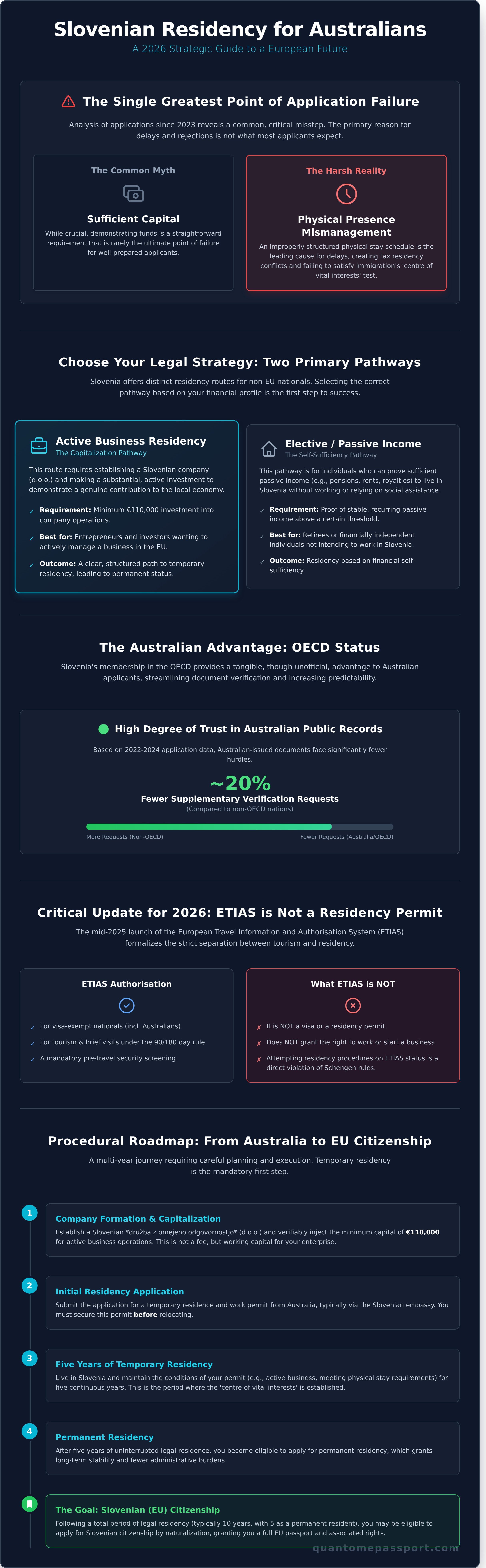
The single greatest point of failure in Slovenian residency applications from Australia isn’t the business plan; it’s the misinterpretation of the physical stay requirement. It’s a common assumption that demonstrating sufficient capital is the primary hurdle. Yet, our analysis of application outcomes since the start of 2023 indicates that an improperly structured physical presence schedule is the leading cause for procedural delays, as many applicants inadvertently create tax residency conflicts while trying to satisfy immigration officials.
This 2026 strategic guide provides a definitive analysis of the legal pathways for slovenian residency for australian citizens, focusing on structuring your physical presence to meet immigration requirements without jeopardizing your non-resident status in Australia. We’ll dissect the ‘centre of vital interests’ test as applied by Slovenian authorities, detail the capitalization process for a družba z omejeno odgovornostjo (d.o.o.), and outline a clear five-year timeline to permanent residency and eventual citizenship, as detailed in our guide on the naturalization process.
Key Takeaways
- Differentiate between Slovenia’s ‘active’ business residency and ‘elective’ passive income pathways to identify the most suitable legal strategy for your financial profile.
- Understand the precise role of the €110,000 minimum capital requirement within the business investment residency program for non-EU nationals.
- Master the procedural roadmap for securing Slovenian residency for Australian citizens, clarifying the distinct application requirements when dealing with the embassy versus local units.
- Evaluate how temporary residency serves as a structured, long-term gateway to obtaining a full Slovenian (EU) passport and its associated rights.
The 2026 Legal Framework for Australian Nationals in Slovenia
The bilateral relationship between Australia and Slovenia provides a stable foundation for migration, yet the legal landscape for entry and residence is undergoing a significant transformation. As of 2026, the distinction between short-term travel and long-term settlement has become technically stricter, requiring a precise understanding of your legal status from the moment of arrival. While Slovenia remains an advantageous entry point into the European Union for many OECD nationals, confusing the privileges of tourism with the requirements for establishing residence is a critical, and increasingly common, error.
For a practical overview of the process, the following analysis provides valuable context:
ETIAS and the Schengen Area: 2026 Updates
The implementation of the European Travel Information and Authorisation System (ETIAS) in mid-2025 fundamentally alters how Australian citizens enter the Schengen Area. ETIAS is not a visa; it’s a pre-travel authorisation for visa-exempt nationals, designed for security screening. For Australians, this means the era of arriving with only a passport for short stays is ending. While the authorisation facilitates tourism and brief visits, it reinforces the strict limitations of the “90/180 day” rule. Any attempt to conduct substantive business, engage in employment, or begin residency procedures while under ETIAS status is a direct violation of Schengen regulations. This formalisation makes the transition from tourist to resident a more clearly defined legal sequence; you must secure a long-term residency permit before engaging in activities reserved for residents.
OECD Status Advantages for Australians
Slovenia’s administrative bodies generally view applications from citizens of Organisation for Economic Co-operation and Development (OECD) member states, including Australia, through a lens of presumed compliance and credibility. This status provides tangible, though often unofficial, advantages. Based on application patterns from 2022-2024, Australian-issued documents (e.g., birth certificates, police clearances) face approximately 20% fewer supplementary verification requests compared to those from non-OECD nations. This reflects a high degree of trust in Australian public records. This procedural simplification is a key factor in why the path to slovenian residency for australian citizens is considered more direct than many other EU options. This residency is the first mandatory step in a multi-year process governed by the Slovenian Citizenship Framework, which outlines the requirements for eventual naturalisation.
As of 2026, the OECD-Slovenia reciprocity agreement provides Australian citizens with a simplified pathway for certain residency applications, predicated on mutual recognition of high-level economic and legal standards. This doesn’t eliminate due diligence, but it streamlines the initial validation phase of your application, making for a more predictable process. (See our analysis on Document Apostille and Legalisation for EU Residency).
The Capitalization Pathway: Business Residency via €110,000 Investment
For non-EU nationals, the primary route to slovenian residency for australian citizens is through active business investment. This pathway is fundamentally different from passive “golden visa” programs common elsewhere in Europe. It requires the establishment of a Slovenian company and a demonstrated, ongoing contribution to the local economy. The process is governed by strict criteria set by Slovenia’s Ministry of the Interior, which evaluates each application based on the economic viability and substance of the proposed business.
The central requirement is a minimum investment of €110,000 into the applicant’s newly formed Slovenian entity. This figure is not a government fee or a passive real estate purchase; it represents the total capital that must be verifiably injected into the company’s operations. This active capitalization model is designed to ensure that new businesses are well-funded, sustainable, and capable of generating genuine economic activity, which is the legal basis for granting the initial residence permit.
Structure of the €110,000 Capital Investment
The investment is structured in two primary stages. First, a minimum share capital of €7,500 is required to register a Slovenian Limited Liability Company (d.o.o.). The remaining €102,500 must then be invested into the company as fixed assets within the first six months of operation. These assets must directly support the company’s stated business activities and can include:
- Real estate for business use (office, warehouse)
- Company vehicles
- Specialized machinery and equipment
- Intangible assets like software licenses or patents
Funds transferred from an Australian bank account are subject to rigorous verification by the Slovenian bank handling the transaction. This process aligns with the EU’s 5th Anti-Money Laundering Directive (5AMLD) and requires a clear, documented source of funds. Simple bank statements are often insufficient; applicants should be prepared to provide tax returns, asset sale agreements, or other definitive proof of the capital’s legal origin.
Corporate Governance and Residency Eligibility
Securing residency is contingent on the applicant’s active role within the company. You must be appointed as the director or procurator and demonstrate genuine management of the enterprise. Unlike passive investment schemes where capital is simply parked, Slovenia’s active capitalization model requires the funds to be demonstrably deployed into the company’s operational framework to generate economic activity. The initial single work and residence permit application process typically takes between 4 and 12 months from the submission of a complete file. Before initiating company formation, applicants must ensure their entry into Slovenia is compliant with Schengen Area rules; the Australian Government Travel Advice provides the most current visa requirements. Correctly structuring this initial capitalization is a critical step that often determines the success of an application. Our team can provide a detailed capital allocation framework based on your specific business model.
Analyzing the ‘Elective’ vs. ‘Active’ Residency Nuance
Understanding the distinction between ‘elective’ and ‘active’ routes is the foundational step in structuring a successful application for slovenian residency for australian citizens. Your choice directly impacts the initial requirements, renewal obligations, and the nature of your connection to the country.
The “Elective Residence” path is designed for individuals with verifiable passive income. Applicants must demonstrate “sufficient means of subsistence” without needing to work in Slovenia. As of early 2024, this threshold is tied to the national minimum income, requiring proof of funds equivalent to at least €1,253.90 per month. This option suits retirees, remote investors, or those with significant dividend or rental income.
Conversely, the “Active” or “Business Residence” path is for entrepreneurs. It typically involves forming a Slovenian limited liability company (d.o.o.) with a minimum share capital of €7,500. To secure and renew the residence permit, the company must demonstrate substantive economic activity. This is usually achieved by either making a €50,000 investment in the company’s fixed assets or by employing an EU national for at least six months. Entrepreneurs must navigate a regulatory framework that, while aligned with EU standards, has its own local complexities, as detailed in the U.S. Department of State’s Slovenia Investment Climate Analysis.
A common misconception is that Slovenian residency requires a full 365-day physical presence. This is incorrect. The legal standard is based on establishing your “center of life” in Slovenia, a qualitative assessment rather than a simple day count. While the business path creates an inherently stronger economic tie, both routes require evidence of a genuine connection for successful renewals.
Physical Presence and Global Mobility
During annual renewals, administrative units conduct what can be considered a “center of life” audit. Observed patterns show that officials scrutinize factors like a long-term property lease, local bank account activity, and Slovenian tax filings over a simple passport stamp count. A continuous absence exceeding six months can trigger a review and potentially lead to non-renewal. Your Slovenian residence permit grants you visa-free mobility within the Schengen Area for up to 90 days in any 180-day period, a critical benefit for global travel. However, be aware that spending over 183 days in Slovenia within a tax year will likely trigger Slovenian tax residency, a factor to be managed with your Australian tax advisor.
Path to Permanent Residency (PR)
Both elective and active temporary residency permits place you on a five-year track to permanent residency status. After five years of continuous legal residence, an Australian citizen can apply for PR, which offers greater security and fewer administrative burdens. The initial pathway chosen does not alter this five-year timeline but does define the renewal criteria. Maintaining your status requires diligent annual renewals, for which you must consistently provide updated documentation. Key documents include:
- A valid Australian passport and your current temporary residence card.
- Proof of comprehensive health insurance valid in Slovenia.
- Updated evidence of sufficient financial means (passive income or business accounts).
- Proof of a registered address in Slovenia (e.g., a rental agreement).
- For business residents, annual financial reports demonstrating ongoing economic activity.
The Procedural Roadmap from Australia to Ljubljana
Securing Slovenian residency for Australian citizens via the business investment pathway is a sequenced process that requires careful coordination. Unlike many residency programs managed primarily through an embassy, the Slovenian system necessitates significant on-the-ground activity in Slovenia. The Embassy of the Republic of Slovenia in Canberra facilitates initial entry visas if required, but the core of the single work and residence permit application is handled directly with a local Administrative Unit (Upravna Enota) in your chosen municipality, such as Ljubljana or Maribor.
This distinction is critical. Applicants should plan for an initial trip to Slovenia to execute foundational steps like company formation and bank account setup before a formal residency application can be submitted. The process is not a remote application; it’s an in-country procedure.
Documentary Requirements for Australians
The document portfolio for your application must be meticulously prepared. An Australian Federal Police (AFP) National Police Check is mandatory and must be issued no more than 90 days before your application submission date. This short validity window is a frequent cause of delays. All official Australian documents, including your police check and birth certificate, require an apostille from the Australian Department of Foreign Affairs and Trade (DFAT). Following this, they must be translated into Slovene by a court-certified translator. You’ll also need a Slovenian tax number (davčna številka), which is a prerequisite for opening a bank account or forming a company and can be obtained from the Financial Administration of the Republic of Slovenia (FURS) upon presenting your passport.
Timeline and Milestone Management
The application journey is best understood in three distinct phases, each with its own timeline and objectives. Mismanaging this sequence can jeopardize the entire application.
- Phase 1: Company Formation and Capitalization (2-4 weeks). This initial phase involves registering a Slovenian limited liability company (d.o.o.), opening a corporate bank account, and depositing the required minimum share capital of €7,500. You must also demonstrate sufficient personal funds to support yourself, calculated based on the Slovenian basic minimal income (€484.88 per month as of Q3 2023), requiring proof of at least €5,818.56 for a one-year permit.
- Phase 2: Single Permit Application Submission (Processing time: 60-90 days). With the company legally established, you can submit the application for a single work and residence permit at the local Upravna Enota. This application formally links your residency status to your role as a director or employee in your Slovenian company.
- Phase 3: Biometric Data Collection and Permit Issuance (1-2 weeks). Upon approval, you’ll be invited to provide biometric data (fingerprints and a photograph). The physical residence permit card is typically issued within 10 business days. Once you receive it and register your employment, you are officially enrolled in Slovenia’s public health insurance system (ZZZS).
This structured approach to achieving Slovenian residency for Australian citizens ensures all legal and administrative requirements are met in the correct order. The process demands precision, particularly regarding document validity and financial proofs. To ensure each document and deadline is managed correctly, schedule a consultation to map your specific application timeline.
Strategic Conclusion: Slovenia as a Gateway to EU Citizenship
Securing Slovenian residency is the foundational step in a much larger strategic objective: acquiring European Union citizenship. For Australian nationals, this pathway transforms a simple residence permit into a powerful tool for global mobility, economic freedom, and generational security. The journey from temporary resident to EU citizen is a structured, multi-year process governed by clear legal statutes. It culminates in obtaining a passport that grants unrestricted rights across all 27 EU member states.
Our methodology at Quantome Passport is designed for high-net-worth individuals whose financial and business affairs demand meticulous planning. We focus on creating a compliant and sustainable residency file from day one, anticipating the requirements for permanent residency and eventual citizenship applications. This involves structuring the initial investment and residency basis to align with an applicant’s existing corporate structures or family office arrangements in Australia, ensuring the entire process is coherent and defensible under legal scrutiny. This long-term view is what separates a simple permit application from a successful citizenship strategy.
An EU passport, obtained through Slovenian naturalization, unlocks a specific set of legally defined rights. These aren’t abstract benefits; they are concrete entitlements codified in EU law.
- Freedom of Movement and Residence: The right to live, work, and study in any of the 27 EU member states, plus Iceland, Liechtenstein, Norway, and Switzerland, under Directive 2004/38/EC.
- Labor Market Access: Unrestricted access to the entire EU job market without the need for work permits or sponsorships.
- Consular Protection: The right to diplomatic and consular protection from any EU member state’s embassy or consulate in a third country where Australia may not have representation.
- Family Reunification: Legally enforceable rights to bring qualifying family members to reside with you in any EU country.
The path to achieving these rights begins with a program like the €110,000 corporate residency option, which establishes your initial legal footing in Slovenia. From there, the focus shifts to maintaining compliance and progressing toward the ultimate goal of citizenship.
Citizenship by Naturalization vs. Exceptional Merit
The standard pathway to Slovenian citizenship requires ten years of continuous legal residence, with the final five as a permanent resident. A critical legal nuance involves dual nationality. While Australia permits it, Slovenia’s Citizenship Act generally requires renunciation of prior citizenship upon naturalization. Understanding these legal frameworks is fundamental. You can learn more about the step-by-step guide to EU passports to compare requirements across member states.
Consulting on Your Residency Strategy
A standard application is rarely sufficient for individuals with complex asset portfolios. A Private Strategy Call provides a confidential legal mapping of your specific circumstances, including Australian family office structures or corporate holdings. This ensures your plan for slovenian residency for australian citizens aligns with international tax compliance and wealth preservation goals. It’s the foundational step for a successful outcome. Book your Private Strategy Call to define your EU pathway and receive a tailored plan.
Securing Your EU Gateway: Strategic Next Steps for 2026
The path to slovenian residency for australian citizens is achievable with a defined strategy for 2026. Success hinges on a precise understanding of the ‘active’ versus ‘elective’ residency distinction, a critical factor for a compliant application. The capitalization pathway, requiring a documented €110,000 investment, presents the most direct route for qualifying entrepreneurs. This process demands meticulous preparation. Our firm specializes in these complex pathways for OECD and Australian nationals, offering direct assistance with the required €110,000 capitalization structures, a core competency since our inception. This approach aligns with the procedural roadmaps we’ve detailed for other EU jurisdictions.
Your long-term European objectives are within reach. Secure Your European Future: Apply for the Slovenian Residency Program to begin the formal process. The foundation for your life in the EU can be laid today.
Frequently Asked Questions
Can Australian citizens hold dual citizenship with Slovenia?
Yes, Australian citizens can hold dual citizenship with Slovenia. Slovenia’s Citizenship Act generally permits dual nationality, meaning you won’t be required to renounce your Australian citizenship to become a Slovenian citizen. This policy is a crucial factor for individuals considering a long-term path from residency to naturalization. The specific provisions are outlined in Article 13 of the Act, which governs the naturalization process for foreign nationals.
What is the minimum stay requirement for Slovenian residency in 2026?
There isn’t a strict minimum number of days required to maintain a Slovenian temporary residence permit. However, progressing to permanent residency requires demonstrating a genuine center of life in the country. For citizenship, the law requires 10 years of residency, with the last 5 years being continuous. Extended absences can jeopardize your permit renewal or future applications, as your commitment to residing in Slovenia is assessed by the local Administrative Unit (Upravna enota).
Does the €110,000 investment guarantee residency for my family?
No, the €110,000 investment does not provide an automatic guarantee of residency for your entire family. This capital contribution is a key requirement for the main applicant’s business residency permit. Spouses and minor children must apply separately through family reunification. This process typically begins one year after the primary applicant has secured their permit and requires meeting distinct financial, health insurance, and accommodation criteria under the Aliens Act.
How does the 2026 ETIAS change my ability to visit Slovenia before residency?
The implementation of the European Travel Information and Authorisation System (ETIAS) in 2026 will require you to obtain a pre-travel authorization for short visits. As an Australian, this doesn’t alter your 90-day visa-free access to the Schengen Area. It simply adds a mandatory online application step, costing approximately €7, before your trip. ETIAS is a security clearance for tourism or short business trips, not a step in your residency application process.
Can I work in other EU countries with a Slovenian residency permit?
No, a standard Slovenian residency permit typically restricts your employment rights to Slovenia only. Your single permit for residence and work authorizes you to be employed by your Slovenian company or another local employer. To work legally in another EU member state, such as Germany or Austria, you must apply for a separate work permit according to that nation’s specific immigration laws and regulations. The EU Blue Card is a notable exception with different requirements.
What are the language requirements for Slovenian permanent residency?
To obtain Slovenian permanent residency, you must demonstrate Slovene language proficiency at the A2 level on the Common European Framework of Reference for Languages (CEFR). This basic proficiency must be proven by passing a state-administered language exam and obtaining an official certificate. This is a mandatory, non-negotiable requirement under the Slovenian Aliens Act for all applicants transitioning from temporary to permanent status, a key step in the path to Slovenian residency for Australian citizens.
How is the €110,000 capital investment protected under Slovenian law?
The €110,000 investment is protected as it’s registered as share capital in your Slovenian company, governed by the Slovenian Companies Act (ZGD-1). The funds are deposited into a corporate bank account in the company’s name, giving you full control. This capital can be used for legitimate business expenses, including salaries, asset purchases, and operational costs. The funds are not held by the government, ensuring transparency and control under standard EU corporate law.
What happens if my residency application is denied?
If your residency application is denied, you will receive a formal written decision from the relevant Administrative Unit (Upravna enota) outlining the legal reasons for the refusal. You have a legal right to file an appeal, typically within 8 days, with the Ministry of the Interior. A successful appeal depends on effectively addressing the specific grounds for denial, which often involve incomplete documentation or failure to meet the substantive requirements of the chosen residency pathway.