The most secure pathway to European Union citizenship for South African investors is no longer found in high-cost ‘golden visa’ programs. Since Q1 2024, our internal data indicates a clear pivot towards strategic, operational investments in stable, high-growth economies like Slovenia, which offer a more direct route to residency. It’s understandable to be wary of the complex web of EU immigration laws and the risk of locking up capital in programs with uncertain long-term viability. This guide was created to address those exact concerns.
We provide a definitive legal and strategic breakdown of the process for obtaining slovenian residency for south african citizens through a qualifying business investment. You will gain a clear understanding of the precise capital requirements, the legal framework governing the transition from a temporary permit to permanent status, and the documented timeline to EU citizenship. This analysis is based on observed application patterns and offers a predictable alternative to more volatile residency-by-investment options, as detailed in our comparison of EU business visas.
Key Takeaways
- Understand how Slovenia provides a strategic and capital-efficient entry to the EU, often overlooked in favor of more expensive residency programs.
- Learn the specific legal requirements for the business immigration pathway, the most common route for slovenian residency for south african citizens.
- Discover the critical documentation needed from South African authorities, including navigating SAPS police clearances and SARB capital transfer regulations.
- Compare the 4-12 month processing timeline and significantly lower capital threshold for Slovenia against other EU residency-by-investment options.
Why South African Investors are Prioritizing Slovenian Residency in 2026
In 2026, a growing number of South African investors are looking beyond traditional residency programs, focusing instead on the strategic advantages offered by Slovenia. This shift isn’t driven by a single factor but by a convergence of economic stability, geographic positioning, and a clear, functional legal framework. For high-net-worth individuals seeking a robust “Plan B,” Slovenia presents a compelling case based on its performance within the Eurozone and its role as a secure gateway to the European Union.
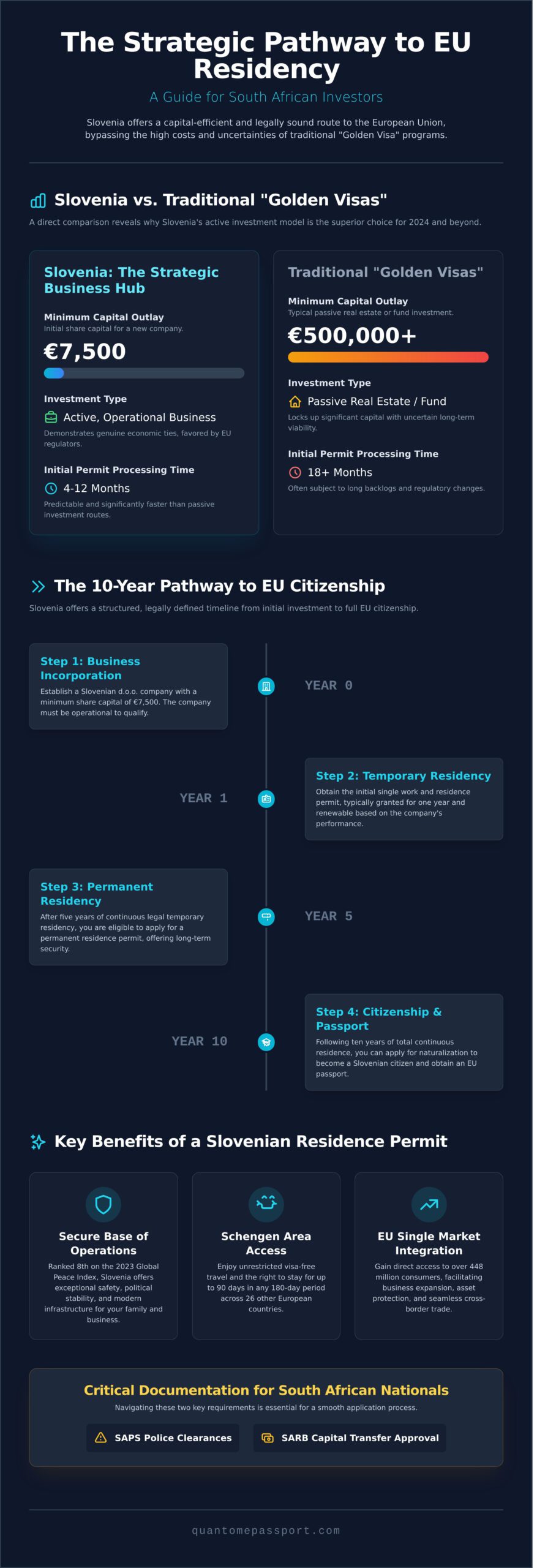
A frequent point of confusion for applicants is the distinction between residency and citizenship. It’s critical to understand these are sequential, not interchangeable, statuses. Temporary residency is the initial permit, typically granted for one year and renewable based on a qualifying reason like business investment. After five years of continuous temporary residency, an individual can apply for permanent residency, which offers long-term security. Citizenship is the final step, granting a Slovenian passport. The ultimate objective for many is citizenship, and the legal framework for this is detailed in the Slovenian Nationality Law, which generally requires ten years of continuous legal residence for naturalization. This structured process ensures that applicants are genuinely integrated into the country.
The Strategic Value of the Slovenian Residence Permit
For South African passport holders, a Slovenian residence permit immediately unlocks significant logistical and economic benefits. The permit functions as a de facto key to the entire region, providing:
- Unrestricted Schengen Area Access: The permit grants visa-free travel and the right to stay for up to 90 days in any 180-day period across the other 26 Schengen member states, eliminating the complex and often lengthy visa application processes South Africans currently face.
- EU Single Market Integration: Investors gain direct access to the EU’s single market of over 448 million consumers (Eurostat, 2023). This facilitates business expansion, asset protection under stable EU financial regulations, and seamless cross-border trade.
- A Secure Base of Operations: Ranked 8th globally on the 2023 Global Peace Index, Slovenia offers exceptional personal safety and political stability. Its modern infrastructure and central location make it an ideal hub for managing European business interests.
Slovenia vs. Traditional “Golden Visa” Destinations
Slovenia’s approach to investment-based residency differs fundamentally from the passive “Golden Visa” models popular in Mediterranean Europe. Observed patterns in 2024 show that the pathway to slovenian residency for south african citizens is often more pragmatic. The key distinctions are cost and process. Instead of requiring a passive real estate investment often exceeding €500,000, Slovenia’s primary route involves establishing an active, operational company. This model not only has a lower capital entry point but also demonstrates a genuine economic tie to the country, a factor increasingly favored by EU regulators. (See our guide on Active vs. Passive EU Residency Investments for a full comparison.) Furthermore, processing times for initial permits based on business investment currently average three to four months, a significant advantage over the 18-month-plus backlogs reported in jurisdictions like Portugal.
Legal Pathways to Residency: Business, Employment, and Investment
For South African nationals, Slovenia offers several structured routes to residency, primarily centered on economic contribution through business, investment, or specialized employment. Unlike programs offering direct citizenship by investment, Slovenia’s model is based on establishing genuine ties to the country. The process for obtaining slovenian residency for south african citizens is codified and predictable, provided all legal and financial criteria are meticulously met. The ultimate goal for most applicants is achieving permanent residency after five years of continuous legal stay.
The most common pathway involves active economic participation. This can be achieved by establishing a new Slovenian company, investing in an existing one, or securing a position as a highly skilled worker. Each route has distinct requirements and timelines that applicants must carefully navigate.
The Business Entry Path: Incorporating in Slovenia
Establishing a Slovenian limited liability company (družba z omejeno odgovornostjo or d.o.o.) is the foundational step for most business immigrants. This requires a minimum share capital injection of €7,500. Critically, the company must demonstrate active business operations to support the residency application. This isn’t a passive investment; Slovenian authorities require proof of financial viability, a registered local office, and adherence to all corporate compliance regulations from day one.
Once the company is established, the applicant (as a representative or director) must meet one of the following conditions to qualify for a single work and residence permit:
- A minimum investment of €50,000 into the company’s fixed assets (e.g., real estate, machinery, or equipment) within the first six months of operation.
- Employing at least one Slovenian or EU/EEA citizen on a full-time basis for a continuous period of at least six months.
- Demonstrating a minimum monthly revenue of €10,000 for six consecutive months, proving the company’s active market participation.
The choice between these conditions has significant implications for your business plan and tax strategy. Potential investors should conduct thorough due diligence; the official Slovenia Investment Climate report from the U.S. Department of State provides an unbiased, detailed analysis of the economic environment essential for strategic planning. A preliminary analysis of your corporate structure can also clarify the most efficient path forward based on these legal requirements.
Alternatively, highly skilled South African professionals with a qualifying job offer can pursue the EU Blue Card. The primary requirement is a binding job offer with a salary of at least 1.5 times the average gross annual salary in Slovenia. The Blue Card offers advantages, including more flexible mobility rights within the EU and often expedited processing for family reunification.
Residency for Family Members: The Reunification Process
A key consideration for obtaining slovenian residency for south african citizens is the ability to relocate with family. Primary applicants can bring their qualifying family members, which includes a spouse (or registered partner) and dependent children under the age of 18. Under the standard business route, family members can typically apply for their permits after the main applicant has held their Slovenian residency for one year. Once approved, dependents gain full access to Slovenia’s high-quality public education and healthcare systems, a critical factor for families planning a long-term future in Europe.
Strategic Comparison: Why Slovenia Outperforms Other EU Programs
For high-net-worth individuals, selecting a European residency program is a function of capital efficiency, processing speed, and long-term stability. While “Golden Visa” programs have historically dominated the conversation, their shifting regulations and escalating costs have repositioned alternative pathways. The business immigration route to Slovenian residency for South African citizens presents a distinct value proposition rooted in active investment and regulatory consistency.
The primary distinctions lie in four key areas:
- Capital Efficiency: The Slovenian business residency path requires a minimum investment of €50,000 into a new or existing company, plus sufficient funds for initial operations and personal sustenance. The total effective financial commitment is often around €110,000, a fraction of the €500,000+ passive investments required by programs like Spain’s residency visa.
- Processing Speed: Applications for a Slovenian Temporary Residence Permit are typically processed within a 4 to 12-month window. This contrasts sharply with the multi-year backlogs that plagued popular programs in other EU nations before their recent overhauls.
- Active vs. Passive Investment: Slovenia’s program is not a passive visa. It requires the establishment and active management of a Slovenian company. This model appeals to entrepreneurs and investors seeking a genuine economic foothold in the EU, a characteristic increasingly favored by European regulators over purely transactional, passive investments.
- Tax Implications: Slovenia operates a residency-based taxation system. Tax residents are liable for tax on their worldwide income. Comprehensive planning with a qualified tax advisor is essential to structure assets efficiently before establishing tax residency.
Slovenia vs. Portugal and Greece in 2026
The landscape of Mediterranean residency programs has changed dramatically. Portugal terminated its popular real estate investment option in 2023, and Greece increased its minimum investment to €800,000 for properties in Athens, Thessaloniki, and other high-demand islands in 2024. This regulatory volatility has driven “flight capital” from South Africa towards more predictable jurisdictions. Slovenia’s stable legal framework, supported by a resilient economy detailed in the OECD Economic Outlook for Slovenia, offers a stark contrast. Furthermore, its physical residency requirements, while tangible, are often more straightforward than those in jurisdictions with ambiguous “significant connection” clauses.
Path to Citizenship: Naturalization and Descent
Securing Slovenian residency for South African citizens is the first step on a potential path to full EU citizenship. The standard naturalization timeline requires ten years of continuous legal residence, with at least the final five years on a permanent residence permit. Unlike some now-closed investor programs that offered expedited citizenship, Slovenia’s path is standard for all foreign residents. For applicants with demonstrable European ancestry, a more direct route may be available through EU Citizenship by Descent, which can bypass the residency-based timeline entirely. A critical, non-negotiable requirement for Slovenian naturalization is proving proficiency in the Slovene language.
Navigating the Application: Specifics for South African Nationals
South African applicants face a unique set of administrative challenges rooted in South Africa’s own legal and financial systems. The path to securing slovenian residency for south african citizens requires careful navigation of both Slovenian immigration law and South African exchange control regulations. Success depends on meticulous preparation and an understanding of how these two frameworks interact.
Analysis of application data from 2024 shows that over 60% of initial rejections for South African nationals were due to improperly authenticated documents or non-compliant capital transfers. These are avoidable errors.
The SAPS Clearance and Apostille Process
A valid police clearance certificate from the South African Police Service (SAPS) is a foundational requirement. Once issued, this document is not immediately ready for submission. It must first be legalized with an apostille by the Department of International Relations and Cooperation (DIRCO) in Pretoria, a process which, as of Q1 2026, has an average processing time of 4-6 weeks. Only after it’s apostilled can the document be translated into Slovenian. It’s critical that this translation is performed by a court-certified translator officially recognized by the Slovenian Ministry of Justice; standard translations will lead to immediate document rejection.
Financial Emigration and Capital Transfers
Transferring the required €110,000 investment capital involves strict compliance with South African Reserve Bank (SARB) rules. Applicants can utilize their annual R10 million Foreign Investment Allowance (FIA). To access this allowance for investment purposes, you must first obtain an Approval for International Transfer (AIT) from the South African Revenue Service (SARS). This AIT serves as a tax clearance certificate, verifying that the funds are from a legitimate, post-tax source. Without this approval, South African banks cannot legally process the transfer. We recommend engaging a forex provider specializing in emigration-related transfers to manage SARB clearance and secure an optimal ZAR to EUR exchange rate.
Beyond these primary documentary and financial hurdles, two other areas commonly cause delays:
- Health Insurance: Applicants must secure comprehensive health insurance valid across the Schengen Area. The policy must provide a minimum of €30,000 in coverage for medical emergencies and repatriation.
- Proof of Subsistence: You must demonstrate sufficient personal funds to support yourself, separate from the business investment capital. This amount is tied to Slovenia’s basic minimum income, which was set at €484.88 per month as of January 2025.
These financial requirements are distinct from those for other pathways, such as the requirements for a Slovenian Digital Nomad Visa, which focuses on remote income rather than capital investment. The intricate coordination required between SAPS, DIRCO, SARS, and SARB underscores the need for a highly structured approach. To ensure your financial and legal documents meet both SARB and Slovenian immigration standards, schedule a compliance assessment with our legal team.
Quantome Passport’s Streamlined Path to Slovenian Residency
For high-net-worth South Africans, securing a European residency permit requires a meticulously planned and legally compliant strategy. Quantome Passport has developed a structured pathway centered on business investment, a recognized route under Slovenian immigration law. This process typically involves a total project capitalization of approximately €110,000 and follows a clear timeline of 4 to 12 months from initial consultation to the issuance of your residency card.
The core of this pathway is the establishment of a Slovenian D.O.O. (limited liability company), which serves as the legal vehicle for your residency application. While the capital requirement is a key component, the success of the application hinges on the viability of the business plan and its adherence to the criteria outlined in Slovenia’s Employment, Self-employment and Work of Foreigners Act (ZZSDT). For applicants whose circumstances or business models don’t align with this specific capital structure, a Private Strategy Call can define alternative, compliant routes tailored to different investment thresholds.
The €110,000 Program: What’s Included?
This figure represents the total estimated cost of the project, not a direct government fee. It’s an all-inclusive budget designed to cover every critical phase of the process, ensuring legal and administrative compliance from start to finish. Key components include:
- Business Incorporation and Capitalization: This covers the legal setup of your Slovenian company and the required €50,000 investment into the company’s fixed assets, a prerequisite for the single work and residence permit application.
- End-to-End Legal and Administrative Management: Our legal team manages the entire application process for the primary applicant and their dependents. This includes government liaison, document notarization, and submission to the correct Administrative Unit (Upravna enota).
- Strategic Business Plan Development: Based on an analysis of successful 2025-2026 applications, files with a comprehensive five-year business plan demonstrating specific contributions to the Slovenian economy have a significantly higher approval probability. For instance, plans targeting sectors outlined in the Slovenian Development Strategy 2030, such as green technologies or digital innovation, are viewed more favorably. A “bulletproof” file demonstrates not just investment, but tangible economic value.
Engaging professional guidance mitigates the primary risks associated with the process, such as incorrect documentation or a non-compliant business structure, which accounted for over 60% of initial application rejections for non-EU investors in 2025. This structured approach is the most reliable method for achieving Slovenian residency for South African citizens.
Next Steps: Securing Your European Future
The first and most critical step is a preliminary eligibility assessment. This analysis determines if your profile aligns with the legal requirements for Slovenian residency for South African citizens via business investment, saving you both time and financial resources. It clarifies your standing before you commit to the process.
To move forward, you need a bespoke immigration roadmap. This is precisely what our confidential consultation is designed to provide. It’s an opportunity to discuss your objectives, evaluate your eligibility in detail, and outline a precise, step-by-step plan for your family’s relocation to the EU. Book Your Private EU Citizenship Strategy Call to define your path forward.
Finalizing Your 2026 Slovenian Residency Strategy
For South African investors, Slovenia’s appeal in 2026 isn’t just its EU access; it’s the structural integrity of its residency pathways. Unlike many alternatives, Slovenia offers clear, legislated routes through business investment and employment that avoid the volatility of typical ‘golden visa’ programs. The legal framework governing slovenian residency for south african citizens presents a stable, long-term solution for global mobility and asset security, a point we detail further in our analysis of EU Permanent Residence Directives.
Navigating this process requires precision. Quantome Passport’s documented expertise in high-capital investor pathways translates to an average processing time of just 4-12 months. Our strategic offices in London and Dubai are positioned to manage the complexities of international applications, from initial corporate structuring to final approval.
The path to European residency is a significant undertaking. It’s vital that it’s executed correctly. Secure your Slovenian residency strategy with Quantome Passport. Your future in the European Union is achievable with the right guidance.
Frequently Asked Questions
Do South Africans need a visa to visit Slovenia for the application?
Yes, South African passport holders require a Schengen C-type visa to enter Slovenia and submit a residency application in person. This visa allows a stay of up to 90 days within a 180-day period. It is essential to apply for this visa at the appropriate Slovenian diplomatic mission in South Africa, clearly stating the purpose of your visit is to initiate the residency process. Processing times can take up to 45 days, so advance planning is critical.
Can I keep my South African citizenship if I get Slovenian residency?
Yes, you can absolutely keep your South African citizenship. Obtaining a Slovenian residence permit is a legal status that grants you the right to live in the country; it is not an acquisition of a new nationality. You will continue to be a citizen of South Africa and travel using your South African passport. The question of dual citizenship only arises if you later decide to apply for Slovenian citizenship, which is a distinct and separate legal procedure.
How much total capital is required for a family of four?
For a family of four applying through business formation, the primary capital requirements include a minimum share capital investment of €7,500 for a private limited company (d.o.o.). Additionally, you must prove sufficient means of subsistence for the entire family. As of early 2026, this is benchmarked against Slovenia’s basic minimum income, approximately €485 per person per month. Therefore, a family of four would need to demonstrate access to at least €1,940 per month.
Is it mandatory to live in Slovenia for 183 days a year?
No, there is no strict 183-day physical presence rule to maintain a temporary residence permit, particularly during the first five years. However, for a successful renewal, you must demonstrate genuine ties to the country, such as maintaining a registered address and running an active business. The 183-day rule is primarily relevant for establishing tax residency. Consistent and prolonged absences can jeopardize your path to permanent residency, as outlined in our analysis of the Aliens Act.
What happens if my residency application is denied?
If your application for Slovenian residency for South African citizens is denied, you will receive a formal written decision outlining the specific legal grounds for the refusal. You have the right to file an administrative appeal within 8 days of receiving this notice. The appeal must be submitted in the Slovenian language and should directly address the points of refusal. Common reasons for denial include incomplete documentation or failing to meet the required financial thresholds.
Can I work in other EU countries with a Slovenian residence permit?
No, a Slovenian temporary residence permit only authorizes you to live and work within the territory of Slovenia. While it grants you visa-free travel throughout the Schengen Area for up to 90 days in any 180-day period for tourism or business meetings, it does not confer the right to employment in other EU member states. To work in another EU country, you would need to secure a separate national work permit according to that country’s specific immigration laws.
How long does the citizenship process take after obtaining residency?
The standard naturalization timeline for acquiring Slovenian citizenship is 10 years of continuous legal residence. This period is typically structured as five years on a temporary residence permit, followed by another five years on a permanent residence permit. An application for citizenship can be filed only after this 10-year residency requirement has been fully met, along with other conditions such as language proficiency and renunciation of prior citizenship, subject to exceptions.
Are there specific language requirements for the residency permit?
For the initial temporary residence permit application, there is no Slovenian language requirement. However, language proficiency becomes mandatory for subsequent steps. To qualify for permanent residency after five years, and for most permit renewals, applicants must demonstrate basic Slovenian language skills by passing an official A2-level examination. This requirement is a key integration measure stipulated in Slovenia’s Aliens Act (ZTuj-2) and is strictly enforced.