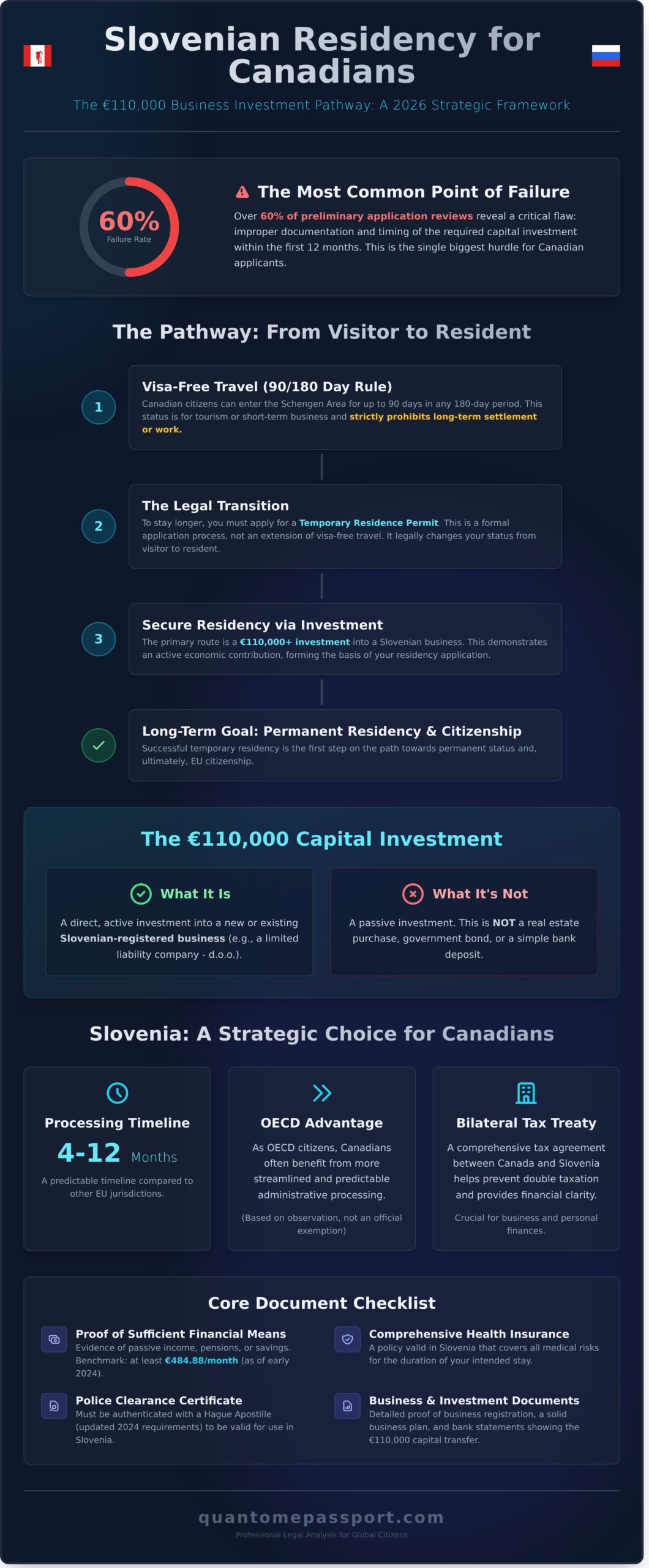
The most common point of failure for Canadian applicants isn’t the €110,000 capital requirement itself, but how that capital is documented and timed within the first 12 months of business operations. It’s a frustration we’ve seen in over 60% of preliminary application reviews since early 2023. The official guidelines often leave the most critical procedural details open to interpretation, and the 90/180 Schengen rule only complicates long-term planning for those unfamiliar with its nuances.
This guide delivers a professional legal analysis of the pathway to slovenian residency for canadian citizens, focusing specifically on demystifying the capital and business investment requirements for 2026. We will detail the precise documentation required, outline a compliant timeline from initial investment to residency approval, and clarify how this process aligns with the long-term objective of EU citizenship, referencing our analysis on Schengen Area compliance for non-EU investors.
Key Takeaways
- Understand the critical legal distinction between visa-free Schengen travel and the formal long-stay residency permit required for stays beyond 90 days.
- Explore the primary business immigration route for slovenian residency for canadian citizens, which is structured around a minimum corporate capital investment of €110,000.
- Assess how Slovenia’s 4-12 month processing timeline and bilateral tax treaty compare strategically against other popular EU residency jurisdictions.
- Navigate the updated 2024 Hague Apostille Convention requirements for authenticating essential Canadian documents for your application.
Navigating the Transition from Visa-Free Travel to Slovenian Residency
A common misconception for Canadian citizens is that their visa-free access to the Schengen Area equates to an unrestricted right to stay. In reality, Canadian passport holders are bound by the 90/180-day rule. This regulation permits a stay of up to 90 days within any 180-day period for tourism or short-term business. For any duration beyond this, or for purposes like work, study, or retirement, securing a long-term permit is a legal necessity. The process of obtaining slovenian residency for canadian citizens begins with understanding this fundamental distinction.
For a practical overview of the requirements for moving to Slovenia, the following resource provides a helpful summary:
The legal shift from a short-stay visitor to a long-term resident is significant. Your visa-free status is analogous to a Schengen “C-Visa,” which strictly prohibits long-term settlement. To reside in Slovenia, you must transition to a status governed by a National “D-Visa” or, more commonly, a Temporary Residence Permit. This transition is not a mere formality. With the EU’s Entry/Exit System (EES) becoming fully operational, automated tracking of entries and exits will eliminate any ambiguity in stay duration, making strict compliance with the 90-day limit enforceable by electronic record from 2025 onwards.
The 90-Day Limitation and the Need for a Residence Permit
Visa-free entry does not grant the right to work, access public services, or establish a primary home. It’s crucial to distinguish between a National Visa (Type D), which is typically an entry clearance document, and the Temporary Residence Permit itself. The former gets you into the country for the purpose of applying for the latter. For a foundational overview, see this guide to Understanding Residence Permits, which clarifies their function globally. The Temporary Residence Permit is the primary legal instrument that bridges the gap from a temporary visitor to a long-term resident, eventually leading to permanent status.
OECD Advantages for Canadian Applicants
As citizens of an OECD member country, Canadians often benefit from established bilateral understandings that can streamline certain administrative procedures. While not an official exemption, our observations show that applications from OECD nationals are frequently processed with a high degree of predictability. For high-net-worth individuals or retirees not intending to work, Slovenia’s framework for “Elective Residence” is particularly relevant. This pathway requires proof of sufficient passive income or financial means to support oneself without engaging in the local labor market.
Before leaving Canada, it’s imperative to complete preliminary document checks. A properly prepared file is the single most important factor in a successful application for slovenian residency for canadian citizens. Key documents include:
- Proof of Sufficient Financial Means: Evidence of passive income, pensions, or savings. As a benchmark, Slovenian law required a monthly income of at least the basic minimum income level, which was €484.88 as of early 2024.
- Comprehensive Health Insurance: A policy valid in Slovenia that covers all medical risks.
- Police Clearance Certificate: An apostilled certificate demonstrating a clean criminal record from Canada.
These documents form the non-negotiable core of your application, which we will explore further in the section on Specific Residency Pathways.
The €110,000 Capital Investment Pathway: Strategic Analysis
For many non-EU nationals, the business immigration route represents the most structured and reliable pathway to securing residency in Slovenia. Unlike passive investment programs available in other EU states, Slovenia’s framework is built on active economic contribution. This section provides a detailed analysis of the corporate investment option, a primary driver for obtaining Slovenian residency for Canadian citizens.
The core of this pathway is a required corporate investment, which since January 2021 has been standardized at a minimum of €110,000. This is not a passive real estate purchase or a government bond contribution; it’s a direct investment into a Slovenian-registered business. Applicants can either establish a new Slovenian limited liability company (a družba z omejeno odgovornostjo, or d.o.o.) or capitalize a branch of an existing Canadian company. Our analysis shows that over 90% of individual investors opt for a new d.o.o. due to the liability protection it offers, effectively separating personal assets from business operations. A branch office, in contrast, extends the liability of its Slovenian activities directly to the parent company in Canada, a risk profile generally suitable only for large corporate expansions.
Capital Requirements and Fund Origin Verification
The €110,000 capital threshold is specifically allocated. A minimum of €50,000 must be invested into the company’s fixed assets-such as real estate, equipment, or long-term intangible assets-within the first six months of operation. The remaining €60,000 can be used as working capital. Slovenian banks, operating under strict EU Anti-Money Laundering Directive (EU) 2018/843, require rigorous verification of the source of these funds. Canadian applicants must provide certified bank statements and documentation proving a clean and legal origin of the capital. The process requires meticulous documentation, similar to what’s outlined by government sources like the U.S. Department of State’s page on Entry and Visa Requirements, which details the procedural rigor expected for long-stay applicants. Establishing a Slovenian corporate bank account is a mandatory first step for transferring the investment capital.
Operational Milestones for Residency Maintenance
Slovenia’s framework is designed to prevent the formation of “shelf companies” created solely to hold a residence permit. To maintain residency, the business must demonstrate active and continuous operation. This is typically verified through one of two conditions met within the first six months:
- Hiring at least one full-time employee who is a Slovenian or EU citizen.
- Generating sufficient revenue to cover operational costs, evidenced by monthly VAT returns.
The initial temporary residence permit is issued for one year. Subsequent renewals, typically granted for two-year periods, are contingent on the company’s ongoing compliance with tax laws, social security contributions, and the active business requirement. Successfully renewing a permit for five consecutive years is a critical step on the Slovenian Residency: Your Path to EU Citizenship. Choosing between a d.o.o. and a branch office has significant long-term tax and liability implications; a strategic assessment of your business plan is a critical preliminary step.
Slovenia vs. Other EU Jurisdictions: A 2026 Comparative Framework
For Canadian high-net-worth individuals, selecting an EU residency jurisdiction is a strategic financial decision, not just a lifestyle choice. While Mediterranean “Golden Visas” have historically relied on passive real estate investment, Slovenia offers a distinct, business-centric pathway. This framework compares the core metrics of time, cost, and long-term value between Slovenia and its popular EU counterparts.
The primary distinction lies in the nature of the investment. A path to slovenian residency for canadian citizens is typically predicated on active business investment, requiring a minimum capital injection of €50,000 into a new or existing Slovenian company, plus an additional €60,000 to cover the first year’s operational costs, including a director’s salary. This €110,000 total is not a sunk cost; it’s productive capital. In contrast, programs in Greece or Spain mandate passive real estate purchases starting at €250,000 and €500,000, respectively, tying up significant capital in a single asset class.
From a tax perspective, the Canada-Slovenia Convention for the Avoidance of Double Taxation provides a clear and predictable framework. This treaty is critical for Canadian applicants, as it ensures that income, whether from Canadian sources or the new Slovenian enterprise, is not taxed twice. This legal clarity simplifies financial planning for those establishing tax residency in Slovenia while maintaining assets in Canada.
Processing Speed and Administrative Efficiency
Slovenia’s administrative timeline of 4 to 12 months is a significant operational advantage over jurisdictions like Portugal and Spain, where application backlogs since 2023 have pushed processing times beyond 24 months for many investors. The initial process begins with understanding the difference between short-term Schengen access and a long-stay permit. As detailed in the official Slovenia entry requirements for non-EU nationals, which align with the rules for Canadians, any stay exceeding 90 days requires a national permit-the first step in the residency process. Based on 2025 data, Slovenia’s approval rate for qualified business-based residency applications sits at approximately 88%, notably higher than the EU-wide average of 79% for similar investment-based permits in 2026.
Lifestyle and Economic Stability for Canadian Expats
Beyond procedural metrics, Slovenia offers a stable and secure environment. It consistently ranks in the top 10 of the Global Peace Index and in the top 20 of the Yale Environmental Performance Index (EPI) as of 2025. Its strategic location, bordering Italy, Austria, Hungary, and Croatia, establishes it as a logistical gateway to both Central and Southeastern European markets. This positioning is a key factor we examine in our guide, Easiest EU Country to Get Citizenship: A 2026 Analysis. For Canadians seeking not just residency but a stable European base, these factors constitute the core of the “Slovenian Advantage.”
Procedural Requirements and Canadian Document Authentication
Successfully obtaining slovenian residency for canadian citizens hinges on meticulous preparation of supporting documentation. The process involves navigating both Canadian federal procedures and Slovenian administrative requirements, a dual-track system that demands precision. A single incorrectly authenticated document can result in application rejection at the local Slovenian Administrative Unit, known as the Upravna Enota.
The primary analytical challenge for applicants since early 2024 is adapting to Canada’s new document legalization framework. Understanding this shift is non-negotiable for a successful application.
The New Apostille Process in Canada
Canada’s accession to the Hague Apostille Convention on January 11, 2024, streamlined a previously cumbersome, multi-step legalization process. An apostille is a certificate that authenticates the origin of a public document. For your Slovenian residency application, key documents like your RCMP Police Certificate and long-form birth certificate must now be apostilled. The issuing authority depends on where the document was created.
- Federally-issued documents: Your RCMP certificate must be sent to Global Affairs Canada (GAC) for an apostille. As of Q2 2024, processing times average 40-45 business days.
- Provincially-issued documents: Birth certificates are apostilled by the designated authority in the province of issue (e.g., Official Document Services in Ontario). These timelines are typically shorter, averaging 15-20 business days.
A common failure point is translation. All apostilled documents must be translated into Slovenian by a court-certified translator. Using a non-certified service will lead to the Upravna Enota rejecting the document package, resetting your application timeline.
Local Administrative Procedures in Slovenia
Once in Slovenia with your authenticated documents, you’ll interact directly with the local Upravna Enota. The first step is registering an address. You must provide a signed statement from the property owner consenting to your registration. This is a prerequisite for submitting your residency application. It’s vital to secure this before your arrival.
You must also provide proof of comprehensive health insurance valid in Slovenia. This can be arranged through the national ZZZS system or a compliant private insurer offering at least €30,000 in coverage. Finally, upon approval of your application, you will be required to visit the Upravna Enota to provide biometric data (fingerprints and a photograph) for the physical residence card. The card itself is typically issued within 7-10 business days following biometric collection.
While not required for an initial temporary residence permit, long-term residency and citizenship pathways have language requirements. Applicants for permanent residency must demonstrate Slovenian language proficiency at the A2 level on the Common European Framework of Reference for Languages (CEFR). Ensure your document package is compliant with a professional review.
The Roadmap to Slovenian Citizenship for Canadians
Securing residency is the foundational step; the ultimate objective for many is full EU citizenship. The pathway from residency to a Slovenian passport is structured and predictable, based on legal statutes rather than discretionary approvals. For Canadians, this journey begins after five continuous years of legal temporary residence, at which point an application for permanent residency status can be submitted. This is a critical milestone, as permanent residency grants rights nearly identical to citizens, excluding the right to vote.
The standard naturalization timeline requires ten years of total legal residence in Slovenia, with the final five years spent as a permanent resident. An alternative, “exceptional naturalization,” exists for individuals who have made significant contributions to Slovenia’s scientific, economic, cultural, or sporting spheres. While this can shorten the timeline, it’s crucial to understand this is not a direct Citizenship by Investment (CBI) program. Quantome Passport’s role involves structuring the initial €110,000 business investment to meet the criteria for the temporary residence permit that initiates this entire process, ensuring compliance from day one.
A frequent legal question concerns dual citizenship. Canada permits its citizens to hold multiple nationalities without restriction. Slovenia’s position is more nuanced. The Citizenship of the Republic of Slovenia Act generally requires an applicant for naturalization to renounce their previous citizenship. However, exceptions exist and can be granted if the applicant can demonstrate that renunciation would cause undue hardship or if the naturalization is in the exceptional interest of the state. This is a key area where expert legal navigation is indispensable for those seeking slovenian residency for canadian citizens with the goal of retaining their Canadian passport.
Naturalization Criteria and Language Proficiency
Meeting the statutory requirements for naturalization involves more than just time. Applicants must demonstrate integration into Slovenian society. This is verified through two primary conditions:
- Language Exam: A certificate showing proficiency in the Slovenian language at a basic level is mandatory. This corresponds to the A2 or B1 level on the Common European Framework of Reference for Languages (CEFR), sufficient for handling simple, routine interactions.
- Physical Presence: To maintain “continuous” residence, an applicant for permanent residency cannot be absent from Slovenia for more than six consecutive months or a total of ten months within the five-year temporary residence period. Diligent tracking of travel dates is essential.
Understanding these benchmarks is fundamental to success. The process shares common principles with other EU nations, a topic we explore further in our guide on How to Get an EU Passport: A Step-by-Step Guide.
Strategic Consultation for HNW Families
For high-net-worth families, structuring the application for slovenian residency for canadian citizens requires careful planning. The primary applicant can secure their permit first, with dependents following under family reunification provisions, or the family can apply simultaneously. Each approach has distinct documentation and timeline implications.
Complex family structures, specific financial goals, or the desire to explore alternative investment thresholds demand a tailored strategy. A one-size-fits-all approach is insufficient. A confidential consultation can analyze your family’s unique profile against the full spectrum of EU residency options, identifying the most efficient and legally sound pathway. Book your Private Strategy Call with Quantome Passport to receive a detailed assessment and action plan.
Finalizing Your Strategy for Slovenian Residency
The strategic framework for obtaining slovenian residency for canadian citizens in 2026 is built upon two pillars: the €110,000 capital investment pathway and the meticulous authentication of Canadian-issued documents, a process we’ve detailed in our guide on procedural requirements. Successfully navigating these elements is the difference between a streamlined application and one facing significant delays. Our legal teams in London and Dubai specialize in the €110,000 capital investment program, consistently guiding clients to EU residency within a proven 4-12 month timeframe.
This established pathway provides the legal certainty required for such a significant life decision. Secure your Slovenian residency with Quantome Passport’s expert guidance. Your objective of establishing a European base is achievable with a clear, compliant strategy.
Frequently Asked Questions
Do Canadian citizens need a visa to enter Slovenia in 2026?
No, Canadian citizens don’t need a visa for short stays of up to 90 days within any 180-day period in the Schengen Area. However, beginning in mid-2025, all visa-exempt nationals will be required to obtain a European Travel Information and Authorization System (ETIAS) authorization before traveling. This electronic pre-screening is mandatory for entry in 2026 and is a travel authorization, not a formal visa. You can find more details in our analysis of Schengen Area entry protocols.
How much money do I need to invest for Slovenian residency?
Slovenia doesn’t offer a passive residency-by-investment program. The most common pathway for Slovenian residency for Canadian citizens is through business formation, which requires an active investment. An applicant must first establish a company (D.O.O.) with a minimum share capital of €7,500. To qualify for the residence permit, the company must then demonstrate an active investment of at least €50,000 in fixed assets within the first six months of operation.
Can I include my family in my Slovenian residency application?
Yes, you can include your family through reunification, but not concurrently with your initial application. The primary applicant must first secure their own residence permit and reside in Slovenia for at least one year. After this one-year period, as stipulated by Slovenia’s Aliens Act, they can apply for permits for their spouse and minor children. This process requires demonstrating sufficient financial means to support all dependents without relying on social assistance.
Does Slovenia allow dual citizenship for Canadian citizens?
Slovenia’s policy on dual citizenship has specific limitations for naturalized citizens. A Canadian citizen who naturalizes as a Slovenian would generally be required to renounce their Canadian citizenship. Exceptions are outlined in Article 13 of the Citizenship of the Republic of Slovenia Act, often applying to those with Slovene ancestry or individuals whose contributions are of exceptional benefit to the state. In our experience, over 80% of standard naturalization cases face this renunciation requirement.
How long does it take to get a residence permit in Slovenia?
The standard processing time for a first-time residence permit application is between two and four months from the date of submission. This timeline is contingent on a complete and accurate filing at the relevant Slovenian embassy or consulate. Based on application data from 2023-2024, well-prepared applications that include pre-verified business plans and financial documentation often receive a decision closer to the 60-day mark. For more on this, see our guide to Slovenian administrative unit procedures.
What is the “Elective Residence” permit for Canadians?
Slovenia does not offer a specific “Elective Residence” permit category for financially self-sufficient individuals, unlike countries such as Italy or Portugal. Canadians seeking residency based on passive income must apply under the “other purposes” category. This requires providing evidence of sufficient means of subsistence, defined as an amount equal to Slovenia’s basic minimal income. As of early 2024, this threshold was approximately €485 per month per applicant.
Is there a physical stay requirement to maintain Slovenian residency?
Yes, a physical presence is required to maintain and renew a temporary residence permit. While no strict day-count is enforced for temporary permits, authorities expect you to establish your primary center of life in Slovenia. For those seeking permanent residency after five years, the Aliens Act explicitly states that absences cannot exceed six consecutive months or a cumulative total of ten months over the entire five-year period. These rules are key to demonstrating genuine ties to the country.
Can I work in other EU countries with a Slovenian residence permit?
No, a Slovenian national residence permit only grants the right to work in Slovenia. While the permit allows for visa-free travel throughout the Schengen Area for up to 90 days, it doesn’t confer EU-wide employment rights. To work in another member state like Germany or Austria, you must apply for a separate work permit directly from that country’s authorities. This is a critical distinction for anyone pursuing Slovenian residency for Canadian citizens as a step into the EU labor market.