
Imagine the freedom to live in Paris, work in Berlin, or retire on the sunny coast of Spain. For many, this dream feels buried under a mountain of confusing paperwork, unclear eligibility rules, and intimidating bureaucracy. The path to European Union citizenship can seem overwhelmingly complex, but it doesn’t have to be. What if you had a clear, reliable roadmap to guide you through every step, helping you avoid the scams and misinformation along the way?
This is your ultimate guide for 2026. We are here to demystify the process and empower you with knowledge. In this article, you will discover the life-changing benefits of holding an EU passport and explore all the legitimate pathways to obtaining one-from ancestry and naturalization to investment. We will provide the clarity you need to find a realistic route for you and your family, turning your European dream into an achievable plan. Your journey toward a life of European freedom starts right here.
What is EU Citizenship and Why is it So Valuable?
Many people dream of holding a European passport, but what does that truly mean? It’s important to understand that there isn’t a single “EU passport.” Instead, you acquire european union citizenship by becoming a citizen of any of the 27 member states. This status is supplementary to, not a replacement for, your national citizenship. Established by the Maastricht Treaty, the concept of Citizenship of the European Union grants you a consistent set of powerful rights across the entire bloc. Think of it as a master key unlocking a continent of unparalleled freedom, security, and opportunity.
To better understand this powerful status, this video provides a helpful overview:
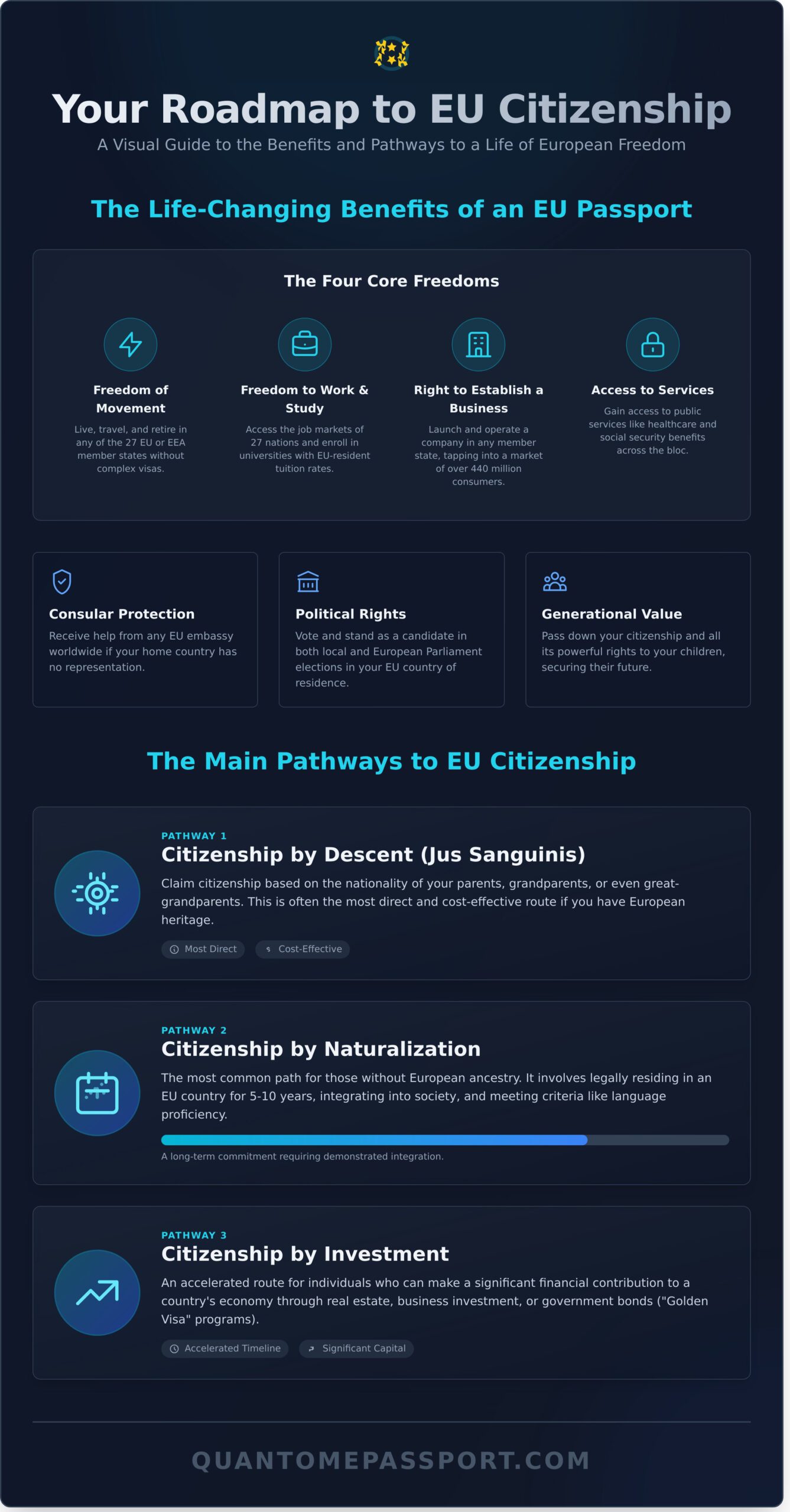
The Four Freedoms: Your Core Rights
At the heart of EU citizenship are the “Four Freedoms,” which form the foundation of the single market and your personal liberty within it. These rights transform how you can live, work, and invest across an entire continent.
- Freedom of Movement: You have the fundamental right to travel, live, and even retire in any other EU or European Economic Area (EEA) country without the need for complex visas or permits.
- Freedom to Work & Study: Access the job markets of 27 nations on the same terms as a local. You can also enroll in universities, often benefiting from subsidized EU-resident tuition rates.
- Right to Establish a Business: Launch, own, and operate a company in any member state, tapping into a vast, integrated market of over 440 million consumers.
- Access to Services: Under specific conditions, you can gain access to public services like healthcare, social security benefits, and education systems across the bloc.
Beyond the Obvious: Additional Powerful Benefits
The value extends far beyond the core freedoms. This elite status also includes often-overlooked yet critical advantages that provide security and a lasting legacy.
- Consular Protection: If you’re in a country outside the EU where your home nation has no embassy, you can seek help and protection from any other EU member state’s embassy or consulate.
- Political Rights: As an EU citizen living in another member state, you have the right to vote and stand as a candidate in both European Parliament and local municipal elections, giving you a voice in your community.
- Generational Value: Perhaps the most profound benefit is that you can pass down your citizenship and all its associated rights to your children, securing their future and opportunities for generations to come.
The 4 Main Pathways to Becoming an EU Citizen
The journey to obtaining european union citizenship can seem complex, but it generally follows one of four established routes. For non-EU nationals, understanding these options is the first step toward unlocking the life-changing benefits of an EU passport. Each pathway has unique requirements, processing times, and financial considerations, making the ‘best’ choice entirely dependent on your personal circumstances, such as your family history, professional background, and financial capacity. Exploring these routes will help you identify the most viable strategy for securing the full spectrum of official rights of EU citizens, from freedom of movement to enhanced global mobility.
Pathway 1: Citizenship by Descent (Jus Sanguinis)
If you have European heritage, this is often the most direct and cost-effective route. Known as jus sanguinis or “right of blood,” this pathway allows individuals to claim citizenship based on the nationality of their parents, grandparents, or in some cases, even great-grandparents. Countries like Ireland, Italy, Poland, Spain, and Hungary have well-established programs for descendants, though you must provide extensive documentation to prove your lineage and connection.
Pathway 2: Citizenship by Naturalization
Naturalization is the most common path for individuals without European ancestry. This process involves legally residing in an EU country for a specified number of years, typically ranging from five to ten. Beyond simply living there, applicants must demonstrate successful integration into society. This usually includes proving language proficiency, passing a civic or history exam, showing financial stability, and maintaining a clean criminal record. It is a long-term commitment to becoming part of a new community.
Pathway 3: Residency & Citizenship by Investment
For those with the financial means, investment programs offer a more structured and accelerated route to residency and, eventually, citizenship. These “Golden Visa” or “Citizenship by Investment” programs require a significant financial contribution to the country’s economy. Common options include purchasing real estate, investing in a local business, or buying government bonds. This pathway provides a more predictable timeline and is ideal for investors and entrepreneurs seeking a strategic foothold in Europe.
A Deeper Dive into Naturalization: The Path of Residency
For many, the most common route to acquiring an EU passport is through naturalization, a process grounded in long-term legal residency. This path is a significant commitment, typically spanning five to ten years, and involves a clear progression: from a temporary residence permit to permanent residency, and finally, to full citizenship. Throughout this journey, maintaining an uninterrupted and legal residency status is paramount. While the ultimate goal is the same, the specific rules are determined by each member state, not the EU itself. You can learn more about the rights and policies governing this status directly from the European Commission on EU Citizenship. This path requires patience and diligence but remains the most accessible way for non-EU nationals to gain european union citizenship.
Common Grounds for Obtaining Residency
The first step towards naturalization is securing a legal basis to live in an EU country. While specific visas vary, most fall into several key categories. These pathways serve as the foundation for your long-term residency and eventual citizenship application.
- Employment: Securing a work contract with a local employer is a primary route. For highly skilled professionals, the EU Blue Card program offers a streamlined process with attractive benefits in many member states.
- Business: Entrepreneurs can gain residency by establishing a business that creates jobs, introduces innovation, or otherwise contributes meaningfully to the country’s economy.
- Family Ties: Joining an EU citizen spouse, registered partner, or, in some cases, another close family member, provides a direct path to residency.
Typical Naturalization Requirements
Once you have fulfilled the minimum residency period, you can apply for citizenship. The final hurdles often test your integration into society. While these requirements differ significantly, most countries mandate the following:
- Minimum Residency Period: You must prove you’ve lived in the country legally and continuously for a set number of years, such as 5 years in Portugal or 8 years in Germany.
- Language Proficiency: Expect to pass a language test, typically demonstrating a level between A2 (basic) and B2 (upper-intermediate) on the Common European Framework of Reference for Languages (CEFR).
- Civic & Financial Integration: Many nations require you to pass a civic integration exam on the country’s history, laws, and culture. You must also prove financial stability and that you are not a burden on the state’s social welfare system.
- Clean Criminal Record: A thorough background check is standard, and a clean criminal record is almost always a non-negotiable requirement for obtaining european union citizenship.
Exploring Residency by Investment: An Accelerated Route
For those seeking a more direct and structured route to living in Europe, Residency by Investment (RBI) programs, often called ‘Golden Visas’, offer a compelling solution. It is vital to understand that these are not instant passports. Instead, they provide a streamlined pathway to legal residency, which is the foundational step required before applying for european union citizenship through naturalization. While direct Citizenship by Investment (CBI) programs are extremely rare and face increasing scrutiny within the EU, RBI offers a legitimate and well-established alternative.
How Do These Programs Work?
The core principle is simple: an applicant makes a significant, qualifying financial contribution to an EU member state’s economy. In return, the country grants residency permits to the investor and their immediate family members. This creates a clear, structured timeline. Common investment options include:
- Real Estate Purchase: Acquiring residential or commercial property above a certain value threshold.
- Business Investment: Investing capital into a new or existing company that creates local jobs.
- Capital Transfer: Purchasing government bonds or making a non-refundable contribution to a national development fund.
Once residency is secured, you are on the formal path toward naturalization, which may be accelerated compared to other immigration routes.
Who is This Pathway For?
This pathway is primarily designed for non-EU investors, entrepreneurs, and high-net-worth individuals who value efficiency and predictability. It removes much of the uncertainty of traditional immigration by providing a clear set of financial and legal requirements from the outset. For families looking to relocate together and secure a stable future in Europe, it provides a powerful, unified solution. If your long-term goal is obtaining european union citizenship, a Golden Visa program can be the most strategic first step on your journey. Explore if a residency program is your fastest path to Europe.
Citizenship by Descent: Reclaiming Your European Roots
For many, the dream of european union citizenship isn’t about investment or residency-it’s about heritage. This powerful pathway is rooted in the legal principle of Jus Sanguinis, or ‘right of blood’. If you can prove your lineage to an ancestor from a qualifying EU nation, you may be eligible to claim citizenship yourself. This is an especially popular route for citizens of the USA, Canada, Australia, and Latin American countries, where generations of European immigrants have settled.
Which Countries Offer Citizenship by Descent?
While many EU nations recognize ancestral claims, the rules vary significantly. Some of the most sought-after programs include:
- Ireland: One of the most accessible paths, often allowing you to claim citizenship through an Irish-born grandparent.
- Italy: Known for its generous policy, which allows you to go back several generations with few limitations, provided the line of descent was not broken by naturalization.
- Poland, Hungary, & Lithuania: These countries have provisions for descendants of citizens who fled persecution or were displaced during specific historical periods.
- Germany & Spain: Both offer routes for descendants of those who fled Nazi persecution, with Spain also having a specific path for those of Sephardic Jewish ancestry.
The Process and Required Documentation
Securing citizenship by descent is a meticulous genealogical and administrative marathon. The core of your application is proving an unbroken chain of citizenship from your ancestor to you. The process typically involves:
- Gathering Vital Records: You must collect official birth, marriage, and death certificates for every person in your direct line of descent.
- Proving Unbroken Lineage: This involves demonstrating that your ancestor did not naturalize in another country before the birth of the next person in your family chain.
- Consulate Application: Once your dossier is complete, you’ll submit it through the relevant country’s consulate or embassy in your region.
Patience is key. Be prepared for a long wait, as these applications can often take two to four years, or even longer, to process.
Reclaiming your roots is a deeply rewarding way to obtain an EU passport and all the benefits that come with it. Because the laws are complex and specific to each country, navigating the process can be daunting. Exploring your eligibility with an expert can clarify your path to european union citizenship and ensure your application is built on a solid foundation. Learn more about how we can assist at quantomepassport.com.
Key Considerations on Your Journey to EU Citizenship
Embarking on the path to an EU passport is a significant life decision, filled with complex questions and critical details. Managing your expectations from the outset is vital for a smooth process. This section addresses the most common considerations to help you plan your journey with confidence.
Dual Citizenship: Can You Keep Your Original Passport?
For many applicants, this is the most pressing question. The good news is that the vast majority of EU member states now permit dual citizenship, meaning you won’t have to renounce your original nationality. However, the rules are not universal. While countries like Ireland, Italy, and Portugal are accommodating, nations such as Austria and the Netherlands have stricter policies. It’s essential to verify the specific laws of both your home country and your target EU country, as regulations can change.
Realistic Timelines and Costs
The time and financial investment required for european union citizenship vary dramatically depending on your chosen route. Understanding these differences is key to selecting the right strategy for your goals.
- Citizenship by Descent: Typically takes 2 to 5 years. This is often the most affordable path, with costs primarily related to document retrieval, translation, and legal assistance.
- Citizenship by Naturalization: Requires 5 to 10+ years of legal residency. Costs include long-term living expenses, integration course fees, and administrative applications.
- Citizenship by Investment: The fastest route to residency (often 4-12 months), but it demands a significant capital outlay in real estate, government bonds, or business ventures.
The Role of Professional Advisors
Navigating the legal and bureaucratic maze of immigration law on your own can lead to costly mistakes and significant delays. Professional advisors serve as your strategic partner, ensuring your application is accurate, complete, and optimized for success. They demystify complex requirements and manage communication with government bodies, saving you invaluable time and stress.
Understanding which path is right for you is the first and most critical step. Book a private strategy call to map your personal path to the EU.
Your European Future Awaits: The Path to EU Citizenship
The dream of living, working, and traveling freely across 27 nations is a powerful one, and as we’ve explored, it is more attainable than many realize. From the patient path of naturalization and the accelerated route of investment to the profound connection of citizenship by descent, there is a strategy suited to your unique circumstances. The journey demands careful planning and commitment, but the ultimate prize-full european union citizenship-unlocks a world of unparalleled freedom, opportunity, and lifelong security for you and your family. This global mobility makes exploring unique cultural events worldwide much easier; as an example for travelers heading to Asia, you can learn more about Jasumo Tickets to see how they help visitors access live events in Japan.
Navigating the intricate requirements of each country can be the most challenging part of the process. This is where expert guidance is not just a benefit, but a necessity. At Quantome Passport, our team provides personalized strategies for individuals and families, leveraging deep expertise in structured residency-to-citizenship programs. With a global presence and offices in London and Dubai, we are uniquely positioned to manage your case with precision and care. Your new chapter in Europe is waiting to be written. Begin Your Journey to European Freedom with a Confidential Consultation.
Frequently Asked Questions About EU Citizenship
What is the difference between EU residency and EU citizenship?
EU residency grants you the right to live, work, and study in one specific EU country. It is often a temporary status that requires renewal. In contrast, EU citizenship is a permanent status that grants you a passport and the full rights of a natural-born citizen. This includes the freedom to live, work, and retire in any of the 27 EU member states without restriction, as well as the right to vote in European elections.
Can you simply buy a European Union passport?
You cannot directly “buy” an EU passport, as this is illegal. However, several countries offer legitimate “citizenship by investment” programs. These pathways require you to make a significant, qualifying investment in the country’s economy, such as in real estate or a national development fund. After meeting strict due diligence checks and residency requirements, you can then apply for citizenship. These are structured, legal routes, not simple transactions.
Which is the easiest and fastest EU country to get citizenship in?
The “easiest” and “fastest” path depends on your personal circumstances and financial capacity. Malta’s investment program offers one of the most direct routes, potentially leading to citizenship in 12 to 36 months for a substantial investment. Portugal’s Golden Visa is also popular, offering a path to citizenship eligibility after five years of legal residency with minimal physical presence requirements, making it a flexible and attractive option for many investors.
Do I need to learn a new language to become an EU citizen?
Language requirements vary significantly by country and application path. Citizenship by descent, for instance, often has no language test. However, most standard naturalization processes, which follow years of residency, require applicants to demonstrate proficiency in the national language. For example, Germany and Spain both require language tests. Some investment programs may have more lenient rules, but it is a critical factor to verify for your chosen country.
As a US or UK citizen, what’s the best way to get EU citizenship?
For US and UK citizens, the most common routes are ancestry, residency, or investment. If you have a parent or grandparent from an EU country like Ireland, Italy, or Poland, you may be eligible for citizenship by descent. For those without ancestral ties, residency-by-investment programs in countries like Portugal or Greece provide a structured path to achieving european union citizenship after fulfilling the program’s time and financial requirements.
Can my family (spouse and children) get citizenship with me?
Yes, a major advantage of most programs is the ability to include your family. The main applicant can typically include their spouse and dependent children in the same application. Some countries also allow for the inclusion of dependent parents and even grandparents. This ensures your entire immediate family can enjoy the extensive benefits of european union citizenship, including freedom of movement, education, and healthcare across the EU.
What is the Schengen Area and how does it relate to EU citizenship?
The Schengen Area is a border-free zone comprising 27 European countries, allowing for unrestricted travel between them. While most EU member states are part of Schengen, the two are not identical (e.g., Ireland is in the EU but not Schengen). For an EU citizen, this means you can travel, work, and live throughout this vast area without internal border checks, presenting only a passport or national ID card. It is the practical realization of the EU’s freedom of movement principle.