
Does the thought of securing a second passport feel like navigating a labyrinth of complex paperwork, hidden costs, and potential scams? You’re not alone. The world of citizenship by investment can seem overwhelmingly bureaucratic, leaving many families uncertain about which country is the right fit or how to avoid illegitimate schemes. It’s a life-changing decision, and you deserve absolute clarity and confidence every step of the way.
That’s precisely why we created this ultimate 2026 guide. We’re here to demystify the entire process for you. In the following sections, we will break down the true benefits, transparent costs, and legal requirements of the most reputable programs available today. You will gain a clear understanding of the application journey and learn how to identify a trusted advisor to secure your family’s future. Consider this your definitive roadmap to achieving greater global mobility and lasting peace of mind.
What is Citizenship by Investment (and What It’s Not)?
Citizenship by Investment (CBI) is a formal, legal process where an individual makes a significant economic contribution to a country in exchange for its citizenship and passport. It is crucial to understand that this is not simply “buying a passport”; it is a strategic investment governed by national laws. These government-sanctioned immigrant investor programs are designed to channel funds into a country’s development while offering qualified, vetted individuals the full rights and benefits of citizenship.
To see how these programs work in practice, this video provides a clear overview of some of the most popular options:
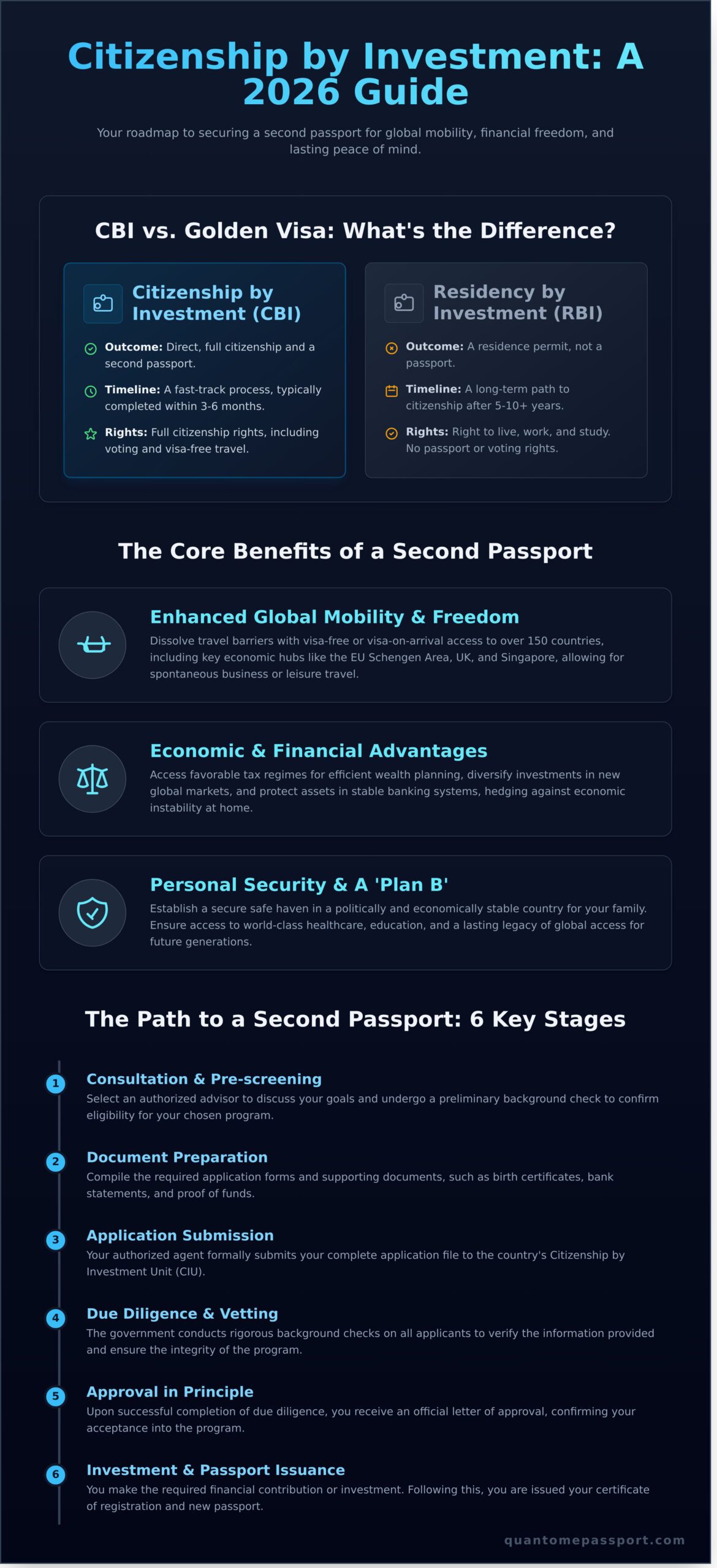
CBI vs. Residency by Investment (RBI): Key Differences
It’s easy to confuse CBI with Residency by Investment (RBI), often called “Golden Visas.” While related, they offer fundamentally different outcomes.
- Residency by Investment (RBI): Grants the right to live, work, and study in a country. You receive a residence permit, not a passport. It can be a pathway to citizenship through naturalization, a process that often takes five to ten years or more.
- Citizenship by Investment (CBI): Directly grants full, often irrevocable citizenship and a second passport in a much shorter timeframe, typically within months. This provides immediate rights, including the right to vote and travel visa-free to the country’s partner nations.
The Legal Framework: How Countries Justify These Programs
Every nation has the sovereign right to determine its own citizenship laws. Countries that offer citizenship by investment programs do so under a carefully constructed legal framework. The primary motivation is economic: attracting Foreign Direct Investment (FDI) to boost the national economy without incurring debt.
These funds are typically earmarked for specific public benefits, such as building new infrastructure, funding social programs, paying down national debt, or creating disaster relief funds. By formalizing this process, governments ensure that investments are secure, applicants are thoroughly vetted through strict due diligence, and the integrity of their citizenship is maintained.
The Core Benefits: Why High-Net-Worth Individuals Seek a Second Passport
For high-net-worth individuals, a second passport is rarely just a travel document; it’s a strategic tool for solving complex challenges. The motivation extends far beyond convenience, addressing fundamental concerns about mobility, financial freedom, and personal security in an unpredictable world. A citizenship by investment program acts as a powerful solution, offering a comprehensive hedge against the limitations and volatility tied to a single country of origin.
Enhanced Global Mobility and Freedom
The most immediate advantage is the radical transformation of global mobility. A restrictive passport can mean missed business opportunities and cumbersome visa applications. A strong second passport dissolves these barriers, providing visa-free or visa-on-arrival access to over 150 countries, including key economic hubs.
- Unrestricted Access: Travel freely throughout the EU Schengen Area, the UK, Singapore, and other major business centers without prior visa approvals.
- Spontaneous Travel: Finalize a last-minute business deal in London or take an impromptu family vacation without the bureaucratic delays of visa processing.
- Overcoming Limitations: For citizens of nations with limited visa-waiver agreements, a second passport is the key to unlocking true global freedom.
Economic and Financial Advantages
A second citizenship opens a new world of financial strategy and opportunity. It allows investors to structure their assets and business affairs across multiple jurisdictions, enhancing both growth potential and protection. This isn’t about evasion, but about legitimate, strategic planning in a globalized economy. Understanding the economic impact of citizenship programs, as detailed by institutions like the IMF, underscores their established role in international finance.
- Tax Optimization: Gain access to favorable tax regimes, enabling efficient wealth and legacy planning.
- Global Investment: Diversify your portfolio by entering new markets that may have been previously inaccessible.
- Asset Protection: Safeguard your wealth in countries with stable banking systems and robust legal frameworks, protecting it from economic instability at home.
Personal Security and a ‘Plan B’
Ultimately, the most profound benefit of a second citizenship is peace of mind. In an era of geopolitical and economic uncertainty, having a ‘Plan B’ is invaluable. It provides a secure safe haven for you and your family, ensuring stability and access to a higher quality of life, no matter what the future holds.
- A Safe Haven: Establish a second home in a politically and economically stable country, creating a secure retreat for your family.
- Access to Better Services: Secure your family’s access to world-class healthcare, leading educational institutions, and a higher standard of living.
- Generational Security: Pass down the benefits of dual citizenship, providing future generations with a legacy of global access and security.
Navigating the Process: A Step-by-Step Overview
Embarking on the path to a second passport can seem complex, but the journey is a structured, multi-stage process. Understanding these steps demystifies the experience and sets clear expectations for timelines and requirements. The entire process is managed by a government-authorized agent or advisory firm, who acts as your dedicated guide, ensuring compliance and a seamless application.
Stage 1: Initial Consultation and Pre-screening
Your journey begins with selecting a reputable advisory firm. This crucial first step ensures you receive expert guidance tailored to your unique circumstances. We conduct a confidential pre-screening to verify your eligibility, identify potential red flags early, and help you select the most suitable country and investment option to align with your personal and financial goals. This foundational stage is designed to build a successful strategy from day one. To understand your options with clarity, we invite you to book a private strategy call with one of our specialists.
Stage 2: Document Preparation and Due Diligence
Once a program is selected, we assist you in compiling a comprehensive application file. This involves gathering a specific set of documents, including:
- Passports and birth certificates for all applicants
- Proof of address and marriage certificates
- Detailed financial records and bank statements
Every legitimate citizenship by investment program mandates rigorous due diligence. Governments conduct multi-layered background checks to verify your identity and, most critically, the source of your funds. This vetting ensures the program’s integrity, a point reinforced by the detailed OECD analysis of investment schemes, which underscores the global importance of financial transparency.
Stage 3: Investment and Final Approval
After your file is submitted to the government’s Citizenship by Investment Unit (CIU), it undergoes formal review. Upon successful due diligence, you will receive an “Approval in Principle” letter. This is a key milestone, as it confirms your acceptance before you are required to make the qualifying investment. Only then do you transfer the funds for your chosen option-be it a real estate purchase or a contribution to a national development fund. Once the investment is confirmed, the government issues your Certificate of Citizenship, and you can apply for your new passport.
Popular Citizenship by Investment Programs: A Global Comparison
The global landscape of citizenship by investment is diverse, with each program offering a unique balance of cost, speed, and benefits. The “best” option is entirely dependent on your personal and financial objectives, whether you prioritize rapid processing, global mobility, or long-term value. To help you navigate the choices, we’ve compared some of the most established programs by region.
Caribbean Programs: Speed and Affordability
For investors seeking a fast and cost-effective solution, the Caribbean is the undisputed leader. Nations like St. Kitts & Nevis, Grenada, and Dominica have refined their programs over decades, making them highly efficient. They offer a powerful passport for a relatively low capital outlay.
- Typical Investment: A non-refundable donation starting at $100,000 or a real estate purchase from $200,000.
- Processing Time: Exceptionally fast, with approvals often granted in just 3 to 6 months.
- Primary Benefit: Visa-free access to over 150 countries, including the EU Schengen Area, the UK, and Hong Kong.
European Programs: The Gold Standard of Access
While several European nations offer residency, Malta provides the only direct path to EU citizenship through investment that is recognized by the European Commission. This option represents the pinnacle of global access but comes with a significantly higher investment and a more rigorous vetting process.
- Investment Threshold: A substantial non-refundable contribution (e.g., €750,000) combined with a real estate purchase or lease and a philanthropic donation.
- Processing Time: A longer timeline of 12 to 36 months, reflecting exhaustive due diligence.
- Primary Benefit: The unmatched right to live, work, and study in any of the 27 EU member countries.
Other Notable Programs
Beyond the primary hubs, other countries offer strategic advantages. Turkey has emerged as a popular choice due to its straightforward real estate investment path and its unique geopolitical position. It is an excellent option for those seeking a foothold between Europe and Asia.
- Investment Path: A qualifying real estate purchase of at least $400,000.
- Key Advantage: A strong passport for regional travel and business, plus eligibility for the E-2 Investor Visa to the USA.
Navigating these options requires a clear understanding of your long-term goals. For a detailed assessment of which program aligns with your future, explore our expert consultations.
Due Diligence and Legitimacy: How to Avoid Scams and Pitfalls
The global mobility landscape is under increasing scrutiny from international bodies like the OECD, and for good reason. The rise in popularity of investment migration has unfortunately attracted fraudulent operators. Navigating this complex environment requires vigilance and an unwavering commitment to due diligence. A successful journey to a second citizenship is not just about the investment; it’s about ensuring every step is legal, transparent, and secure for the long term.
The Importance of Government-Approved Programs
Your first and most critical step is to engage exclusively with official, government-legislated programs. If an offer seems too good to be true-such as a heavily discounted investment amount or an impossibly fast timeline-it is almost certainly a scam. Fraudulent schemes can result in worthless travel documents and the permanent loss of your investment. Always verify a program’s existence on the country’s official government or Citizenship by Investment Unit (CIU) website before proceeding.
Working Only with Authorized Agents
Host governments do not accept direct applications. Instead, they appoint a limited number of licensed agents to handle submissions, ensuring a high standard of quality and compliance. Submitting an application through an unauthorized individual is a significant risk that can lead to rejection, financial loss, and potential legal trouble. To protect yourself:
- Request a License: Always ask for the agent’s official license number.
- Verify Credentials: Cross-reference the agent on the official CIU website of the country you are interested in.
- Assess Reputation: An experienced firm will have a proven track record and transparent processes.
Understanding Your Global Tax and Reporting Obligations
Acquiring a new citizenship can create new tax responsibilities and reporting obligations under international frameworks like the Common Reporting Standard (CRS). It is crucial to understand that a second passport is not a tool for tax evasion or hiding assets. The true value of a legitimate citizenship by investment program lies in enhancing global mobility, security, and opportunity. We strongly advise all applicants to seek independent, professional tax and legal advice to ensure full compliance with all relevant jurisdictions.
Navigating these complexities is why partnering with a transparent, compliant advisor is crucial. Contact our experts to ensure your journey is secure and successful from start to finish.
Secure Your Global Future: The Final Step in Your Citizenship Journey
As we’ve explored, a second passport is far more than a travel document; it’s a strategic asset for global mobility, financial security, and personal freedom. Navigating the world of citizenship by investment requires a clear understanding of the intricate processes and a commitment to rigorous due diligence to ensure you are partnering with legitimate, government-approved programs. The right choice unlocks a world of opportunity, while the wrong one can lead to significant pitfalls.
The path to a second passport is unique for every individual. To explore your options with clarity and confidence, our team provides expert guidance on government-approved programs, a confidential pre-screening and eligibility assessment, and a transparent process from start to finish. Take the definitive next step on your journey. Book a Private Strategy Call to Discuss Your Personal Pathway to EU Residency and allow our experts to map out your bespoke plan.
Your journey towards a borderless life and a legacy of global citizenship starts with a single, informed decision. The future you envision is within reach.
Frequently Asked Questions
What is the difference between citizenship by investment and residency by investment?
Residency by investment, often called a “Golden Visa,” grants you the right to live, work, and study in a country, but it does not make you a citizen. It is a permit that often requires renewal and physical presence. In contrast, citizenship by investment provides a direct path to a second passport and full citizenship rights, including the right to vote and travel with that nation’s passport. It is a permanent status that does not typically require you to reside in the country.
How long does the entire citizenship by investment process typically take?
The timeline varies significantly by country. Caribbean programs, such as those in St. Kitts & Nevis or Grenada, are among the fastest, often taking just 3 to 6 months from application submission to passport issuance. European programs, like Malta’s, are more extensive due to stricter due diligence and residency requirements, typically taking between 12 and 36 months to complete. The complexity of your personal file also influences the overall processing time.
Can my family members also get citizenship through my investment?
Yes, one of the primary benefits of these programs is the ability to include family members in a single application. Eligible dependents typically include your spouse, minor children, and often dependent adult children up to a certain age (e.g., 30), provided they are financially reliant on you. Many programs also allow for the inclusion of dependent parents and even grandparents, making it a comprehensive solution for the entire family. Specific rules and fees for dependents vary by country.
What are the tax implications of acquiring a second citizenship?
Tax obligations depend on both your new country’s laws and your country of origin. Many nations offering citizenship by investment, particularly in the Caribbean, have favorable tax regimes with no global income, inheritance, or wealth taxes for non-residents. However, your original country may still tax you on worldwide income, as is the case for U.S. citizens. It is crucial to consult with an international tax advisor to understand your specific obligations and plan accordingly.
Which country offers the ‘best’ citizenship by investment program?
The “best” program is entirely subjective and depends on your personal goals and priorities. If your primary goal is speed and affordability, Caribbean options like St. Lucia or Dominica are excellent choices. For those seeking enhanced global mobility and access to the EU Schengen Area, Malta’s program is a premium option. The best citizenship by investment program for you will align with your budget, family needs, and long-term objectives for travel, business, or lifestyle.
Do I have to give up my current citizenship to get a new one?
No, you typically do not. The vast majority of countries that offer citizenship by investment programs fully permit dual or multiple citizenships. This means you can hold their passport without renouncing your original one. The more critical consideration is whether your current country of citizenship allows for dual nationality. It is essential to verify the laws of your home country before starting the application process to ensure you are not at risk of losing your original citizenship.
What happens if my application is rejected?
If an application is rejected, it is usually due to a failed due diligence check, providing false information, or having a criminal record. In most cases, the non-refundable application and due diligence fees are forfeited. However, the main investment amount (such as a real estate purchase or donation) is only required after you receive approval-in-principle. This structure protects the majority of your capital. Some countries may offer a formal appeals process to contest the decision.