
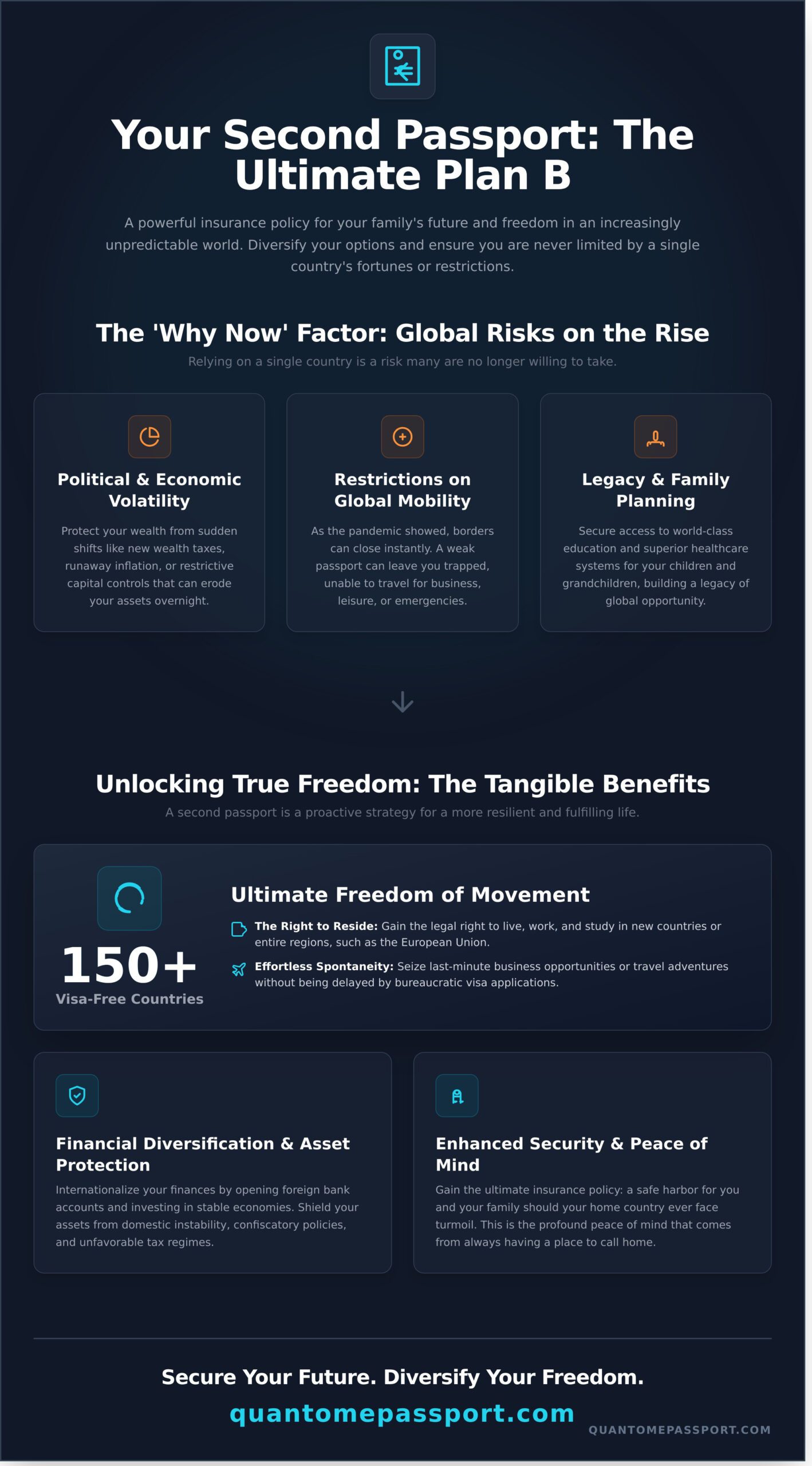
We diversify our financial portfolios to protect against market volatility, so why wouldn’t we do the same for our most valuable asset: our family’s future and freedom? In an increasingly unpredictable world, relying on a single country for your security, wealth, and mobility is a risk many are no longer willing to take. This is where viewing a second passport as a plan b becomes not just a wise consideration, but a fundamental strategy for resilience. It’s far more than a travel document; it’s a powerful insurance policy against the uncertainty that defines our times, offering a safe harbor should your home country ever face political or economic turmoil.
This article is your guide to understanding this ultimate safeguard. We will explore exactly how securing a second citizenship provides the unparalleled security and opportunity you and your family deserve. You’ll discover how it unlocks true global mobility, grants access to more stable economies and superior healthcare, and ultimately delivers the most valuable commodity of all: the profound peace of mind that comes from knowing you always have a place to call home, no matter what the future holds.
Key Takeaways
- Understand why increasing global instability makes relying on a single country a growing risk for your family’s security and freedom.
- Learn how a second passport as a plan b offers more than just visa-free travel; it unlocks new rights, opportunities, and a secure future.
- Discover the surprisingly accessible and fully legal pathways to obtaining a second citizenship that sovereign nations have established.
- Gain a clear framework for strategically choosing the right citizenship program that aligns with your family’s long-term financial and lifestyle goals.
The ‘Why Now’ Factor: Global Uncertainty and the Need for a Plan B
In an era defined by rapid, unpredictable change, the once-solid ground of global stability now feels uncertain. From geopolitical tensions and economic volatility to social unrest in even the most developed nations, the world is sending a clear signal: relying on a single country of citizenship is a risk that global families can no longer afford to ignore. The illusion of permanent stability is fading, replaced by the pragmatic need for a robust backup strategy.
This escalating global instability underscores the urgent need for a proactive solution. This is precisely where a second passport as a plan b transcends being merely a travel document and emerges as the ultimate insurance policy for global citizens. It’s not about abandoning your current home; rather, it’s about strategically expanding your horizons and safeguarding your future. For those seeking practical pathways to this enhanced freedom, Quantome Passport specializes in guiding individuals and families through the complexities of obtaining alternative citizenships. We help you navigate the strategic acquisition of freedom—the freedom to move, to invest, and to protect your family, ensuring your future isn’t dictated by the unpredictable whims of a single government or geopolitical event.
Political and Economic Volatility
Deepening political polarization and the looming threat of new wealth taxes, capital controls, or runaway inflation can erode your wealth and security overnight. A second citizenship offers a powerful hedge, providing a safe haven for your assets and a stable environment for your family. It insulates you from localized turmoil, ensuring that a crisis in one country doesn’t become a crisis for your entire life.
Restrictions on Global Mobility
The COVID-19 pandemic was a stark reminder of how quickly borders can close, trapping citizens and disrupting lives. The strength of your passport directly dictates your freedom of movement for business, leisure, or emergency relocation. A high-ranking second passport ensures you and your family are never confined by a single nation’s travel restrictions, keeping the doors to the world open, no matter what happens.
Legacy and Family Planning
Securing a second passport is one of the most profound investments you can make in your family’s future. It unlocks access to world-class education and healthcare systems for your children and grandchildren. By establishing a legal foundation of multiple citizenship, you are not just gaining a travel document; you are creating a lasting legacy of global access, opportunity, and unshakable security for generations to come.
Unlocking True Freedom: The Tangible Benefits of a Second Passport
While the concept of a contingency plan is wise, the real power of a second passport lies in the immediate, tangible advantages it offers. It moves beyond theory and fundamentally changes your approach to life, business, and personal freedom. This isn’t just another travel document; it’s a key that unlocks a world of opportunities, transforming the idea of a second passport as a plan b into a proactive strategy for a more resilient and fulfilling life. It diversifies your options, ensuring you are never limited by a single country’s fortunes or restrictions.
Ultimate Freedom of Movement
Imagine a world where borders are opportunities, not obstacles. A second passport grants you unparalleled global mobility. This means:
- Visa-Free Travel: Instantly access over 150 countries, including major economic hubs in Europe and Asia, without the hassle of visa applications.
- The Right to Reside: Gain the legal right to live, work, and study in an entirely new country or region, such as the European Union, opening doors to new careers and educational paths for your family.
- Effortless Spontaneity: Seize last-minute business opportunities or embark on spontaneous travel adventures without being delayed by bureaucratic red tape.
Financial Diversification and Asset Protection
A second citizenship is one of the most powerful tools for internationalizing your finances and protecting your wealth. It allows you to open bank accounts and invest in more stable foreign economies, shielding your assets from potential domestic instability, capital controls, or confiscatory policies. Beyond personal banking, many entrepreneurs find the benefits of a second passport extend to creating more resilient business structures, often with access to more favorable tax regimes and global markets.
Enhanced Personal Security and Privacy
In an unpredictable world, personal safety is paramount. A second passport provides a secure safe haven for you and your family to relocate to during times of political unrest, economic crisis, or social instability at home. This is where a second passport as a plan b proves its ultimate worth. Furthermore, it enhances your privacy by allowing you to travel using a different nationality, which can reduce your profile and make you less of a target in certain high-risk regions around the globe.
The Path to a Second Citizenship: How Is It Legally Obtained?
Contrary to popular belief, obtaining a second passport is not a clandestine process reserved for spies and the ultra-wealthy. It is a well-established legal procedure governed by the laws of sovereign nations. For those seeking a second passport as a plan b, understanding these legitimate pathways is the first step toward global mobility and security. Each route offers a different timeline, set of requirements, and unique benefits, allowing you to choose the one that best fits your circumstances.
Fundamentally, there are three primary, lawful routes to acquiring a new citizenship:
Citizenship by Ancestry (Jus Sanguinis)
Your family tree could hold the key to a second passport. Known as jus sanguinis or “right of blood,” this principle allows you to claim citizenship based on your heritage. Many countries, including Ireland, Italy, Poland, and Hungary, offer this path if you can prove descent from one of their citizens. The process involves meticulous documentation, such as birth, marriage, and death certificates, to create an unbroken chain linking you to your ancestor.
Citizenship by Naturalization
This is the most traditional route to citizenship, earned through long-term legal residency. While it requires a significant time commitment, often five to ten years or more, it is a straightforward path for those willing to integrate into a new society. Key requirements typically include:
- Sustained physical presence in the country.
- Passing language proficiency and civics examinations.
- Maintaining a clean criminal record.
- Demonstrating financial self-sufficiency.
Citizenship by Investment (CBI)
For those seeking an accelerated path, Citizenship by Investment (CBI) programs offer a legitimate and efficient solution. These government-sanctioned programs grant citizenship to individuals who make a significant economic contribution to the country. This is often done through a real estate purchase, a donation to a national development fund, or a business investment. As the fastest route, often taking just one to two years, it is an ideal strategy for securing a powerful second passport as a plan b. Explore how investment can secure your EU residency.
How to Choose Your Ideal ‘Plan B’ Country: Key Factors to Consider
Once you’ve committed to the ‘why’ behind securing your family’s future, the next critical step is the ‘where’. Not all passports are created equal, and the most powerful citizenship is one that aligns perfectly with your long-term goals. Choosing the right country is the most important decision you will make when establishing a second passport as a plan b, turning a theoretical safety net into a tangible, powerful asset.
For many, this long-term planning phase also involves exploring potential retirement destinations. If you’re curious about what this lifestyle looks like in practice, you can discover Expat Retirement Chronicles, which offers personal stories and planning guidance for those considering a future in popular expat hubs like Thailand.
To move from concept to reality, evaluate potential countries against a clear set of criteria. This framework will help you compare programs objectively and select the one that offers your family the greatest security and opportunity.
Passport Strength and Visa-Free Access
A passport’s primary value lies in the freedom it grants. Analyze global rankings like the Henley Passport Index to gauge a passport’s power, but look beyond the total number. Prioritize visa-free access to regions most important for your business, travel, or family, such as the EU Schengen Area, the UK, or key economic hubs in Asia. A country with a strong international reputation and stable diplomatic ties ensures your freedom of movement is secure for the long term.
Economic and Political Stability
Your Plan B destination must be a bastion of stability. Look for nations with a proven history of political tranquility, a robust rule of law, and strong protections for private property rights. A predictable and fair legal system is non-negotiable for safeguarding your assets and personal security. Countries within stable blocs like the European Union often provide an excellent benchmark for this, offering economic resilience and a secure regulatory environment.
Program Requirements and Feasibility
The practical details of a citizenship program determine its accessibility. Carefully compare the key variables to find the right fit for your circumstances:
- Investment Type and Threshold: Does the program require a non-refundable donation, a real estate purchase, or another form of investment?
- Application Timeline: How quickly can you and your family expect to receive citizenship and passports? Timelines can range from a few months to several years.
- Residency Requirements: Must you physically reside in the country to maintain your citizenship? Many popular programs have no or very minimal stay requirements.
- Family Inclusion: Ensure the program allows you to include your spouse, dependent children, and sometimes even parents or grandparents in a single application.
Navigating these complex factors requires deep expertise. For a personalized assessment of which country best suits your needs, explore our bespoke citizenship solutions.
Debunking the Myths: The Truth About Second Passports
The idea of a second passport is often clouded by misconceptions shaped by spy movies and headlines. These myths can create unnecessary fear and prevent you from exploring a powerful strategy for personal and financial security. Let’s separate fiction from fact, so you can make a truly informed decision about securing your future.
Myth: ‘It’s Illegal or Shady’
This is the most common and unfounded fear. The reality is that holding dual citizenship is perfectly legal and recognized by most Western nations, including the United States, the UK, and Canada. Furthermore, formal Citizenship by Investment (CBI) programs are legitimate, government-established initiatives designed to attract foreign capital in exchange for citizenship. The process is transparent and regulated. The key is to work with accredited agents and legal experts who navigate the official channels, ensuring every step is compliant and secure.
Myth: ‘You Must Renounce Your Original Citizenship’
The fear of losing your original identity is a significant barrier for many, but it’s largely a myth. The vast majority of countries offering citizenship through investment do not require you to renounce your existing citizenship. You can legally hold two or more passports. Countries that are highly accepting of dual nationality include:
- The United States
- The United Kingdom
- Canada
- Australia
- Most nations within the European Union
This allows you to enjoy the benefits of both nations without having to make an impossible choice.
Myth: ‘It’s Only for the Ultra-Rich or Tax Evaders’
While obtaining a second passport is a significant investment, it’s not exclusively for billionaires. Many programs are accessible to successful professionals, entrepreneurs, and families looking to diversify their assets and opportunities. When you compare the cost to other major life investments like a postgraduate degree or a vacation property, the value proposition of global mobility and lifelong security becomes clear.
The primary motivation for most individuals seeking a second passport as a plan b is not tax evasion, but freedom-the freedom to travel, live, and work where you are treated best. It’s about creating options for your family’s safety and future prosperity. To understand what’s possible for you, we invite you to book a private call to discuss your specific situation.
Your Future-Proof Strategy: From Plan B to Reality
In an era defined by unpredictability, relying on a single citizenship is a gamble you don’t have to take. As we’ve explored, a second passport provides more than just a new travel document; it’s a powerful tool for unlocking global mobility, financial diversification, and ultimate personal freedom. Viewing a second passport as a plan b is the most proactive step you can take to safeguard your family’s future and secure your peace of mind against political and economic instability.
Navigating this journey doesn’t have to be complex. With expert guidance on exclusive routes like the Slovenian EU Residency Program, you can secure a legal pathway to live, work, and travel throughout Europe. We specialize in creating personalized strategies for individuals and families worldwide, turning your aspirations into a concrete reality.
Don’t leave your future to chance. Book a Confidential Strategy Call to Create Your Plan B. The power to build a more secure, free, and resilient life is in your hands. Take the first step today.
Frequently Asked Questions About Your Second Passport
Is it legal to own two passports from different countries?
Yes, holding two passports is legal in many countries and is known as dual citizenship. Nations like the UK, Canada, and most of the EU permit their citizens to hold another nationality. However, some countries have restrictions, so it is crucial to verify the laws of your current country and the one you are considering to ensure you will not be required to renounce your original citizenship.
What is the difference between residency and citizenship?
Residency grants you the legal right to live, work, or study in a country, but it is often conditional and does not grant you a passport. Citizenship, on the other hand, is the highest legal status, granting you full rights, including the right to vote and hold that country’s passport. Residency can be a pathway to citizenship, but citizenship provides a permanent, unconditional connection to the nation.
Will I have to pay taxes in my new country of citizenship?
Tax obligations depend entirely on the new country’s laws. Many nations only tax residents on income earned within the country, while others (like the U.S.) tax citizens on their worldwide income regardless of where they live. It is essential to consult with an international tax expert to understand the tax implications of both countries and to structure your affairs to avoid double taxation.
How long does it take to get a second passport?
The timeline varies significantly depending on the path you take. Citizenship by Investment (CBI) programs are the fastest, with processing times often ranging from just 3 to 6 months. In contrast, obtaining citizenship through naturalization based on residency is a much longer process, typically requiring you to live in the country for 5 to 10 years or more before you become eligible to apply.
Can my family get second passports along with me?
Yes, most citizenship programs allow the main applicant to include their family. This typically covers a spouse, dependent children, and in many cases, dependent parents and even grandparents. Each program has specific rules and additional fees for including family members, so it is important to verify the eligibility criteria for all your dependents before applying to ensure everyone can be included in your application.
What is the easiest and fastest way to get a second passport?
By far, the fastest and most straightforward route is through a Citizenship by Investment (CBI) program. These programs allow you to legally acquire a second passport as a plan b in exchange for a significant economic contribution, such as a real estate purchase or a donation to a government fund. This path bypasses the lengthy residency requirements associated with traditional naturalization, offering a direct route to citizenship.
Which countries offer the best Citizenship by Investment programs?
The “best” program depends on your individual goals. Caribbean nations like St. Kitts & Nevis, Grenada, and Dominica are popular for their speed, affordability, and excellent visa-free travel benefits. For those seeking EU access, Malta offers a premium option. Other countries like Turkey provide a strategic location and a strong passport through a real estate investment. Evaluating your priorities will help determine the ideal program for you.