
Since Brexit, the path to becoming a British citizen can feel like navigating a complex maze. If you’re an EU, EEA, or Swiss national living in the UK, you’re likely wrestling with questions about your long-term status and the intricate process of securing uk citizenship for eu citizens. The fear of complex paperwork, bureaucratic hurdles, and making a costly mistake on your application can be overwhelming, leaving you uncertain about where to even begin.
This guide is designed to be your definitive roadmap, turning that uncertainty into confidence. We will cut through the confusion and provide a clear, actionable plan to turn your goal into a reality. We will walk you through the entire journey, step by step, from verifying your eligibility under the EU Settlement Scheme to preparing for your ceremony. You’ll gain a complete understanding of the exact requirements, timelines, and costs involved, empowering you to secure your future in the United Kingdom.
The Post-Brexit Landscape: What’s Changed for EU Citizens?
The United Kingdom’s departure from the European Union fundamentally changed the rules for EU, EEA, and Swiss citizens wishing to live, work, and eventually settle in the UK. The era of Freedom of Movement, which allowed citizens from member states to reside in the UK with minimal formalities, officially ended on 31 December 2020. This shift marked the most significant change in immigration policy in decades, creating a new pathway that must be navigated correctly for those aspiring to attain uk citizenship for eu citizens.
To understand the new requirements, it’s helpful to see a breakdown of the current system. This short video offers a clear overview:
From Freedom of Movement to the Points-Based System
Before Brexit, EU citizens could enter the UK, find employment, and access public services with their national ID or passport. Now, they are subject to UK immigration rules, similar to non-EU nationals. This new framework is governed by a points-based system and the broader principles of British nationality law. To protect the rights of those already living here, the government introduced the EU Settlement Scheme (EUSS). While the main deadline to apply was 30 June 2021, the scheme remains central to the citizenship journey for eligible individuals.
Understanding the EU Settlement Scheme (EUSS)
The EUSS was designed to grant a secure immigration status to EU, EEA, and Swiss citizens (and their eligible family members) who were resident in the UK by 31 December 2020. Securing status under this scheme is the foundational step towards naturalisation. It is crucial to understand that EUSS grants residency rights, not citizenship itself. Although the primary deadline has passed, the Home Office may still accept late applications if you have “reasonable grounds” for not applying on time.
Settled Status vs. Pre-Settled Status: Key Differences
The EUSS grants one of two types of status, each with different implications for your path to citizenship. Understanding the distinction is vital for planning your future in the UK.
- Pre-Settled Status: This is typically granted to applicants who had lived in the UK for a continuous period of less than five years. It is a temporary status, valid for five years, during which you must continue residing in the UK to later qualify for Settled Status.
- Settled Status: Also known as indefinite leave to remain, this is granted to those who have lived in the UK for a continuous period of five years or more. Settled Status is a permanent residency right and is the essential milestone you must reach before you can apply for British citizenship.
For most EU citizens, achieving Settled Status is a non-negotiable prerequisite before beginning the citizenship application process.
The Core Pathway: How to Get Citizenship via Settled Status
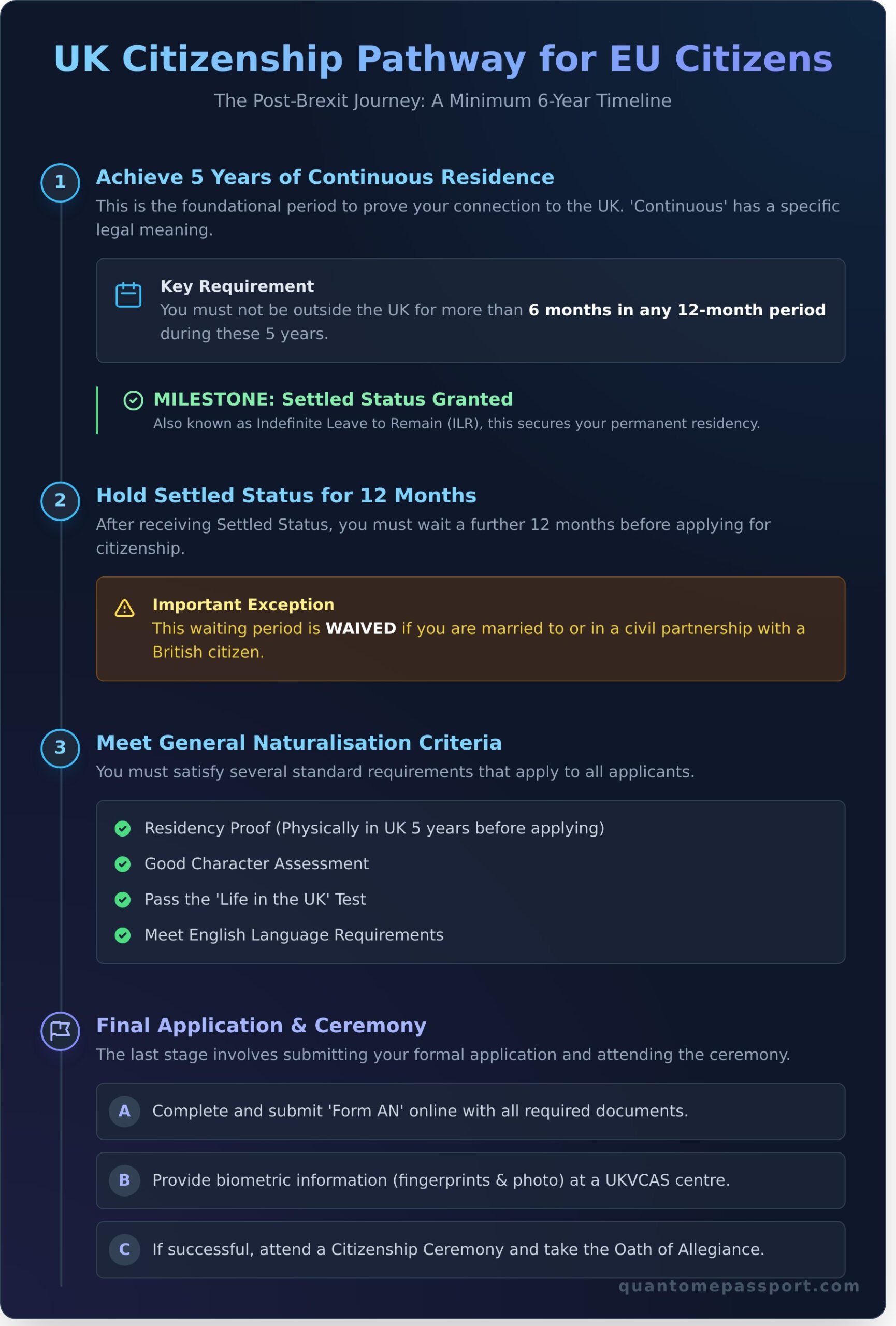
For the vast majority of EU, EEA, and Swiss citizens living in the UK, the route to becoming a British national is a formal process called naturalisation. It’s crucial to understand that this is not an automatic right but a structured journey that requires a successful application. This pathway, from arriving in the UK to attending your citizenship ceremony, typically takes a minimum of six years to complete.
The entire process for achieving uk citizenship for eu citizens is built upon a foundation of long-term, lawful residence. Let’s break down the key stages involved.
Step 1: Achieving Settled Status (Indefinite Leave to Remain)
Your first major milestone is securing Settled Status under the EU Settlement Scheme. This is a form of Indefinite Leave to Remain (ILR), granting you the right to live, work, and study in the UK without time limits. To be eligible, you must have lived in the UK for a continuous 5-year period. ‘Continuous residence’ generally means you have not been outside the UK for more than 6 months in any 12-month period during those 5 years.
Step 2: The 12-Month Waiting Period After Settled Status
Once you have been granted Settled Status, a clock starts. You must hold this status for at least 12 months before you can apply for British citizenship. This period serves to demonstrate your ongoing commitment and stable connection to the UK. There is a significant exception: if you are married to or in a civil partnership with a British citizen, you do not need to wait for these 12 months and can apply as soon as you receive Settled Status.
Step 3: Meeting the General Naturalisation Requirements
After the waiting period, you must meet the standard requirements for naturalisation that apply to all applicants. This is a critical phase where your application is scrutinised. Before proceeding, it is wise to use the official government portal to Check your eligibility for British citizenship and understand your position. The core criteria include:
- Residency: You must prove you were physically in the UK exactly 5 years before the day the Home Office receives your application and meet limits on absences.
- Good Character: A comprehensive check of your background, including any criminal record or immigration breaches.
- Knowledge of the UK: You must pass the Life in the UK Test.
- Language Skills: You must prove you meet the English language requirement.
Step 4: The Application and Citizenship Ceremony
The final stage is the application itself. You will complete and submit ‘Form AN’ online, providing extensive documentation to support your case. As part of the process, you will be required to attend an appointment at a UK Visa and Citizenship Application Services (UKVCAS) centre to provide your biometric information (fingerprints and a photo). If your application is successful, the last step is to attend a citizenship ceremony, where you will take an Oath of Allegiance and officially become a British citizen.
Naturalisation Requirements: A Detailed Checklist for Applicants
Transitioning from settled status to full British citizenship involves meeting a strict set of legal requirements. This checklist breaks down each criterion to help you prepare a robust application. We strongly advise gathering the necessary documents for each point well in advance. While this guide provides a detailed overview, you should always consult the Official government guidance on citizenship for the most current rules and regulations.
Residency & Absences: Proving Your Continuous Presence
The Home Office needs to see that the UK is your established home. To prove this, you must demonstrate continuous residency, and the rules are very specific. Keep meticulous records of all travel outside the UK.
- 5-Year Period: You must have been physically present in the UK exactly five years before the date your application is received.
- Total Absences: Your total time spent outside the UK during this five-year period cannot exceed 450 days.
- Final Year Absences: In the final 12 months, your absences cannot exceed 90 days.
The ‘Good Character’ Requirement: What Does It Mean?
This is a crucial and often subjective assessment by the Home Office. It covers your entire background, including criminal records, immigration history, and financial soundness (e.g., bankruptcy). You must declare all criminal convictions, cautions, and fixed penalty notices, including driving offences. A failure to disclose, even for minor issues, can lead to an automatic refusal. This is a cornerstone of the application for uk citizenship for eu citizens and is taken very seriously.
Passing the ‘Life in the UK’ Test
This computer-based test assesses your knowledge of British traditions, history, values, and customs. It consists of 24 multiple-choice questions based on the official handbook. You must book your test at an approved centre, and the current fee is £50 per attempt. Passing this test is mandatory before you can submit your naturalisation application, so prepare thoroughly.
Proving English Language Proficiency
Unless you are under 18 or over 65, you must prove you have sufficient knowledge of the English language. You can meet this requirement in two primary ways:
- Pass a Secure English Language Test (SELT) from an approved provider at a minimum of B1 level on the Common European Framework of Reference for Languages (CEFR) scale.
- Hold a degree-level academic qualification that was taught or researched in English. A degree from a UK university automatically qualifies.
Alternative Routes and Special Circumstances
While the path through the EU Settlement Scheme (EUSS) is the most common route, it is not the only one. Your personal circumstances, such as your marital status or ancestry, can significantly alter the requirements. Understanding these exceptions is crucial for finding the most direct route to uk citizenship for eu citizens. It is important to note, however, that these are not shortcuts; they are distinct legal pathways with their own strict criteria.
The Spousal Route: Married to a British Citizen
If you are an EU citizen married to or in a civil partnership with a British citizen, you may qualify for an accelerated naturalisation process. The main advantage is a shorter residency requirement. Instead of the standard five years, you only need to prove three years of lawful residence in the UK. Furthermore, the requirement to hold Indefinite Leave to Remain (or Settled Status) for 12 months before applying is waived.
You can apply as soon as you receive your Settled Status, provided you meet the three-year residency rule. However, all other standard requirements still apply, including:
- Passing the Life in the UK Test
- Proving your English language ability
- Meeting the “good character” requirement
UK Citizenship by Descent: Do You Have British Ancestry?
Citizenship by descent is entirely separate from naturalisation and is unaffected by Brexit. This route applies if you were born outside the UK but one of your parents was a British citizen at the time of your birth (other than by descent themselves). This is an automatic claim to citizenship, not an application based on residency. If you believe you qualify, you will typically apply for your first British passport as proof of your nationality.
The Special Case for Irish Citizens
Thanks to the long-standing Common Travel Area (CTA) agreement, Irish citizens hold a unique position in UK immigration law. They are considered settled in the UK from the day they arrive and do not need to apply through the EUSS to secure their status. For citizenship purposes, Irish citizens can apply for naturalisation after five years of continuous residence in the UK, just like non-EU nationals, without needing to hold Settled Status first.
Navigating these specific rules can be complex. For personalised advice on the best path for your situation, explore the expert services at quantomepassport.com.
UK vs. EU Citizenship: A Strategic Comparison
You have navigated the practical steps, but the final decision is a strategic one. Securing uk citizenship for eu citizens solidifies your future in the UK, but it’s essential to understand the trade-offs-particularly the loss of EU Freedom of Movement that came with your original passport. Let’s compare the two to help you plan your next steps.
Benefits of UK Citizenship Post-Brexit
Gaining British citizenship provides ultimate security and integration in the United Kingdom. You are no longer subject to immigration rules and can enjoy the full rights of a citizen, including:
- Unrestricted Right to Reside: Live, work, and study in the UK indefinitely without any visa restrictions.
- Political Participation: Gain the right to vote in all UK general elections and referendums.
- British Passport: Hold one of the world’s most powerful passports for global travel.
- Freedom from Controls: Permanently end your relationship with the Home Office and immigration controls.
The Power of an EU Passport: Regaining Freedom of Movement
While a British passport opens many doors, your EU passport holds a unique power: unrestricted access to 27 countries. This includes the right to live, work, and retire across the bloc, access the EU single market for business, and benefit from consular protection from any EU member state when travelling abroad. For many, losing this is a significant consideration.
Is Dual Citizenship Your Best Option?
The ideal solution is not a choice but a combination. The UK government permits dual citizenship, allowing you to hold both a British and an EU passport. This ‘best of both worlds’ approach grants you full rights in the UK and retains your Freedom of Movement across Europe. However, you must confirm that your EU country of origin also allows dual nationality, as rules vary significantly.
Exploring Alternative EU Residency and Citizenship
What if your home country restricts dual citizenship? Or what if you simply want to maximize your global access? Strategic residency-by-investment programs offer a powerful alternative. Pathways in countries like Slovenia can provide a clear route to a new EU passport, restoring your European mobility. This forward-thinking strategy ensures you and your family have ultimate freedom and security.
Understanding which path aligns with your long-term goals is complex. Book a private strategy call with our experts to explore your global citizenship options and build a bespoke plan.
Your Next Chapter: Securing British Citizenship Post-Brexit
Navigating the path to British citizenship after Brexit requires a clear understanding of the new landscape. The journey is far from impossible, but it demands careful planning. The key takeaway is that achieving Settled Status is the foundational step for most, followed by meticulously meeting the strict naturalisation requirements, from residency periods to the ‘good character’ test. While the process is detailed, you don’t have to navigate it alone.
Securing uk citizenship for eu citizens is a strategic decision that solidifies your long-term future, and expert guidance can transform a complex application into a clear, manageable plan. Our team offers personalised strategies for individuals and families, backed by in-depth knowledge of European mobility pathways.
Ready to take the next step with confidence? Schedule a Private Strategy Call to Plan Your Global Future and turn your British citizenship goals into a reality. Your new chapter awaits.
Frequently Asked Questions
Can I hold dual citizenship with the UK and my EU country?
Yes, the UK government permits dual nationality, so you will not be asked to renounce your original citizenship. However, you must also check the laws of your EU home country. While most EU nations like France, Italy, and Poland allow dual citizenship, others may have restrictions or specific conditions. It is essential to confirm with your country’s consulate or embassy before you begin the application process to avoid any unforeseen complications with your original passport.
How long does the entire UK citizenship process take for an EU citizen?
After you submit your application and provide your biometric information, you can typically expect a decision from the Home Office within six months. If your application is successful, you must then book and attend a citizenship ceremony, which usually takes place within three months of your approval. Therefore, the entire process, from application to ceremony, generally takes between six to nine months. Complex cases or periods of high application volume can sometimes extend this timeline.
What are the total costs for applying for British citizenship?
The total cost is composed of several fees. The main application fee for naturalisation is £1,580 (as of 2024). In addition, you must pay for the mandatory Life in the UK Test, which costs £50. If you need to prove your English language ability, the B1 SELT test fee is typically around £150. Finally, there is a fee for the citizenship ceremony, which is £80. Be sure to budget for all these components when planning your application.
Do I lose my rights under the EU Settlement Scheme if my citizenship application is refused?
No, a refusal of your British citizenship application does not affect your status under the EU Settlement Scheme (EUSS). Your Pre-Settled or Settled Status remains valid, and you retain your right to live, work, and study in the UK under the terms of that scheme. The citizenship application is entirely separate from your EUSS rights, so you will not be at risk of losing your residency if your naturalisation attempt is unsuccessful for any reason.
Is the UK citizenship process harder for EU citizens after Brexit?
The core requirements for citizenship-such as the residency period, good character, and passing the necessary tests-are the same for all applicants, including EU citizens. However, Brexit introduced a mandatory preliminary step. The path to UK citizenship for EU citizens now requires first securing Indefinite Leave to Remain, which for most is achieved by holding Settled Status under the EUSS for at least 12 months. This adds an extra stage to the overall journey that did not exist before.
What happens if I was outside the UK for more than the allowed number of days?
The standard residency requirement is that you must not have been absent from the UK for more than 450 days in the five years before applying, and no more than 90 days in the final 12-month period. If you exceed these limits, your application may be refused. The Home Office has some discretion for excess absences due to compelling professional or compassionate reasons, but this is not guaranteed. It is highly advisable to seek legal advice if you have exceeded the absence limits.
Do my children automatically become British citizens if I do?
No, your children do not automatically become British citizens when you naturalise. A child born in the UK after you have obtained Settled Status is generally born a British citizen automatically. However, children born in the UK before you had Settled Status, or those born outside the UK, will need to be registered separately. This is a different application process with its own requirements and fees. It is a common misconception that their status changes with yours.