
Dreaming of an EU passport but feeling lost in a labyrinth of 27 different rulebooks? The path from residency to citizenship in the EU can feel overwhelming, clouded by confusing terms, uncertain timelines, and worries about hidden requirements like language exams. It’s easy to feel stuck between temporary status, permanent residency, and the ultimate goal of citizenship, unsure of the next step or how long it will all take.
Consider this your definitive 2026 roadmap. We are here to demystify the entire journey, breaking down the process chronologically from your first day as a resident to the moment you become a full EU citizen. In this guide, you’ll gain a realistic understanding of the time and commitment involved, learn about the key milestones and common requirements you need to prepare for, and feel empowered to navigate your future with clarity and confidence.
Key Takeaways
- Understand the three essential stages of becoming an EU citizen-temporary residency, permanent residency, and naturalization-to strategically plan your journey.
- Discover the critical integration requirements you must meet during your 5-10 year residency period to successfully qualify for naturalization.
- The total path from residency to citizenship in eu varies significantly by country; compare timelines to see which nation best fits your long-term goals.
- Explore how Residency by Investment programs can offer a more predictable and structured route to an EU passport, bypassing common uncertainties.
Understanding the Three Key Milestones: Temporary, Permanent, and Citizenship
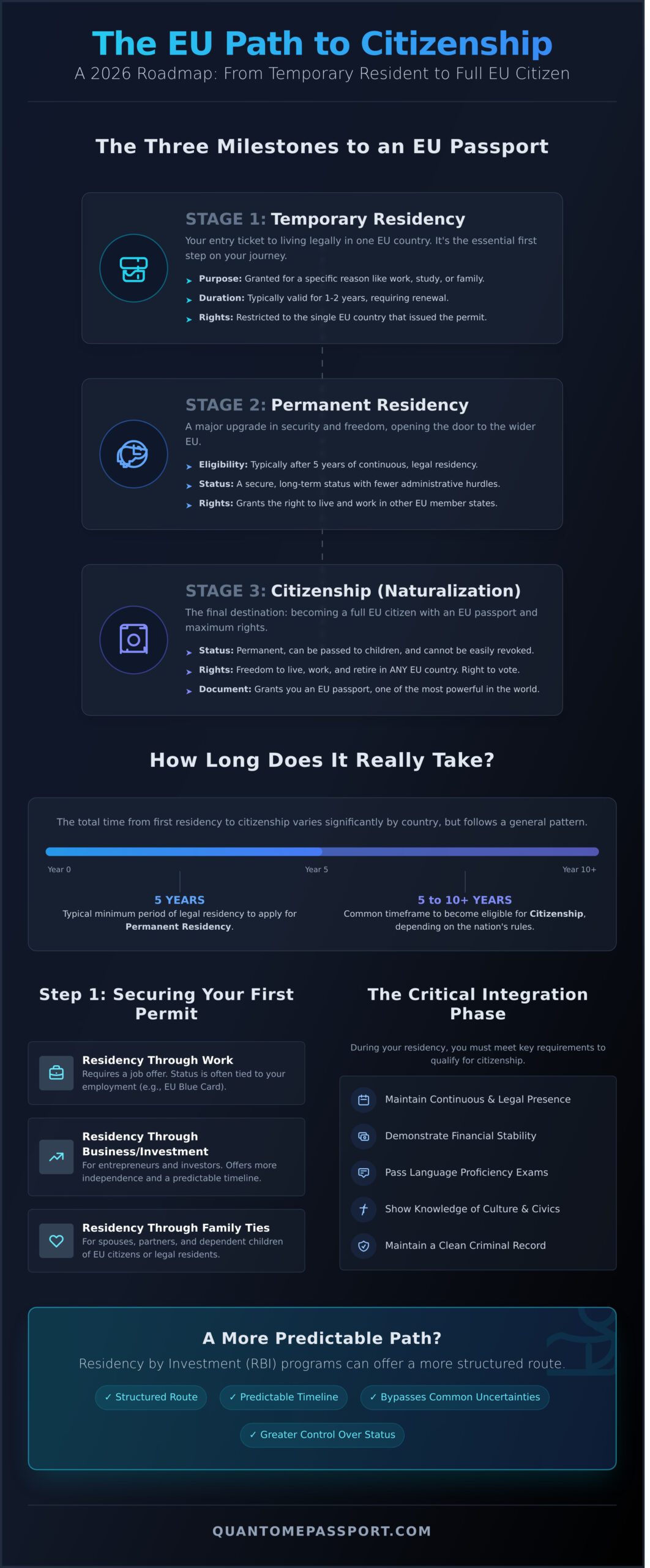
Embarking on the path from residency to citizenship in EU countries is a structured journey with distinct, progressive stages. Think of it as climbing a ladder: each rung you ascend grants you more rights, greater stability, and increased freedom. For non-EU nationals, this progression moves from a temporary legal status to a secure, long-term one, and finally, to the ultimate goal of full citizenship. Understanding these three key milestones-Temporary Residency, Permanent Residency, and Citizenship-is the first and most crucial step in planning your future in Europe.
To better understand this journey, this short video provides a helpful overview of the main pathways:
Stage 1: Temporary Residency
A temporary residence permit is your entry ticket to living legally in a specific EU country. It is almost always the first step for anyone moving from outside the EU. These permits are typically granted for a specific purpose, such as employment, study, or family reunification, and are valid for one to two years before requiring renewal. During this stage, your rights to work and live are generally restricted to the single EU country that issued your permit.
Stage 2: Permanent Residency (Long-Term EU Residence)
After maintaining a continuous and legal presence in an EU country for five years, you can typically apply for permanent residency. This is a significant upgrade, offering much greater security and fewer administrative burdens. This status is largely harmonized across the bloc under the EU Long-Term Residence Directive, which grants holders the right to live and work in other EU member states. Achieving permanent residency is the critical stepping stone that opens the door to citizenship eligibility.
Stage 3: Citizenship
Citizenship is the final destination. By becoming a citizen of an EU member state through a process called naturalization, you become a full EU citizen. This grants you the ultimate set of rights, including an EU passport, the freedom to live, work, and retire in any EU country without restriction, and the right to vote in local and European elections. This status is permanent, cannot be easily revoked, and can be passed down to your children, securing their future as EU citizens.
Step 1: Securing Your Initial EU Residency Permit
Your journey begins here. Securing your first residency permit is the foundational step on the path from residency to citizenship in eu. This is not a one-size-fits-all process; the reason you are moving to Europe directly determines the type of permit you will apply for. Each pathway comes with its own set of rules, documentation, and processing times. Understanding these common routes is crucial for starting your application on the right foot.
Below are the three primary avenues non-EU citizens use to gain legal residence.
Residency Through Work
This is a popular route for non-EU nationals, typically requiring a confirmed job offer from a company within an EU member state. Common permits include those for local hires, intra-company transfers for multinational employees, or the highly sought-after EU Blue Card for skilled professionals. While widely accessible, be aware that your residency status is often directly tied to your employment, which can limit your flexibility.
Residency Through Business or Investment
For entrepreneurs and investors, this pathway offers greater independence. It involves starting a business, registering as self-employed, or making a significant capital investment into a country’s economy. This route often provides a more structured and predictable timeline for long-term settlement, granting you more control over your status as you are not dependent on an employer. Explore how a business investment can secure your EU residency.
Residency Through Family Ties
If you have close family in the EU, this may be your most direct option. This category generally applies to spouses, registered partners, and dependent children of EU citizens or legal residents. In some cases, it can extend to dependent parents. You will need to provide official documentation proving the family relationship and, often, evidence of financial dependency. The specific rules and rights granted can vary significantly between member states.
While these three avenues represent the most common entry points, the nuances of each country’s immigration laws are critical. The requirements for how long you must hold residency before being eligible for citizenship, for example, can differ substantially. A comparative overview of EU naturalization requirements shows just how much these rules diverge. Successfully navigating your initial application sets a strong foundation for the entire path from residency to citizenship in eu.
The Integration Phase: Maintaining Residency and Moving Towards Citizenship
Once you’ve secured your initial residence permit, you enter the longest and most critical stage of your journey. This integration phase, typically lasting between five and ten years, is where you transition from a temporary resident to a prospective citizen. It’s less about paperwork and more about actively demonstrating your commitment to your new home country. Successfully navigating this period is fundamental to the path from residency to citizenship in EU nations, as failure to meet these ongoing requirements can reset your timeline or even lead to the non-renewal of your permit.
The Physical Presence Requirement
Most EU countries mandate a minimum period of physical presence to maintain your residency status. This isn’t about being a tourist; it’s about making the country your primary home. While rules vary, a common benchmark is that you cannot be absent for more than 6-10 months cumulatively over a five-year period. Diligently tracking your travel dates and keeping records like flight tickets and passport stamps is crucial to prove you meet this continuous residency obligation.
Financial Self-Sufficiency and Clean Record
Throughout your residency, you must prove you can support yourself and any dependents without relying on the state’s social welfare system. This means providing evidence of stable income, whether from employment, a business, or sufficient personal funds. Equally important is maintaining a clean criminal record. Any serious offense can immediately disqualify you from renewal and citizenship, making this a non-negotiable aspect of your integration.
Language and Civic Integration
Demonstrating cultural integration is a key step on the path from residency to citizenship in EU countries. This almost always involves proving your connection to the society through language and civic knowledge. Common requirements include:
- Passing a language proficiency test, often at an A2 or B1 level on the Common European Framework of Reference for Languages (CEFR).
- Successfully completing an exam on the country’s history, political system, and cultural values.
- Attending mandatory integration courses in some member states, which cover local customs and laws.
The Final Step: Applying for Citizenship via Naturalization
After years of legal residency and successful integration, you have reached the final milestone. Applying for citizenship through naturalization is the formal, legal process that transforms your status from a foreign resident to a full citizen of an EU member state. This is the culmination of your journey, but it requires precision and patience. The administrative processing of a well-prepared application can take anywhere from 12 to 24 months, or sometimes longer, depending on the country and individual case complexity.
Success at this stage hinges on submitting a flawless application. Any missing documents, incorrect translations, or incomplete forms can lead to significant delays or even outright rejection, setting you back years. Meticulous preparation is not just recommended; it’s essential for a smooth conclusion to your path from residency to citizenship in EU.
Gathering Your Documentation
Your application is a comprehensive file proving you meet all legal requirements for citizenship. While the exact list varies by country, most will demand a core set of documents, all of which must be recent, officially translated, and often certified with an Apostille. Key items include:
- Personal Identity: Your original birth certificate and a valid passport from your country of origin.
- Residency History: All previous and current residency permits to prove continuous and legal stay.
- Financial Stability: Recent tax returns, employment contracts, or bank statements to demonstrate self-sufficiency.
- Integration Proof: Certificates from your language proficiency and civic knowledge exams.
- Clean Record: A criminal record certificate from your home country and your country of EU residence.
The Application and Interview Process
Once your dossier is complete, you will submit it to the designated government body, typically the Ministry of Justice or Interior. An official will review the file for completeness, and you will likely be invited for a formal interview. This meeting serves to verify the information in your application, assess your motivations, and confirm your language skills. If your application is approved, the final step in the entire path from residency to citizenship in EU is attending an oath-taking or citizenship ceremony, where you formally pledge allegiance and receive your naturalization certificate.
Dual Citizenship Considerations
A critical factor to consider is whether you can keep your original nationality. EU countries have differing stances on dual citizenship. Some nations, such as Portugal, Ireland, Italy, and Sweden, are generally permissive, allowing you to hold multiple passports. However, others may require you to renounce your prior citizenship as a condition of naturalization. Countries like Spain, the Netherlands, and Austria often have restrictive policies. Germany has recently liberalized its laws, but it’s crucial to verify the current regulations. Always investigate the specific laws of both your target EU country and your country of origin before applying.
How Long Does It Really Take? A Comparative Overview
One of the most critical questions for any aspiring European citizen is, “How long will this take?” While online articles often quote minimum residency periods, the reality is a multi-year journey involving legal residency, integration, and bureaucratic processing. Understanding the true timeline is essential for managing expectations and planning your future.
It’s crucial to remember that the timelines listed are minimums. Application backlogs, complex personal circumstances, and administrative delays can add months or even years to the process. The total time from your first residency permit to holding a new passport is almost always longer than the statutory residency period.
Standard Timelines (5-8 Years)
A significant number of EU countries have set their minimum residency requirement at five years. Nations like Portugal, Ireland, and France fall into this category. After fulfilling five years of continuous and legal residency, you become eligible to apply. However, factoring in the 1-3 years it typically takes to process the citizenship application itself, the realistic total timeline is closer to 6-8 years. These countries also have clear integration requirements, such as language proficiency and a clean criminal record.
Longer Timelines (8-10+ Years)
Other major EU economies traditionally require a longer commitment. Spain generally mandates 10 years of residency before you can apply for citizenship, although notable exceptions exist for citizens of Ibero-American countries. Italy also requires 10 years for most non-EU nationals. Until recently, Germany required 8 years, but recent legislation has reduced this to 5 years, and even 3 for applicants who demonstrate exceptional integration.
Timeline Comparison at a Glance:
- Portugal: 5 years residency + 1-2 years processing
- Ireland: 5 years residency + 1-2 years processing
- Spain: 10 years residency + 1-2 years processing (standard path)
- Germany: 5 years residency + ~1 year processing (can be reduced to 3)
- Slovenia: 10 years residency + 1-2 years processing (standard path)
A Note on Slovenia
Slovenia’s standard path to citizenship requires 10 years of continuous residency, placing it among the longer timelines in the EU. However, for certain individuals, particularly those making a significant economic contribution, the country offers a more structured, albeit demanding, framework. This alternative can provide a clearer, more predictable route for those who qualify, turning a long-term goal into a strategic objective.
Ultimately, the path from residency to citizenship in eu is a marathon, not a sprint. Each country’s timeline is a complex equation of legal requirements and administrative realities. Navigating these timelines effectively requires deep knowledge and strategic planning. For a personalized assessment of the most efficient route based on your unique profile, exploring tailored solutions can provide invaluable clarity.
Is There a More Predictable Path? The Role of Residency by Investment
The traditional journey to EU citizenship, while rewarding, can often be long and filled with uncertainty. Relying on employment, family ties, or other conventional routes can involve years of navigating complex bureaucracy with no guaranteed outcome. For individuals and families seeking greater control and clarity, there is an alternative: Residency by Investment (RBI).
This approach doesn’t offer a shortcut to a passport, but it provides a structured, legally defined foundation for the path from residency to citizenship in eu. It’s about starting your journey on solid ground, with a clear roadmap from the very beginning.
What is Residency by Investment?
Residency by Investment programs allow foreign nationals to obtain a residence permit in an EU country in return for a qualifying economic contribution. Instead of depending on a job offer or ancestry, you secure your legal status by investing in the country’s economy-for example, through real estate acquisition, business creation, or capital investment. This route effectively streamlines the critical first step of securing residency, setting a predictable course for the years ahead.
Key Benefits for Your Citizenship Journey
Opting for an investment-based route offers distinct advantages that directly impact your long-term citizenship goals. By securing residency through a formal investment program, you gain a level of certainty that other pathways often lack. This strategic first step makes the entire path from residency to citizenship in eu significantly more manageable.
Key benefits include:
- A Clear, Legally Defined Pathway: Investment programs operate on clear, published legal frameworks. You know the requirements, timelines, and obligations from day one.
- Greater Stability for You and Your Family: Most programs allow for the inclusion of immediate family members, ensuring everyone has a secure legal status as you work towards citizenship.
- Potential for Flexibility: Some investment-based residency schemes offer more lenient physical presence requirements, providing greater freedom for international business professionals and their families.
Understanding if this strategic route aligns with your personal and financial goals is the critical first step. Book a private strategy call to see if an investment path is right for you.
Your European Future Awaits: Charting Your Course to Citizenship
Embarking on the journey to European Union citizenship is a significant undertaking, but it’s a well-defined one. As we’ve explored, the process progresses through key milestones-from securing temporary residency to achieving permanent status and, finally, applying for citizenship. Understanding these stages and each country’s unique integration requirements is fundamental to successfully navigating the path from residency to citizenship in eu. While traditional routes require patience, options like residency by investment can offer a more predictable timeline for your goals.
The intricacies of this process can be daunting, but you don’t have to navigate them alone. Quantome Passport provides expert guidance on legal pathways to EU residency. Specializing in structured investment-based programs, our team develops personalized strategies for individuals and families to ensure a smooth and efficient journey. Ready to start your EU journey? Discover your pathway with Quantome Passport. Your dream of holding an EU passport is closer than you think. Take the first confident step today.
Frequently Asked Questions
Can I work in other EU countries while I am a temporary resident in one?
Generally, no. A temporary residence permit from one EU country does not automatically grant you the right to work in another. Your work rights are typically restricted to the nation that issued your permit. To work in a different EU country, you would usually need to secure a separate work visa or permit for that specific nation. The full freedom of movement to live and work across the EU is a benefit reserved for EU citizens and, in some cases, long-term residents.
Do I have to give up my original citizenship to become an EU citizen?
This depends entirely on the laws of both the EU country you are naturalizing in and your country of origin. Some EU nations, like Germany and Ireland, generally permit dual citizenship. Others, such as Spain or the Netherlands, may require you to renounce your previous nationality, although exceptions can apply. It is crucial to verify the specific dual citizenship policies of both countries involved before you begin the application process to avoid any unwelcome surprises.
What is the ‘continuous residency’ rule and how do absences affect it?
Continuous residency means you have lived in the country without significant interruptions. Most EU countries have strict rules on absences. For example, to qualify for long-term residency, you might be allowed absences of no more than six consecutive months and a total of ten months over a five-year period. Exceeding these limits can “break” your continuity, forcing you to restart the clock on your residency requirement. This is a critical step on the path from residency to citizenship in EU nations.
What are the most common reasons a citizenship application is rejected?
The most common reasons for rejection include failing to meet the continuous residency requirement, not passing the mandatory language or civic integration exams, and having a criminal record. Other frequent issues are insufficient financial stability or submitting an application with incomplete, inaccurate, or fraudulent documentation. Ensuring every detail is correct and all requirements are met before submission is vital for a successful outcome and a smooth path from residency to citizenship in eu.
Is the path to citizenship faster if I marry an EU citizen?
Yes, marrying an EU citizen typically accelerates the timeline for citizenship, but it is not an instant grant. Most countries reduce the standard residency requirement for spouses. For instance, instead of needing to reside in a country for five or ten years, the requirement might be shortened to three years. However, you will still need to meet all other conditions, such as language proficiency, integration tests, and demonstrating a genuine and continuing marital relationship.
Do my children automatically become citizens if I do?
Not always. The rules depend on the child’s age, place of birth, and the specific country’s laws. Minor children who reside with you in the country when you naturalize can often be included in your application or acquire citizenship shortly after you do. However, adult children or children born and living outside the EU will typically need to qualify for residency and citizenship on their own merits, as they are not automatically covered by your naturalization.