
Dreaming of European residency but daunted by the complex and often opaque price tag? You see a headline figure for a Golden Visa, but what about the government processing fees, legal costs, and other expenses that can quickly inflate the final price? Navigating the true investment visa europe cost can feel like trying to solve a puzzle with missing pieces, making it nearly impossible to compare a real estate purchase in Portugal to a fund investment in Greece and know which path offers the best value for your future.
That confusion ends today. We’ve created this complete 2026 breakdown to provide the transparency you deserve. In this guide, we pull back the curtain on Europe’s most sought-after investment visa programs, offering a clear, apples-to-apples comparison of the total financial commitment. You’ll get a detailed look at every potential fee-from the minimum investment to due diligence, application charges, and legal services-empowering you to make a financially sound decision with absolute confidence.
Key Takeaways
- Look beyond the advertised minimum investment; our guide reveals the hidden government, legal, and processing fees that determine your true total outlay.
- Compare Europe’s top Golden Visa programs side-by-side to see which offers the most favorable financial terms and overall value for 2026.
- Your final investment visa europe cost is not fixed; learn how factors like family size and investment type can significantly raise or lower your expenses.
- Discover cost-effective alternatives to traditional real estate investments, such as Slovenia’s unique business-focused residency program.
Understanding the True Cost: Investment vs. Total Outlay
When exploring European residency by investment, the advertised minimum investment is just the starting point. Many prospective applicants are surprised by the additional expenses that constitute the total financial commitment. Budgeting accurately for the full investment visa europe cost is the first and most critical step toward a successful application. This section breaks down every fee you will encounter, distinguishing between recoverable investments and non-refundable sunk costs.
These residency routes are part of a global landscape of Immigrant investor programs offering various paths to residency and citizenship. The true cost of any program is a combination of the core investment and several layers of mandatory fees.
The Core Investment Amount
This is the largest component of your outlay and often the most flexible. Your choice will determine whether your capital is recoverable. Options typically include:
- Real Estate Purchase: A popular option that can provide rental income and potential appreciation. However, it comes with property taxes, and transaction fees.
- Capital Investment/Business Formation: An entrepreneurial path requiring investment in a new or existing European company. This is a higher-risk, higher-reward option.
- Government Bonds: A secure, low-risk investment where you lend money to the government. The capital is returned after a set period (e.g., five years), but with minimal to no interest.
- Donations: A non-recoverable contribution made directly to a national development fund. This is a pure sunk cost but often represents the fastest path.
Mandatory Government and Application Fees
These non-refundable fees are required by the host country to process your application. They are a fixed part of the total investment visa europe cost and cover the state’s administrative expenses. Key fees include:
- Due Diligence Fees: Charges for extensive background checks on the main applicant and any dependents.
- Application Processing Fees: A standard administrative fee paid upon submission of your file.
- Residence Permit Issuance Fees: A final fee paid to receive your physical residence card upon approval.
Essential Professional Service Costs
Navigating the complex legal framework of a Golden Visa application is nearly impossible without expert help. These costs are a necessary investment to ensure your application is seamless and successful. You should budget for:
- Legal Advisory Fees: For immigration lawyers who handle legal paperwork and ensure compliance.
- Agency or Consultant Fees: For firms that manage the entire application process from start to finish.
- Document Costs: Expenses for translation, apostille, and notarization of official documents.
Comparing Europe’s Top Investment Visa Programs by Cost (2026)
Understanding the true investment visa europe cost requires looking beyond the minimum investment figure. Government fees, legal expenses, and due diligence checks can significantly increase the total outlay. As you evaluate your options, it’s crucial to consider the entire financial commitment and the long-term value each program offers. The landscape is also under constant review, and understanding the EU’s position on investment schemes provides valuable context on their stability and future.
Most Affordable Entry Points: Greece & Latvia
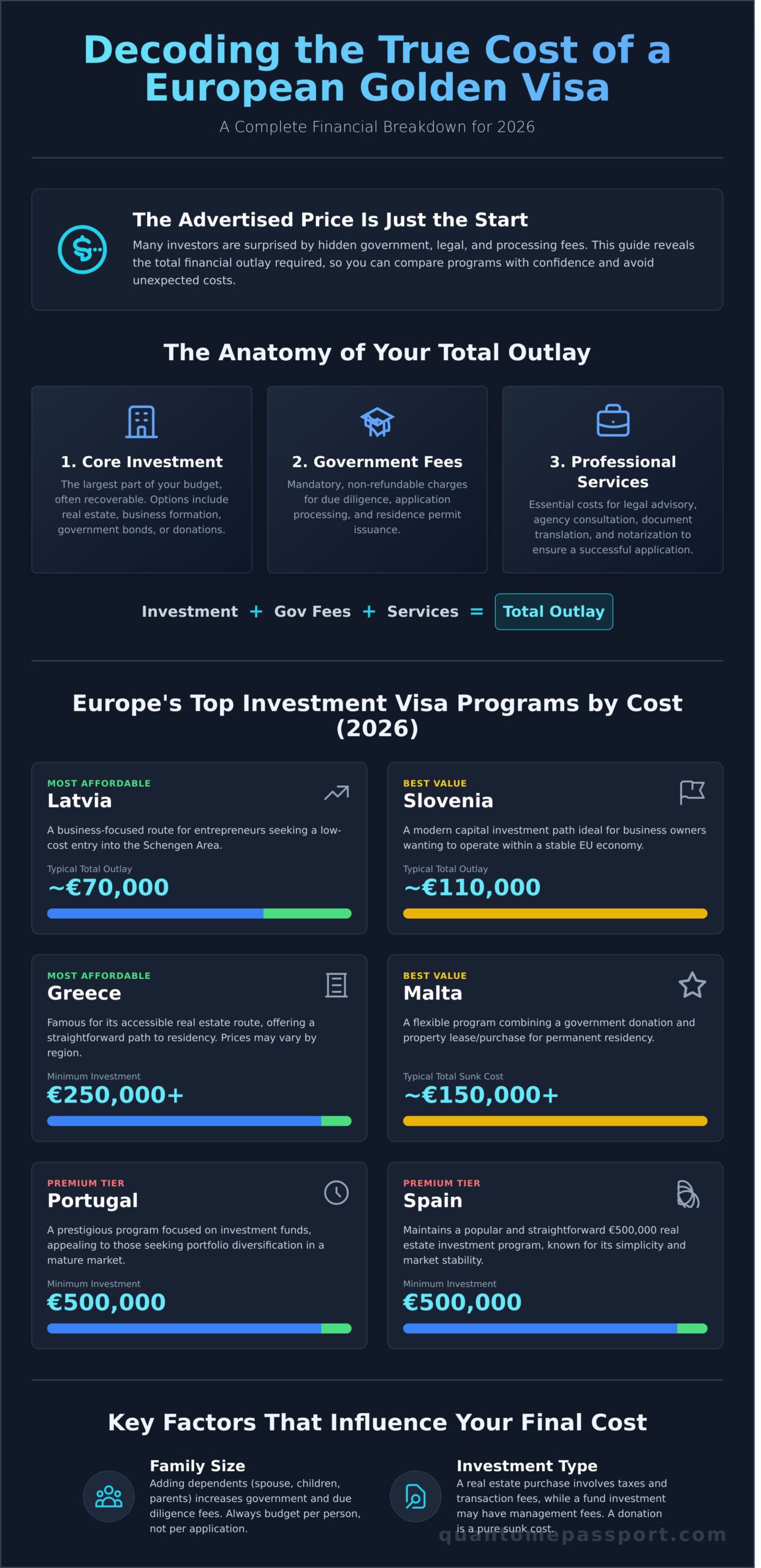
For those seeking the lowest initial capital outlay, Greece and Latvia present compelling options. Greece’s Golden Visa program is famous for its real estate route, starting at €250,000 in some regions (though this may rise in major cities). Latvia offers a unique business investment pathway from just €50,000, but be prepared for additional government fees and contributions that raise the total cost closer to €70,000.
Best Overall Value: Malta & Slovenia
Value isn’t just about the lowest price. Malta’s permanent residency program combines a government donation with a property lease or purchase, offering a clear path to long-term settlement in a stable EU nation. Slovenia, a rising star, provides a modern capital investment route for around €110,000, appealing to entrepreneurs looking to establish a business in the Schengen Area. Both offer excellent value for families seeking a secure future.
Premium Tier Programs: Portugal & Spain
Portugal and Spain represent the premium tier, with investments reflecting their mature markets and high quality of life. After recent changes, Portugal’s popular route is now through investment funds, typically starting at €500,000. Spain maintains its straightforward €500,000 real estate investment program. These higher price tags often come with access to more robust economies and well-established expatriate communities.
Investment Visa Cost Comparison Table
| Country | Minimum Investment | Est. Total Cost (Single Applicant) | Family Inclusion |
|---|---|---|---|
| Greece | €250,000 (Real Estate) | ~€280,000+ | Spouse, children under 21, dependent parents |
| Latvia | €50,000 (Business) | ~€70,000+ | Spouse and minor children |
| Malta | ~€150,000 (Donation + Lease) | ~€175,000+ | Spouse, children, parents, and grandparents |
| Portugal | €500,000 (Investment Fund) | ~€550,000+ | Spouse, dependent children, dependent parents |
| Spain | €500,000 (Real Estate) | ~€560,000+ | Spouse, dependent children, dependent parents |
A Closer Look: The Slovenian Residency Program Cost
Slovenia offers a compelling, business-centric route to EU residency, standing out among the various programs detailed in a recent European Parliament report on investment schemes. Instead of real estate acquisition or large capital donations, Slovenia’s program is built on active business investment, making it a strategic choice for entrepreneurs and executives seeking a foothold in the heart of Europe. This approach provides a clear, structured pathway to residency with transparent financial commitments.
Breakdown of the €110,000 Minimum Capital
This is a crucial point of differentiation. The required €110,000 is not a sunk cost or a passive government bond purchase; it is working capital for your new Slovenian company. These funds are allocated towards tangible business assets and operational costs, such as equipment, inventory, or salaries. This model ensures your investment is actively building a sustainable enterprise that serves as the legal basis for your residency permit, directly linking your success to your residency status.
Total Estimated Cost for the Slovenian Program
When evaluating the total investment visa europe cost for Slovenia, it’s important to look beyond the initial capital. A realistic budget for a single applicant is approximately €125,000. This comprehensive figure includes:
- The €110,000 business capital investment.
- Government application and processing fees.
- Legal and advisory fees for professional guidance.
- Company formation and administrative costs.
For families, the cost increases modestly per dependent, typically adding a few thousand euros for each additional family member to cover their respective application and processing fees.
The Value Proposition: What Your Investment Delivers
Slovenia’s program offers an exceptional return on investment in terms of lifestyle, business opportunity, and mobility. The key benefits are clear and significant:
- Fast Processing: The entire process, from company formation to residency permit issuance, is typically completed within 4 to 12 months.
- Full Family Residency: Your spouse and dependent children can be included in the application, securing residency for your entire family.
- Schengen Area Access: As a Slovenian resident, you gain visa-free travel and the right to conduct business across the 29-nation Schengen Zone.
This combination of speed, inclusivity, and access makes Slovenia a top-tier choice. To understand how these costs apply to your specific situation, we recommend you get a personalised cost assessment for Slovenia.
Key Factors That Influence Your Final Visa Cost
While every European Golden Visa program has a minimum investment threshold, the advertised number is rarely the final figure. Your personal choices, family structure, and long-term goals significantly shape the total investment visa europe cost. Understanding these variables is crucial for accurate financial planning and avoiding unexpected expenses on your journey to European residency.
Investment Type: Real Estate vs. Financial Instruments
Your choice of asset is one of the most significant cost drivers. While real estate offers the potential for capital appreciation and rental income, it comes with ongoing taxes, maintenance, and acquisition fees. Financial instruments like government bonds or fund investments are often simpler to manage and more liquid, but may offer lower returns. Evaluating the risk, liquidity, and long-term management needs of each option is essential.
- Real Estate: Includes purchase taxes, legal fees, and annual property taxes.
- Financial Options: May involve fund management fees but avoids property-related overheads.
For investors comfortable with more sophisticated financial routes, exploring premium asset marketplaces can provide further insight into the institutional-grade opportunities available; you can learn more about SIMI to see how such platforms operate.
Family Composition: The Cost of Including Dependents
Most residency by investment programs are family-friendly, but including dependents adds to the final price. Government application fees, due diligence checks, and legal processing costs are typically charged per person. A ‘dependent’ usually includes your spouse and minor children, though some programs generously extend this to unmarried adult children, parents, and even grandparents, making them more cost-effective for larger families.
Long-Term Costs: Renewals and Path to Citizenship
Your financial commitment doesn’t end after the initial investment. To maintain your status, you must budget for residency permit renewal fees, which are typically due every two to five years. Furthermore, if your goal is citizenship, there will be additional costs for language tests, application processing, and legal assistance. Many countries also require you to maintain your original investment until you secure permanent residency or citizenship, tying up your capital for five years or more.
Planning for these factors provides a complete picture of your financial commitment. For a detailed cost analysis tailored to your family and investment preferences, we recommend consulting with an expert.
Your Path to European Residency: Finalizing Your Investment Strategy
As we’ve detailed for 2026, understanding the true investment visa europe cost requires looking beyond the initial capital requirement. The key is to evaluate the total outlay, including all associated fees, and to recognize that different programs-from powerhouse economies to hidden gems like Slovenia-offer vastly different value propositions. Your final cost will always be unique to your circumstances and the specific path you choose.
Navigating these financial and legal complexities requires a clear, expert-led strategy. Our team offers precisely that, with specialized guidance on the Slovenian residency program, transparent fee structures with no hidden costs, and a personalized assessment of your eligibility and total investment. Instead of guessing, get clarity and confidence on your journey.
Ready to map out your investment and secure your future in Europe? Book a Private Strategy Call to Discuss Your Options.
Frequently Asked Questions About Investment Visa Costs in Europe
What is the absolute cheapest Golden Visa in Europe?
Currently, the Latvian Golden Visa is one of the most affordable options. It requires a real estate investment of €250,000, plus a mandatory one-time state fee of 5% of the property value. This makes it a highly competitive choice for those seeking European residency. While other programs have low entry points, Latvia’s combination of a reasonable investment threshold and clear associated fees makes it a consistently cost-effective route to securing residency in the Schengen Area.
Do I get my investment back with a Golden Visa?
Yes, in most cases, the capital you invest is recoverable. Golden Visa programs are based on investments, not non-refundable donations. If you purchase real estate, you can sell it after a mandatory holding period, typically five years, and potentially profit from appreciation. Similarly, investments in funds or government bonds can be redeemed once you meet the program’s requirements. Your ability to get your investment back is a key feature that distinguishes these residency programs.
How much are the legal and agency fees for an investment visa?
Beyond the main investment, you must budget for additional costs. Legal, agency, and government processing fees typically range from €15,000 to €50,000, depending on the country and the complexity of your application. These fees cover essential services like due diligence checks, legal counsel, document preparation, and application submission. Factoring these expenses into the total investment visa europe cost is crucial for accurate financial planning and a smooth application process.
Does the investment visa cost include my family members?
The main investment amount typically grants eligibility for the primary applicant, their spouse, and dependent children. However, including family members almost always incurs additional government application and processing fees. For each dependent you add, expect to pay extra thousands of euros. Some programs also allow the inclusion of dependent parents or adult children for a higher fee. These costs are a significant variable in the final investment visa europe cost.
Is it cheaper to get residency by investment or citizenship by investment?
Residency by investment (RBI), often called a Golden Visa, is significantly cheaper than direct citizenship by investment (CBI). European RBI programs start around the €250,000 mark for an investment. In contrast, European CBI programs, such as Malta’s, require a combination of non-recoverable donations and investments that often exceed €750,000. For most investors, starting with residency is the far more accessible and cost-effective pathway.
Are there hidden taxes I should know about when buying property for a Golden Visa?
While not “hidden,” there are several mandatory taxes and fees associated with property acquisition that applicants must anticipate. These typically include a Property Transfer Tax (which can be up to 8-10% in countries like Portugal or Spain), Stamp Duty, notary fees, and registration fees. Furthermore, you will be liable for annual property taxes. When the time comes to sell, you may also face Capital Gains Tax on any profit you have made from the sale.