
Imagine a future where your children have access to world-class universities, your entire family benefits from premier healthcare, and you all have the freedom to live, work, and travel across 27 nations. This dream often feels buried under a mountain of complex paperwork, confusing programs, and the nagging fear of making a costly mistake. You worry about the process, the timeline, and whether you can truly bring everyone-your spouse, your children, and even your parents-along on this life-changing journey. The path to EU second citizenship for families doesn’t have to be a maze of bureaucracy and anxiety.
This comprehensive 2026 guide is designed to be your trusted roadmap. We cut through the noise to demystify the entire process, providing you with a clear understanding of the most secure and efficient legal pathways to obtaining European passports for your loved ones. We’ll break down the requirements, realistic total costs, and timelines for the most family-friendly programs, empowering you to choose the right option with confidence and build that secure ‘Plan B’ your family deserves.
Key Takeaways
- Securing EU second citizenship for families is more than a travel document; it’s a strategic investment in your family’s future stability and freedom.
- Learn how to evaluate the key pathways-ancestry, naturalization, and investment-to find the most efficient option for achieving EU second citizenship for families in 2026.
- Discover the specific eligibility rules for including your spouse, children, and even parents in your application. The inclusive nature of EU second citizenship for families is one of its greatest benefits.
- Follow a clear roadmap that breaks down the entire journey of obtaining EU second citizenship for families, from initial inquiry to successfully receiving your passports. Our guide makes the process of getting EU second citizenship for families clear and manageable.
Why an EU Second Citizenship is a Game-Changer for Your Family
Securing an EU second citizenship for families is more than acquiring a new passport; it’s a profound, long-term investment in your collective future. In a world of increasing economic and political uncertainty, it provides a powerful ‘Plan B’-a safe haven that ensures stability and prosperity. This single decision unlocks a lifetime of benefits not just for you, but for your children and their children, establishing a legacy of generational security and boundless opportunity.
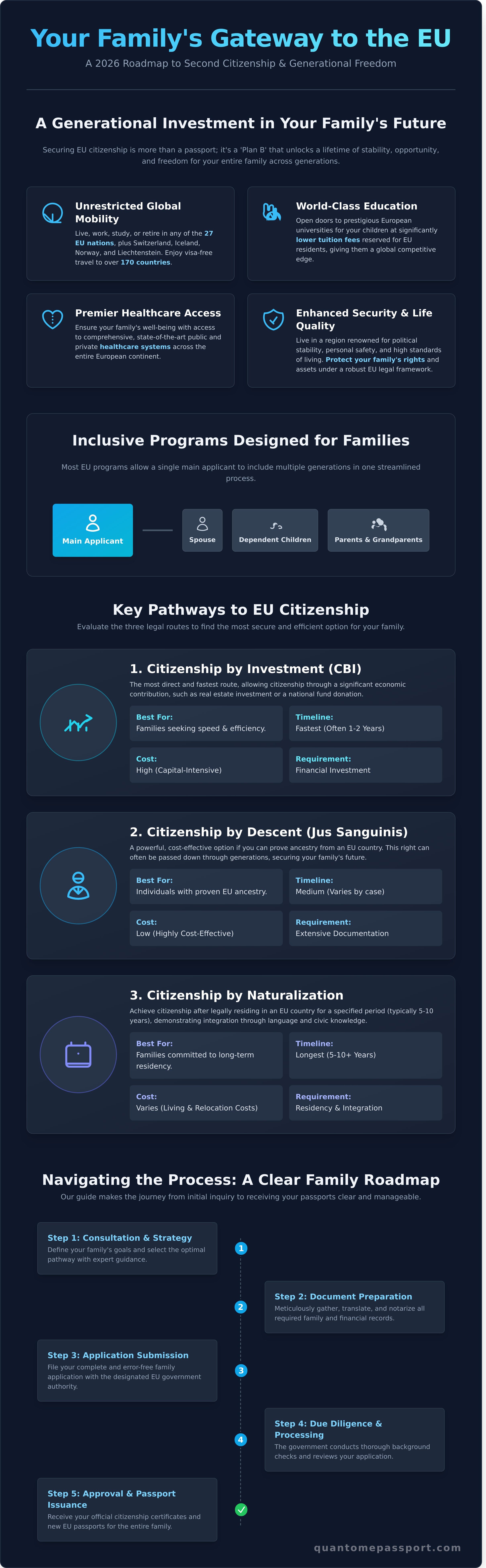
To better understand the possibilities this unlocks, this overview provides a helpful starting point:
Unrestricted Global Mobility for All
Imagine your family’s world without borders. An EU passport grants every member the freedom to travel visa-free to over 170 countries. More importantly, it bestows the right to live, work, study, or retire in any of the 27 EU member states, plus Switzerland, Iceland, Norway, and Liechtenstein. This unparalleled mobility simplifies everything from spontaneous family vacations in the Schengen Area to pursuing international business ventures or relocating for a new career path.
Access to World-Class Education & Healthcare
An EU citizenship opens the doors to some of the world’s finest institutions for your children. They can attend prestigious European universities at significantly lower tuition fees reserved for EU residents, giving them a competitive edge without the financial burden. The benefits extend to high-quality public schooling and access to comprehensive, state-of-the-art healthcare systems across the continent, ensuring your family’s well-being is always a priority.
Enhanced Quality of Life and Security
The European Union is renowned for its high standards of living, political stability, and exceptional personal safety. As citizens, your family is protected by a robust legal framework that guarantees fundamental rights and social benefits. This security is rooted in the legal status of being a European. But What is EU Citizenship? It is a designation that grants you the right to own property, establish a business, and enjoy the same protections as any person born in the EU, creating a secure environment for your family to thrive.
Key Pathways to EU Citizenship for Families
Securing EU second citizenship for families opens a world of opportunities, but the path you choose is critical. There are three primary legal routes to consider: investment, descent, and naturalization. Each pathway has unique timelines, costs, and requirements, directly impacting how your spouse and children can be included. Understanding these differences is the first step in selecting the strategy that best aligns with your family’s long-term goals and immediate circumstances.
Citizenship by Investment (CBI) & Residency (RBI)
Often the most direct route, these programs allow you to gain legal status through a significant economic contribution, such as a real estate purchase or a donation to a national fund. They are explicitly designed for families, allowing a main applicant to include their spouse, dependent children, and sometimes even parents in a single application. While this is the fastest option, it is also the most capital-intensive.
Citizenship by Descent (Jus Sanguinis)
Citizenship by Descent, or jus sanguinis (right of blood), is a powerful option if you can prove ancestry from an EU country. If you have a parent, grandparent, or even great-grandparent who was a citizen, you and your children may be eligible. This right can be passed down through generations, securing their future. This pathway is highly cost-effective but demands meticulous genealogical research and extensive official documentation to validate your claim.
Citizenship by Naturalization
Naturalization is the process of becoming a citizen after legally residing in an EU country for a specified period (typically 5-10 years). This route requires a long-term commitment, as the entire family must usually live, work, or study in the country to meet the residency criteria. Applicants must also demonstrate integration by passing language proficiency exams and civic knowledge tests, proving their connection to their new home.
| Pathway | Typical Timeline | Estimated Cost | Key Requirements |
|---|---|---|---|
| Investment (CBI/RBI) | 6 months – 2 years | High (€250,000+) | Significant financial investment, clean criminal record. |
| Descent (Jus Sanguinis) | 1 – 4 years | Low | Verifiable proof of ancestry, official documents. |
| Naturalization | 5 – 10+ years | Moderate | Continuous legal residency, language and integration tests. |
How to Include Your Family Members in the Application
One of the most significant advantages of pursuing an EU passport is the ability to secure the same rights and freedoms for your loved ones. Programs offering EU second citizenship for families are specifically designed to accommodate a group application, but success hinges on meticulous preparation and a clear understanding of who qualifies as a dependent. Each family member must meet the host country’s specific eligibility criteria, and their inclusion requires a complete and accurate set of supporting documents.
Qualifying Family Members: Spouse and Minor Children
The standard ‘family unit’ in most EU citizenship applications includes the main applicant, their legal spouse, and their biological or legally adopted children under the age of 18. To prove these relationships, you will need to provide official, government-issued documents such as a valid marriage certificate and birth certificates for each child. A key long-term benefit is that children born after you have successfully obtained citizenship may automatically be entitled to EU citizenship by descent.
Including Dependent Parents and Adult Children
Many programs allow you to extend the application to include adult children and dependent parents or grandparents, though the rules are strict. Adult children are often eligible if they are under a certain age (typically 26), unmarried, enrolled full-time in post-secondary education, and financially dependent on the main applicant. Similarly, parents or grandparents, usually over the age of 65, can often be included if you can prove they are part of your household and financially reliant on you for support.
Documentation Checklist for Family Applications
While specific requirements vary by country, a comprehensive family application will require a dedicated file for each individual. Your core documentation package should include:
- Valid passports and national identity cards for every applicant.
- Original or certified copies of birth certificates for everyone.
- Official marriage certificate (and divorce certificates, if applicable).
- Police clearance certificates from your country of birth and any country you have resided in for more than six months.
- Detailed proof of funds and the legal source of your investment capital (for the main applicant).
Important: All official documents not issued in the host country’s official language must be professionally translated and certified with an apostille or legalized by the appropriate authorities.
Comparing Top EU Programs for Families in 2026
Navigating the landscape of EU second citizenship for families requires a clear comparison of the available pathways. Your family’s unique circumstances-budget, timeline, and long-term goals-will determine the best fit. While the allure of instant citizenship is strong, residency-by-investment programs often present a more strategic and accessible first step. Let’s break down the top contenders for 2026.
Direct Citizenship by Investment
Malta’s Exceptional Investor Naturalization (MEIN) program is the EU’s gold standard for direct citizenship. It allows for the inclusion of a spouse, dependent children (up to 29), and even dependent parents and grandparents. However, with a minimum contribution of €600,000 and a 12-36 month processing time, it represents a significant investment. It’s crucial to note that direct CBI programs are rare and under intense scrutiny from the European Commission.
Residency Leading to Citizenship
For many families, the most practical route is residency-by-investment (RBI), also known as “Golden Visas.” These programs offer a foothold in the EU with a clear, structured path to citizenship over time. Key options include:
- Portugal: Requires just 5 years of residency, with a famously low physical stay requirement (average of 7 days per year), making it ideal for families who aren’t ready to relocate full-time.
- Greece: A popular real estate investment route (starting from €250,000) leading to citizenship eligibility after 7 years of residency and passing language tests.
- Spain: Offers a pathway through a €500,000 real estate investment, but the timeline to citizenship is longer at 10 years.
- Slovenia: A compelling alternative, this business investment route (starting at €50,000) provides a path to citizenship after 10 years, appealing to entrepreneurial families.
Citizenship by Ancestry
If you have European roots, an ancestry-based application is by far the most cost-effective option. Countries with family-friendly rules include Italy (which has no generational limit on claims), Ireland (up to grandparents), Poland, and Hungary. The primary trade-off is time; these applications are document-heavy and can take several years to process, but they solidify a priceless family legacy without a major financial outlay.
Each of these pathways offers a distinct set of benefits and requirements. Choosing the right one is a critical decision. For a personalized strategy tailored to your family’s needs, contact our team of experts.
Navigating the Process: A Step-by-Step Family Roadmap
Embarking on the path to EU second citizenship for families can feel like a monumental task, filled with legal complexities and paperwork. However, when broken down into a structured plan, the journey becomes clear and manageable. This roadmap demystifies the process, guiding you from initial consideration to holding your new EU passports and unlocking a future of global mobility.
Step 1: Initial Assessment and Strategy
The foundation of a successful application is a bespoke strategy. This initial phase involves a deep dive into your family’s unique circumstances and goals. We help you determine eligibility across various EU programs, considering every member from your spouse to dependent children and even parents. Together, we’ll define your priorities-whether it’s speed, investment budget, or lifestyle benefits-to select the single best pathway for your family’s future.
Step 2: Document Collection and Legalization
This is often the most time-intensive stage, where meticulous preparation is critical. Your family will need to gather a comprehensive portfolio of documents. This typically includes:
- Birth and marriage certificates for all applicants
- Valid passports and national identity documents
- Detailed proof of funds and financial records
- Clean criminal records from your country of residence
Each document must be officially translated and legalized (e.g., with an Apostille) to meet strict government standards. Starting this process early prevents significant delays.
Step 3: Application Submission and Processing
Once your file is complete and flawlessly prepared, it is submitted through the official government channels. The application then enters the processing phase, which includes rigorous due diligence and background checks on all adult applicants. This is a waiting period where government authorities verify your information. Timelines vary significantly by country, from several months to a few years, making patience and expert oversight essential.
Step 4: Approval and Final Steps
Receiving your official approval-in-principle is a major milestone. From here, you’ll complete the final requirements, such as making the qualifying investment, visiting the country for biometrics, or taking an oath of allegiance. Once these steps are fulfilled, you will be issued Certificates of Naturalization. The final, rewarding step is applying for and receiving your new EU passports. Ready to begin? Start your family’s journey with a private strategy call.
Secure Your Family’s European Legacy Today
As we’ve explored, securing an EU second citizenship for families is more than a travel document; it’s a profound investment in a future filled with world-class education, unparalleled freedom of movement, and lifelong security across 27 nations. From understanding the key residency-to-citizenship pathways to ensuring every family member is included in your application, the journey requires a clear and strategic roadmap. The right program, tailored to your unique circumstances, can open a world of opportunity for generations to come.
The path to Europe may seem complex, but you don’t have to walk it alone. Our team provides expert guidance on residency-to-citizenship pathways, including the strategic Slovenian program, crafting personalized strategies that align with your family’s goals. We are here to help you build a clear and achievable plan for your future.
Ready to take the first step? Book a Private Strategy Call to Discuss Your Family’s Future in the EU. The legacy you envision for your loved ones is within reach, and the time to act is now.
Frequently Asked Questions
Can my adult children (over 18) get EU citizenship with me?
This depends on the specific program. Most investment-based routes have an age limit for dependent children, often up to 28, provided they are unmarried, financially dependent on you, and enrolled in full-time education. For example, Malta’s program has clear dependency criteria. In contrast, citizenship by descent typically has no age limit for children, but direct lineage must be proven. Always verify the rules of your target country.
What happens if my country of origin does not allow dual citizenship?
If your home country prohibits dual citizenship, you will likely be required to renounce your original citizenship upon acquiring a new one. This is a major decision with significant legal and personal consequences. We strongly recommend seeking professional legal counsel in your country of origin to fully understand the implications of renunciation before you begin the application process for a second passport. This step is critical for a smooth transition.
How long does the entire process take for a family, from start to finish?
The timeline for securing EU second citizenship for families varies significantly by country and program. Direct Citizenship by Investment (CBI) programs, such as Malta’s, can take between 12 and 36 months. Residency by Investment (RBI) routes that lead to citizenship after a set period, like in Portugal or Greece, typically take five to ten years to complete. A family application may add a few months for extra due diligence checks.
Are there language or physical residency requirements for my spouse and children?
This is highly program-specific. Most direct investment citizenship programs have minimal to no physical residency or language requirements for any family members. However, paths to citizenship through naturalization after years of residency (like in Portugal or Spain) almost always require the main applicant and spouse to meet physical presence rules and pass language and culture exams. Children are often exempt, especially if they attend local schools.
What are the most common reasons a family’s citizenship application is rejected?
The most common reasons for rejection are failed due diligence checks and issues with documentation. This can include a past criminal record for any applicant, misrepresentation of facts on the application, or an inability to clearly prove the legal source of investment funds. Ensuring all family members have a clean background and that all financial information is transparent and verifiable is absolutely essential for a successful outcome.
Can I include my same-sex partner in a family application for EU citizenship?
Yes, in many EU countries that legally recognize same-sex unions. Nations such as Spain, Portugal, and Malta allow the inclusion of a same-sex spouse in a family application. It is vital to verify the specific laws of your chosen country, as you will need to provide legal proof of your relationship, such as a marriage certificate, that is officially recognized by that nation’s authorities to proceed.
How much does it typically cost to secure EU citizenship for a family of four?
The costs vary dramatically depending on the program. For a direct Citizenship by Investment program like Malta’s, a family of four can expect a total outlay between €800,000 and €1.5 million, including investments, government contributions, and fees. Residency programs that lead to citizenship, such as Portugal’s Golden Visa, have lower initial investment thresholds (starting around €280,000) but accrue additional costs over the 5+ years required to qualify.