
Dreaming of building a life in Europe but feeling lost in a maze of complex legal terms and confusing requirements? You’re not alone. The path from a temporary visa to long-term stability can seem overwhelming, filled with bureaucratic hurdles and the fear of making a costly mistake. The key to unlocking this future often lies in a single, powerful status: EU permanent residency. This isn’t just another stamp in your passport; it’s a gateway to living, working, and thriving across the continent with nearly the same rights as a citizen, without having to renounce your original nationality.
This comprehensive guide is designed to cut through the noise and eliminate the guesswork. We will break down everything you need to know, demystifying the core requirements like residency duration and income thresholds. You’ll get a simple, step-by-step roadmap of the application process and a clear understanding of the incredible benefits that await. By the end, you’ll have the clarity and confidence to take the next decisive step towards making your European dream a permanent reality.
What is EU Permanent Residency? (And Why You Should Want It)
For non-EU citizens dreaming of a long-term future in Europe, securing eu permanent residency is a monumental step. In simple terms, it is a legal status that grants you, a third-country national, the right to live, work, and study in an EU country indefinitely, much like a citizen. After residing legally in a member state for a continuous period-typically five years-you can apply for this robust and stable status.
This isn’t just a national permit; its foundation is the EU long-term resident directive (2003/109/EC), which harmonizes the status across participating member states. This creates a unified framework, ensuring your rights are recognized beyond the borders of the country that issued your permit. It’s crucial to understand this status is designed specifically for non-EU nationals, distinguishing it from the inherent free movement rights that EU citizens possess.
To better understand this concept, watch this helpful video:
Key Benefits of Being an EU Permanent Resident
Acquiring this status unlocks a host of advantages that significantly enhance your quality of life and career prospects in Europe:
- Live and Work Indefinitely: You are no longer tied to temporary visas or work permits. You can change employers or even start a business with far greater freedom.
- Equal Treatment: You gain access to employment, education, and social security benefits (like healthcare and pensions) on the same terms as nationals of the host country.
- Enhanced EU Mobility: While not total freedom of movement, it gives you the right to move, live, and work in other EU countries, subject to certain conditions.
- A Path to Citizenship: Permanent residency is often the final, mandatory step before you can apply for full citizenship and an EU passport.
Permanent Residency vs. Temporary Visa vs. Citizenship
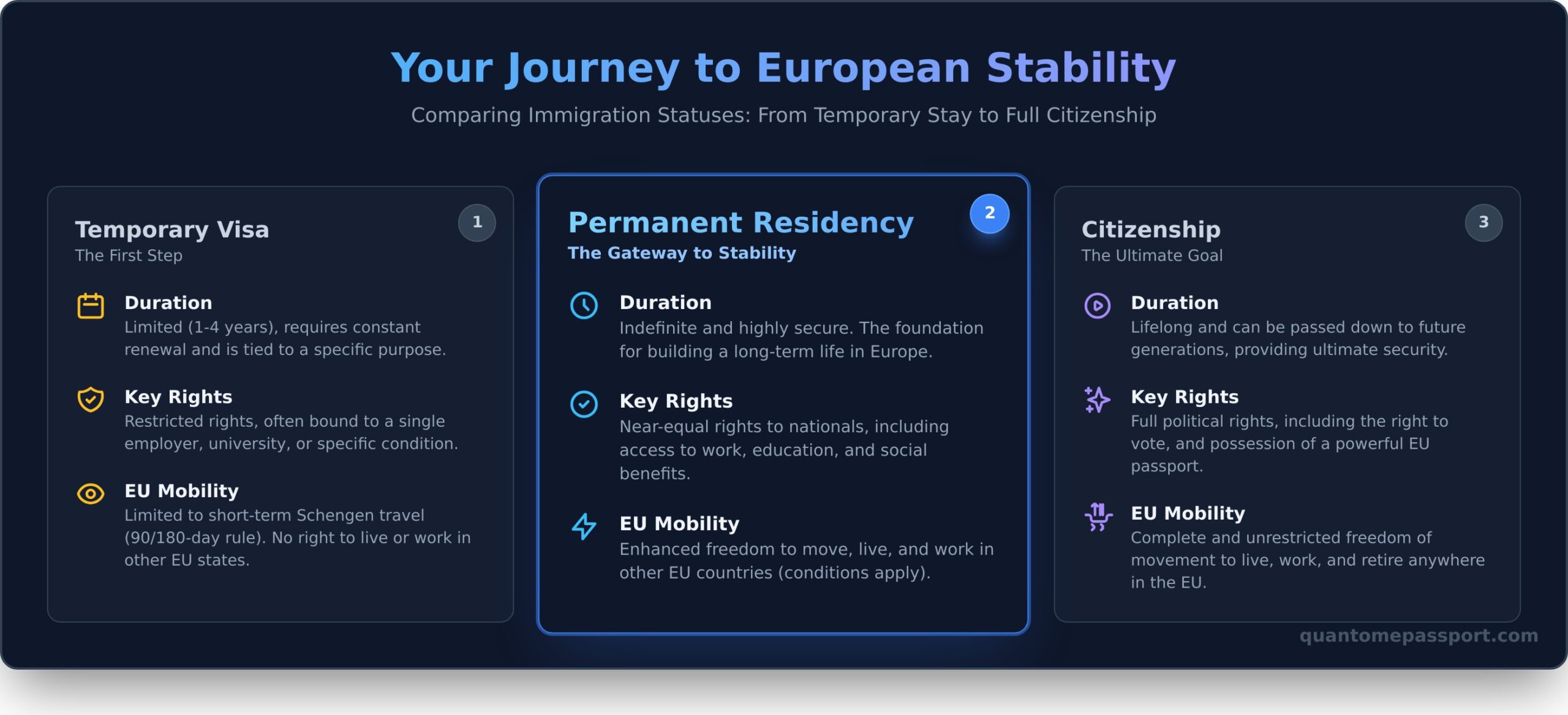
Understanding where permanent residency fits in the immigration journey is key. It acts as the secure bridge between temporary status and full citizenship. The table below clarifies the main differences.
| Feature | Temporary Visa/Permit | Permanent Residency | Citizenship |
|---|---|---|---|
| Duration | Limited (1-4 years), requires renewal | Indefinite, highly secure | Lifelong and for future generations |
| Key Rights | Restricted, often tied to a specific job or school | Near-equal rights to nationals (work, social benefits) | Full political rights (e.g., voting) and an EU passport |
| EU Mobility | Limited to Schengen travel (90/180-day rule) | Right to move to other EU states (conditions apply) | Complete freedom of movement |
In essence, while a temporary visa offers a foothold, eu permanent residency provides the foundation to build a life. It grants the stability and rights needed to truly integrate, making it the most critical long-term goal for non-EU citizens in Europe.
Are You Eligible? The 5 Core Requirements for EU Permanent Residency
Securing long-term resident status is a major milestone, proving your stability and integration into your new home country. The path is governed by the EU Long-Term Residence Directive (2003/109/EC), which sets a common baseline for all member states. However, each country adds its own specific conditions. The goal is always the same: to demonstrate that you are a settled, self-sufficient, and integrated member of society. Below are the five core pillars you must satisfy to be eligible for eu permanent residency.
The 5-Year Rule: Legal and Continuous Residence
The cornerstone of your application is proving you have lived in the host EU country legally and continuously for five uninterrupted years. ‘Legal’ residence means you held a valid permit, such as a work visa or family permit. Absences are permitted but strictly limited-typically, you cannot be outside the country for more than six consecutive months or a total of ten months within the five-year period. Be aware that time spent on certain temporary statuses, like a student visa, may only count for 50% or not at all, depending on national law.
Financial Stability: Proving Sufficient Resources
You must demonstrate that you have ‘stable and regular resources’ to support yourself and any dependents without relying on the host country’s social assistance system. This reassures the authorities that you will not become a financial burden. Evidence typically includes:
- Employment contracts and recent payslips
- Bank statements showing consistent income
- Tax returns from previous years
- Proof of business income if you are self-employed
Health Insurance and Accommodation
Applicants are required to have comprehensive health insurance coverage for themselves and their family members in the host country. This policy must cover all the same risks as it would for a national citizen. Additionally, you must prove you have adequate housing that is considered normal for a comparable family in that region. A rental agreement or a property deed is standard proof.
Integration Requirements
Many EU countries require you to actively demonstrate your integration into society. This is often the most variable requirement between member states. It can involve passing a language proficiency test, usually at an A2 or B1 level, to show you can handle everyday conversations. You may also need to complete a civics course or pass a test on the host country’s history, laws, and social values.
The Application Process: A General Step-by-Step Roadmap
Navigating the path to EU permanent residency can feel complex, but it follows a predictable pattern. This roadmap outlines the four main stages you’ll encounter. Remember, while the EU sets the general framework, each member state implements the rules with its own specific procedures and timelines. Always consult the official immigration portal of your country of residence for precise details. Feeling overwhelmed? A private strategy call can simplify your personal roadmap.
Step 1: Document Preparation
This is the most crucial phase, where meticulous preparation prevents delays. While the exact list varies by country, you will almost certainly need to gather the following:
- Your valid passport and current residence permit.
- Proof of stable and regular financial resources (e.g., bank statements, employment contracts).
- Proof of comprehensive health insurance.
- Evidence of suitable accommodation (e.g., rental agreement or property deed).
- Proof of integration, such as a language certificate or civic integration course diploma.
Important: Documents issued outside the EU, like birth or marriage certificates, often require an official translation and an apostille or legalization to be accepted.
Step 2: Submitting Your Application
Once your file is complete, you will submit it to your country’s national immigration authority. This could be a ministry, a specialized agency, or even a local administrative office. Many countries now offer online portals for submission, though an in-person appointment for biometrics may still be required. Expect to pay an application fee, which typically ranges from €100 to €250.
Step 3: Waiting for the Decision
After submission, the waiting period begins. Authorities will conduct background checks and verify every document you provided. Processing times vary widely across the EU but generally fall between three and twelve months. Some countries provide an online tracking system to monitor your application’s status. Patience is key during this thorough and legally significant process.
Step 4: Receiving Your Permit
Upon approval, you will be notified to collect your long-term residence permit card. This card is the physical proof of your new status. It is typically valid for five or ten years and is renewable. It’s vital to understand that your status is permanent; only the physical card has an expiration date. Renewing it is a straightforward administrative procedure, unlike the initial application for your eu permanent residency.
Navigating Country-Specific Rules: How the Process Varies
While the EU Long-Term Residence Directive provides a common framework, achieving permanent residency is not a one-size-fits-all process. Each member state retains the authority to set its own specific criteria, creating a complex landscape of different financial thresholds, language tests, and integration requirements. Understanding these national nuances is the difference between a smooth application and a frustrating rejection.
This is where generalized advice falls short. A strategy that works perfectly in one country may be entirely unsuitable for another. To illustrate these critical differences, let’s examine the requirements in a few popular EU destinations.
Example: Germany
Germany’s path to permanent residency is highly structured and emphasizes economic stability and social integration. Applicants must prove they can support themselves without state benefits, meeting specific income thresholds. Key requirements include:
- Pension Contributions: Proof of at least 60 months of payments into the German statutory pension insurance scheme.
- Language & Integration: A B1 level of German language proficiency and passing the “Leben in Deutschland” (Life in Germany) test are mandatory.
Example: Spain
Spain requires five years of continuous legal temporary residence before you can apply for long-term residence (permiso de residencia de larga duración). The process focuses heavily on financial self-sufficiency and a clean legal history. Applicants must demonstrate:
- Financial Means: Sufficient and stable funds, often calculated as a percentage of Spain’s IPREM index (Public Multiple Effects Income Indicator).
- Clean Criminal Record: No criminal record in Spain or in any previous country of residence for offenses recognized in the Spanish legal system.
Example: Slovenia (The Quantome Pathway)
Often overlooked, Slovenia offers one of the most streamlined and strategic routes to living and working in the EU. For entrepreneurs and investors, the business investment pathway provides a clear and predictable process for obtaining residency. This option is particularly attractive for those looking for an efficient entry point into the Schengen Area, combining business opportunities with a high quality of life. The requirements are transparent, making it an excellent alternative to more complex Western European systems. Discover if the Slovenian residency program is your fastest path to the EU.
As these examples show, the journey to EU permanent residency is unique to the country you choose. A successful application depends on a tailored strategy that aligns with your personal and professional profile. Navigating this complexity with expert guidance ensures you are on the most efficient and secure path from the very beginning.
Your Journey to European Residency Starts Now
Securing long-term residency in the EU is a life-changing goal, offering unparalleled freedom, stability, and access across a vibrant continent. As we’ve explored, the path involves meeting core eligibility criteria, such as five years of legal and continuous residence, but the specific rules and application processes can vary dramatically from one country to another. Successfully navigating these nuances is the key to achieving your goal of eu permanent residency.
The journey can seem complex, but you don’t have to navigate it alone. Our team provides expert guidance on complex immigration pathways, offering personalized strategies for individuals and families. We specialize in streamlined routes, including the highly accessible Slovenian residency program, to find the most efficient path for your unique situation. Don’t let bureaucracy stand in the way of your future.
Ready to turn your European dream into a reality? Book a Private Strategy Call to find your best path to European residency. Your new life in Europe is closer than you think.
Frequently Asked Questions about EU Permanent Residency
Can I work in any EU country with a permanent residence permit?
Not automatically. An EU permanent residence permit issued by one member state (e.g., Germany) primarily grants you the right to live and work in that specific country. While it simplifies the process of moving to another EU country (e.g., France), you will generally still need to apply for a new residence and work permit there. The key benefit is that you won’t be subject to labor market tests in the new country.
How can my family members also get permanent residency?
Your immediate family members (spouse and minor children) who have resided with you legally and continuously in the host EU country for five years can typically apply for their own permanent residence permits. They must also meet integration requirements, such as having health insurance and stable income, and may need to demonstrate basic language proficiency. The specific conditions are determined by the national laws of the country where you reside.
How long can I live outside the EU without losing my permanent resident status?
You can be absent from the territory of the European Union for up to 12 consecutive months without losing your long-term resident status. This period is extended to 24 consecutive months for former holders of an EU Blue Card. Exceeding these time limits can result in the revocation of your permit, so it is crucial to carefully track any time spent living outside the EU to maintain your status.
Does time spent as a student or refugee count towards the 5-year requirement?
This depends on the member state’s national laws. As a general rule, only half of the time spent on a student visa may count towards the five-year residency calculation. For beneficiaries of international protection, such as refugees, the rules are often more favorable. The full period from the date they lodged their asylum application can sometimes be counted towards the five-year requirement. Always check with the local immigration authority.
What is the difference between an EU Blue Card and an EU Permanent Residence permit?
An EU Blue Card is a temporary work and residence permit for highly-skilled non-EU citizens, typically valid for one to four years and tied to a specific high-paying job. In contrast, EU permanent residency is a long-term status granted after five years of continuous legal residence. It is not tied to a specific employer and provides greater stability, security, and more rights, similar to those of EU citizens.
Is it possible to lose my EU permanent resident status once I have it?
Yes, your status can be revoked under specific circumstances. The most common reasons include an extended absence from the EU (typically over 12 consecutive months), committing a serious crime that threatens public order or security, or if it is discovered that the permit was obtained fraudulently. Your status is also superseded if you acquire citizenship of an EU member state, as you would then become an EU citizen.