
Imagine holding a passport that unlocks the freedom to live, work, and travel across 27 nations, but the thought of uprooting your life for years feels like an impossible price to pay. The process seems buried in bureaucracy, and the fear of navigating a complex system-or worse, falling for a costly scam-can be paralyzing. For many ambitious individuals and families, the limitations of their current passport keep a world of opportunity just out of reach.
But what if the traditional path isn’t the only one? The truth is, securing EU citizenship without residency is a viable, strategic option for those who know the legitimate routes. In this definitive 2026 guide, we cut through the noise and complexity to reveal the fastest, legally-sound pathways to a powerful European passport. You’ll gain a clear understanding of the real requirements, timelines, and costs involved, empowering you to make an informed decision and finally secure the global mobility you and your family deserve.
Key Takeaways
- Understand the critical distinction between low-residency pathways and the myth of acquiring EU citizenship without residency with zero connection, as genuine EU citizenship without residency is always based on legal grounds.
- Discover if you qualify for EU citizenship without residency through your family ancestry, a direct route that often requires no prior physical presence.
- Learn how strategic investments or exceptional talents can create legitimate pathways to EU citizenship without residency for qualified applicants.
- Identify the fastest and most suitable option for your unique situation by comparing the key requirements for each pathway to EU citizenship without residency.
The Myth of ‘Citizenship Without Residency’: Understanding the Reality
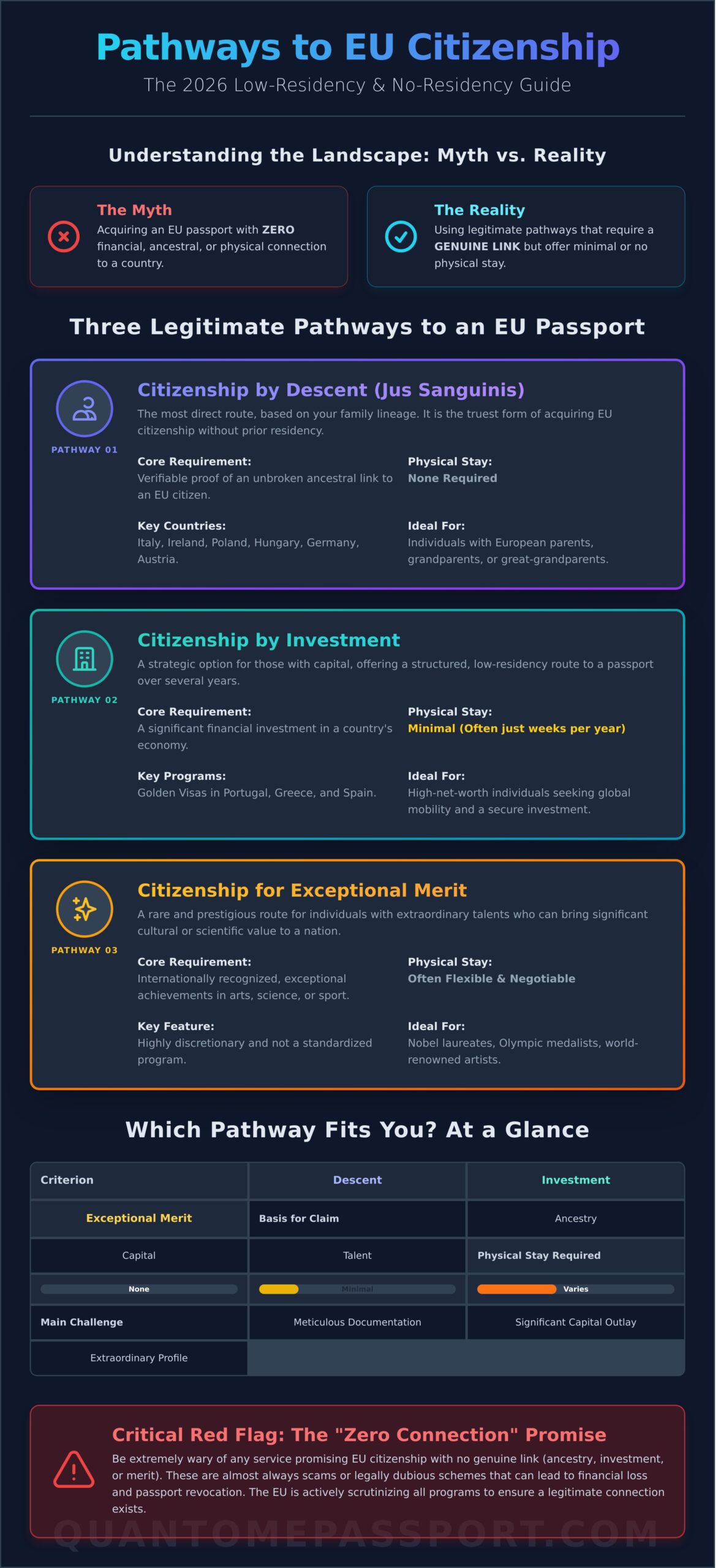
Let’s address the big question head-on: Is it truly possible to get EU citizenship without residency? The short answer is no, not in the way most people imagine. The idea of acquiring a powerful EU passport with zero financial or ancestral connection to a country is, for all practical purposes, a myth. Legitimate pathways always require you to establish a genuine link.
However, this doesn’t mean the dream is out of reach. The more accurate and achievable goal is citizenship with minimal physical stay. This is the key distinction that separates legitimate, strategic routes from fraudulent schemes. These pathways are designed for global citizens who want the benefits of an EU passport without having to relocate full-time.
To better understand one of the most popular low-residency routes, watch this detailed overview of what to expect from the Portugal Golden Visa in 2026:
European Union member states are understandably protective of their sovereignty. The status of Citizenship of the European Union grants extensive rights, including the freedom to live, work, and study across 27 countries. Consequently, every legitimate program requires you to establish a connection, whether through ancestry (jus sanguinis), a significant investment, or a defined period of legal residence-even if that period is very short.
Why ‘No Residency’ is a Red Flag
Be wary of any program promising a passport with zero connection. These offers are almost always scams or legally dubious schemes that can result in your passport being revoked. The EU has been actively increasing scrutiny on investment migration programs, emphasizing that a “genuine link” between the applicant and the country is a critical legal principle. True EU citizenship without residency is a misnomer; a tangible connection is non-negotiable.
Redefining the Goal: Low-Residency Pathways
Instead of chasing a myth, the strategic approach for 2026 is to focus on flexible, low-residency options. Programs like the Golden Visas offered by countries such as Portugal, Greece, or Spain allow you to maintain your primary home elsewhere while fulfilling minimal stay requirements-often just a few weeks a year. The objective isn’t to find a loophole but to use an established, legal framework to gain a powerful second citizenship with the least possible disruption to your life.
Pathway 1: Citizenship by Descent (Jus Sanguinis) – The Ancestry Route
For many individuals seeking a European passport, the most direct and legitimate route is through ancestry. This pathway, known as Jus Sanguinis or ‘right of blood,’ is a legal principle where citizenship is determined by the nationality of one’s parents, grandparents, or even more distant ancestors, rather than by place of birth. It is the cornerstone method for acquiring EU citizenship without residency, as it requires no prior physical presence in the country.
The core of a citizenship by descent application is proving your direct lineage to an EU citizen ancestor. This involves a meticulous process of gathering official documents that create an unbroken chain from them to you. If you can successfully demonstrate this connection, you may be entitled to claim citizenship yourself.
Top EU Countries for Citizenship by Descent
While many EU nations recognize Jus Sanguinis, their eligibility rules vary significantly. Some countries offer more expansive opportunities than others, depending on your family history. Key examples include:
- Italy: Famous for its generous policy, which technically has no generational limit, provided the line of citizenship was never broken.
- Ireland: Allows you to claim citizenship if one of your grandparents was an Irish citizen born in Ireland.
- Poland & Hungary: Have complex rules often linked to ancestors who were citizens within specific historical borders and timeframes.
- Germany & Austria: Often focus on restoring citizenship for descendants of those who were persecuted and stripped of their nationality by the Nazi regime.
The Application Process and Key Requirements
Successfully navigating a descent application hinges on meticulous documentation. You must collect a portfolio of vital records, including birth, marriage, and death certificates for every ancestor in your lineage, along with naturalization records to prove citizenship was never renounced. This evidence is typically submitted through the country’s consulate or embassy in your home nation.
Processing times can be lengthy, often ranging from one to four years. Given the complexity of sourcing and verifying historical documents, which may require apostilles or translations, engaging professional assistance is crucial. Experts can help prevent common errors and navigate the bureaucratic hurdles, ensuring your application for EU citizenship without residency is as strong as possible.
Pathway 2: Investment Programs – Fast-Tracking Through Capital
For individuals without eligible ancestry, investment offers the most direct and accelerated route to an EU passport. This path is often misunderstood, so it’s crucial to distinguish between two primary models: Residency by Investment (RBI) and Citizenship by Investment (CBI). While direct CBI programs are virtually non-existent in the EU, RBI schemes, often called “Golden Visas,” provide a structured, multi-year journey to a second passport.
These programs are the closest practical option to achieving EU citizenship without residency for investors. The core advantage is their extremely low physical presence requirements, allowing you to maintain your life and business elsewhere while your path to citizenship progresses.
How Residency by Investment (Golden Visas) Work
The process is straightforward and designed for high-net-worth individuals. An applicant and their family gain residency rights in an EU country, which can later be converted to full citizenship. The typical steps include:
- Making a Qualifying Investment: This usually involves purchasing real estate, investing in government-approved funds, or establishing a business that creates local jobs.
- Receiving a Residence Permit: Upon approval, you and your dependents are granted legal residency, often with visa-free travel rights within the Schengen Area.
- Maintaining the Investment: You must hold the investment for a specified period (typically 5+ years) and meet minimal stay requirements, such as visiting for just 7-14 days per year.
- Applying for Citizenship: After fulfilling the residency timeline (e.g., 5 years in Portugal, 7 in Greece), you become eligible to apply for permanent residency and then citizenship.
Leading Low-Residency Programs in Europe
Several EU nations offer compelling RBI programs renowned for their flexibility. Portugal’s Golden Visa has historically been a top choice, requiring an average stay of only seven days per year. Greece offers a popular real estate investment route with no minimum stay requirement to maintain residency status.
Malta: The EU’s Last Direct Citizenship by Investment Program
Malta offers a unique path known as the “Exceptional Investor Naturalization” (MEIN) policy. It is not an instant passport; it requires a significant non-refundable contribution, a substantial investment, and a mandatory residency period of either 12 or 36 months before citizenship is granted. While it is the most direct route to EU citizenship without residency through investment, it is also the most expensive by a significant margin. Explore your investment-based options with a strategy call.
Pathway 3: Exceptional Merit – Citizenship for Special Talents
Beyond ancestry and investment, a select few EU nations offer a highly exclusive route to citizenship based on exceptional merit. This pathway is designed for individuals whose extraordinary contributions in fields like science, arts, or sports can bring significant prestige and benefit to the host country. Unlike standard naturalization, this process often bypasses typical requirements, including physical residency and language proficiency, making it a unique form of EU citizenship without residency.
However, it is crucial to understand that this is not a standard application but a discretionary honor bestowed by government decree. The bar for entry is exceptionally high, reserved for those at the absolute peak of their profession.
Who Qualifies for Exceptional Merit?
While criteria vary by country, candidates are typically world-renowned figures who have achieved international acclaim. The focus is on a proven track record of excellence and a contribution that is deemed to be of “exceptional interest” to the nation. Examples include:
- Internationally recognized athletes, such as Olympic medalists or world champions representing the country.
- Prominent scientists and researchers, including Nobel laureates or pioneers in critical fields like medicine or technology.
- World-renowned artists, musicians, writers, or cultural figures whose work has had a global impact.
- Influential business leaders whose work could bring substantial economic benefit to the nation.
How the Process Works
This pathway operates outside of conventional immigration channels. There is no standard application form, predictable timeline, or published set of rules. The process is typically initiated by a nomination from a national body, such as a sports federation, cultural institution, or government ministry. The candidate must then provide an extensive portfolio proving their exceptional contributions and international standing. The final decision is made at the highest level of government, often by a cabinet or presidential decree, and is entirely discretionary.
While this route is rare, it remains a powerful testament to how some EU nations value and reward extraordinary human achievement. For those who don’t qualify, more structured pathways exist. Explore your alternative options for securing an EU passport with our expert team.
Comparing the Pathways: Which Low-Residency Option Fits You?
Navigating the journey to EU citizenship can feel complex, but understanding the core pathways simplifies the decision. There is no single “best” route; the ideal option depends entirely on your personal history, financial capacity, and long-term goals. This comparison is designed to help you identify the most suitable and strategic approach for your unique situation.
Comparison Table: Descent vs. Investment vs. Merit
Use this at-a-glance summary to see how the main pathways for acquiring EU citizenship without residency stack up against each other.
Making Your Decision: Key Questions to Ask Yourself
To narrow down your options, reflect on these critical questions. Your answers will point you toward the most viable pathway.
- Do I have provable European ancestry? If you have a parent, grandparent, or even great-grandparent from a country like Italy, Ireland, Poland, or Spain, the descent route is often the most direct and cost-effective option.
- What is my investment budget and risk tolerance? If you have significant capital, investment programs in countries like Malta or Portugal can provide a structured, albeit longer, path to a passport.
- How quickly do I need the benefits of EU citizenship? Citizenship by descent is typically the fastest route. Investment pathways require a multi-year commitment, though they grant residency benefits almost immediately.
- Am I planning this for myself or my entire family? Most programs allow for the inclusion of a spouse and dependent children, but the specific requirements and costs vary significantly between pathways.
Ultimately, choosing the right strategy may even involve combining approaches. For example, you might pursue a long-term residency visa while your citizenship by descent application is processing. Because every case is different, developing a personalized strategy is key to success. For expert guidance on your specific circumstances, explore a professional consultation to build a clear roadmap to your EU passport.
Chart Your Course to European Citizenship
While the goal of instant EU citizenship without residency is more nuanced than it appears, this guide has illuminated the most viable, low-residency routes available. From leveraging your ancestry through descent to strategic investment programs and recognition for exceptional merit, a European passport is attainable. The key is understanding that each pathway demands careful planning and expert navigation to align with your unique circumstances and goals.
The journey from ambition to application is complex, but you don’t have to navigate it alone. Our team provides personalized strategies for high-net-worth individuals, offering expert guidance on transparent and legal pathways, including the promising Slovenian business investment program. We help you identify the most efficient route to secure your future in Europe.
Ready to take the definitive next step? Book a Private Strategy Call with our experts today and turn your European dream into a tangible reality. Your future awaits.
Frequently Asked Questions
Can I really get an EU passport without ever visiting the country?
While some pathways minimize travel, obtaining an EU passport without any visits is exceptionally rare. Programs based on ancestry, for instance, often require you to visit a consulate or the country itself to submit documents and biometrics. Investment programs, like Malta’s, mandate a residency period and property ties, which inherently require your physical presence at some point. The goal is low residency, not zero residency.
What is the difference between EU residency and EU citizenship?
EU residency grants you the right to live in the specific EU country that issued your permit. It’s often temporary and may come with restrictions. In contrast, EU citizenship makes you a full citizen of that member state. This status is permanent and gives you an EU passport, granting you the freedom to live, work, and travel across all 27 EU countries without limitations, as well as voting rights.
Are ‘Golden Passport’ programs legal and safe?
Official Citizenship by Investment (CBI) programs run by national governments are legal. However, they face significant scrutiny from the European Commission, leading some countries to end their programs. To ensure safety, it’s vital to work with reputable legal advisors and choose established, transparent programs. Thorough due diligence is essential to protect your investment and ensure the process is compliant with all regulations, safeguarding your future citizenship status.
How much does a low-residency EU program typically cost?
Costs vary dramatically depending on the pathway. Citizenship by descent can be the most affordable, often costing just a few thousand euros in legal, translation, and administrative fees. Investment-based routes are a significant financial commitment. For example, Malta’s program requires a minimum contribution and investment package starting around €700,000. This wide range defines the options for securing EU citizenship without residency in the traditional sense.
Which is the absolute fastest country to get EU citizenship?
The fastest route is almost always citizenship by descent. If you can prove recent ancestry from a country like Ireland, Italy, or Poland, the processing time can be as short as 12 to 24 months. Among investment programs, Malta offers a relatively swift path, allowing for a citizenship application after maintaining residency for just 12 months, although the full process from start to finish will take longer.
Do my family members also get citizenship with me?
Yes, most pathways to EU citizenship allow the main applicant to include their family members. This typically covers a spouse or registered partner and dependent children. Many programs also extend eligibility to dependent parents and grandparents, although specific age and dependency requirements vary by country. It is a key benefit that allows your entire immediate family to enjoy the advantages of EU citizenship together.