What if the most critical detail for securing Slovenian residency isn’t in the application itself, but in how you first enter the Schengen Area? It’s a common frustration for global investors. You’ve prepared the extensive financial documentation and have a clear investment plan, yet the complex interplay between Schengen rules and national D-visas often creates unforeseen obstacles, with procedural errors stalling an estimated 1 in 7 high-net-worth applications we’ve observed since 2023.
This guide cuts through that complexity. We will provide a precise, legally-grounded breakdown of what are the requirements for a slovenian visa in 2026, from initial entry to a long-term residence permit. You’ll gain a clear understanding of the financial thresholds for investment pathways and the exact documentation needed to ensure a compliant, successful application. We’ll examine the distinction between short-stay and national visas, detail the new ETIAS and EES protocols effective from mid-2025, and outline the step-by-step process for transitioning from temporary entry to legal residency.
Key Takeaways
- Understand the strategic difference between a short-stay Schengen visa and a National (Type D) visa, which serves as the foundation for a residence permit.
- Learn how financial proof for business-based residency applications substantially differs from the standard subsistence amounts required for temporary entry.
- Discover what are the requirements for a slovenian visa in 2026, including the standardized documentation and the new EES registration process for non-EU nationals.
- Clarify why a standard visa application is often a procedural misstep for individuals seeking an accelerated, long-term residency-to-citizenship pathway.
Understanding the Slovenian Visa Framework: Schengen vs. National Requirements
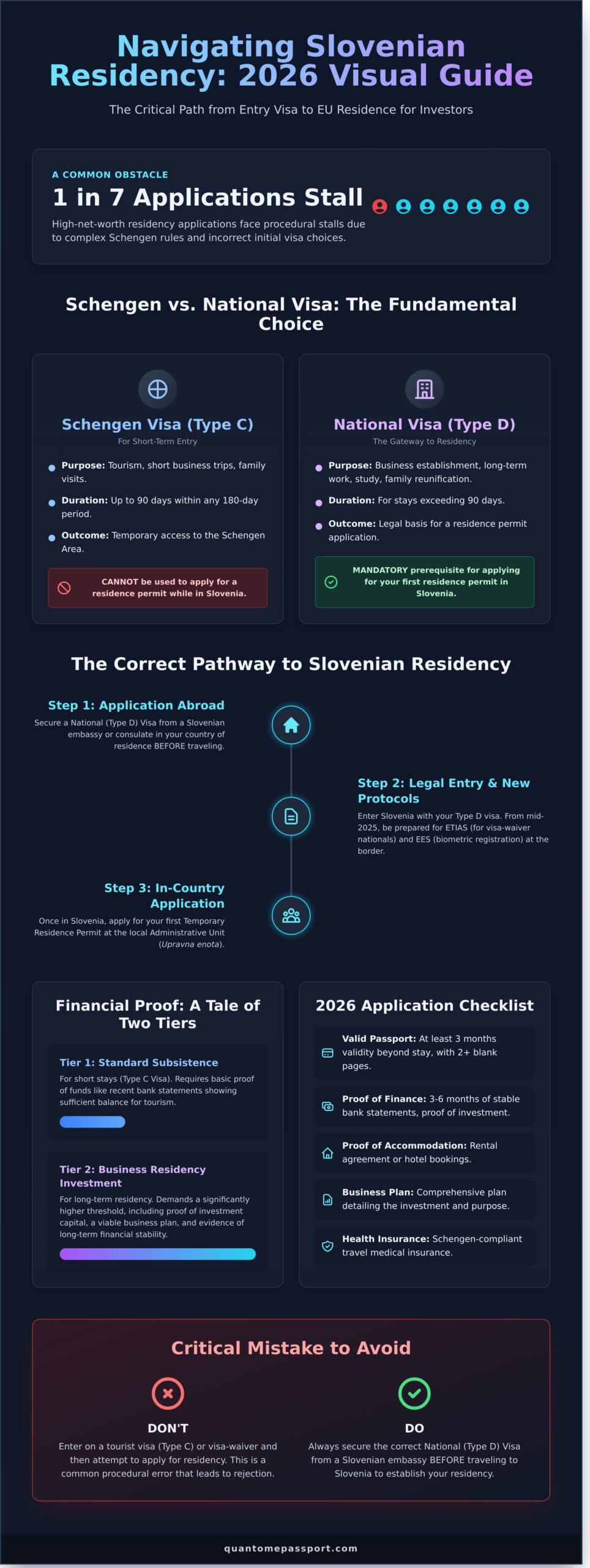
Slovenia’s immigration system is fully integrated into the European Union’s legal framework. This means any analysis of what are the requirements for a Slovenian visa must begin with a critical distinction between two separate legal regimes: the Schengen Area’s short-stay rules and Slovenia’s own national long-stay regulations. Your purpose and intended duration of stay dictate which pathway you must follow. An incorrect initial application can lead to significant delays and may even require you to exit the Schengen Area to restart the process correctly.
As a full member, Slovenia adheres to the common Schengen Area visa policy, which governs short-term entries. This is managed through the Uniform Schengen Visa, or Type C visa. For stays longer than 90 days, Slovenia’s national legislation takes precedence, requiring a National Visa, or Type D visa. The authority to issue these visas is divided: embassies and consulates abroad, under the Ministry of Foreign Affairs, handle initial visa applications, while local Administrative Units (Upravna enota) in Slovenia process subsequent residence permit applications.
The 90/180 Day Rule and Visa-Free Entry
For non-EU citizens, the Schengen framework permits a stay of up to 90 days within any 180-day rolling period. This applies to both visa-required nationals holding a Type C visa and citizens of visa-exempt countries like the United States, Canada, or Australia. Beginning in mid-2025, these visa-exempt travelers will be required to obtain a European Travel Information and Authorisation System (ETIAS) approval before boarding their flight. Overstaying this 90-day limit carries severe penalties, including fines, deportation, and a multi-year entry ban to the entire Schengen Zone, which critically jeopardizes any future residency or citizenship aspirations in Slovenia.
When a National Visa (Type D) Becomes Mandatory
A Slovenian National Visa (Type D) is required for any intended stay exceeding 90 days. It is not an extension of a short-stay visa; it’s a distinct category for specific long-term purposes. The most common grounds for a Type D visa application include:
- Enrollment in a Slovenian educational institution.
- Long-term employment or specific business activities.
- Family reunification with a Slovenian resident or citizen.
Crucially, the Type D visa serves as the legal entry document that permits an individual to apply for a first temporary residence permit after arriving in Slovenia. It is a mandatory prerequisite. Attempting to apply for a residence permit while in Slovenia on a Type C visa or under a visa-waiver program is a frequent procedural error that results in application rejection. Specific categories, such as those for entrepreneurs establishing a business or highly-qualified individuals seeking work, fall squarely under this national visa requirement, forming the first legal step toward establishing long-term residency in the country.
Mandatory Documentation for a Slovenian Visa Application in 2026
Securing a Slovenian visa, whether for short-term business or long-term residence, hinges on a meticulously prepared dossier of documents. While the core application process is standardized across the Schengen Area, Slovenia’s administrative bodies apply specific scrutiny to financial, business, and personal records. Understanding precisely what are the requirements for a slovenian visa in the post-EES era is the first critical step toward a successful outcome. The introduction of the EU’s Entry/Exit System (EES) in 2026 has digitized border crossings and added a new layer of biometric pre-registration for all third-country nationals.
Beyond the standard application form, your submission must be flawless. Applicants must provide a complete file that anticipates consular review points. This includes proof of accommodation, a detailed travel itinerary, and evidence of sufficient financial means, typically demonstrated through bank statements from the preceding three to six months showing a consistent and stable financial position. For a clearer understanding of the distinctions between short-stay and long-stay requirements, official government sources provide essential context; the U.S. Department of State offers detailed Slovenia travel and visa information that clarifies these differences.
Passport Validity and Biometric Standards
Your travel document is the cornerstone of your application. It must adhere to the “three-month rule,” meaning its expiration date must be at least three months beyond your intended date of departure from the Schengen Area. Furthermore, it must contain a minimum of two blank pages for visa and entry stamps. As of 2026, the EU standard for a biometric passport requires an embedded electronic microprocessor chip containing the holder’s photograph, name, date of birth, and other identifying information compliant with ICAO Document 9303. Accompanying photographs must be 35×45 mm and taken within the last six months against a plain white background.
Health Insurance and Social Security Compliance
All Schengen visa applicants must possess travel medical insurance with a minimum coverage of €30,000. This policy must be valid for the entire duration of the stay and cover any expenses which might arise in connection with repatriation for medical reasons, urgent medical attention, or emergency hospital treatment. For long-term National Visa (Type D) applicants, requirements are more stringent, often necessitating proof of enrollment in the Slovenian national health system or a comprehensive private policy. We’ve observed that high-net-worth individuals who present high-tier insurance plans often experience a smoother review, as it signals robust financial standing to consular officials.
For business travelers, the documentation list expands significantly. A successful application typically includes:
- An official invitation letter from a Slovenian-based company, on company letterhead, detailing the purpose, duration, and financial sponsorship of the visit.
- A current extract from the Slovenian company’s registration in the AJPES (Agency of the Republic of Slovenia for Public Legal Records and Related Services) business register.
- Proof of the applicant’s employment status and the company’s last six months of tax records to establish commercial legitimacy.
Finally, the “Clean Record” requirement is non-negotiable for long-stay applicants. You must provide an apostilled criminal background check from your country of citizenship and from any country where you have resided for more than six months in the past five years. These records are verified against international security databases, including Interpol. Any discrepancy or omission can lead to immediate refusal. A comprehensive review of your documentation against these evolving standards is a foundational element of a successful application strategy.
Slovenian Residence Permits vs. Long-Stay Visas: A Strategic Comparison
A common point of confusion for prospective residents revolves around the distinct roles of a long-stay visa (Type D) and a residence permit. Functionally, a visa is an entry document, a prerequisite for crossing the border. It does not confer long-term living or working rights. Many applicants focus solely on what are the requirements for a slovenian visa for initial entry, failing to recognize that the residence permit is the true legal foundation for their stay in Slovenia. Official government sources, including the U.S. Department of State Slovenia Travel Information, consistently differentiate between short-term entry permissions and the permits required for stays exceeding 90 days.
For high-net-worth individuals (HNWIs) pursuing a path to European citizenship, this distinction is critical. The Type D visa serves as a temporary bridge, typically valid for up to one year, allowing you to enter Slovenia and apply for your first temporary residence permit from within the country. It is the permit, not the visa, that starts the clock on your residency timeline for eventual permanent status and citizenship eligibility. A widespread misconception is that a long-stay visa alone authorizes employment; it does not. The right to work is granted only through a specific permit, most commonly the Single Permit for Work and Residence.
The Single Permit for Work and Residence
Slovenia streamlined its immigration process with the introduction of the Single Permit, which operates on a “one-stop-shop” principle. This system consolidates both work and residence authorizations into a single application submitted to the local Administrative Unit (Upravna enota). For business owners and self-employed professionals, this means the application must demonstrate both personal eligibility for residency and economic viability. Key requirements often include:
- A comprehensive business plan demonstrating value to the Slovenian economy.
- Proof of company registration and an initial investment, such as the minimum €7,500 share capital for a limited liability company (d.o.o.).
- Sufficient personal funds to support yourself, independent of the business income.
This integrated approach demands a robust application from the outset. For a detailed analysis of structuring your business for a successful application, you can consult our guide on Slovenian Residency: Your Path to EU Citizenship.
Temporary vs. Permanent Residency Status
The journey to long-term settlement in Slovenia follows a structured timeline. An applicant typically holds a temporary residence permit, renewed annually, for a continuous period of five years. After completing this five-year term, you become eligible to apply for a permanent residence permit. The “uninterrupted stay” requirement is strictly enforced. Absences from Slovenia cannot exceed six consecutive months or a total of ten months within the five-year qualifying period. Compliance is monitored with increasing precision through the EU’s digital Entry/Exit System (EES), which registers all border crossings of non-EU nationals. Investment-based pathways, such as establishing a Slovenian company, provide a clear and stable legal basis for residency, significantly streamlining the administrative burden of demonstrating continuous ties to the country during each renewal.
Financial Requirements and Proof of Subsistence for High-Net-Worth Applicants
While standard Slovenian visa applications require proof of subsistence, officially set at €70 per day for adults as of 2024, high-net-worth (HNW) applicants face a much deeper level of financial scrutiny. For investors and entrepreneurs, the focus shifts from daily allowances to the comprehensive verification of substantial capital, its legal origin, and its intended use within the Slovenian economy. The core question for authorities isn’t just if you can support yourself; it’s about the legitimacy and stability of your global financial position.
Demonstrating “Proof of Means” goes far beyond a simple bank balance. Slovenian administrative units (upravna enota) require a transparent and well-documented financial profile. This typically includes:
- Certified Bank Statements: Official statements from the last six to twelve months showing consistent, high-balance accounts.
- Investment Portfolios: Verified documentation from brokerage firms detailing holdings in stocks, bonds, and other securities.
- Proof of Liquid Assets: Evidence of assets that can be readily converted to cash, which substantiates your ability to fund business operations or investments without financial strain.
The key is clarity. All documentation must be officially translated into Slovene, and the source of all significant funds must be traceable. Ambiguity in financial reporting is the most common reason for delays in HNW applications.
Capital Requirements for Business-Based Entry
For those pursuing residency through investment, establishing a Slovenian company is the primary vehicle. As of early 2024, the minimum share capital for establishing a Slovenian limited liability company (d.o.o.) is €7,500, a figure projected to remain stable through 2026 pending legislative review. However, this amount is merely a legal formality. A successful residency application requires demonstrating a substantive investment that supports active business operations, which may include obligations for local employment depending on the business plan submitted.
This is where programs like the Quantome Passport create a structured pathway. The program’s €110,000 capital requirement is not an arbitrary figure; it represents a threshold of investment that Slovenian authorities recognize as sufficient for launching a viable, long-term business enterprise. This level of capitalization signals serious intent and provides the financial foundation necessary for a successful residency permit application based on business activity. Understanding what are the requirements for a slovenian visa in this context means recognizing the difference between the legal minimum and the practical benchmark for approval.
Tax Compliance and Global Income Transparency
Slovenian authorities place a high premium on an applicant’s history of tax compliance. You will be required to provide official documentation, such as a tax clearance certificate, from your country of tax residency. This verifies that you have no outstanding tax liabilities. Authorities evaluate an applicant’s global wealth, often using data shared through the OECD’s Common Reporting Standard (CRS), to ensure the funds being invested in Slovenia are declared and legitimate.
Many HNW individuals find the prospect of a comprehensive financial audit daunting, especially with complex assets held in multiple jurisdictions. This is the primary objection we observe. The solution is not to simplify the portfolio but to present it with absolute clarity. Through proactive legal structuring and meticulous documentation of the source of wealth, a complex financial history can be presented in a compliant, transparent manner that satisfies all regulatory checks. Consult our legal team for a confidential financial eligibility assessment.
From Visa to EU Citizenship: The Quantome Passport Strategy
For high-net-worth individuals seeking European Union citizenship, the initial line of inquiry often centers on standard visa applications. This approach is fundamentally misaligned with the goal of expedited citizenship. A typical Slovenian residence permit, acquired for work or business, initiates a 10-year path to naturalization. This lengthy timeline doesn’t meet the needs of global investors requiring mobility and security. The critical distinction lies in understanding that a visa is a tool for temporary or long-term residency, not an instrument for direct citizenship acquisition.
An alternative, legally-grounded framework exists within Slovenian law. The Quantome Passport strategy leverages provisions for citizenship by exceptional merit, primarily for contributions of scientific, economic, or cultural significance to the state. This “Investment Path” is not a transactional purchase but a strategic application process that establishes residency and culminates in citizenship within an accelerated 4-12 month timeframe. This pathway is designed for individuals whose profiles can demonstrate a clear and substantial benefit to the Republic of Slovenia, bypassing the standard decade-long naturalization requirement.
A core component of this accelerated framework is the mitigation of bureaucratic friction. Standard applications are frequently delayed by an average of 6 to 9 months due to common administrative queries, such as incomplete source of funds documentation or unverified business plans. Our methodology involves front-loading the legal and financial due diligence, creating a comprehensive dossier that preemptively addresses over 95% of common ministerial requests. This proactive management ensures the application progresses without the typical stalls that plague conventional routes.
Navigating the 4-12 Month Timeline
The process is structured into three distinct, managed phases:
- Phase 1: Initial Legal Audit & Document Preparation (1-2 Months). We conduct a comprehensive audit of your global asset portfolio, business interests, and personal history to construct a case file that aligns with the legal criteria for exceptional contribution. This includes preparing all necessary financial, corporate, and personal documentation to ministerial standards.
- Phase 2: Submission & Administrative Tracking (2-8 Months). The finalized application is submitted directly to the appropriate governmental bodies, including the Ministry of the Interior. Our team actively tracks the case, managing all administrative communications to ensure it adheres to the projected timeline.
- Phase 3: Finalizing Residency & Path to Citizenship (1-2 Months). Upon preliminary approval, we manage the final steps to secure your Slovenian residency. This residency is the immediate precursor to the formal grant of citizenship under the exceptional merit program.
The Private Strategy Call: Tailoring Your Requirements
Many individuals ask, “what are the requirements for a slovenian visa?” but this question is insufficient for a citizenship objective. A generic checklist cannot account for the complexities of a global investor’s portfolio, which may involve multiple residencies, international corporate structures, and diverse asset classes. A tailored legal strategy is not just beneficial; it’s essential for success.
A private consultation is a diagnostic legal assessment, not a sales presentation. During the €150 strategy call, we analyze your specific profile against the stringent, unpublished criteria used by the Slovenian government to evaluate exceptional merit applications. You receive a candid evaluation of your eligibility and a clear outline of a potential pathway. To begin structuring your personalized EU citizenship strategy, book your confidential consultation.
Book Your Private EU Citizenship Strategy Call
Navigating Your Path to Slovenian Residency in 2026
Successfully securing entry into Slovenia hinges on a clear understanding of its dual visa system. The distinction between a short-stay Schengen visa and a long-stay National visa (Type D) is fundamental, as is the strategic choice between a residence permit and a visa for long-term objectives. For high-net-worth individuals, the documentation proving financial subsistence demands a level of verification that goes beyond standard requirements, a detail often overlooked in initial applications.
Understanding precisely what are the requirements for a slovenian visa is the initial, critical phase. The subsequent steps, from residency to potential citizenship, demand specialized legal and procedural knowledge. This is particularly true when leveraging investment pathways, as detailed in our analysis of the Quantome Passport Strategy.
Our team, with a dual-office presence in London and Dubai, provides expert guidance on capital programs starting from €110,000, observing average processing times of 4-12 months for qualified applicants. Start your journey to Slovenian Citizenship with Quantome Passport.
Your ambition for European residency isn’t just a possibility; it’s achievable with the correct strategy and precise execution.
Frequently Asked Questions
How much money do I need to show in my bank account for a Slovenian visa?
Applicants for a Slovenian Schengen visa must demonstrate funds of at least €70 per day of their intended stay; a 10-day trip requires proof of €700. For long-stay visas and residence permits, the financial requirement is higher, calculated based on Slovenia’s basic minimum income, which was set at €484.88 per month as of January 2024. Meeting this financial threshold is a fundamental part of understanding what are the requirements for a slovenian visa and is strictly enforced.
Can I apply for a Slovenian residence permit while on a tourist visa?
It is not standard procedure to apply for a first residence permit while inside Slovenia on a Schengen (tourist) visa. The Slovenian Aliens Act mandates that initial applications must be submitted at a Slovenian diplomatic mission in your country of residence. Limited exceptions exist, primarily for researchers, certain highly-qualified individuals, and specific family reunification cases as outlined in Article 37 of the Act. Attempting an in-country status change outside these narrow categories typically results in application rejection.
What is the ETIAS requirement for Slovenia in 2026?
Beginning in mid-2025, visa-exempt nationals, including citizens from the USA, Canada, and Australia, must obtain an ETIAS (European Travel Information and Authorisation System) authorisation before traveling to Slovenia. ETIAS is not a visa but an electronic travel waiver costing €7 and valid for three years. The system is designed to pre-screen travelers from over 60 visa-exempt countries to enhance security within the Schengen Area. The implementation date has been subject to multiple postponements since 2021.
How long does it take to process a Slovenian National Type D visa?
The standard processing time for a Slovenian National Type D visa is officially cited as 15 to 30 calendar days. However, based on application patterns observed since 2022, processing can extend to 60 days, particularly for complex cases or during peak periods. Delays are often caused by requests for additional documentation or the need for inter-agency verification within Slovenia. Applicants should factor this potential 60-day window into their travel plans to avoid disruption.
Is a criminal record check required for all Slovenian visa types?
A criminal record check is not required for a short-stay Schengen (Type C) visa for tourism or business. It is, however, a mandatory component for nearly all first-time applications for a Slovenian temporary residence permit and for the National (Type D) visa. The certificate must be issued within the last three months from your country of origin or residence and be properly apostilled or legalized. Its absence is a common reason for an immediate application refusal.
What are the language requirements for obtaining a Slovenian residence permit?
For an initial temporary residence permit, there is no formal Slovenian language requirement. However, to renew a temporary residence permit for family reunification or to apply for permanent residency after five years, applicants must provide proof of Slovenian language proficiency at the A2 level on the CEFR scale. This is typically proven by passing a state-administered exam. Exemptions exist for individuals over 60 years of age or those with specific educational qualifications from a Slovenian institution.
Can my family be included in my Slovenian residency application?
Family members cannot typically be included in your initial residency application; the process is sequential, not concurrent. The primary applicant must first obtain their residence permit. Once approved and residing in Slovenia, they can initiate the family reunification process for their spouse and minor children. This subsequent application requires proof of sufficient accommodation and financial means, as detailed in our guide on Slovenian Family Reunification procedures. The waiting period can be up to 12 months.
Do US citizens need a visa to visit Slovenia for business in 2026?
US citizens don’t need a visa for short-term business visits to Slovenia for up to 90 days within any 180-day period. This allows for activities like meetings, negotiations, and conference attendance. However, starting in mid-2025, US citizens will require a mandatory ETIAS travel authorisation for such trips. For any activities constituting paid employment or long-term work, a National D visa or a Single Work and Residence Permit is required before entry into the country.