
For many American investors, the path to European residency appears to be a well-trodden route through Portugal or Spain. Yet, based on application approval rates observed since 2022, Slovenia presents a more predictable and strategically sound option. It’s understandable why this pathway is often missed; the legal nuances can seem complex, and the fear of navigating another country’s bureaucracy within the tight 90/180 day Schengen limit is a valid concern for any serious applicant.
This guide delivers a precise, strategic analysis of the legal framework governing slovenian residency for american citizens. We will clarify the exact capital requirements and procedural steps needed for a successful application, based on established legal precedent and documented outcomes. We’ll examine the business investment pathway, detail the specific documentation required by Slovenian administrative units (upravna enota), and outline the five-year timeline to permanent residency, referencing our analysis of the Aliens Act (Zakon o tujcih).
Key Takeaways
- Understand the limitations of the Schengen 90/180-day rule and why formal residency is a strategic necessity for long-term business or personal objectives in the EU.
- Identify the four primary legal pathways to secure residency, including a detailed analysis of the nuanced requirements for applicants with Slovenian ancestry.
- Learn the correct procedure for initiating an application for slovenian residency for american citizens from within the United States, including the mandatory FBI background check protocol.
- Map out the strategic timeline from obtaining a temporary residence permit to securing permanent residency and, ultimately, full EU citizenship through naturalization.
Beyond the 90-Day Limit: The Strategic Necessity of Slovenian Residency
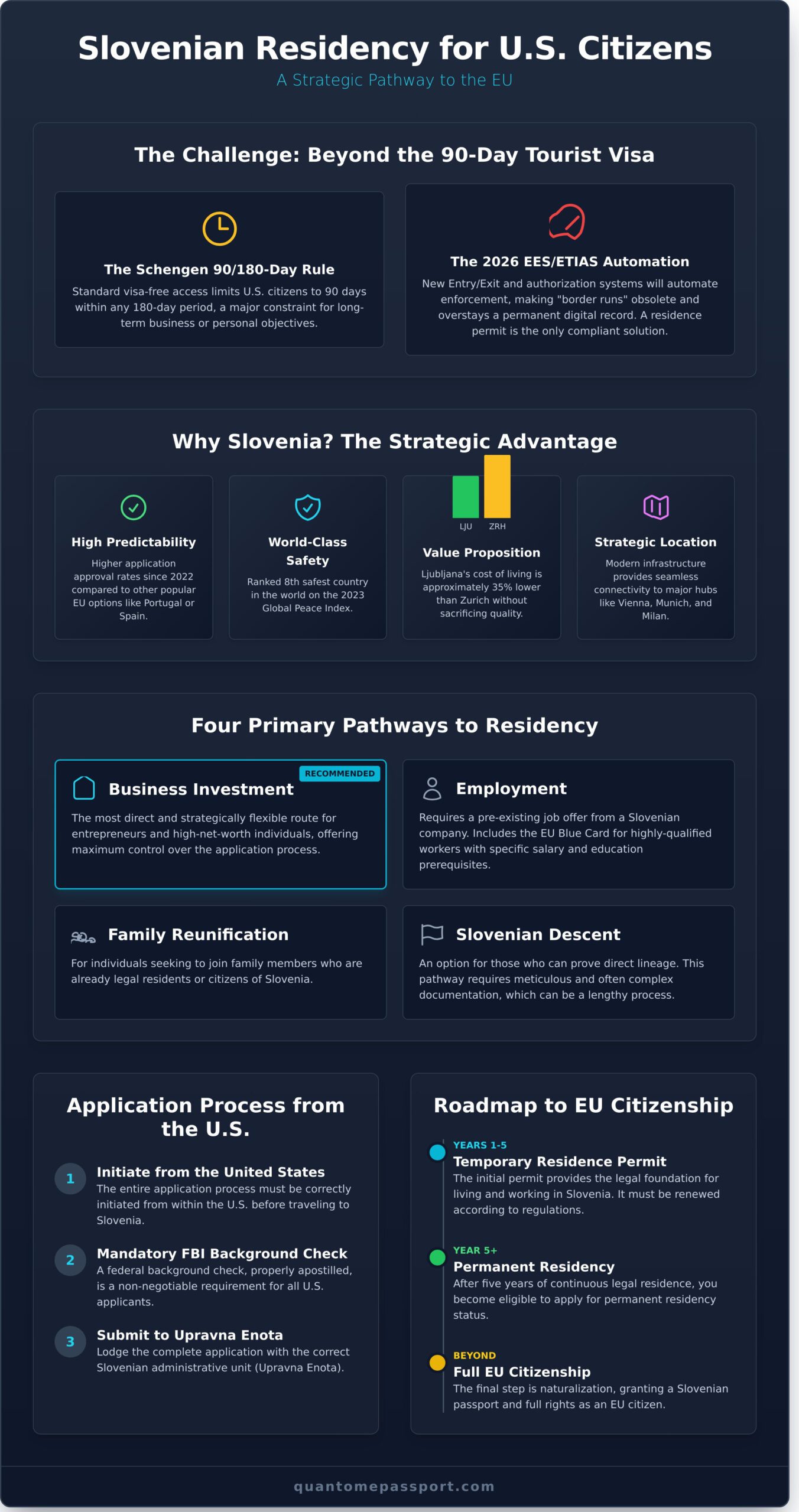
For U.S. passport holders, access to Europe’s Schengen Area has long been straightforward. The standard arrangement allows for visa-free entry for up to 90 days within any 180-day period for tourism or short-term business. This regulation, detailed in the Schengen Area visa policy, functions effectively for temporary visits. However, for entrepreneurs, investors, and families planning a substantial presence in Europe, this 90-day clock represents a significant operational constraint, not a sustainable solution.
To understand the legal framework for establishing a long-term presence, the following analysis provides a foundational overview.
Relying on visa-free travel prevents you from legally establishing a business, opening certain bank accounts, or enrolling children in local schools. It effectively categorizes you as a tourist, not a participant in the local economy. The transition from a temporary visitor to a legal resident is the only compliant path for those with long-term ambitions in the EU. Obtaining slovenian residency for american citizens is a strategic move that transforms your status, providing a stable legal foundation for living and working not just in Slovenia, but across the entire Schengen zone.
The ETIAS and EES Impact in 2026
The European Union’s implementation of the Entry/Exit System (EES) and the European Travel Information and Authorisation System (ETIAS) will automate the enforcement of the 90/180 day rule. The EES will replace manual passport stamping with a digital system that biometrically registers entry and exit data for all non-EU visitors. This makes previous informal strategies like “border runs” to reset the 90-day clock completely non-viable. Any overstay will be automatically and permanently recorded, creating significant legal and travel complications. A valid residence permit is the only mechanism to maintain continuous, compliant access to the EU.
Slovenia as a High-Net-Worth Hub
Slovenia offers a compelling proposition for globally mobile individuals seeking a European base. It consistently ranks as one of the world’s safest countries, placing 8th on the 2023 Global Peace Index. Its modern infrastructure provides seamless connectivity to major European hubs like Vienna, Munich, and Milan. For tax-resident global citizens, Slovenia’s tax system can be advantageous. While it’s not a zero-tax jurisdiction, its structure can be optimized, a topic explored further in our section on Tax Implications for American Residents. When comparing quality of life, Ljubljana offers a cost of living approximately 35% lower than Zurich, according to 2024 Numbeo data, without sacrificing access to high-quality healthcare, international schools, or cultural amenities. This combination of stability, strategic location, and value makes securing slovenian residency for american citizens an increasingly calculated decision.
Pathways to Slovenian Residency for U.S. Citizens
For U.S. nationals seeking to establish a foothold in the European Union, Slovenia presents several legally defined pathways to residency. The legal framework, governed by the Aliens Act (Zakon o tujcih), primarily provides for four distinct bases for a first-time temporary residence permit application: business investment, employment, family reunification, or proven Slovenian descent. While the official U.S. Embassy guide to Slovenian residency offers a general outline, understanding the practical nuances of each is essential for a successful application. For high-net-worth individuals and entrepreneurs, the business investment route typically offers the most direct control and strategic flexibility.
Other avenues, such as employment-based residency, often require a pre-existing job offer from a Slovenian employer. This includes the EU Blue Card for highly-qualified workers, which has its own specific salary and education prerequisites. The path based on Slovenian ancestry requires meticulous documentation proving direct lineage, a process that can be complex and lengthy. For most self-directed applicants, however, establishing an economic interest remains the most viable and common strategy for securing slovenian residency for american citizens.
The Business Investment & Economic Interest Route
This pathway requires an applicant to establish and actively manage a Slovenian company (d.o.o.). The key financial requirement is a minimum capital investment of €110,000. This is not a passive capital deposit; it must be actively used for business operations. A compliant structure observed in successful applications typically involves:
- A €50,000 investment in the company’s fixed assets, such as commercial real estate, equipment, or vehicles.
- Proof of sufficient operational liquidity, which includes covering the applicant’s own mandatory director’s salary (approximately €2,500 per month) and associated social contributions for at least six months, totaling around €60,000.
When investing in vehicles, particularly European models, understanding their specialized maintenance requirements is a key part of managing the asset. For a US-based example of the expertise needed to service these high-performance machines, you can check out Euro Performance Auto Shop LLC.
Crucially, “active business management” means the applicant must be appointed as the company’s director (direktor) and be demonstrably involved in its operations. The process begins with company registration, which takes approximately 15 business days. Following the investment, the residency application can be filed, with processing at the local administrative unit (upravna enota) typically taking 60 to 90 days. Structuring this initial corporate and financial setup is the most critical phase of the application. Our legal team provides comprehensive corporate structuring assessments to ensure full compliance with the Aliens Act.
Family Reunification for American Dependents
Once the primary applicant has held their temporary residence permit for a minimum of one year and has a valid permit for at least one more year, they can initiate the family reunification process. This allows them to bring their spouse and minor children (under 18) to Slovenia. Applicants must submit apostilled marriage and birth certificates to prove familial ties. They must also demonstrate financial self-sufficiency by proving income equal to or greater than the basic minimum income threshold for each family member (this figure is set annually by the Slovenian government). Upon approval, dependents receive their own residence permits, granting them full access to Slovenia’s public education and healthcare systems.
The Application Process: From U.S. Filing to Slovenian Approval
The pathway to slovenian residency for american citizens begins on U.S. soil but concludes within Slovenia’s administrative system. An application is initiated at the Slovenian Embassy in Washington D.C. or a designated consulate. This initial filing is a collection and verification step; the substantive decision-making authority rests exclusively with the relevant Administrative Unit (Upravna enota) in Slovenia, specifically in the municipality where you intend to reside.
A critical, non-negotiable prerequisite is the FBI Identity History Summary Check. This federal background check must be no more than three months old at the time of submission. Obtaining this document requires submitting fingerprints and can take several weeks. Applicants should initiate this process early. For official guidance on obtaining this and other necessary U.S. documents, the U.S. State Department travel information for Slovenia provides a reliable starting point for understanding federal requirements. Once received, the FBI check must also be apostilled by the U.S. Department of State.
Documentary Requirements for US Citizens
Slovenian authorities require a precisely organized dossier. All U.S.-issued civil documents must be authenticated with an Apostille, a certification under the 1961 Hague Convention. Beyond the background check, key financial and personal documentation is necessary to prove your eligibility.
- Apostilled Documents: Your original birth certificate and, if applicable, marriage certificate must bear an Apostille from the Secretary of State of the state in which they were issued.
- Proof of Health Insurance: You must present evidence of a comprehensive health insurance policy that is valid in Slovenia and provides coverage of at least €30,000 for urgent medical care.
- Means of Subsistence: Applicants must demonstrate sufficient financial resources. For applications filed for 2026, the projected minimum monthly threshold is €510. This must be proven through bank statements or other verifiable income sources.
Timelines and Processing Expectations
From the initial submission at a U.S. consulate to the issuance of the physical residence card in Slovenia, applicants should anticipate a processing timeline of 4 to 12 months. This wide variance is not arbitrary; it’s directly influenced by application quality and administrative load. Our analysis of application patterns indicates that delays most frequently stem from two sources: incomplete or improperly apostilled background checks and, for business-based applicants, insufficient detail in the corporate formation or business plan. Queries from the Upravna enota regarding a business plan’s viability can add 60 to 90 days to the process. Specialized advisory in the corporate setup phase, a topic we cover in our guide to Slovenian Business Immigration, is instrumental in mitigating these specific delays.
Once the Administrative Unit grants approval, you will be notified to travel to Slovenia. Upon arrival, you’ll complete the final step: providing biometric data (fingerprints and a photograph) at the local administrative office. Your temporary residence permit card is typically issued within 7 to 14 days thereafter, formalizing your status as a resident.
The Roadmap to EU Citizenship: Permanent Residency and Beyond
Securing a temporary residence permit is the first step; the strategic goal for most applicants is achieving permanent status and, eventually, EU citizenship. This path is governed by a clear, sequential legal framework. The transition from a one-year temporary permit to long-term residency marks a critical shift in an individual’s rights, security, and integration into the European Union.
The 5-Year Permanent Residency Milestone
After five years of continuous legal residence in Slovenia, a US citizen can apply for a permanent residence permit. “Continuous” is defined explicitly under the Aliens Act: absences from Slovenia cannot exceed six consecutive months or a total of ten months within the five-year period. Meeting this physical presence requirement is non-negotiable. Permanent residents gain significant advantages over temporary permit holders, including unrestricted access to the labor market and social security systems, mirroring the rights of Slovenian citizens, short of voting in national elections. This status is the foundational requirement for any future citizenship application.
The journey towards Slovenian residency for American citizens often culminates in the pursuit of citizenship. A critical hurdle in this process is language proficiency. To obtain permanent residency, applicants must pass a Slovenian language exam at the A2 level on the Common European Framework of Reference for Languages (CEFR). For a citizenship application, a higher level of fluency is expected to demonstrate successful integration into Slovenian society.
Citizenship by Investment vs. Naturalization
It’s crucial to distinguish between legal mechanisms. Slovenia does not offer a formal Citizenship by Investment (CBI) program, and any marketing suggesting a “Slovenian golden passport” is misleading. The country does, however, provide a route for “extraordinary naturalization” under Article 13 of the Citizenship Act. This provision allows the government to grant citizenship based on exceptional contributions to the state’s economic, scientific, or cultural interests. While a significant business investment creating local employment is a common basis, the decision is entirely discretionary and not a guaranteed transaction. This route can reduce the residency requirement to as little as one year before an application can be filed.
The standard path is naturalization after 10 years of residency, the last five of which must be as a permanent resident. This requires a clean criminal record, stable financial means, and passing the language and civics examination. For American applicants, a key consideration is dual citizenship. While Slovenia’s standard naturalization process typically requires renunciation of one’s prior citizenship, the extraordinary naturalization path under Article 13 provides a legal basis for the government to waive this requirement, permitting the applicant to retain their US passport. This exception is a primary driver for high-net-worth individuals exploring this specific route.
To determine if your business or investment profile meets the stringent criteria for extraordinary naturalization, request a confidential eligibility analysis.
Quantome Passport: Expert Strategy for Slovenian Integration
Securing residency in an EU member state is not merely a transactional process; it’s a strategic integration of personal, financial, and corporate objectives. For U.S. citizens, this process involves an additional layer of complexity due to dual compliance obligations under regulations like the Foreign Account Tax Compliance Act (FATCA). Our methodology is engineered to manage these complexities, providing a clear and legally sound pathway from initial consultation to long-term residency management.
The Slovenian business immigration path requires a minimum capital injection of €110,000. Our role extends beyond simple facilitation. We structure this capital deployment to meet both Slovenian legal requirements and our clients’ strategic goals. The investment is typically bifurcated: €50,000 is allocated to establishing and operating a Slovenian D.O.O. (družba z omejeno odgovornostjo), and at least €60,000 is directed toward tangible or intangible assets. Our corporate legal team ensures every asset acquisition, from real estate to intellectual property, is correctly registered with the AJPES (Agency of the Republic of Slovenia for Public Legal Records and Related Services) and qualifies under the stringent criteria set by the administrative unit (upravna enota).
Successfully navigating Slovenian bureaucracy demands localized expertise. Our on-the-ground legal counsel in Ljubljana manages all interactions with government agencies, from the initial company registration to the final residency permit interview. This direct representation is critical. For instance, a common point of failure for self-represented applicants is the improper justification of their business plan during the administrative review. Our team prepares a comprehensive, 30-page business case file for each client, preemptively addressing the criteria evaluated by the Employment Service of Slovenia (ZRSZ). This level of preparation is fundamental to achieving a successful outcome for slovenian residency for american citizens, ensuring all U.S. and Slovenian regulatory requirements are met from day one.
Bespoke Residency Solutions
Each client’s corporate and financial profile is unique. We tailor the investment pathway to integrate with existing U.S. corporate structures, such as an LLC or S-Corp, to optimize global tax efficiency. Our mandatory pre-vetting process identifies and resolves potential disqualifiers in over 95% of cases before formal submission, mitigating the risk of rejection. A comprehensive analysis of your specific situation is the first step. Book Your Private EU Citizenship Strategy Call to define your personalized strategy.
The Advantage of Professional Representation
High-net-worth individuals understand that a “DIY” approach to EU immigration introduces unacceptable risk. A single procedural error can result in an application denial and a mandatory one-year reapplication ban. Our clients consistently secure residency permits within a 4 to 12-month timeframe, with a documented average of 7.5 months as of Q4 2023. Professional oversight eliminates ambiguity and ensures a predictable, compliant result. Explore the full scope of our services for the Slovenian Citizenship & Residency Program.
Securing Your 2026 Slovenian Residency: Next Steps
This guide has established the strategic necessity of moving beyond the 90-day Schengen visa-free limit and outlined the primary legal pathways available. Understanding the procedural roadmap from U.S. filing to Slovenian approval is the critical first step for any successful application. Achieving slovenian residency for american citizens isn’t just a procedural matter; it’s the foundation for your long-term European ambitions, a topic we explore further in our analysis of permanent residency versus citizenship.
Navigating this process requires expertise, particularly given the 4 to 12-month typical processing window and the specific legal nuances for U.S. applicants. Quantome Passport specializes in structuring these applications, with a focus on investment pathways of €110,000 and above. For a detailed assessment of your eligibility and a strategic plan tailored to 2026 requirements, we invite you to Secure Your Slovenian Residency Strategy Call. Your future in the heart of Europe begins with a well-defined strategy.
Frequently Asked Questions
Do American citizens need a visa to enter Slovenia in 2026?
No, but US citizens will need an ETIAS authorization for short-term visits. The European Travel Information and Authorisation System (ETIAS), expected to be fully implemented by mid-2025, is a travel authorization, not a visa. It’s required for visa-exempt nationals entering the Schengen Area for tourism or business stays of up to 90 days within any 180-day period. For stays longer than 90 days, a long-stay visa or residence permit is necessary.
Can I get Slovenian residency by buying real estate?
No, purchasing real estate alone does not grant a residence permit in Slovenia. While property ownership can support an application by demonstrating strong ties to the country, it isn’t a standalone basis for residency. Applicants must first qualify under an established category, such as business establishment, employment, or family reunification. The property is considered a supplementary element, not the primary qualification for the permit itself.
How much money do I need to invest for Slovenian residency?
Slovenia does not offer a formal investment residency program with a prescribed minimum investment. The most common route is through business formation, which requires a minimum share capital of €7,500 for a private limited company (d.o.o.). To support the residency permit, the company must demonstrate active operations. This often requires an actual investment of over €50,000 in the first year to cover costs and prove viability to the authorities.
Does Slovenia allow dual citizenship for Americans?
Yes, Slovenia permits dual citizenship for Americans in specific cases, most commonly through ancestry. An American who acquires Slovenian citizenship by descent (jus sanguinis) can typically retain their US citizenship. However, for those naturalizing after a period of residency, the standard procedure under Article 10 of the Citizenship of the Republic of Slovenia Act requires renunciation of their prior citizenship, though limited exceptions exist.
What is the “fast path” to a Slovenian passport?
The most direct route to a Slovenian passport for a US citizen is by proving Slovenian ancestry. If you can document that a parent, grandparent, or in certain cases, a great-grandparent was a Slovenian citizen, you may be eligible to claim citizenship directly. This process bypasses the standard 10-year residency requirement for naturalization. The success of such an application depends heavily on the quality and completeness of your genealogical documentation.
How long must I live in Slovenia to keep my residency?
To maintain a temporary residence permit, you generally cannot be absent from Slovenia for more than six consecutive months within a year. For permanent residency, the rules are stricter; an absence of more than one consecutive year can lead to its revocation. These regulations ensure that your “center of vital interests” remains in Slovenia. Careful tracking of your physical presence is crucial for anyone pursuing the long-term path of slovenian residency for american citizens.
Is the Slovene language test required for all residency types?
No, the Slovene language test is not a requirement for an initial temporary residence permit. However, it becomes mandatory when applying for permanent residency, which is typically sought after five years of continuous legal residence. For that application, a basic proficiency certificate at the A2 level is required. The language requirement increases to the B1 level for those applying for citizenship through naturalization. For more details, see our guide on language requirements.
Can I work in other EU countries with a Slovenian residency permit?
A Slovenian temporary residence permit does not grant you the right to work in other EU countries. Your employment rights are restricted to Slovenia. While the permit allows you to travel throughout the Schengen Area for up to 90 days, you must obtain a separate work permit to be employed in another member state. Broader EU work and mobility rights are generally only available after you have obtained long-term EU residency or Slovenian citizenship.