Many prospective investors are met with conflicting information when researching Slovenian residency, often centered around a non-existent ‘Golden Visa’ program. This ambiguity frequently obscures the legitimate, business-centric pathway that exists for non-EU nationals. Understanding how to invest in Slovenia for residency requires a precise grasp of its specific legal framework, which differs significantly from the direct citizenship-by-investment models seen elsewhere in the EU. This guide provides a definitive analysis of this established legal route, clarifying the procedural steps and capital commitments involved.
Here, we will deconstruct the active business investment structure, clarifying the minimum capital requirements-which our data indicates starts at approximately €110,000-and the necessary operational criteria. You will gain a clear, predictable timeline from initial company formation to securing your temporary residence permit and, eventually, the long-term path toward permanent residency and EU citizenship. We will also detail the legal provisions for including family members in your application, a critical component for many global families. This examination is distinct from the procedural requirements for a Slovenian Work Permit, a related but separate legal process.
Key Takeaways
- Understand why Slovenia’s residency program is a business immigration pathway, not a passive investment Golden Visa, and how this distinction impacts your strategy.
- Learn the required capital structure for the €110,000 investment, including the critical allocation between fixed business assets and operational liquidity.
- Clarify the legal nuance between purchasing property and using real estate as a qualifying business asset to understand how to invest in slovenia for residency effectively.
- Discover the framework for “Exceptional Naturalization” under Article 13, which provides a potential route to EU citizenship faster than the standard 10-year timeline.
Understanding the Slovenian Residency Landscape in 2026
For high-net-worth individuals exploring European Union residency, Slovenia presents a compelling yet frequently misunderstood opportunity. Unlike transactional “Golden Visa” programs, the Slovenian framework is rooted in genuine economic contribution through active business establishment. The pathway is governed by a synthesis of the Aliens Act and the Companies Act (ZGD-1), which together define the requirements for obtaining a Single Residence and Work Permit. As we look toward 2026, administrative scrutiny on the substance of these business activities is intensifying, making a clear understanding of the legal and practical landscape essential for a successful application.
To better understand the core concepts of this investment pathway, the following overview provides a detailed analysis:
The Myth of the Slovenian Golden Visa
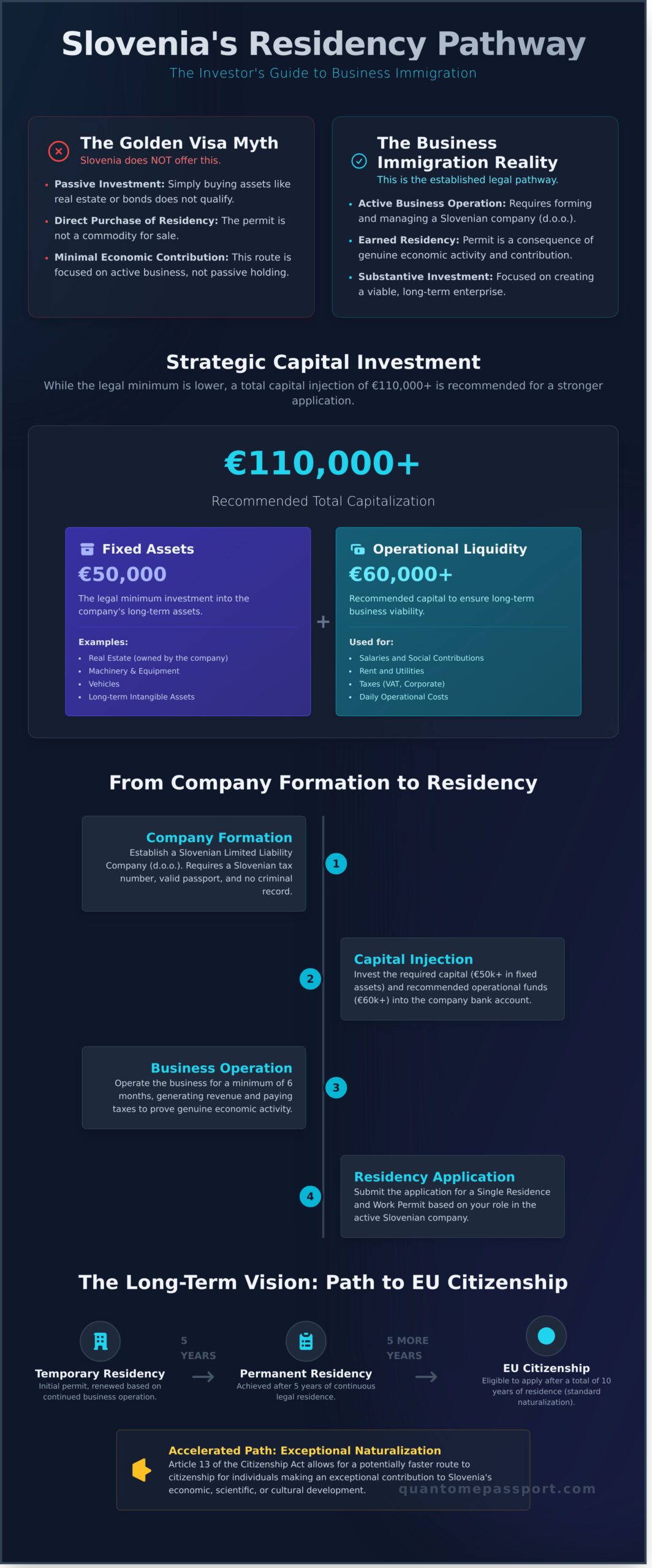
A primary point of clarification is that Slovenia does not offer a Golden Visa. You cannot simply purchase a residency permit through a passive investment, such as real estate or government bonds. The Slovenian model requires the formation and operation of a local company. This distinction is critical; the permit is a consequence of your economic activity, not a commodity for sale. This residency is the first step on a longer path, governed by Slovenian nationality law, which outlines the requirements for eventual citizenship through naturalization. This active business requirement contrasts sharply with the historically passive investment models seen in Greece or Portugal.
The Role of Capital in Residency Approval
While the legal framework requires an investment of at least €50,000 into the company’s fixed assets to qualify for a permit, our analysis of application patterns indicates a more strategic approach is often necessary. A capital injection of €110,000 or more provides a stronger demonstration of “economic benefit” to the Republic of Slovenia. This higher amount substantiates the business plan and signals a serious, long-term commitment. Crucially, the business must remain active-generating revenue, paying taxes, and maintaining operations-as this status is reviewed upon permit renewal. Understanding how to invest in Slovenia for residency effectively means focusing on creating a viable enterprise, not just meeting a minimum capital threshold.
The Business Immigration Pathway: From Company Formation to Residency
For non-EU nationals, the most structured answer to the question of how to invest in Slovenia for residency is through the formation and active management of a local enterprise. This route, governed by the Employment, Self-employment and Work of Foreigners Act, centers on establishing a Slovenian limited liability company, known as a d.o.o. (Družba z omejeno odgovornostjo). This entity serves as the legal and financial vehicle for your investment and subsequent application for a single work and residence permit.
This model of business formation as a residency pathway is common in jurisdictions aiming to attract foreign investment. For entrepreneurs considering other global hubs, the process is conceptually similar. In the UAE, for instance, specialized firms such as Fast Zone Business guide investors through the company setup process required there.
Incorporation and the Investment Threshold
The process begins with company registration, which requires a Slovenian tax number, a valid passport, and a certificate of no criminal record from your country of origin. A crucial, often misunderstood element is the investment structure. While the legal minimum to qualify is a €50,000 investment into the company’s fixed assets (e.g., real estate, machinery, or long-term intangible assets), our analysis of successful applications indicates a more robust capital structure is advisable. A total capitalization of €110,000-comprising the €50,000 in fixed assets plus €60,000 in operational liquidity-demonstrates long-term viability and substantive commitment to the Ministry of Interior, smoothing the path to approval. After incorporation, the company must operate and demonstrate genuine business activity for a minimum of six months before the investor can submit their residency application.
Operational Requirements for Investors
Securing residency is contingent on the company meeting specific operational benchmarks. The investor must prove “active business conduct,” which is typically satisfied by one of the following conditions:
- Achieving a minimum monthly turnover of €10,000 for six consecutive months.
- Employing at least one Slovenian or EU citizen on a full-time basis for a minimum of six months.
Furthermore, the business must maintain a physical office address in Slovenia; a virtual office is insufficient. Navigating these requirements demands a clear understanding of the local regulatory framework, as detailed in the U.S. Department of State’s Slovenia Investment Climate report. Annual compliance, including corporate tax filings and social security contributions for the director, is mandatory and non-negotiable for permit renewal. Finally, family reunification is a subsequent process; dependents can typically apply one year after the primary applicant has successfully obtained and maintained their residency permit, contingent on meeting statutory income and accommodation requirements.
Managing these complex financial and compliance requirements is critical for the long-term success of your investment and residency status. For specialized support, many investors visit SA Unlimited for fractional CFO and financial advisory services.
Real Estate vs. Business Investment: A Comparison for Investors
A common inquiry from prospective investors concerns the viability of real estate acquisition as a direct route to Slovenian residency. Unlike some EU nations offering “Golden Visas” for property purchases, Slovenia does not have such a program. However, real estate can be a central component of a qualifying business investment. Understanding this distinction is fundamental when evaluating how to invest in Slovenia for residency.
The primary route involves establishing a Slovenian company (d.o.o.) that then purchases property as a business asset. This approach transforms the investment from a passive personal holding into an active economic contribution, which is the cornerstone of Slovenia’s business immigration policy. This method offers a tangible, asset-backed investment, which often presents a lower operational risk profile compared to launching a new service-based enterprise. The key is that the company must demonstrate legitimate business activity, such as leasing the property commercially or for tourism.
Structuring Real Estate as a Business Asset
Under Slovenian law, a company you form can acquire commercial or residential property. This property must be integral to the company’s business plan-for example, a portfolio of rental apartments or a commercial office space leased to other businesses. A private residential purchase in a personal name does not meet the criteria for a residence permit application. The 2026 market shows continued interest in logistics facilities and high-end tourist accommodations, presenting strategic opportunities for this model. (For procedural details, see our guide on Slovenian Company Formation).
Comparison of Residency Pathways
When considering how to invest in Slovenia for residency, it is useful to compare the main pathways. While Slovenia is not the “cheapest citizenship by investment in Europe” in direct monetary terms, its value lies in the legitimate, business-oriented path to EU residency and eventual citizenship. The following table outlines the key differences:
Regarding liquidity, an investor can exit by selling the company (which holds the real estate asset) after securing permanent residency or citizenship. This is a market-dependent transaction but provides a clear exit strategy. Non-resident owners should also be aware of property and rental income taxes, which are managed through the corporate structure.
From Residency to EU Citizenship: The Accelerated Timeline
While Slovenia’s standard naturalization process requires ten years of continuous residency, a specific legal provision offers a significantly faster route for high-value investors. This pathway, known as “exceptional naturalization,” is governed by Article 13 of the Citizenship of the Republic of Slovenia Act. It empowers the government to grant citizenship to individuals whose contributions are deemed to be in the national interest, potentially reducing the timeline from a decade to as little as 4-12 months post-investment.
This accelerated option is a critical consideration for those evaluating how to invest in Slovenia for residency with the ultimate goal of EU citizenship. It bypasses the conventional multi-year residency requirements, offering a direct, albeit discretionary, path based on strategic economic impact.
The Exceptional Naturalization Pathway
An “exceptional contribution” is not defined by a fixed investment amount but is assessed on a case-by-case basis. It typically involves a substantial economic investment that creates jobs, introduces new technology, or significantly benefits a key sector like science, culture, or sports. The government exercises full discretion in these grants. Analysis of past successful applications indicates a clear preference for active, high-impact business ventures over passive real estate holdings.
Maintaining Status and Dual Citizenship Rules
A key legal nuance for global investors is dual citizenship. While Slovenia generally requires renunciation of prior citizenship upon naturalization, Article 13 provides an exception. Investors granted citizenship in the national interest are typically permitted to retain their original nationality. Furthermore, physical presence requirements are often more flexible under this framework compared to the standard residency path, although demonstrating a genuine link to the country remains essential. Applicants must also show a commitment to integration, which includes a basic proficiency in the Slovene language.
Quantome Passport: Strategic Guidance for Slovenian Residency
Navigating the path to European Union residency requires precise legal and financial strategy. At Quantome Passport, we provide comprehensive guidance for high-net-worth individuals (HNWIs) leveraging Slovenia’s investment programs. Our primary focus is on structuring applications through the established €110,000 capital investment route, ensuring every procedural step aligns with both current and future regulatory frameworks. Our methodology is designed to provide clarity and predictability for clients exploring how to invest in Slovenia for residency.
Our 4-12 month fast-track methodology is not a shortcut but a system of procedural efficiency. It is built on a deep understanding of administrative requirements and observed patterns in successful application processing. A critical component of our advisory is risk mitigation. We proactively structure investment and legal documentation to comply with the anticipated 2026 regulatory updates, safeguarding the long-term viability of your residency and future citizenship status.
Our Procedural Expertise
We provide end-to-end case management, from the initial strategy call to the final issuance of your residency permit. During a mandatory Private Strategy Call, our advisors assess your unique profile to tailor a solution, including pathways for those with alternative budget considerations. Our physical presence in London, Dubai, and Ljubljana offers a distinct advantage, enabling seamless, real-time coordination between your home jurisdiction and the relevant Slovenian authorities.
Securing Your European Future
A Slovenian residence permit is the gateway to an EU passport and its associated benefits: freedom of movement, the right of establishment across the bloc, and access to premier financial and educational systems. The first step in this journey is a confidential evaluation to determine your eligibility and construct a compliant investment strategy. This foundational analysis is essential for any investor serious about understanding how to invest in Slovenia for residency. To initiate your confidential evaluation and receive a tailored procedural roadmap for the Slovenian Citizenship & Residency Program, we invite you to contact our advisory team.
Finalizing Your Slovenian Investment Strategy for Residency
This guide has detailed the primary legal pathways available to global investors in 2026. The key takeaways are clear: the business immigration route represents the most structured and legally defined method for obtaining residency, and this pathway offers a more direct trajectory to EU citizenship compared to passive real estate holdings. Successfully navigating how to invest in slovenia for residency is contingent upon a precise understanding of the company formation process and its associated capital requirements.
Executing this strategy requires expert legal and financial structuring. Quantome Passport provides specialized guidance on the €110,000 capital investment structure and leverages a specialized path that can lead to citizenship within a 4-12 month timeline. With global offices in London and Dubai, our team is positioned to manage the complexities for international clients seeking legally compliant, long-term European solutions. For a detailed assessment of your eligibility and strategic options, we invite you to connect with our specialists.
Secure your EU future with the Slovenian Citizenship & Residency Program
Frequently Asked Questions
Can I get Slovenian residency by buying a house?
No, Slovenia does not offer a residency-by-property-purchase program. Acquiring real estate alone does not qualify a non-EU national for a residence permit. The primary pathway is through establishing an active business. While a property can be an asset of your Slovenian company, the residency application is evaluated based on the business’s operational viability and economic contribution, not the property’s value itself. This is a common misconception in EU investment immigration.
What is the minimum investment for Slovenian residency in 2026?
Slovenian law does not prescribe a fixed minimum investment amount for a residence permit. Instead, the requirement is to make a “substantive” investment into an active business. Based on administrative practice, a tangible investment of at least €50,000 into the company’s fixed assets (such as equipment, real estate, or technology) is a commonly observed benchmark for successful applications. This amount must be clearly justified by the company’s business plan.
How long does it take to get Slovenian citizenship through investment?
The route to citizenship is a multi-stage process based on residency, not direct investment. An investor must first hold a temporary residence permit for five continuous years to become eligible for permanent residency. After an additional five years of holding permanent residency (for a total of ten years of legal residence), one may apply for citizenship by naturalization, provided all other conditions, such as language proficiency and integration, are met.
Do I need to live in Slovenia full-time to keep my residency?
While daily physical presence is not mandated, maintaining your temporary residence permit requires demonstrating a genuine link to Slovenia, primarily through managing your business and having a registered address. For the eventual transition to permanent residency and citizenship, authorities will assess your periods of actual, continuous habitation. Significant or prolonged absences can negatively impact permit renewals and future applications for permanent status, as it may suggest your center of life is elsewhere.
Is dual citizenship allowed in Slovenia for investors?
Slovenia generally does not permit dual citizenship for individuals who naturalize. As part of the citizenship process, applicants are typically required to provide proof of renunciation of their original citizenship. Exceptions are extremely rare and do not usually apply to those naturalizing through business-based residency. This is a critical legal consideration for any applicant pursuing a long-term strategy that includes obtaining a Slovenian passport and its associated EU rights.
What are the language requirements for Slovenian citizenship?
To be eligible for citizenship by naturalization after the required residency period, all applicants must demonstrate proficiency in the Slovene language. This is formally assessed through a state-administered exam designed to test communication skills at a basic level, sufficient for everyday life. This requirement is a fundamental part of the integration process and cannot be waived. Preparing for this language test should be part of any long-term citizenship strategy.
Can my family join me under the business residency program?
Yes, family reunification is a provision under Slovenian immigration law. After the primary applicant (the business investor) has successfully obtained their residence permit and resided in Slovenia for at least one year, they may apply for permits for their spouse and dependent children under 18. Each family member must submit an individual application and satisfy all requirements, including proof of health insurance and sufficient financial means for their support.
What happens to my investment if my residency application is denied?
Understanding this risk is key to knowing how to invest in Slovenia for residency. Since the investment is made into your own Slovenian company, the capital remains under your control as company assets. If a residency application is denied, you retain full ownership of the business. Your options would then include appealing the decision, restructuring the business for a new application, or liquidating the company and its assets in accordance with Slovenian corporate law.