
The dream of sipping espresso in a Roman piazza or closing a business deal in Berlin often comes with a looming financial question: what about taxes? For many, the fear of being taxed twice on the same income or getting lost in a labyrinth of unfamiliar regulations is a major hurdle. If you’re struggling to find clear, consolidated information that isn’t focused on a US audience, you’re not alone. Understanding the true tax implications of EU residency is essential for your financial peace of mind, and it doesn’t have to be overwhelming.
This guide is your roadmap for 2026. We’ll cut through the complex jargon to show you how EU tax residency actually works, reveal the key principles for legally avoiding double taxation, and give you the confidence to plan your financial future in Europe. You’ll leave with a clear framework for comparing different EU countries and knowing exactly what questions to ask a professional advisor, turning uncertainty into an actionable strategy.
Key Takeaways
- Your legal residency permit and your tax residency status are two separate concepts; understanding the difference is your first step.
- The EU uses a residency-based system, meaning where you live-not your citizenship-dictates the tax implications of eu residency.
- Identify the key tests, such as the 183-day rule, that countries use to officially determine if you are a tax resident.
- Learn how Double Taxation Treaties (DTTs) protect you from paying taxes on the same income in two different countries.
Understanding Tax Residency vs. Legal Residency in the EU
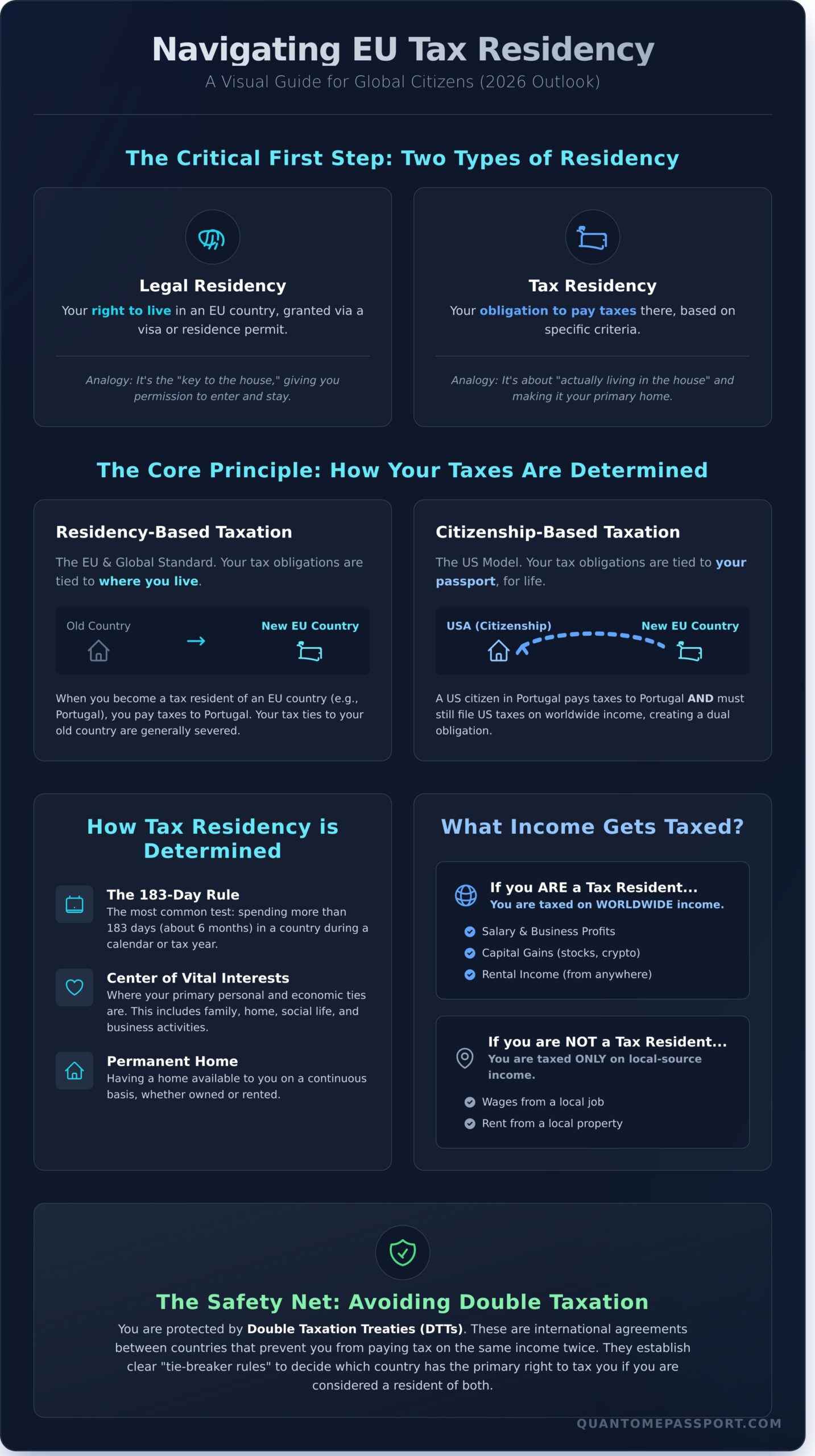
When planning a move to Europe, navigating the tax implications of EU residency begins with a critical distinction: the difference between legal residency and tax residency. Simply put, legal residency is your right to live in an EU country, granted through a visa or residence permit. However, tax residency is your obligation to pay taxes there. The core of the Understanding Tax Residency concept is that it’s determined by specific criteria, not just your permit. It hinges on factors like how much time you spend in the country and where your primary economic and personal ties are located.
Think of it this way: your legal residence permit is like having the key to a house. It gives you the right to enter and stay. Tax residency, on the other hand, is determined by whether you actually live in that house, making it your primary home. While each EU member state has its own specific rules, they generally follow these common principles to determine your status.
Why This Distinction Matters for Global Citizens
For entrepreneurs, investors, and professionals with assets or income streams in multiple countries, this distinction is paramount. Misunderstanding your status can lead to costly mistakes, including unexpected tax bills or even double taxation-where two different countries claim the right to tax the same income. Properly managing the tax implications of EU residency gives you clarity and control, ensuring you meet your legal obligations without overpaying or facing penalties.
The Scope of Taxation: What Income is Typically Considered?
Once a country considers you a tax resident, it generally has the right to tax your worldwide income. This means all your earnings, regardless of where they are generated, could be subject to that country’s tax laws. This typically includes:
- Salary and employment income
- Profits from your own business
- Capital gains from investments (stocks, crypto, etc.)
- Rental income from properties anywhere in the world
In contrast, if you are only a legal resident but not a tax resident, you are usually only taxed on income sourced from that specific country, such as rent from a local property or wages from a local job.
The Core Principle: Residency-Based vs. Citizenship-Based Taxation
To understand the tax implications of EU residency, you must first grasp one fundamental concept: the difference between residency-based and citizenship-based taxation. The European Union, along with nearly every other country in the world, operates on a residency-based system. This means your tax obligations are determined by where you live, not the passport you hold.
This model stands in stark contrast to citizenship-based taxation, a system famously used by the United States (and Eritrea). Under this rule, US citizens must file US tax returns and report their worldwide income to the IRS for life, regardless of where they reside. This creates a layer of complexity that citizens of other nations simply do not face when moving abroad.
The key differences are crucial:
- Residency-Based (The EU & Global Standard): Your primary tax obligation is to the country where you are a tax resident. If you move from Germany to Portugal and become a Portuguese tax resident, you pay taxes to Portugal on your worldwide income.
- Citizenship-Based (The US Model): Your primary tax obligation is to your country of citizenship, forever. A US citizen living in Portugal must still file US taxes on their worldwide income, in addition to their local Portuguese tax obligations.
How Residency-Based Taxation Works in Practice
Let’s use a simple scenario. A Canadian citizen obtains a residence permit for Slovenia and lives there for over 183 days in a year, establishing tax residency. From that point on, they are liable for Slovenian taxes on their worldwide income, including any income from investments back in Canada. Simultaneously, they generally sever their tax residency with Canada, though they may face a one-time “exit tax” on the deemed disposition of certain assets.
Why This is Good News for Non-US Citizens
For the vast majority of people, this structure is empowering. Changing your country of residence effectively changes your primary tax jurisdiction. This provides a clear, internationally recognized path to potentially lowering your overall tax burden by moving to an EU country with a more favorable regime. This clear-cut system is supported by a global network of double taxation treaties designed to prevent the same income from being taxed twice and ensure a smooth transition between jurisdictions.
The Unique Tax Situation for U.S. Citizens
For citizens of the United States, the tax implications of eu residency are uniquely complex. Unlike nearly every other country, which uses a residence-based tax system, the U.S. taxes its citizens on their worldwide income, regardless of where they live and work. This principle, known as citizenship-based taxation, means that even after you establish tax residency in Portugal, Spain, or any other EU member state, your obligation to the IRS continues.
This reality often raises the immediate and valid concern of double taxation-the prospect of paying tax on the same income to both your new European home and the United States. Fortunately, the U.S. tax code has established powerful mechanisms specifically designed to prevent this from happening, ensuring you are not unfairly taxed twice.
Key Mechanisms to Avoid Double Taxation
To mitigate their U.S. tax liability, American expatriates in the EU primarily rely on two tools: the Foreign Earned Income Exclusion (FEIE) and the Foreign Tax Credit (FTC). Choosing the right strategy is crucial and depends entirely on your personal financial circumstances, particularly your income level and the tax rates in your new EU country.
- The Foreign Earned Income Exclusion (FEIE): This allows you to exclude a significant amount of your foreign-earned income from U.S. taxation (up to $126,500 for tax year 2024). It’s a powerful tool, but it only applies to earned income like salary and self-employment earnings, not to passive income from investments, pensions, or rent.
- The Foreign Tax Credit (FTC): This provides a dollar-for-dollar credit against your U.S. tax liability for income taxes you have already paid to a foreign government. For example, if you paid €20,000 in income tax in France, you can claim a credit for that amount on your U.S. return. Since tax rates in many EU countries are higher than in the U.S., the FTC often eliminates your U.S. tax bill completely.
Your U.S. Filing Obligation is Permanent
It cannot be stressed enough: using the FEIE or FTC to reduce your U.S. tax liability to zero does not eliminate your duty to file. As a U.S. citizen, you must file a federal tax return with the IRS every single year, regardless of where you reside or how much tax you owe. This is a non-negotiable requirement of holding a U.S. passport. Successfully navigating the tax implications of eu residency means staying compliant with the tax authorities in both your new home and your country of citizenship.
How EU Countries Determine Your Tax Residency Status
Understanding where you are considered a tax resident is the first step in managing the tax implications of eu residency. While each of the 27 member states has its own specific legislation, most follow a standardized model developed by the Organisation for Economic Co-operation and Development (OECD). This model uses a series of sequential tests to determine your tax home, ensuring you are not taxed as a full resident in two countries simultaneously.
These tests are applied in a specific order. If the first test gives a clear answer, the process stops. If not, tax authorities move to the next test, and so on, until your tax residency is established in one country.
The 183-Day Rule: The Primary Test
The most common and straightforward test is the 183-day rule. If you spend 183 days or more in a single EU country during its tax year, you will almost certainly be considered a tax resident there. It’s important to note that this is not about consecutive days; it’s a cumulative total. Furthermore, any part of a day spent in the country, including your day of arrival or departure, can count towards the total. While this rule is the primary benchmark, it isn’t the final word, especially for those with complex international lifestyles.
Tie-Breaker Rules: When You Have Connections to Multiple Countries
What happens if you spend less than 183 days in any single country, or you meet the residency criteria for two countries at once (e.g., you have a home in both)? This is where “tie-breaker” rules come into play. These rules are applied in a strict hierarchical order to pinpoint your primary country of residence.
- Permanent Home: The first test looks at where you have a permanent home available to you. This can be a property you own or a long-term rental that is continuously at your disposal. If you have a permanent home in only one country, you are a resident there.
- Centre of Vital Interests: If you have a permanent home in two or more countries, authorities will determine where your personal and economic ties are closer. This “centre of vital interests” considers factors like your family’s location, social life, political activities, and the location of your business or primary sources of income.
- Habitual Abode: If the centre of your vital interests is not clear, the next test is your “habitual abode”-the country where you spend more time, even if you don’t have a permanent home there.
- Nationality: As a final resort, if all previous tests are inconclusive, your country of nationality will be used to determine your tax residency.
Navigating these rules is crucial for understanding your obligations and the full tax implications of eu residency.
Avoiding Double Taxation: The Role of Tax Treaties
The biggest financial fear for any individual moving to Europe is the prospect of being taxed twice on the same income-once in their home country and again in their new EU country of residence. Fortunately, a robust international framework exists specifically to prevent this scenario: Double Taxation Treaties (DTTs), also known as Double Taxation Agreements (DTAs).
These are bilateral agreements signed between two countries to protect taxpayers. They clearly define which country has the primary right to tax specific types of income, such as salaries, pensions, dividends, and capital gains. Most developed nations have an extensive network of these treaties, ensuring that the tax implications of eu residency don’t include unfair double payments.
How Do Tax Treaties Actually Work?
While the specifics vary between treaties, they generally provide relief from double taxation through one of two primary methods:
- The Exemption Method: Under this model, the country where you are a tax resident simply exempts the income that has already been taxed in the “source” country (the country where the income was generated). The income is still often considered when calculating the tax rate on your other earnings, but it is not taxed directly a second time.
- The Credit Method: This is the more common approach. Your country of residence calculates the tax you owe on your worldwide income but then allows you to claim a credit for the taxes you’ve already paid to the source country on that same foreign income. For example, if you owe €5,000 in taxes in Spain but already paid €3,500 in Canada on that income, you would receive a credit and only owe the remaining €1,500 to Spain.
Finding and Understanding a Tax Treaty
You can typically find the treaty relevant to you with a simple online search, such as “USA-Germany tax treaty.” However, be warned: these are complex legal documents filled with technical jargon. While you can find them easily, interpreting them correctly requires professional expertise.
The most important takeaway is that a treaty almost certainly exists between your home country and your new EU country. This proves there is a legal mechanism in place to protect you. Navigating the specific articles and ensuring you claim relief correctly is a critical step in managing the financial side of your move. For expert guidance on structuring your assets in compliance with these treaties, explore the residency solutions at Quantome Passport.
Your Action Plan: Navigating Taxes as a New EU Resident
Understanding your future tax obligations is a critical part of a successful move to Europe. As we’ve covered, your tax liability is primarily based on your tax residency status, which is determined by clear tests like the 183-day rule. Thankfully, double taxation treaties exist to prevent you from being taxed twice on the same income. This article provides a framework, but it is not a substitute for personalized financial advice.
To navigate the process with confidence, follow this strategic three-step plan.
Step 1: Define Your Residency Goals
Before exploring visas or tax codes, clarify your primary objective. Are you planning to work, retire, launch a business, or simply invest in the European Union? Your goals will directly influence the most suitable residency program, whether it’s a Digital Nomad Visa in Portugal or a Golden Visa in Greece. Getting this first step right is crucial, as your chosen pathway sets the stage for everything that follows.
Step 2: Secure Your Legal Pathway to Residency
Once your goals are clear, the next step is securing the legal status that allows you to achieve them. A defined legal residency is the foundation upon which all your financial and tax planning is built. Without it, any tax strategy is purely hypothetical. This is where expert guidance is invaluable. At Quantome Passport, we specialize in demystifying this process, helping you identify and secure the most efficient residency pathway tailored to your unique circumstances.
Step 3: Seek Professional Cross-Border Tax Advice
With a clear residency plan in place, it’s time to consult a qualified tax advisor who specializes in expat and cross-border taxation. They can analyze your specific financial situation and provide concrete advice on the tax implications of EU residency. To get the most from your consultation, ask targeted questions:
- Based on my chosen residency path, when and how will my tax residency status change?
- What are my “exit tax” obligations in my current country of residence?
- How will the tax treaty between my home country and my new EU country affect my investment income, pension, and capital gains?
- What are my reporting obligations in both countries moving forward?
Your journey to becoming an EU resident begins with a single, strategic decision. Let us help you make the right one from the start. Book a private strategy call to discuss your EU residency options with an expert today.
Master Your Move: Final Thoughts on EU Residency and Taxation
Navigating your new life in the European Union requires a clear understanding that legal residency and tax residency are distinct concepts. As we’ve covered, knowing how EU countries determine your tax status and leveraging double taxation treaties are fundamental to your financial well-being. Successfully managing the tax implications of eu residency from the start ensures a smooth and prosperous transition.
Don’t leave this critical step to chance. Our team provides expert guidance on the Slovenian residency and citizenship pathway, offering a personalized assessment of your eligibility and a clear, streamlined process designed for non-EU applicants. Let us help you build a solid strategy for your future in Europe.
Ready to move forward with clarity? Book Your Private EU Residency Strategy Call today. Your European dream is within reach, and with the right support, you can navigate this exciting new chapter with confidence.
Frequently Asked Questions About EU Residency and Taxes
Does getting an EU residence permit automatically make me a tax resident?
No, a residence permit does not automatically make you a tax resident. Immigration status and tax status are determined separately. While a permit allows you to live in an EU country, tax residency is established based on factors like the number of days you spend there (the 183-day rule) and where your “center of vital interests” lies. Tax authorities will look at your actual life circumstances, not just your paperwork.
What is the 183-day rule for tax residency in Europe?
The 183-day rule is a common benchmark used by most EU countries. If you are physically present in a country for 183 days or more during a tax year, you will generally be considered a tax resident there. This means you could be liable to pay taxes on your worldwide income in that country. It’s a primary test for tax residency, but other factors like your permanent home can also be considered.
Will I have to pay taxes in two countries if I move to the EU?
You can avoid double taxation thanks to Double Taxation Treaties (DTTs). These are agreements between countries designed to prevent the same income from being taxed twice. A DTT establishes “tie-breaker” rules to determine which country has the primary right to tax your income. You may still need to file tax returns in both countries, but you can typically claim a credit for taxes paid in one against your liability in the other.
How do I prove where my ‘center of vital interests’ is?
Your ‘center of vital interests’ is the place where your personal and economic ties are strongest. You can prove this with documents like a long-term rental agreement or property title, local bank statements, utility bills, and proof of family location (e.g., school enrollment for children). The goal is to show tax authorities which country you genuinely consider to be your permanent home and the hub of your life.
Are taxes high in all EU countries?
No, tax rates vary dramatically across the European Union. While some Scandinavian countries have high income tax rates, others offer much lower burdens. For instance, countries like Bulgaria and Hungary have low, flat income tax rates. Others, such as Malta, Portugal, and Cyprus, have special tax regimes designed to attract foreign residents, expats, and retirees with significant tax benefits. Thorough research on your target country is essential.
Do I still need to pay taxes in my home country if I become an EU resident?
This depends entirely on your home country’s tax laws. The United States, for example, taxes its citizens on worldwide income regardless of where they live. Most other countries, however, base taxation on residency. If you formally establish non-residency in your home country, you will typically only owe tax there on income generated within its borders, such as from rental properties or local business activities.
What is a ‘non-dom’ (non-domiciled) tax regime?
A non-domiciled (non-dom) regime is a special tax status offered by countries like the UK, Ireland, Malta, and Cyprus. It allows foreign residents to be taxed only on income earned within the country and on foreign income that is remitted (brought into) the country. Foreign income and gains that remain offshore are not taxed, which is a crucial factor when considering the overall tax implications of EU residency for high-net-worth individuals.
Does having an EU passport (citizenship) have different tax implications than just residency?
Tax obligations in the EU are almost always tied to your tax residency, not your citizenship. Holding an EU passport doesn’t make you a tax resident in a country you don’t live in. However, citizenship grants you the freedom to live and work anywhere in the EU, which makes it easier to establish residency in a low-tax country. This freedom can significantly influence the long-term tax implications of EU residency and your financial planning.