
The search for ‘how to get EU citizenship for my family’ can be a frustrating one, often leading to a maze of complex paperwork and conflicting advice. The dream of securing a future with boundless opportunities and freedom of movement for your loved ones can feel buried under a mountain of bureaucracy. You might be wondering which family members are eligible, worried about the long timelines and high costs, or simply struggling to find a single, reliable source to guide you through the process.
This complete guide is designed to be your roadmap. We will cut through the noise and demystify the entire journey, providing a clear and actionable overview of the three main legal pathways available. You will discover how to leverage your heritage through Citizenship by Descent, understand the requirements for long-term residency with Citizenship by Naturalization, and explore the possibilities of Citizenship by Investment. By the end, you’ll have the clarity needed to identify the most viable option for your family and take the first confident step toward your European future.
Key Takeaways
- Understand how EU citizenship unlocks unparalleled opportunities for your family, including the right to live, work, and study across 27 member states.
- Explore the three primary legal routes for securing eu citizenship for my family: descent, naturalization, and investment, each with unique requirements.
- Discover if you have a claim to citizenship through your ancestry-often the most direct and cost-effective path for qualifying individuals.
- Learn the critical first steps to assess your family’s eligibility and begin planning your journey toward European residency and citizenship.
Understanding EU Citizenship for Families: The Core Benefits
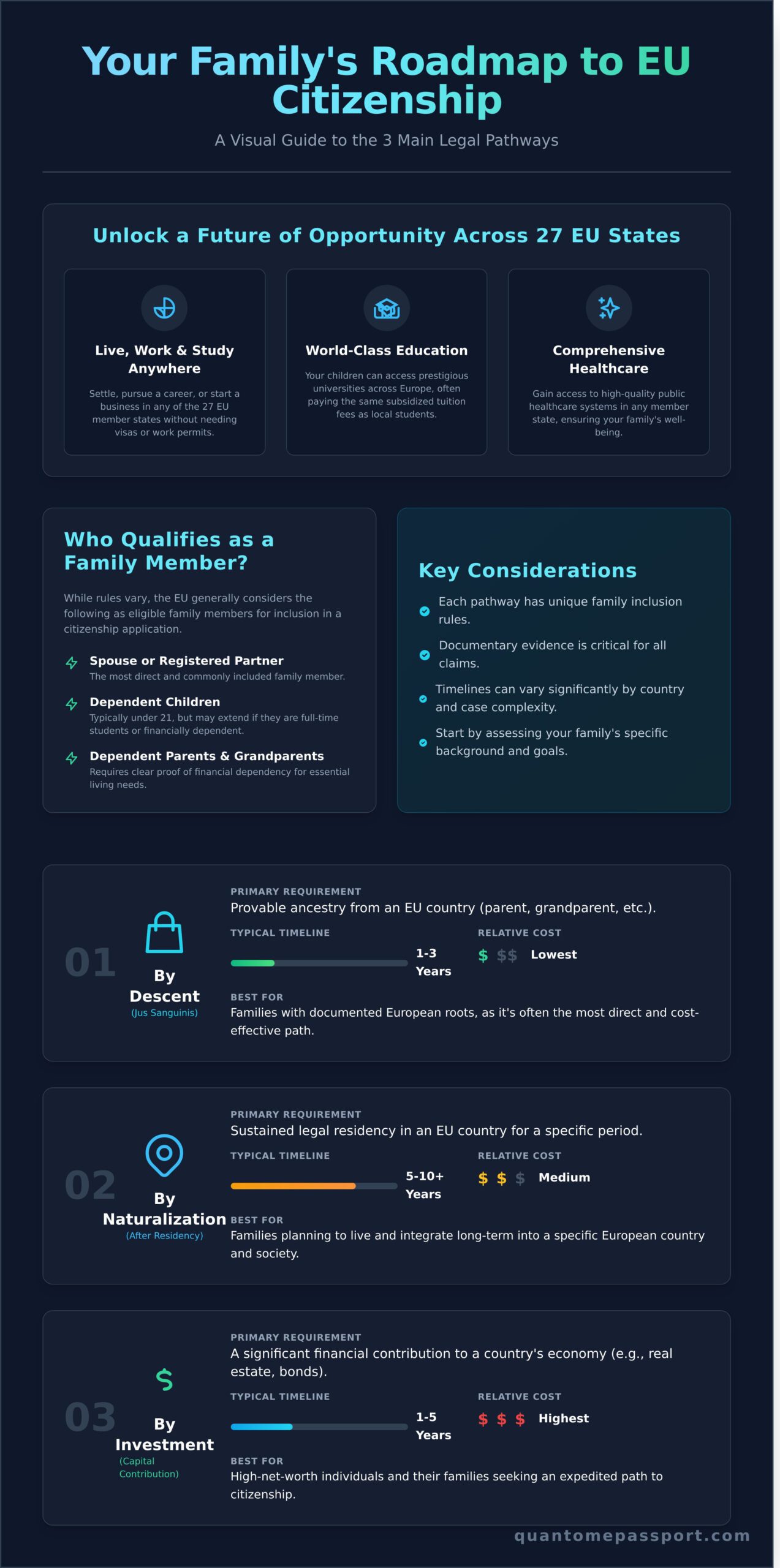
Securing EU citizenship is more than just acquiring a new passport; it’s about unlocking a future of unparalleled opportunity and stability for your loved ones. This powerful status grants your entire family a comprehensive set of rights that span 27 member states. For those planning to obtain eu citizenship for my family, the core advantage is the profound freedom to live, work, and study anywhere within the European Union, creating a legacy of global mobility. For a foundational overview, Understanding EU Citizenship provides a detailed look at the rights and history behind this unique status.
To see how ancestral ties can play a role in this journey, watch this insightful video:
The cornerstone of this new life is the ‘freedom of movement.’ This right allows you and your family to settle in any EU country-from the vibrant cities of Spain to the serene landscapes of Sweden-without the bureaucratic hurdles of visas or work permits. This opens doors to:
- World-Class Education: Your children can attend prestigious universities across Europe, often paying the same subsidized tuition fees as local students.
- Comprehensive Healthcare: Gain access to high-quality public healthcare systems in any member state, ensuring your family’s well-being is always a priority.
- Dynamic Work Opportunities: Pursue your career in Europe’s diverse and robust job market, with the right to work for any employer or start your own business.
Who Qualifies as a Family Member?
When you secure citizenship, it’s crucial to know who can join you. While rules can vary slightly by country and application type, the EU generally considers the following as ‘family’:
- Spouse or Registered Partner: The most direct and commonly included family member in an application.
- Dependent Children: Typically includes children under the age of 21. This can often be extended if the child is a full-time student or otherwise financially dependent on you.
- Dependent Parents & Grandparents: This category has stricter requirements, often demanding clear proof that they rely on you for their essential living needs.
The Three Main Roads to EU Citizenship
There are three primary pathways to acquiring EU citizenship, each with different implications for family applications. We will explore these in detail in the following sections, but here is a brief comparison to help you understand the landscape.
| Pathway | Primary Requirement | Typical Timeline |
|---|---|---|
| Descent | Provable ancestry from an EU country | 1-3 years |
| Naturalization | Legal residency in an EU country | 5-10+ years |
| Investment | Significant financial contribution | 1-5 years |
Each route-ancestry, residency, or investment-offers a unique journey. Understanding their core differences is the first step in choosing the right strategy to secure your family’s European future.
Pathway 1: Citizenship by Descent (Jus Sanguinis)
The principle of Jus Sanguinis, or “right of blood,” is one of the most powerful and direct routes to European citizenship. This pathway is based on your heritage, not your birthplace. If you have a parent, grandparent, or in some cases, even a great-grandparent who was a citizen of an EU country, you may already be eligible to claim that same citizenship. For those who qualify, this is often the most straightforward and least expensive method, as it typically does not require residency, language tests, or large investments.
Countries with historically high rates of emigration, such as Ireland, Italy, Poland, and Germany, have particularly strong citizenship by descent laws. This right is often passed down through generations, meaning a connection established by an ancestor who left Europe over a century ago could unlock a future on the continent for your children today.
Proving Your Ancestry: The Documentation Trail
Your entire application hinges on creating an unbroken, official paper trail from your European ancestor to you. This requires meticulous research and document collection. While specific requirements vary by country, you will generally need:
- Vital records (birth, marriage, and death certificates) for every individual in your direct line of descent.
- Your ancestor’s naturalization records (or proof they never naturalized before the next generation was born).
- Ship manifests or census records to prove residence.
All documents must be official state-issued copies, often with an apostille to certify their authenticity for international use. You will also need certified translations. Common challenges, like name changes or records lost to time, can often be overcome with the help of professional genealogical services that specialize in citizenship applications.
How Descent-Based Citizenship Extends to Your Family
This is where the goal of securing eu citizenship for my family becomes a reality. Once your citizenship is officially recognized, your minor children (under 18) usually acquire citizenship automatically or through a simple registration process. They inherit this right directly from you.
Your spouse’s path is not automatic but is significantly simplified. As the spouse of a newly-minted EU citizen, they can typically apply for citizenship via naturalization on an accelerated timeline, often with reduced residency requirements. It’s important to note that your parents generally do not gain any right to citizenship through your successful claim.
Pathway 2: Citizenship by Naturalization After Residency
For individuals and families without direct European ancestry, naturalization is the most well-trodden path to an EU passport. This long-term strategy involves legally residing in an EU country for a set period until you become eligible to apply for citizenship. The process typically follows a clear progression: secure a legal residence permit, convert it to permanent residency, and finally, apply for citizenship.
This commitment generally spans five to ten years, depending on the country. The initial residency permit is usually granted based on a specific purpose, such as employment, starting a business, studying, or demonstrating financial self-sufficiency.
Securing Initial Residency for Your Family
The process typically starts with a ‘main applicant’ who qualifies for a residence permit. Once approved, they can sponsor their ‘dependents’-usually a spouse and minor children-through family reunification visas. To succeed, you must demonstrate your ability to support your entire family without relying on state benefits. Key prerequisites almost always include:
- Proof of sufficient and stable financial resources.
- Comprehensive health insurance for all family members.
- A rental agreement or property deed for suitable accommodation.
The Journey from Resident to Citizen
Obtaining residency is just the first step. To naturalize, you must maintain a continuous physical presence, meaning you cannot be absent from the country for extended periods. Most nations also have integration requirements, which may include passing a language proficiency test and an exam on the country’s history and civic values. The final stage involves submitting your formal citizenship application and, if successful, taking an oath of allegiance.
Note: Children born in the country after you become a resident may be eligible for citizenship much faster.
Country-Specific Timelines and Rules
The timeline for achieving eu citizenship for my family through residency varies significantly. For example, Portugal requires just five years of legal residency, while Spain generally requires ten. Germany’s standard timeline is eight years, but it can be reduced with proof of advanced integration. It is crucial to research each country’s specific laws, as some have more streamlined family reunification policies than others.
Because regulations are complex and subject to change, we strongly advise consulting with an immigration specialist to determine the most suitable strategy for your family’s unique situation.
Pathway 3: Citizenship by Investment or Capital Contribution
For high-net-worth individuals and their loved ones, Citizenship by Investment (CBI) or Residency by Investment (RBI) programs offer an accelerated and structured route to a new life in Europe. This pathway involves making a significant, qualifying financial contribution to a country’s economy, such as through real estate acquisition, business investment, or capital transfer. The primary advantage is a significantly faster and more predictable timeline, making it one of the most efficient ways to secure EU citizenship for my family.
It’s crucial to distinguish between direct CBI programs, which grant citizenship outright, and RBI programs (often called ‘Golden Visas’), which provide residency first. While direct EU citizenship programs are rare, many Golden Visa programs establish a clear, legally defined path to eventual citizenship for you and your dependents.
How Investment Programs Include the Whole Family
These programs are specifically structured to accommodate families. A single qualifying investment typically covers the main applicant, their spouse or partner, and dependent children (often up to age 25-28). Furthermore, many programs allow for the inclusion of dependent parents and even grandparents for an additional fee, offering a comprehensive, multi-generational solution that is unmatched by other citizenship pathways.
Example: The Slovenian Residency to Citizenship Pathway
Slovenia offers a prime example of a strategic residency-to-citizenship route. The program requires a capital investment of at least €110,000 into a new or existing Slovenian company. This investment establishes your economic ties to the country and secures a temporary residence permit for you and your family. After meeting specific residency and integration requirements over time, this permit creates a direct and viable pathway to applying for full Slovenian citizenship and the EU passport that comes with it.
Ready to take the next step? Explore your eligibility for the Slovenian program with a private consultation.
Due Diligence and Financial Requirements
Securing residency or citizenship through investment is a serious legal and financial undertaking. Every reputable program conducts rigorous due diligence and background checks, requiring you to prove the lawful source of your investment funds. Beyond the principal investment, be prepared for additional costs, including:
- Government processing and application fees
- Legal and advisory fees
- Third-party due diligence fees
- Taxes related to the investment
The investment migration landscape has its share of unaccredited agents and fraudulent schemes. To protect your investment and ensure your application is handled with the utmost professionalism, it is essential to partner with a reputable firm. Navigating the complexities of obtaining EU citizenship for my family requires expert guidance, and our team at Quantome Passport is here to ensure your journey is secure and successful.
Key Considerations and Next Steps for Your Family
Embarking on the journey to secure eu citizenship for your family is a significant decision. As you move from planning to action, several key questions arise. This section provides the practical advice you need to navigate the legal, financial, and logistical steps ahead, ensuring a smooth and successful process.
Dual Citizenship: Can You Keep Your Original Passport?
A common concern is whether you must renounce your original citizenship. Fortunately, many EU member states now permit dual citizenship, allowing you and your family to hold multiple passports. For instance, countries like Portugal, Ireland, and Italy are accommodating, while others such as Austria and the Netherlands have more restrictive policies. It is crucial to verify the laws of both your country of origin and your prospective EU country, as this can be a deciding factor in your strategy.
Building Your Application: A Family Checklist
A well-prepared application is the cornerstone of success. While specific requirements vary by country and pathway, a core set of documents is almost always needed. We recommend starting this process early, as gathering and certifying paperwork can be time-consuming.
- Valid passports for every family member.
- Official birth and marriage certificates, often requiring an Apostille.
- Proof of financial stability, such as bank statements or proof of income.
- Clean criminal record certificates from your country of residence.
Maintaining consistency across all applications is vital to prevent unnecessary delays or rejections.
Finding Professional Guidance
Navigating the complexities of immigration law is challenging, especially when multiple family members are involved. An experienced immigration advisory firm can be your most valuable asset. Professionals save you time, help you avoid critical errors that could jeopardize your application, and provide a clear roadmap. When choosing a partner, look for a firm with a proven track record and deep expertise in the specific pathway you are pursuing. If you’re ready to create a clear and actionable strategy for obtaining EU citizenship for your family, we invite you to book a private strategy call to create a personalized plan for your family.
Your Family’s European Future Starts Today
As we’ve explored, the journey to securing EU citizenship for my family is not a one-size-fits-all process. Whether through ancestral ties (jus sanguinis), a period of dedicated residency, or a strategic capital contribution, a pathway exists for your unique circumstances. Understanding these options is the first critical step toward unlocking a future filled with unparalleled freedom of movement, access to world-class education and healthcare, and lasting security for generations to come.
Navigating the legal and logistical complexities requires a trusted partner. At Quantome Passport, we provide personalized strategies for families worldwide, offering expert guidance on programs like the highly sought-after Slovenian residency and citizenship route. With dedicated offices in London and Dubai to serve our global clientele, our team is equipped to turn your family’s aspirations into a concrete plan.
Don’t leave your future to chance. Discover your family’s path to EU citizenship. Schedule a consultation with Quantome Passport today. The door to Europe is open, and we have the key to help you walk through it.
Frequently Asked Questions About EU Citizenship for Your Family
Which is the easiest EU country to get citizenship for a family?
The “easiest” path to eu citizenship for my family depends on your priorities. For speed, Malta’s investment program is direct but has a high financial threshold. For flexibility, Portugal’s Golden Visa is a popular choice, requiring minimal physical presence over five years before you can apply for citizenship. If you have ancestral ties, Ireland’s program could be the most straightforward. Evaluating your family’s budget, timeline, and heritage is the first step to finding the best fit.
Can my parents and my spouse’s parents also get citizenship with us?
This varies significantly by country and program. Many residency-by-investment programs, such as those in Portugal and Greece, allow the inclusion of dependent parents in the initial application. However, their path to eventual citizenship may have separate requirements. It is crucial to verify the specific dependency rules for each country’s program, as age and financial dependence are often key factors. This ensures all extended family members are eligible from the start of the process.
How long does the entire process take, from application to passport, for a family?
The timeline varies greatly by country. For investment-based routes, expect a multi-year journey. For example, the Portugal Golden Visa requires holding residency for five years before you can apply for citizenship, with the citizenship application itself taking another 1-2 years to process. Direct citizenship programs like Malta’s can be faster, often taking 12-36 months from start to finish. Always factor in initial application processing, the residency period, and the final citizenship review time.
What are the approximate total costs for a family of four to get EU citizenship?
Costs differ dramatically based on the chosen program. For investment routes like Portugal’s Golden Visa fund option, expect a minimum investment of €500,000, plus government fees and legal costs. A direct citizenship program like Malta’s requires a non-refundable contribution starting at €600,000 for the main applicant, plus property investment and other fees. Total costs for a family of four can range from around €600,000 to well over €1 million, depending on the path.
Do my children need to learn the local language to become citizens?
Language requirements for children typically depend on their age. Most EU countries, such as Portugal and Spain, waive language tests for minors (usually under 18) at the time of the citizenship application. However, if your children become adults during the residency period, they may be required to pass a language proficiency test. While often not a legal barrier for young children, encouraging language learning is always beneficial for their integration and future.
If we have a child after getting residency but before citizenship, what happens?
A child born in an EU country while you are legal residents will typically acquire the same residency status as you. Their path to citizenship follows yours. In most EU nations, birth on the soil (jus soli) does not automatically grant citizenship. Instead, the newborn child will be eligible to apply for citizenship at the same time as the rest of the family. You will simply need to add them to your existing residency file, which is a standard procedure.
Can we live in any EU country after getting citizenship in one?
Yes, this is one of the most significant benefits. Once your family becomes citizens of any EU member state-for instance, Portugal-you gain the full rights of EU citizenship. This includes the freedom of movement, allowing you to live, work, study, and retire in any of the other 26 EU countries, as well as Switzerland, Iceland, Liechtenstein, and Norway, with minimal administrative hurdles. This unlocks unparalleled opportunities for your family across the continent.