
The allure of a European passport is undeniable, promising a world of opportunity and the freedom to live, work, and travel across the continent. But the journey to obtaining one is often clouded by misinformation, complex legal jargon, and the genuine fear of fraudulent schemes. Navigating this landscape alone can feel overwhelming, turning a lifelong dream into a source of anxiety. That’s why understanding the process for a second passport Europe legal pathway is not just important-it’s essential for your security and success.
This comprehensive 2026 guide is your definitive roadmap. We cut through the noise to provide a clear, step-by-step breakdown of every legitimate route, from citizenship by investment and reclaiming ancestral heritage to long-term residency. You will gain the clarity to assess your eligibility, understand the real costs and timelines involved, and confidently choose the right path for your future. It’s time to turn your ambition of European citizenship into a tangible, secure reality.
Key Takeaways
- Your journey to a second passport Europe legal status begins by understanding the three core legitimate pathways available in 2026.
- Discover if you qualify for an accelerated path to European citizenship, a key strategy for obtaining a second passport Europe legally through investment or real estate.
- Uncover how your European ancestry might be the key to a second passport Europe legal status, often representing the most straightforward and cost-effective option.
- Identify the ideal pathway for your unique situation by comparing investment, descent, and naturalization. Each is a valid approach to a second passport Europe legally, and choosing the right one is crucial for your second passport Europe legal application.
Understanding the Legal Framework of a Second European Passport
Embarking on the journey to acquire a second European passport is about more than just obtaining a new travel document; it’s about securing full, legal citizenship in a European Union member state. This grants you the same rights, freedoms, and responsibilities as a person born there. It’s crucial to understand that every legitimate path to a second passport Europe legal framework is rooted in the national laws of a specific country, whether through ancestry, naturalization, or a formal Citizenship by Investment (CBI) program.
To better understand the legitimate pathways available, this overview provides a helpful starting point:
What Makes a Second Passport Program ‘Legal’?
A legitimate program is always established and regulated by a national government, never a private entity. The process is meticulous, involving comprehensive due diligence and background checks on all applicants to ensure security and integrity. The concept of holding more than one nationality is a well-established legal principle, and you can learn more by Understanding Multiple Citizenship on a global scale. Ultimately, a legal program results in genuine citizenship, complete with a passport, a national ID, and the right to vote and participate in civic life.
Red Flags: How to Spot an Illegal Passport Scam
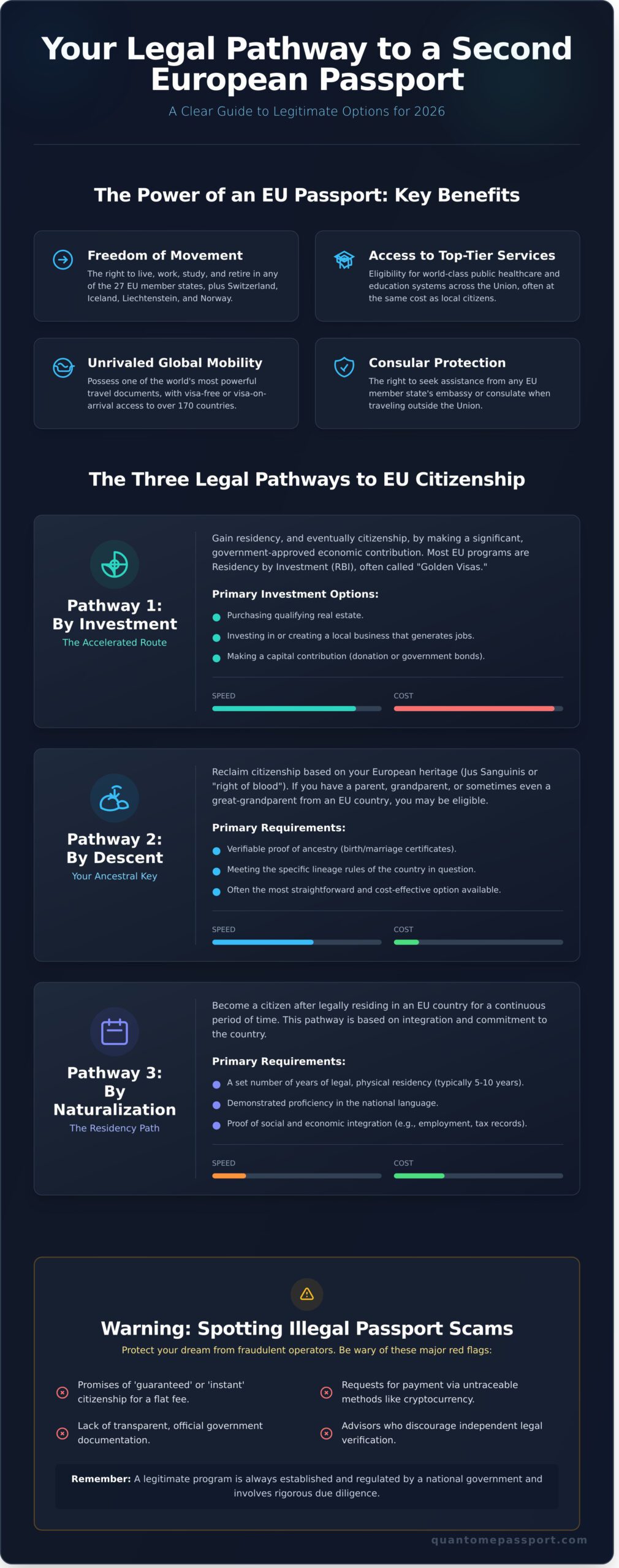
The allure of a fast-track EU passport attracts fraudulent operators. Be wary of any service that promises ‘guaranteed’ or ‘instant’ citizenship, especially for a simple flat fee. These scams often lack a clear, verifiable legal basis tied to a government-endorsed program. Other major red flags include:
- Requests for payment via untraceable methods like cryptocurrency or to personal bank accounts.
- Advisors who discourage you from seeking independent legal verification of the process.
- A lack of transparent, official government documentation outlining the program’s requirements.
The Power of an EU Passport: Key Rights and Benefits
Securing a legal second passport in Europe unlocks a world of opportunity and security for you and your family. The benefits extend far beyond simple travel convenience and are enshrined in EU law. Key advantages include:
- Freedom of Movement: The right to live, work, study, and retire in any of the 27 EU member states, plus Switzerland, Iceland, Liechtenstein, and Norway.
- Access to Services: Eligibility for world-class public healthcare and education systems across the Union, often at the same cost as local citizens.
- Global Mobility: An EU passport is one of the most powerful travel documents in the world, granting visa-free or visa-on-arrival access to over 170 countries.
- Consular Protection: The right to seek assistance from any EU member state’s embassy or consulate when traveling outside the Union.
Pathway 1: Citizenship and Residency by Investment (CBI/RBI)
One of the most structured and direct routes to European residency and eventual citizenship is through investment. These government-sanctioned programs, often called “Golden Visas,” allow qualified individuals to obtain residency by making a significant economic contribution to a country’s economy. It is crucial to distinguish between Citizenship by Investment (CBI), which grants immediate citizenship, and Residency by Investment (RBI), which provides a residence permit that can lead to citizenship after a set period. Within the EU, most programs are RBI, offering a clear, multi-year path to full citizenship and its associated benefits, as outlined in the Official EU Citizenship Rights framework.
How Investment-Based Programs Work
These programs provide a legitimate framework for obtaining a second passport Europe legal status. The process begins with choosing an investment option, which typically includes:
- Real Estate Investment: Purchasing property of a certain minimum value.
- Business Investment: Creating a new company or investing in an existing one, often creating local jobs.
- Capital Contribution: A non-refundable donation to a national development fund or purchase of government bonds.
Every applicant undergoes a rigorous due diligence and background check to ensure the legality of funds and the applicant’s good character. While residency can often be secured in 6-12 months, the journey to citizenship typically takes 5 to 10 years, depending on the country’s naturalization requirements.
Leading European Residency by Investment Programs
Several European nations offer well-established RBI programs. The “Golden Visas” of Portugal, Greece, and Spain are popular for their real estate investment options and lifestyle benefits. Malta offers a unique route for exceptional services by direct investment, which can lead to citizenship more quickly. For entrepreneurs and business owners, Slovenia presents a highly strategic and business-friendly option that is gaining prominence as a gateway to the EU.
Case Study: The Slovenian Program for Business Investment
Slovenia offers a compelling pathway for business-minded individuals seeking a foothold in the EU. The model is straightforward: establish a new business in Slovenia and make a minimum capital investment of €110,000 into the company’s fixed assets. This investment demonstrates a genuine commitment to the local economy and serves as the foundation for your residency application.
This approach grants an initial temporary residence permit, which can be renewed. After five years of continuous legal residency, you become eligible for permanent residency, and after a total of ten years (the last five being continuous), you can apply for Slovenian citizenship. This program is a clear and viable example of a second passport Europe legal pathway built on entrepreneurial merit. Explore your eligibility for the Slovenian program.
Pathway 2: Citizenship by Descent (Jus Sanguinis)
One of the most common and affordable routes to European citizenship is through your heritage. Known as Jus Sanguinis, or “right of blood,” this principle allows you to claim citizenship based on the nationality of your ancestors, regardless of where you were born. This pathway is one of the most direct ways to secure a second passport Europe legal status, but eligibility rules vary dramatically from one country to another. Success depends entirely on your ability to prove your lineage with official documentation.
Could You Qualify Through Your Ancestry?
Eligibility can reach back surprisingly far-often to a parent or grandparent, and in some cases, even a great-grandparent. However, it’s crucial to research each country’s specific laws. Many have historical restrictions, such as generational limits or older gender-based rules where citizenship could only pass through the male line. A critical detail to verify is whether your European ancestor naturalized in another country before the next person in your lineage was born, as this act can legally sever your claim.
Popular European Countries with Favorable Descent Laws
While many EU nations recognize ancestral claims, several are particularly known for their accessible programs. Ireland has broad rules, often allowing you to claim citizenship if you have an Irish-born grandparent. Italy is famous for having no generational limit, though complex historical rules apply, especially concerning female lineage prior to 1948. Countries like Poland and Hungary also have pathways, often for descendants of those who left during specific periods of war or political upheaval.
The Documentation Challenge: Proving Your Lineage
Gathering the required paperwork is the most meticulous and time-consuming part of the process. You must build an unbroken, officially documented chain connecting you directly to your European ancestor. Key documents include:
- Vital Records: Original birth, marriage, and death certificates for every person in your direct line of descent.
- Naturalization Records: Official proof of when (or if) your ancestor became a citizen of another country.
- Supporting Evidence: Census records, ship manifests, and other historical papers can help strengthen your case.
Be prepared for all non-native documents to require certified translations and an international authentication known as an apostille. Diligently compiling and authenticating these records is the foundation of a successful application for a second passport Europe legally acquired by descent.
Pathway 3: Citizenship by Naturalization
For those without ancestral ties or the capital for investment programs, naturalization is the most traditional and accessible route to European citizenship. This is the process of becoming a citizen after legally residing in a country for a specified number of years. Unlike investment-based options, this pathway requires you to build a genuine, long-term connection to your new home country, making it a fully compliant and respected method for obtaining a second passport Europe legally.
The entire process is built upon the foundation of a long-term residency permit, typically secured for work, business, or family reasons. From there, you embark on a journey of integration that culminates in a citizenship application.
The Standard Naturalization Timeline
While timelines vary by country, the journey to naturalization generally follows three core stages:
- Step 1: Obtain a Long-Term Visa. Secure a legal basis for your stay, such as a skilled worker visa, an EU Blue Card, a business visa, or a family reunification permit.
- Step 2: Maintain Continuous Residency. You must live in the country legally and without significant interruption for a set period, typically between 5 and 10 years.
- Step 3: Meet Integration Requirements & Apply. After fulfilling the residency period, you must prove your integration into society and formally apply for citizenship.
Common Requirements for Naturalization in Europe
To successfully naturalize, applicants must typically demonstrate more than just physical presence. Key requirements often include:
- Minimum Residency Period: This is non-negotiable and varies widely, from 5 years in Portugal to 10 years in Spain or Austria.
- Language Proficiency: Most countries require you to pass a language test to a specific level (e.g., A2 or B1).
- Civic & Cultural Integration: You may need to pass an exam on the country’s history, laws, and social norms.
- Financial Stability: Proof of consistent income or financial self-sufficiency is essential.
- Clean Criminal Record: A background check is a standard part of the process.
Is Naturalization the Right Path For You?
This pathway is ideal for individuals and families who genuinely intend to relocate, work, and build a life in Europe. It is less suitable for those seeking a passport primarily for visa-free travel or as a passive backup plan. Committing to naturalization means embracing a new culture and learning a new language. For those willing to make that commitment, it is the most rewarding and integrated route to a second passport Europe legal status. If this long-term vision aligns with your goals, exploring the right initial residency permit is your critical first step.
How to Choose and Pursue Your Legal Pathway
We’ve explored the three primary routes to European citizenship: investment, descent, and naturalization. Each offers a legitimate path, but the ideal one is unique to your background, finances, and long-term goals. Making the right choice is the most critical step in securing a second passport Europe legal status, and it requires a careful evaluation of your personal circumstances.
Assessing Your Personal Profile
To determine your best-fit strategy, start by asking yourself three fundamental questions. Your answers will quickly highlight the most viable options available to you.
- Family History: Do you have parents, grandparents, or even great-grandparents from a European country? If so, citizenship by descent could be your most direct and cost-effective route.
- Financial Capacity: Are you in a position to make a significant contribution to a country’s economy? Programs like those in Malta or through Portugal’s residency path offer an accelerated track in exchange for a qualifying investment.
- Life Plans: Are you willing and able to relocate and reside in a European country for several years? If so, naturalization through long-term residency becomes a rewarding and achievable option.
The Importance of Vetting Your Advisor
The journey to a second passport is complex and filled with legal nuances. The right advisor is not just a facilitator but a strategic partner who protects your interests. Be wary of any consultant promising guaranteed outcomes or pressuring you into a quick decision. A reputable firm will have a public track record, physical offices, and transparent processes. Always ask for client testimonials and verify their professional accreditations before committing.
Your Next Steps Towards a European Passport
Once you have a clearer picture, it’s time to take structured action. Follow these steps to move forward with confidence and clarity.
Step 1: Conduct a Preliminary Assessment. Review your answers to the questions above to identify which route-or routes-seem most plausible for your situation.
Step 2: Gather Key Documents. Begin collecting essential paperwork, such as your birth certificate, passport, marriage certificate, and any ancestral records or financial statements relevant to your chosen path.
Step 3: Seek Expert Guidance. The complexities of immigration law make professional advice indispensable. An expert can validate your eligibility for a second passport Europe legal pathway, manage the application, and help you avoid costly mistakes. Ready to map out your strategy? Book a private strategy call to get expert advice on your specific situation.
Your European Future Awaits: Secure Your Second Passport Legally
As we’ve explored, the journey to a second European passport is not a one-size-fits-all process. Whether through investment, ancestry, or naturalization, a viable and lawful path exists for you. The key is understanding the intricate requirements and choosing the strategy that aligns with your personal and financial goals. Achieving your goal of a second passport Europe legally is entirely possible with the right information and expert support.
Navigating this complex landscape alone can be daunting. That’s why our team offers personalized strategies for high-net-worth individuals, including expert guidance on the legal Slovenian residency-to-citizenship program. We pride ourselves on a transparent process centered on meticulous due diligence and compliance, ensuring your journey is smooth and secure.
Ready to take the definitive next step toward global mobility and freedom? Book a Private Strategy Call to Discuss Your Legal Pathway to Europe. Your new chapter of opportunity awaits.
Frequently Asked Questions
Can you simply buy a legal EU passport?
You cannot directly purchase a passport as a commodity. Instead, you can obtain one through a formal, government-sanctioned process known as Citizenship by Investment (CBI). Countries like Malta offer programs where a significant economic contribution can lead to citizenship. This is the most direct path to acquiring a second passport in Europe legally, but it involves a rigorous application process, background checks, and a substantial investment into the country’s economy, not a simple transaction.
What is the difference between EU residency and EU citizenship?
EU residency grants you the right to live, work, and travel within a specific European country and often throughout the Schengen Area. However, you retain your original passport. EU citizenship, on the other hand, makes you a full citizen of that EU member state. This grants you an EU passport, the right to vote, and the freedom to live, work, and study in any of the 27 EU countries without restrictions.
Which is the fastest legal way to get a second passport in Europe?
The fastest route is typically through a Citizenship by Investment (CBI) program. For example, Malta’s “Citizenship for Exceptional Services by Direct Investment” policy can lead to a passport in as little as 12 to 36 months. This is significantly quicker than Residency by Investment (“Golden Visa”) programs, such as those in Portugal or Greece, which require several years of residency before you can even apply for citizenship, making CBI the most accelerated option for a second passport Europe legal acquisition.
Will I have to renounce my original citizenship to get a European one?
In most cases, no. The majority of European countries that offer citizenship or residency through investment, including popular options like Portugal, Malta, and Spain, permit dual citizenship. This allows you to hold both your original and your new European passport simultaneously. However, you must also verify that your country of origin allows its citizens to hold a second nationality, as rules can vary globally. It is crucial to check the laws of both countries.
How much does it cost to get a second passport in Europe legally?
The cost varies dramatically depending on the program. Residency by Investment (“Golden Visa”) programs can start with investments from €250,000 to €500,000, plus fees. Direct Citizenship by Investment programs are more expensive; for instance, Malta’s program requires a total financial outlay that often exceeds €750,000. These figures are minimums and do not include mandatory government, due diligence, and legal fees, which can add substantially to the final cost.
Can my family members also get a European passport with me?
Yes, a significant benefit of these programs is the ability to include close family members in a single application. This typically covers the main applicant, their spouse or legal partner, and dependent children. Some programs also extend eligibility to dependent parents and even grandparents. The specific rules and additional costs for each family member vary by country, so it is important to review the program’s unique requirements for family inclusion before applying.
What are the tax implications of having a second European passport?
Holding a second passport does not automatically make you a tax resident in that country. Tax liability is generally based on your physical residency-where you spend more than 183 days per year. Many countries offering investment migration have favorable tax regimes for new residents who do not live there full-time. However, tax laws are complex and depend on your global footprint, so consulting with an international tax advisor is essential to understand your specific obligations.