
The allure of an EU passport is stronger than ever-a key to unparalleled freedom, opportunity, and a rich cultural tapestry. Yet, for many, the journey seems shrouded in complexity and uncertainty. Navigating the maze of requirements, timelines, and financial commitments can be daunting, and the fear of falling for a fraudulent scheme is a very real concern. The truth is, finding a legitimate and secure legal EU citizenship pathway is not only possible, but it can be a clear and manageable process when you have the right information. This is where your journey truly begins.
This guide is designed to cut through the noise and demystify the entire process for 2026. We will walk you through every viable route, from uncovering your eligibility through ancestry and understanding the steps for naturalization, to exploring the strategic advantages of citizenship by investment. By the end, you won’t just have a list of options; you’ll have a clear understanding of the most suitable path for your unique situation, the confidence to move forward securely, and a practical roadmap for taking your next steps toward European citizenship.
Key Takeaways
- Understand the critical differences between EU residency and full citizenship to define your long-term goals before starting a legal EU citizenship pathway.
- Discover the four primary routes to an EU passport and identify which legal EU citizenship pathway is the best fit. Each legal EU citizenship pathway has unique criteria based on your personal history or financial status.
- Assess which route is right for you by comparing the distinct timelines, requirements, and investment levels for each legal EU citizenship pathway.
- Get a simplified overview of the general application process, from document gathering to final approval, to make your journey through a legal EU citizenship pathway feel more manageable.
Understanding EU Citizenship: The Ultimate Goal of Global Mobility
For global entrepreneurs, investors, and families, European Union citizenship represents the pinnacle of international mobility and security. It is fundamentally different from residency; while residency grants the right to live in a single European country, EU citizenship bestows a powerful set of rights applicable across the entire bloc. For a detailed exploration of its legal foundation, understanding EU citizenship is the first step. It is a status automatically granted to any person who holds the nationality of an EU member state.
To better understand the rights this status confers, the European Parliament provides this helpful overview:
An EU citizen gains an unparalleled collection of freedoms. It’s crucial to understand that citizenship itself is not granted by a central EU body. Instead, it is acquired through the national laws of a member country. Therefore, every legitimate and legal EU citizenship pathway is rooted in the specific legislation of a nation like Portugal, Spain, or Ireland.
- Freedom of Movement: The right to travel, live, and settle in any of the 27 EU member states, plus Iceland, Liechtenstein, Norway, and Switzerland.
- Right to Work: Pursue a career or start a business anywhere in the EU without needing a work permit.
- Access to Services: Benefit from world-class healthcare and education systems on the same terms as nationals.
- Political Participation: The right to vote and stand as a candidate in municipal and European Parliament elections in your country of residence.
The Value of an EU Passport in 2026
An EU passport is one of the world’s most powerful travel documents, offering visa-free or visa-on-arrival access to over 180 countries. Beyond travel, its value extends to your family, as spouses and dependent children can often derive similar rights to live, work, and study across the Union. Furthermore, it provides a critical safety net: the right to consular protection from any EU member state’s embassy or consulate when traveling outside the EU.
Myth Busting: Can You ‘Buy’ an EU Passport?
Let’s be clear: you cannot legally “buy” an EU passport. The idea of an instant transaction for citizenship is a dangerous myth often promoted by fraudulent schemes. Reputable programs commonly mislabeled as “Citizenship by Investment” are, in fact, Residency by Investment. These provide a structured, legal EU citizenship pathway where an investment leads to residency status. After fulfilling strict legal requirements over several years-including physical presence and integration-an individual can then apply for naturalization.
The 4 Main Legal Pathways to an EU Passport
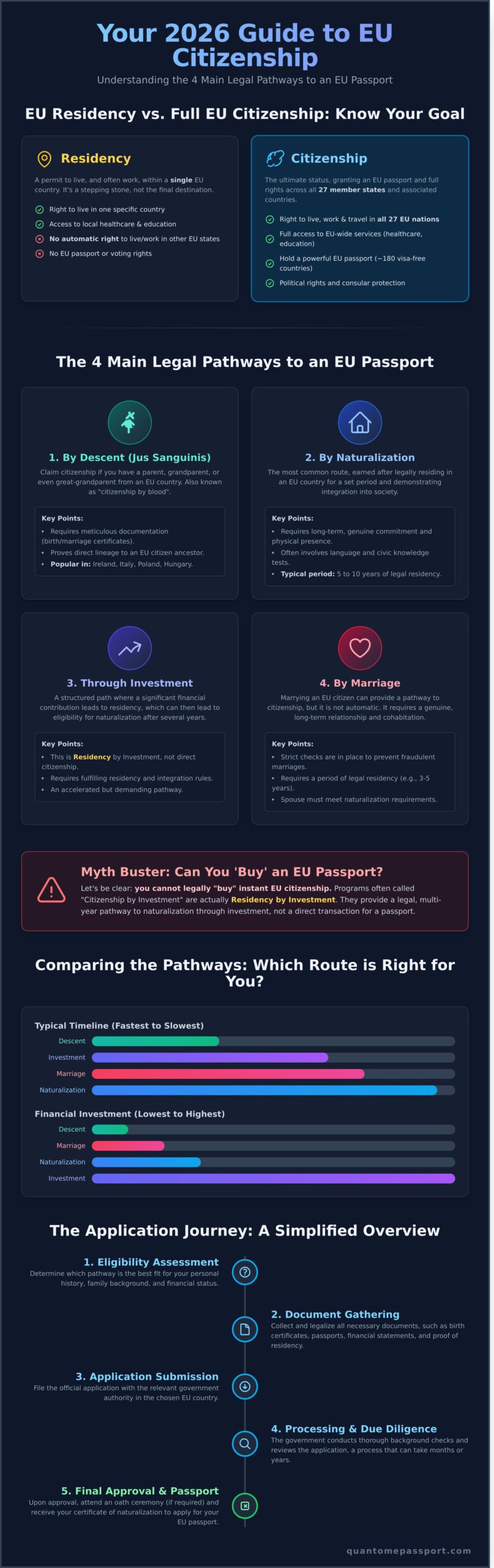
Navigating the journey to an EU passport begins with understanding the four primary routes available. This guide outlines each legal EU citizenship pathway, helping you identify which may apply to your unique circumstances. While the fundamental principles are similar across the Union, remember that each member state has specific laws governing these processes. It’s also possible that you may qualify for more than one option.
Pathway 1: Citizenship by Descent (Jus Sanguinis)
Often called ‘citizenship by blood,’ this path allows you to claim citizenship based on your ancestry. If you have a parent, grandparent, or even a great-grandparent from an EU country, you may be eligible. Countries with particularly strong descent-based laws include:
- Ireland
- Italy
- Poland
- Hungary
Securing citizenship this way requires meticulous documentation, such as official birth and marriage certificates, to prove your direct lineage.
Pathway 2: Citizenship by Naturalization (Based on Residency)
This is the most common route, granting citizenship to foreign nationals who have legally resided in an EU country for a set period, typically between 5 and 10 years. This process demonstrates your integration into society and often involves passing language and civic knowledge tests. As detailed in a recent official EU report on citizenship pathways, the requirements vary significantly. This path requires a genuine, long-term commitment to living in your new home country.
Pathway 3: Citizenship by Marriage or Family Ties
Marrying a citizen of an EU member state can open a route to citizenship, but it is not an instant solution. Authorities require proof of a genuine, ongoing marriage and a period of legal residency and cohabitation. This is to ensure the union is not one of convenience. This pathway can also extend to family reunification for dependent children or parents, though specific rules apply.
Pathway 4: Residency by Investment (Leading to Citizenship)
For individuals with the necessary capital, some EU countries offer ‘golden visa’ programs. These provide a residence permit in exchange for a significant economic contribution, such as a real estate purchase or business creation. This is not direct citizenship; rather, it provides a faster route to residency, which then starts the clock on the naturalization timeline. It’s an accelerated legal EU citizenship pathway for those who qualify.
Comparing the Pathways: Which Route is Right for You?
Understanding the different routes to EU citizenship is the first step toward achieving your goal. There is no single “best” option; the ideal choice depends entirely on your personal history, financial situation, and long-term plans. Each legal EU citizenship pathway has distinct requirements, timelines, and costs. This comparison will help you assess which avenue aligns most closely with your circumstances.
Comparison Table: EU Citizenship Pathways at a Glance
| Pathway | Typical Timeline | Estimated Cost | Key Requirement |
|---|---|---|---|
| Citizenship by Descent | 1-4 years | Low (€500 – €5,000+) | Verifiable European ancestry |
| Citizenship by Naturalization | 5-12+ years | Moderate (Varies) | Long-term legal residency |
| Citizenship by Marriage | 3-5+ years | Low (€500 – €3,000+) | Genuine marriage to an EU citizen |
| Citizenship by Investment | 1-3 years (to residency) | High (€250,000+) | Significant, qualifying investment |
Who Should Consider Each Pathway?
To find your fit, consider your primary motivation and background:
- Descent: This is for individuals who have a parent, grandparent, or even great-grandparent from an EU country. If you have known or suspected European family roots, this is your most direct route.
- Naturalization: This path is designed for those who want to live, work, and integrate into a specific EU country for the long term. It requires patience and a genuine commitment to making a new country your home.
- Marriage: This option is available to individuals in a committed, legally recognized relationship with an EU citizen. The process is designed to verify the authenticity of the relationship.
- Investment: This accelerated pathway is tailored for high-net-worth individuals who can make a substantial economic contribution in exchange for residency, which can eventually lead to citizenship.
The Role of Professional Guidance
Navigating the complex web of national immigration laws can be daunting. While the core rights are defined by the European Commission on EU Citizenship, each member state sets its own specific rules for acquisition. A simple documentation error or missed deadline can lead to years of delays and significant financial loss. Engaging an expert ensures your application is accurate, complete, and optimized for success.
At Quantome Passport, we specialize in structuring the most efficient legal EU citizenship pathway through investment programs. We handle the complexity so you can focus on your future. Book a strategy call to discuss your specific situation.
The Application Journey: A General Step-by-Step Overview
Embarking on the path to European citizenship can feel complex, but it follows a logical sequence. While the specific requirements differ dramatically between countries and methods (like descent, naturalization, or investment), the core journey can be broken down into four key stages. Think of this as your roadmap-a universal guide to help you navigate your chosen legal EU citizenship pathway from start to finish.
Step 1: Eligibility Assessment and Strategy
This is the critical foundation of your entire application. Before anything else, you must definitively determine which pathway you qualify for. This involves deep research into your family history for ancestry claims, reviewing your residency status, or exploring investment options. Choosing the right country is a strategic decision based not just on eligibility, but on your long-term goals. Expert consultation at this stage can save you months of wasted effort and point you toward your most viable option.
Step 2: Document Collection and Legalization
Prepare for a meticulous and often lengthy process of gathering paperwork. This phase requires collecting a wide range of official documents, which may include:
- Passports and national ID cards
- Birth, marriage, and death certificates
- Proof of residence (utility bills, rental agreements)
- Financial records and proof of income
- Clean criminal record certificates
Most documents must be officially translated and legalized with an Apostille to be valid abroad. This is typically the most time-consuming part of the journey.
Step 3: Application Submission and Processing
With your complete, legalized document portfolio in hand, you will formally submit your application to the designated government authority, such as a ministry of interior, consulate, or immigration office. Once submitted, a long waiting period begins. During this time, authorities conduct thorough background checks and verify every detail of your file. You may also be called for an in-person interview or to provide biometric data like fingerprints.
Step 4: Approval, Oaths, and Passport Issuance
Receiving the official letter of approval is the moment you’ve been working towards. Following this, most countries require you to attend a formal citizenship ceremony and take an oath of allegiance, officially welcoming you as a new citizen. The final, exhilarating step is applying for and receiving your new EU passport-the key that unlocks a world of opportunities. This completes your successful legal EU citizenship pathway and marks the beginning of your new chapter as a European.
Chart Your Course to European Citizenship
As we’ve explored, securing EU citizenship is the ultimate key to global mobility, unlocking unparalleled freedom to live, work, and travel across the continent. You now understand the primary routes available-from ancestry and naturalization to investment-and recognize that success hinges on identifying the single best strategy for your unique circumstances. Choosing the correct legal EU citizenship pathway from the start is the most critical decision you will make.
Navigating this complex journey alone can be overwhelming. At Quantome Passport, we specialize in creating personalized strategies for high-net-worth individuals, offering expert guidance on programs like the sought-after Slovenian residency-to-citizenship route. With offices in London and Dubai serving a global clientele, our team is perfectly positioned to architect your success. Don’t leave your future to chance. Take the definitive next step and Book Your Private EU Citizenship Strategy Call today.
The life you envision in Europe is within your reach.
Frequently Asked Questions
What is the easiest and fastest way to get legal EU citizenship?
While there is no single “easiest” method, Citizenship by Investment (CBI) and Residency by Investment (RBI) programs are generally the fastest. Countries like Malta offer direct investment routes that can accelerate the timeline. For residency leading to citizenship, Portugal’s and Greece’s “Golden Visa” programs are popular for their clear requirements, often involving a significant real estate investment. These pathways are considerably quicker than traditional naturalization, which can take over a decade.
Do I have to give up my current citizenship to become an EU citizen?
This depends on the laws of both your home country and your chosen EU nation. Many EU countries, including Portugal, Ireland, and Malta, permit dual citizenship, allowing you to hold multiple passports. However, other member states like Austria and Spain have stricter regulations that may require you to renounce your original citizenship. It is vital to verify the specific dual nationality policies of both countries before you begin the application process.
How much does it cost to get EU citizenship?
The cost varies dramatically based on the route you choose. Citizenship by Investment programs require substantial capital, with minimums often starting from €250,000 for real estate investment up to over €1 million in contributions and investments. In contrast, traditional routes like naturalization have lower direct fees but involve the long-term costs of living and working in the country. Each legal EU citizenship pathway has a distinct financial commitment that must be carefully considered.
Do I need to speak the local language to become a citizen?
For most traditional naturalization paths, language proficiency is a mandatory requirement. Countries like Germany and Spain, for instance, require applicants to pass an official language test, typically at an intermediate level (B1). However, many investment-based residency programs do not require language skills to obtain the initial residence permit. The language requirement usually becomes a factor only when you apply for permanent residency or full citizenship after several years.
Can my entire family get citizenship with me?
Yes, most EU citizenship programs allow the main applicant to include their immediate family. This typically covers a spouse or registered partner and dependent children. Some investment programs, such as those in Malta and Portugal, have more generous provisions, allowing for the inclusion of dependent parents, grandparents, and even financially dependent adult children. Always check the specific program’s rules on family dependents before applying to ensure everyone is eligible.
Which countries offer the most straightforward citizenship by investment programs?
For a direct path to citizenship, Malta’s “Citizenship for Exceptional Services by Direct Investment” program is a well-established option, although it requires a significant financial contribution and a 12-to-36-month residency period. For residency-by-investment leading to citizenship, Greece’s Golden Visa is often considered one of the most straightforward, with a clear real estate investment requirement and efficient processing times. Portugal’s program is also popular, though recent changes have shifted its focus from real estate.
How can I verify if a citizenship program or consultant is legitimate?
First, always check the country’s official government immigration or investment agency website. All legitimate programs are established by law and detailed on official sources. When evaluating a consultant, request client testimonials, verify their professional credentials, and ask for their license number if applicable. Be cautious of anyone guaranteeing citizenship or promising unrealistic timelines. A reputable advisor will provide transparent guidance on the official legal EU citizenship pathway, including all fees and requirements.