
The dream of holding a European passport-unlocking a future of travel, opportunity, and stability-often comes with a daunting reality: a complex web of bureaucracy, confusing requirements, and the paralyzing fear of making a costly mistake. If you’re struggling to find clear, consolidated information and feel uncertain about which path applies to you, you’ve come to the right place. This guide is your definitive 2026 roadmap, designed to demystify the entire European passport legal process.
We will walk you through every legitimate pathway, from uncovering ancestral claims and navigating naturalization to exploring citizenship by investment. You will gain a crystal-clear understanding of the timelines, requirements, and critical steps for each route. By the time you finish reading, you’ll have the confidence to identify the most viable option for your family and begin your journey toward European citizenship with a clear, actionable plan in hand.
Key Takeaways
- The first step in any European passport legal process is understanding that EU citizenship is granted by individual member countries, not a central EU body, which helps identify your correct pathway.
- Discover if you qualify for citizenship by descent by learning the critical documentation required to officially prove your European lineage, a vital step in this specific European passport legal process.
- The European passport legal process for non-EU nationals living in Europe typically begins with securing a long-term residence permit.
- Learn to avoid common pitfalls throughout the European passport legal process by treating your application as a formal legal case. Meticulous preparation is the key to successfully completing the European passport legal process.
Understanding the Core Legal Pathways to EU Citizenship
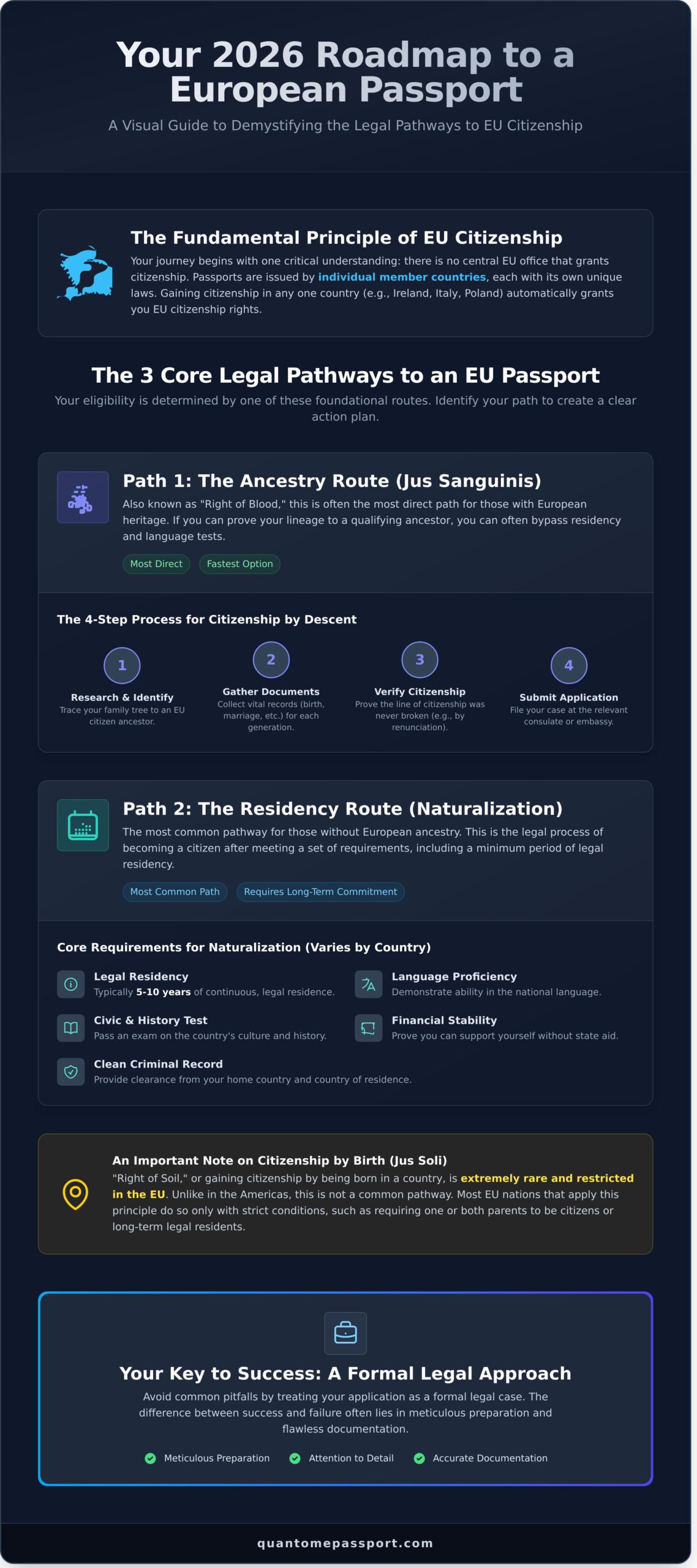
Embarking on the journey to obtain a European passport begins with a crucial understanding: there is no central EU office that grants citizenship. Instead, citizenship is awarded by individual member states according to their own national laws. Once you become a citizen of any EU country-be it Ireland, Italy, Poland, or Portugal-you automatically gain a powerful set of European Union citizenship rights, including the freedom to live, work, and travel across the entire bloc.
While the specific requirements and timelines vary significantly from one nation to another, the legal foundations for acquiring citizenship are based on three core principles. Understanding which pathway applies to your situation is the first and most important step in your journey.
To get a better sense of how movement within the EU is managed, this video explains a key upcoming system:
Citizenship by Descent (Jus Sanguinis)
Known as jus sanguinis or ‘right of blood,’ this is often the most direct path for individuals with European heritage. If one of your parents, grandparents, or in some cases, even great-grandparents was a citizen of an EU country, you may be eligible to claim citizenship by descent. This route bypasses many residency and language requirements, making it a highly sought-after option for the global diaspora.
Citizenship by Birth (Jus Soli)
The principle of jus soli, or ‘right of soil,’ grants citizenship to anyone born within a country’s territory. While common in the Americas, this pathway is extremely rare and restricted within the European Union. Most EU countries that apply jus soli do so with strict conditions, such as requiring one or both parents to be legal residents or citizens at the time of the child’s birth.
Citizenship by Naturalization
For those without direct European ancestry, naturalization is the most common route to an EU passport. This is the legal process by which a foreign national becomes a citizen after fulfilling a set of government-mandated requirements. Navigating the European passport legal process through naturalization typically involves:
- A minimum period of legal residency (often 5-10 years).
- Demonstrating proficiency in the national language.
- Passing a civic integration or history test.
- Proving financial stability and having a clean criminal record.
Path 1: The Ancestry Route – Claiming Citizenship by Descent
For many individuals, the most direct route in the European passport legal process is through their heritage. This path, known as citizenship by descent or jus sanguinis (“right of blood”), allows you to claim citizenship based on your lineage to an EU citizen ancestor. If you can successfully prove this connection, it is often the fastest and most affordable way to secure an EU passport, bypassing residency requirements and language tests common to other methods.
This pathway is entirely dependent on your ability to produce a clear and unbroken chain of documentation linking you to your European ancestor. The legal complexities can be significant, but the reward is full citizenship rights within the European Union.
How the Descent Process Works
The journey to citizenship by descent is a meticulous process of genealogical research and legal documentation. While specifics vary by country, the core legal framework for Claiming Citizenship by Descent generally follows these essential steps:
- Step 1: Research and Identification: Begin by researching your family tree to identify a qualifying ancestor from an EU country. This involves tracing your lineage through parents, grandparents, or even great-grandparents.
- Step 2: Document Gathering: Collect all necessary vital records for every person in your ancestral line. This includes birth, marriage, and death certificates, as well as naturalization records if applicable.
- Step 3: Citizenship Verification: Crucially, you must prove that citizenship was passed down through each generation without being broken. This means confirming your ancestor did not renounce their citizenship before the next person in line was born.
- Step 4: Application Submission: Once your evidence is compiled, translated, and certified, you will submit your application to the relevant country’s consulate or embassy in your home country.
Key Countries Offering Citizenship by Descent
Each EU nation sets its own rules, with some being far more lenient than others regarding generational gaps. Notable examples include:
- Ireland: Eligibility extends to those with an Irish-born parent or grandparent.
- Italy: Offers one of the most generous programs, often with no generational limit, provided the line is unbroken.
- Poland & Germany: Have specific rules often tied to historical borders and events, requiring careful verification of an ancestor’s status at a particular time.
- Spain & Portugal: Have established programs for descendants of Sephardic Jews who were expelled centuries ago.
Common Challenges and Documentation
The European passport legal process via ancestry is document-intensive and presents several common hurdles. Applicants often face difficulties finding official, certified records, especially from small towns or regions affected by historical conflicts. Furthermore, discrepancies like name changes or spelling variations between documents can create significant delays. Be prepared to obtain official translations and apostilles (a form of international certification) for every non-native document, adding another layer of complexity and cost to your application.
Path 2: The Residency Route – Acquiring Citizenship by Naturalization
For many non-EU nationals, the most common and structured route to an EU passport is through naturalization. This path is built on the foundational principle of legal, long-term residency, allowing you to demonstrate your commitment and integration into your new home country. The end goal is to prove you are a stable, contributing member of society-a journey that typically requires five to ten years of continuous legal residence before you can apply for citizenship.
General Requirements for Naturalization
While each member state sets its own specific rules, the core requirements for naturalization are consistent across the Union. This part of the European passport legal process is designed to verify your connection to the country. According to official EU guidance on citizenship, these national rules must respect EU law. Generally, applicants must satisfy the following conditions:
- Minimum Residency Period: You must have lived legally and continuously in the country for a set number of years (e.g., 5 years in Portugal, 8 in Germany, 10 in Spain).
- Language Proficiency: Demonstrating a command of the official national language through a standardized test is almost always required.
- Civic Integration: You may need to pass a test on the country’s history, laws, and social norms.
- Financial Stability & Clean Criminal Record: Proof of self-sufficiency and a clear legal history are mandatory to show you are of good character.
How to Secure Residency: The First Crucial Step
Your journey to naturalization begins with securing a long-term residence permit. This is the legal foundation upon which your citizenship application will be built. Common pathways to obtaining residency include:
- Work Permits: For skilled professionals with a job offer, such as the EU Blue Card for highly qualified workers.
- Family Visas: For individuals joining a spouse, partner, or parent who is an EU citizen or legal resident.
- Student Visas: In some countries, years spent studying on a student visa can partially count towards the residency timeline.
- Residency by Investment: A direct route for those with capital who can make a qualifying investment in the country’s economy.
The Role of Residency by Investment Programs
For individuals who may not have a job offer or family ties in Europe, Residency by Investment (RBI) programs offer a predictable and streamlined alternative. These government-approved programs provide a legal residence permit in exchange for a significant investment, such as in real estate or a national fund. This offers a proactive way to establish legal residency and officially start the naturalization clock, making the entire European passport legal process more accessible. Explore a structured path to EU residency.
Navigating the Legal Maze: Key Process Steps & Common Pitfalls
Embarking on the path to EU citizenship is more than just filling out forms; it is a formal legal procedure that demands precision and diligence. Every step, from initial document gathering to final submission, is scrutinized by government authorities. Understanding the intricacies of the European passport legal process is not just helpful-it is essential for managing expectations and significantly improving your chances of a successful outcome. Mistakes or omissions can lead to frustrating delays or, in the worst-case scenario, an outright rejection of your application.
The Application and Documentation Phase
Your entire claim for citizenship rests on the quality and accuracy of your documentation. Every piece of evidence, from birth certificates to proof of residence, must be an official, certified copy, often requiring an apostille for international recognition. It is critical to fill out all application forms completely and truthfully. Be prepared for authorities to request additional information or clarification at any stage. To protect yourself and stay organized, always keep high-quality digital and physical copies of every single document you submit.
Common Pitfalls to Avoid
Many applicants encounter preventable setbacks that can derail their journey. Being aware of these common pitfalls is the first step to avoiding them:
- Underestimating Timelines: Sourcing official documents from different countries, getting them translated, and having them certified can take many months. Start as early as possible.
- Residency Miscalculations: For naturalization paths, exceeding the maximum number of days allowed outside the country can invalidate your residency period. Keep a meticulous travel log.
- Improper Documentation: Submitting documents that are incomplete, incorrectly translated, or not properly certified is a frequent cause for immediate rejection.
- Relying on Unofficial Advice: Taking guidance from online forums or fraudulent “agents” can lead to costly and irreversible errors.
Why Professional Guidance is Invaluable
Navigating the complex and country-specific nuances of the European passport legal process alone can be daunting. An expert immigration consultant ensures your application is not only complete but also correctly formatted to meet the specific requirements of your chosen country. Professional guidance helps you sidestep common pitfalls and provides peace of mind. Investing in expert support transforms a stressful ordeal into a structured, manageable process. To ensure your application is positioned for success, consider partnering with a team of specialists. Learn how our experts can streamline your path to EU citizenship.
Your Journey to European Citizenship Starts Here
Embarking on the path to an EU passport is a significant undertaking, but as we’ve explored, it is an achievable goal. Whether you’re claiming citizenship through your ancestry or establishing it through residency, understanding the specific requirements is paramount. Successfully navigating the intricate European passport legal process means avoiding common pitfalls and meticulously preparing your documentation, transforming a complex challenge into a clear, manageable journey.
Don’t leave your future to chance. Our team provides expert guidance on legal residency and citizenship pathways, ensuring you have a clear, transparent process from start to finish. We specialize in a structured Slovenian residency program that offers a reliable route for individuals and families. To gain clarity and confidence in your next steps, we invite you to Book a Private Strategy Call to assess your legal pathway to an EU passport.
The life of freedom, opportunity, and mobility that an EU passport provides is closer than you think. Take the first definitive step toward your future in Europe today.
Frequently Asked Questions
How long does the entire legal process for a European passport usually take?
The timeline for the European passport legal process varies significantly by country and application path. Standard naturalization, based on residency, typically takes 5 to 10 years. For example, Portugal requires 5 years of legal residency, while Spain requires 10. Faster routes exist, such as citizenship by descent, which can take 1-3 years to process, or citizenship by investment programs, which may have shorter processing times but different initial requirements.
Do all EU countries allow dual citizenship with my current passport?
Not all EU countries permit dual citizenship. Many, including Ireland, Italy, France, and Portugal, generally allow you to keep your original passport. However, other member states like Spain, Germany, and Austria have stricter rules, often requiring you to renounce your previous citizenship upon naturalization. It’s crucial to verify the specific laws of the country you are applying to, as exceptions for certain nationalities or circumstances can sometimes apply.
What is the difference between a permanent residence permit and citizenship?
A permanent residence permit grants you the right to live, work, and access social services indefinitely within a specific EU country. However, it does not grant you a passport or the right to vote in national elections. Citizenship, on the other hand, makes you a full national of that country and an EU citizen. This includes receiving an EU passport, voting rights, and the unconditional freedom to live and work in any other EU member state.
Can my family members also get an EU passport through my application?
Yes, in most cases, your family can also gain citizenship through your application, a process known as family reunification. Your spouse and minor children (under 18) can typically be included in your naturalization application or apply after you become a citizen. Rules for dependent adult children or elderly parents are more complex and vary greatly by country, often requiring proof of financial dependency. Each family member must meet their own specific eligibility criteria.
What are the general costs involved in the legal process for obtaining EU citizenship?
The costs associated with obtaining EU citizenship are multi-faceted. They include government application fees, which can range from a few hundred to over a thousand euros. You must also budget for legal assistance, document translation and apostille services, language and integration course fees, and potential travel expenses. Total costs for the legal process can vary widely, from a few thousand euros for a straightforward descent application to significantly more for complex naturalization cases.
Is it possible to get an EU passport without living in Europe?
Yes, it is possible, primarily through citizenship by descent. If you have a parent, grandparent, or sometimes even a great-grandparent from an EU country like Ireland, Italy, Poland, or Hungary, you may be eligible to claim citizenship without ever having lived there. Some citizenship by investment programs may also have minimal physical residency requirements, but most pathways, especially standard naturalization, require years of continuous legal residence within the country.
Which EU country is considered the easiest or fastest for obtaining citizenship?
The “easiest” or “fastest” path is subjective and depends entirely on your personal circumstances. For residency-based naturalization, Portugal is often cited due to its relatively short 5-year timeline and basic A2-level language requirement. For those with eligible ancestry, Ireland can be a very direct route. If considering investment, Malta’s program offers a faster, albeit more expensive, path to citizenship. It is essential to evaluate which country’s criteria best align with your background.