
Dreaming of the freedom an EU passport brings, but feeling lost in a maze of bureaucratic red tape? The process can seem overwhelmingly complex, with information scattered across countless government websites and the constant worry of a single missed document leading to rejection. If you’re wondering where to even begin, you’re not alone. We believe that learning how to apply for an EU passport shouldn’t be a source of stress, but a clear path toward your goal.
This comprehensive, step-by-step guide is designed to be your single source of clarity. We’ll demystify the entire journey, providing a practical checklist that covers everything from identifying your eligibility and gathering the correct documents to navigating the submission and approval stages. You’ll gain a clear understanding of the required paperwork, costs, and timelines, empowering you to move forward with confidence and successfully claim the opportunities that await.
Key Takeaways
- Confirm your specific path to EU citizenship before gathering documents; this is the most critical first step when learning how to apply for an EU passport and determines all subsequent actions.
- Master the universal 5-step framework that simplifies the process, providing a clear roadmap for how to apply for an EU passport that is applicable across most member states.
- Prepare for key milestones beyond paperwork; understanding how to apply for an EU passport includes passing citizenship tests, interviews, and official oaths to verify your connection.
- Understand that receiving your citizenship certificate is not the final step; the complete guide on how to apply for an EU passport involves a separate process to obtain the physical book.
- Learn to recognize critical points where expert guidance on how to apply for an EU passport can save you from costly mistakes and significant delays.
Before You Apply: The Crucial Preparation Phase
Embarking on the journey to secure an EU passport is an exciting prospect. The prize is significant: the right to live, work, and travel freely across 27 member states. But before diving into the application forms, it’s essential to understand What is EU Citizenship? and that this guide covers the process, not a guarantee of eligibility. This initial preparation phase is the most critical step. It’s where you lay the groundwork to avoid costly mistakes, frustrating delays, and potential rejection.
Remember, there is no single “EU passport office.” You are applying for citizenship in one of the 27 sovereign member states, each with its own unique laws, timelines, and requirements. Proper preparation can drastically reduce your application timeline and increase your chances of success.
To get a high-level overview of the process, this video provides a helpful starting point:
Step 1: Confirm Your Eligibility Pathway
The first question is not how to apply for an EU passport, but if you are eligible. Your entire application hinges on having a valid claim to citizenship through a specific pathway, such as descent (jure sanguinis), naturalization after a period of residency, investment, or marriage to an EU citizen. You must have definitive, official proof for your chosen path before you begin. Starting an application based on a “maybe” is the fastest way to waste time and money.
Step 2: Create a Master Document Checklist
Organization is your best ally. Create a master checklist, ideally in a spreadsheet, to track every required document. Start with universal items and then add your path-specific paperwork. Your list might include:
- Universal: Your current passport, birth certificate, and proof of address.
- Path-Specific: Your ancestor’s birth and marriage certificates (for descent), long-term residency permits (for naturalization), or your marriage certificate to an EU national.
Track the status of each item: Obtained, Translated, and Legalised.
Step 3: Understand Apostilles and Document Legalisation
Foreign documents are not automatically accepted by EU governments. They must be authenticated. For countries signed to the Hague Convention, this is done via an Apostille-a special certificate that validates the document’s origin. You will also need official, certified translations for any documents not in the official language of the country you’re applying to. This step is non-negotiable and a common point of failure for disorganized applicants. Treat it with the seriousness it deserves.
The General EU Passport Application Process: A 5-Step Framework
Once you’ve successfully completed naturalization, the final step is obtaining your passport. While the specific rules vary between member states, understanding how to apply for an EU passport follows a universal framework. This structured approach helps demystify what can often feel like a complex bureaucratic process. Each stage requires meticulous attention to detail, and you must always defer to the official instructions provided by your new home country. This framework breaks down the journey from finding the right forms to final submission.
Step 1: Locating the Correct Authority and Forms
Your first task is to identify the correct government body responsible for issuing passports. This could be a specific ministry, a regional office, or the consulate or embassy if you are applying from abroad. Always start your search on the country’s official government portal. For example, before the passport stage, applicants in Ireland would use the official Irish Citizenship by Naturalisation Process page as their single source of truth. Use this same principle for the passport application: find the official page and download the latest forms directly. Avoid third-party websites that may provide outdated or incorrect information.
Step 2: Completing the Application Form
Accuracy is paramount. To ensure legibility and minimize errors, fill out the application form digitally if the option is available. Carefully review every field, paying close attention to the spelling of names, dates, and addresses. Your answers must be 100% consistent with the information in your supporting documents, such as your naturalization certificate. If you are unsure about any question, seek clarification from the issuing authority rather than guessing.
Step 3: Assembling and Submitting Your Portfolio
Your application is more than just a form; it’s a complete portfolio of evidence. Organize all your supporting documents precisely as requested in the official checklist. This often includes:
- Your certificate of naturalization
- Proof of identity (e.g., previous passport or national ID card)
- Passport-sized photographs meeting exact specifications
- Proof of address
Pay close attention to requirements for certified translations or apostilles for any foreign documents. Pay the application fees using the approved methods and submit your completed portfolio exactly as instructed—whether in person at a designated office or via secure, registered mail.
Step 4: The Waiting Period and Follow-Up
Patience is a key part of learning how to apply for an EU passport. Processing times can range from a few weeks to several months. Immediately after submission, make and keep digital and physical copies of every document, including your application form and payment receipts. Some countries offer an online portal to track your application status. If not, wait until the standard processing time has passed before making a polite inquiry through official channels. A single, well-timed follow-up is more effective than repeated calls.
Navigating Key Milestones: Interviews, Tests, and Oaths
Successfully submitting your application paperwork is a major achievement, but the journey doesn’t end there. Most pathways to EU citizenship involve a series of personal interactions designed to verify your identity, assess your integration, and confirm your commitment to your new home country. These stages are not mere formalities; failure here can halt your progress. Preparation is the key to navigating these final hurdles and is an essential part of understanding how to apply for an EU passport.
The Citizenship Interview
The citizenship interview is your opportunity to demonstrate your connection to the country in person. An immigration official will use this time to verify the information in your application and understand your motivations for becoming a citizen. Expect questions about:
- Your personal background and reasons for moving.
- Your life in the country (work, community involvement, family).
- Your understanding of the rights and responsibilities of a citizen.
To succeed, be honest, professional, and thoroughly review your application beforehand to ensure your answers are consistent. Treat it as a formal meeting, but let your genuine enthusiasm for the country show.
Language and Culture Tests
Demonstrating integration is a core requirement for citizenship. This is typically assessed through standardized tests. Most countries mandate a language proficiency exam, often requiring a level of A2 or B1 on the Common European Framework of Reference for Languages (CEFR). These integration requirements are a standard part of acquiring citizenship via naturalization in most EU member states. Additionally, you may need to pass a test on the nation’s history, government, and cultural norms. Official government websites are the best source for study guides, but language apps and local integration courses are also excellent preparation resources.
The Oath of Allegiance Ceremony
The final step on your path to citizenship is the oath of allegiance. This is a formal, often celebratory, ceremony where you and other new citizens publicly pledge loyalty to your new country. By taking the oath, you legally accept the full rights and responsibilities of citizenship. It’s a profound moment that marks the official conclusion of your naturalization journey and the beginning of your life as an EU citizen, making you eligible to apply for your passport.
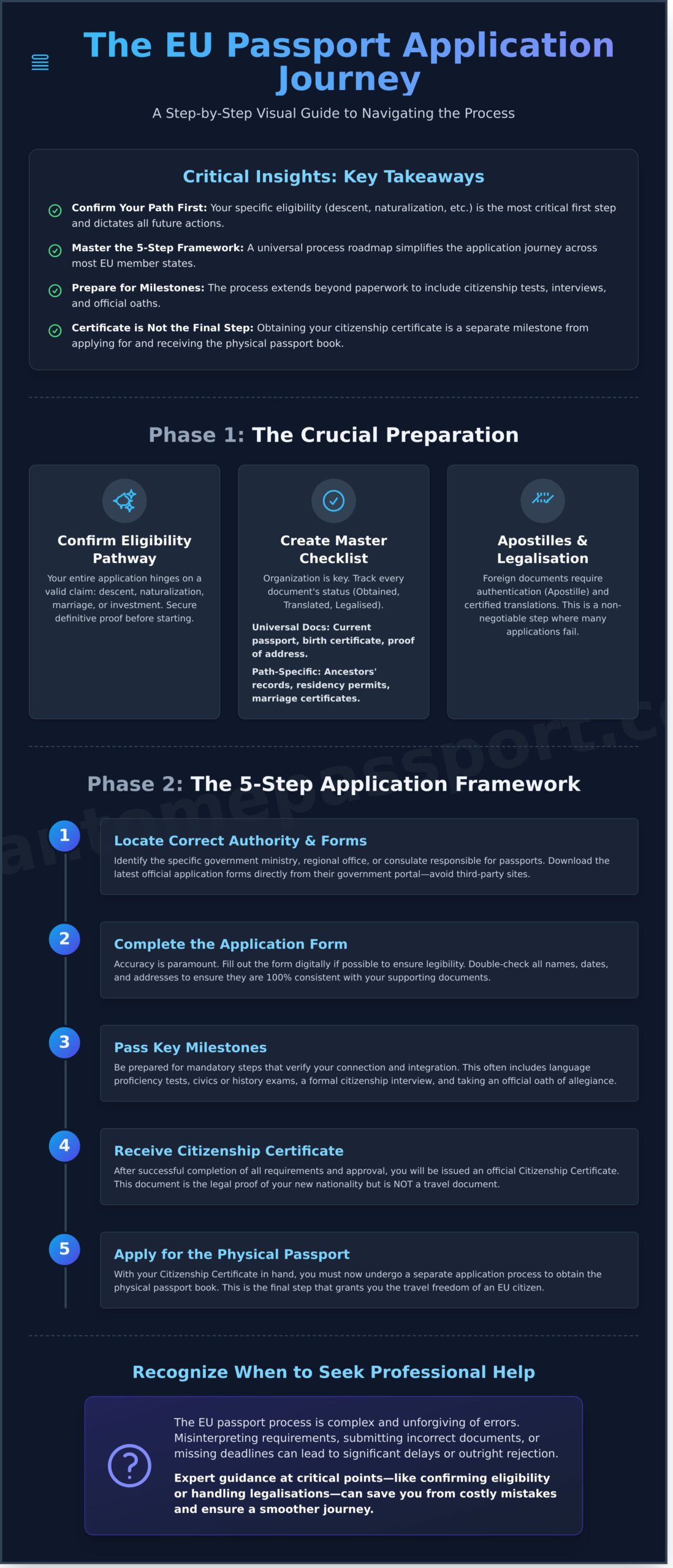
After Approval: From Citizenship Certificate to EU Passport
Receiving your official citizenship approval is a momentous occasion and a cause for celebration. You have successfully navigated a complex process and are now a citizen of a European Union member state. However, this is the final milestone, not the finish line. While you hold the legal status of a citizen, you do not yet have the official documents to prove it or travel freely.
This section outlines the final administrative steps to bridge the gap between your letter of approval and holding a new EU passport in your hands. Fortunately, this stage is far more straightforward and significantly faster than the naturalization process itself.
Receiving Your Certificate of Naturalisation
Your journey begins with the arrival of your Certificate of Naturalisation or Citizenship. This is not just a piece of paper; it is the cornerstone legal document proving your new nationality. It is irreplaceable and essential for every subsequent step. Guard this document carefully-we recommend making certified copies and storing the original in a secure location, such as a fireproof safe or a bank’s safe deposit box.
Applying for Your First National ID and Passport
With your citizenship certificate in hand, the next step is to integrate into the national system. In most EU countries, you must first apply for a national identity card. You will present your citizenship certificate and other required documents (like your birth certificate and proof of address) at a local municipal office or designated government agency. Once you receive your national ID card, you can finally proceed with the last step of how to apply for an EU passport. The passport application is typically a simple process submitted at the same time or shortly after the ID application, usually taking a few weeks to be processed and delivered.
Understanding Your New Rights and Responsibilities
Becoming an EU citizen grants you a powerful set of rights but also comes with responsibilities. You are now a citizen of both your new home country and the wider European Union. Key benefits include:
- Freedom of Movement: The right to live, work, study, and retire in any other EU/EEA country and Switzerland.
- Political Participation: The right to vote and stand as a candidate in municipal and European Parliament elections.
- Consular Protection: The right to seek help from any EU country’s embassy or consulate when traveling abroad.
You must also be aware of your new obligations, which may include tax responsibilities and, in some countries, compulsory military service. Understanding these duties is a crucial part of integrating as a new citizen. If you have questions about leveraging your new status, the experts at Quantome Passport can provide clarity.
When to Seek Professional Help with Your Application
While it is possible to manage your EU passport application independently, the journey is often fraught with potential pitfalls. Each country has its own intricate laws, specific document requirements, and bureaucratic hurdles that can easily derail an unprepared applicant. Recognizing when you need expert guidance is a strategic decision that saves invaluable time, money, and stress.
An investment in a professional service is an investment in certainty. Specialized firms navigate these legal landscapes daily, transforming a daunting process into a structured, manageable plan to secure a priceless asset for your future.
Complex Cases That Warrant Expert Guidance
Certain situations significantly increase the risk of delays or rejection. If your claim is based on ancestry but you have gaps in your family tree or missing historical documents, an expert can assist with genealogical research and legal affidavits. Likewise, applicants with previous visa denials or a complex personal history should seek counsel to frame their application correctly. Finally, understanding the specific due diligence and financial requirements of investment-based citizenship programs is a task best left to seasoned professionals.
The Benefits of a Professional Service
Engaging a specialized firm offers more than just help with paperwork; it provides a comprehensive support system designed to maximize your chances of success. Key advantages include:
- Document Perfection: Ensuring every form is correct and all supporting evidence is properly translated, apostilled, and legalized according to the destination country’s exact standards.
- Strategic Pathway Planning: An expert can analyze your unique circumstances to advise on the most efficient and viable route, clarifying exactly how to apply for an EU passport in a way that aligns with your goals.
- Professional Liaison: Your representative handles all communication with government agencies, consulates, and local authorities, overcoming language barriers and procedural obstacles on your behalf.
How Quantome Passport Can Help
At Quantome Passport, we cut through the complexity. We specialize in a streamlined residency-to-citizenship pathway through Slovenia, a stable and welcoming EU member state. Our program is meticulously designed for clarity and efficiency, providing a predictable timeline for clients who value a secure and straightforward process. If you’re serious about obtaining European citizenship, we can show you the most direct route.
Discover if our premier program is the right fit for you. Book a private strategy call to assess your options with an expert today.
Embark on Your EU Passport Journey with Confidence
Securing your European citizenship is a life-changing goal. As this guide has shown, understanding how to apply for an EU passport involves more than just filling out forms; it requires meticulous preparation, a clear grasp of your chosen country’s requirements, and perseverance through key milestones like interviews and tests. The journey is detailed, but the reward-the freedom and opportunity of an EU passport-is immense.
The path can seem daunting, but you don’t have to walk it alone. We provide expert guidance on complex residency and citizenship pathways, with a specialization in the efficient Slovenian program. For a personalized assessment of your unique situation and a clear, actionable plan, we invite you to take the next step. Book a Private Strategy Call to get a clear path forward.
Your future with the freedom to live, work, and travel across Europe is closer than you think. Take the next confident step toward your goal today.
Frequently Asked Questions About Applying for an EU Passport
What is the average cost to apply for EU citizenship?
The cost of EU citizenship varies dramatically by country. Application fees can range from €255 in Germany to over €1,000 in other nations. You must also budget for document translation, apostilles, and potential legal assistance, which can add several thousand euros. It’s crucial to research the specific fee schedule for your chosen country, as there are no EU-wide standardized costs. This initial research is a key step in your application journey.
How long does the entire process take, from application to receiving a passport?
The timeline from submitting your citizenship application to receiving a passport can range from one to four years, or even longer. Processing times depend heavily on the specific country, the complexity of your case, and the current volume of applications they are handling. For example, some countries have backlogs that significantly extend the wait. Ensuring your application is complete and accurate from the start can help prevent unnecessary delays in this lengthy process.
Do I need a lawyer to apply for an EU passport?
While it is not a legal requirement, hiring an immigration lawyer is highly recommended. The naturalization process is complex, and laws differ significantly between EU member states. A qualified lawyer ensures your application is error-free, all required documents are included, and deadlines are met. Their expertise can be invaluable in navigating bureaucratic hurdles and increasing your chances of a successful outcome, saving you time and potential rejection down the line.
Can my spouse and children get citizenship at the same time as me?
This depends on the specific country’s laws. Some nations allow for a family application where your spouse and minor children can naturalize with you. In other countries, they must apply separately after you have become a citizen. Generally, children born after you gain citizenship are automatically considered citizens. It is essential to verify the family naturalization policies of the country you are applying to, as the rules can be quite strict.
What are the most common reasons for an EU citizenship application to be rejected?
The most common reasons for rejection include incomplete or inaccurate documentation, failure to meet the physical residency requirements, and having a criminal record. Other frequent issues are failing the mandatory language or integration tests and not demonstrating sufficient financial stability. A thorough and honest application is your best defense against rejection. Double-checking every detail and requirement before submission is absolutely critical for a successful outcome.
Can I apply for citizenship in more than one EU country at the same time?
Legally, you can apply for citizenship in multiple EU countries simultaneously if you meet the eligibility criteria for each. However, this is strongly discouraged. Each application is a complex, expensive, and time-consuming process. It is far more practical and strategic to focus your resources and efforts on the single country where you have the strongest and most straightforward case for naturalization. This targeted approach significantly increases your likelihood of success.
Do I have to give up my current citizenship to get an EU passport?
Whether you must renounce your current citizenship depends on the laws of both your home country and the EU nation you’re applying to. Many EU countries, such as Ireland, Italy, and Sweden, permit dual citizenship. However, others like Germany and Spain have stricter rules that often require renunciation, with some exceptions. Researching the dual citizenship policies is a critical step when learning how to apply for an EU passport.