
You’ve built a life with the person you love, but now you face a daunting new chapter: a mountain of paperwork and the nagging fear that your genuine relationship could be questioned. The path to citizenship by marriage can feel overwhelming, clouded by bureaucratic hurdles and uncertainty about timelines. This is where that anxiety ends. This ultimate 2026 guide is designed to replace confusion with confidence, providing a clear roadmap to securing your future together.
We will walk you through every critical step, from gathering irrefutable proof of your bona fide marriage to navigating the specific residency rules and processing times in different countries. You’ll learn how to build a rock-solid application, understand what happens if your circumstances change, and gain the clarity needed to turn this complex legal journey into a successful reality. Let’s get you started on the path to your new passport.
Understanding Citizenship by Marriage: Beyond Saying ‘I Do’
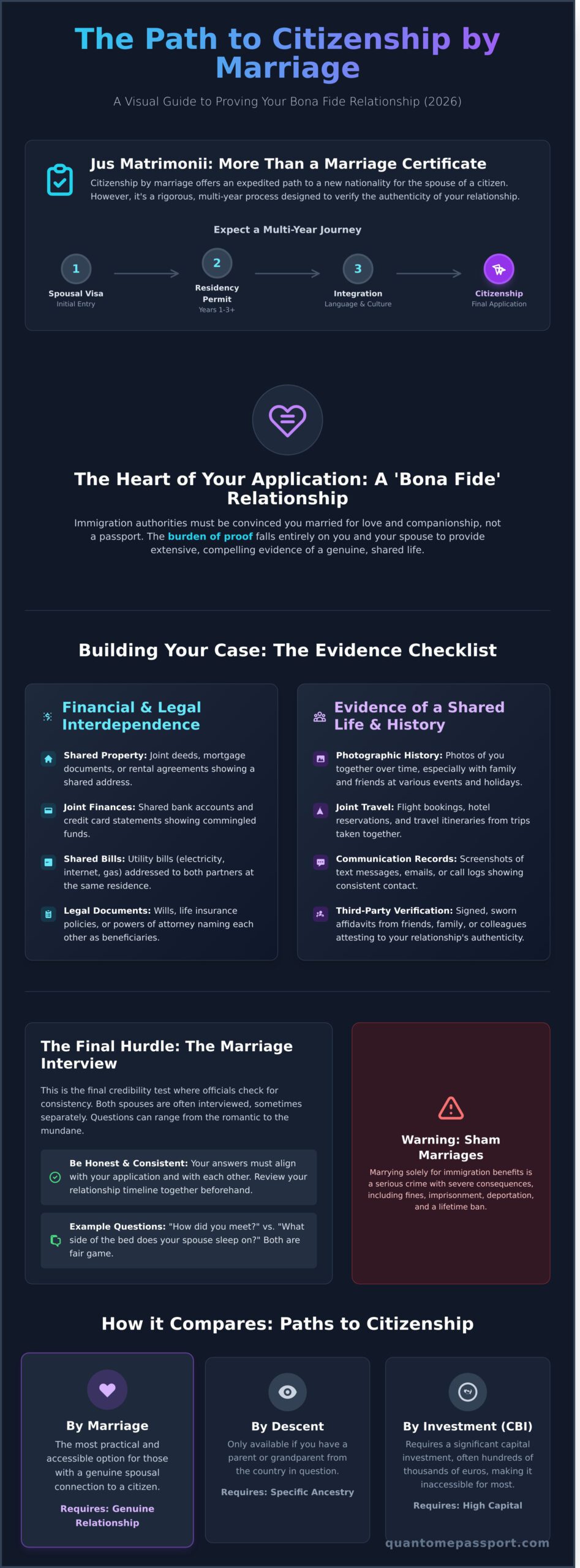
Acquiring citizenship by marriage, a concept rooted in the legal principle of Jus Matrimonii, is a common pathway to a new nationality. It is a form of naturalization that offers an expedited route for the foreign spouse of a country’s citizen, often reducing the standard residency requirements. However, it’s vital to set realistic expectations from the outset: this is not an instant passport. It is a rigorous, multi-year process designed to verify the authenticity of your relationship.
To better understand the core principles and requirements, this video provides a valuable overview:
Governments are extremely vigilant against fraudulent or ‘sham marriages’-unions entered into solely for immigration benefits. Engaging in such a scheme is a serious crime with severe consequences, which can include hefty fines, imprisonment, deportation, and a lifetime ban from entering the country. The entire application process is structured to distinguish genuine couples from those attempting to exploit the system.
The Core Principle: Bona Fide Relationship
At the heart of every successful application is the ability to prove a ‘bona fide’-or genuine and subsisting-relationship. Immigration authorities need to be convinced that you married for love and companionship, not for a passport. The burden of proof falls entirely on you and your spouse. You will be expected to provide extensive evidence, such as joint financial records, shared property deeds or leases, photographs together over time, and travel itineraries. Each country’s specific Nationality law outlines the exact requirements, but the core principle of authenticity is universal.
Marriage vs. Other Paths: How Does it Compare?
The marriage route offers a distinct alternative to other common pathways to citizenship:
- Citizenship by Descent (Jus Sanguinis): This is based on ancestry and is only available if you have a parent or grandparent from the country in question.
- Citizenship by Investment (CBI): This requires a significant capital investment, often running into hundreds of thousands of euros, making it inaccessible for most people.
For those with a genuine spousal connection to an EU citizen, the marriage pathway is often the most practical and accessible option, bypassing the high financial costs of investment programs and the specific lineage required for descent.
The Universal Requirements: How to Prove Your Marriage is Real
Securing citizenship by marriage is not as simple as presenting a marriage certificate. This is often the most scrutinized part of the entire application process. Immigration officials are trained to distinguish between genuine relationships and “marriages of convenience” designed solely for immigration benefits. They need to see compelling evidence that you and your spouse have built a legitimate, shared life together.
Your goal is to paint a clear and consistent picture of your relationship through documentation. Inconsistencies between documents or interview answers can raise immediate red flags. Think of your application as a story-every piece of evidence should support the central theme of your genuine partnership.
Financial & Legal Cohabitation
One of the strongest ways to demonstrate a shared life is by intertwining your finances and legal affairs. This shows a level of commitment and mutual trust that goes far beyond a simple ceremony. Key documents include:
- Joint bank or credit card statements
- Shared property deeds, mortgage documents, or rental agreements
- Utility bills addressed to both partners at the same residence
- Wills, life insurance policies, or powers of attorney that name each other as beneficiaries
Evidence of a Shared Life
Beyond finances, officials want to see the day-to-day reality of your relationship. This evidence helps humanize your application and proves your bond. While specific requirements vary by EU country, the principle of demonstrating a bona fide relationship is universal. For instance, the detailed evidence required for a U.S. Immigrant Visa for a Spouse highlights the importance of comprehensive proof. Consider gathering:
- Photographs together over time, especially with family and friends at various events.
- Travel itineraries, flight bookings, and hotel reservations from trips taken together.
- Communication records, such as screenshots of text messages, emails, or call logs.
- Signed affidavits from friends, family, or colleagues who can attest to the authenticity of your relationship.
The Marriage Interview: What to Expect
The interview is the final test of your application’s credibility. Both spouses are often interviewed, sometimes separately, to check for consistency. Questions can range from the romantic (‘How did you meet?’) to the mundane (‘What side of the bed does your spouse sleep on?’). The key to success is simple: be honest, be consistent with your application, and prepare by reviewing your relationship timeline and documents together beforehand.
The Path to a Passport: A Step-by-Step Application Guide
The journey to obtaining citizenship by marriage in an EU country is not a single event but a multi-stage process that can take several years. While the specific requirements differ from one member state to another, the path generally follows a clear progression: from securing initial legal residency to proving integration and finally applying for naturalization. Understanding this sequence is crucial for a successful application.
Stage 1: The Spousal Visa & Initial Residency
Your journey begins with securing the legal right to live in your spouse’s EU country. This typically involves applying for a spousal visa or family residence permit from your home country or upon arrival. This initial step is often the most document-intensive, requiring you to prove the authenticity of your marriage. For a detailed example of such requirements, the process for a spouse of a U.S. citizen, outlined by the U.S. Department of State, highlights the level of scrutiny involved. Expect to provide a comprehensive file, including:
- Your valid passport and your spouse’s ID
- An official, often apostilled, marriage certificate
- Proof of joint finances or your spouse’s ability to support you
- Results from mandatory health screenings and criminal record checks
Stage 2: Fulfilling Residency & Integration Requirements
Once you have your residence permit, the clock starts on your residency requirement. Most EU countries demand a period of continuous residency, typically three to five years, before you can apply for citizenship. This means you cannot spend significant time outside the country. During this period, you will also need to demonstrate integration. This usually involves passing a language proficiency test, often at an A2 or B1 level, and a civic integration exam covering the nation’s history, government, and cultural values.
Stage 3: The Naturalization Application & Oath
After satisfying the residency and integration criteria, you can submit your final naturalization application. This involves compiling your documents-residence permits, integration certificates, and proof of continued marriage-and paying the application fee. Authorities will conduct a final review and thorough background check, which may include a final interview. Upon approval, the last step is attending a citizenship ceremony. Here, you will take an Oath of Allegiance, officially completing your path to becoming an EU citizen.
Top EU Countries for Citizenship by Marriage: A 2026 Comparison
Navigating the path to citizenship by marriage in the European Union reveals that some countries offer significantly faster or more flexible routes than others. When we refer to the ‘easiest’ options, we typically mean those with the shortest residency requirements or less demanding language tests. However, it’s crucial to remember two universal, non-negotiable conditions: your marriage must be genuine and legally recognized, and you must fulfill a period of physical residency.
To simplify your research, here is a direct comparison of the most favorable EU countries for spousal naturalization in 2026:
| Country | Timeline | Key Requirement |
|---|---|---|
| Spain | 1 year of residency | A2 Spanish + Culture Test |
| Portugal | 3 years of marriage | A2 Portuguese + Community Ties |
| Italy | 2-3 years of residency | B1 Italian Language |
| Ireland | 3 years of marriage & residency | No Language Test (Good Character) |
While these represent some of the most favorable options, the timelines can still be substantial. If these seem too long, you might want to explore faster residency options with our experts.
Spain: One of the Fastest Routes
Spain stands out with one of the quickest naturalization timelines in the EU. After just one year of legal residency while married to a Spanish citizen, you can apply. You’ll need to pass a basic A2-level Spanish language exam and a cultural knowledge test (CCSE). This attractive path is even more accessible for nationals of Ibero-American countries, the Philippines, or Equatorial Guinea, who may have pre-existing residency advantages.
Portugal: A Popular & Flexible Option
Portugal offers a uniquely flexible route. You can apply for citizenship after being married to a Portuguese national for three years, with no strict minimum residency period required. However, you must demonstrate strong and effective ties to the Portuguese community. An A2-level Portuguese language certificate is a key component in proving this connection, alongside other evidence like property ownership or regular integration into local life.
Italy: The Ancestry & Marriage Hub
For spouses of Italian citizens, the naturalization timeline is two years if you reside in Italy or three years if you live abroad. A significant hurdle is the language requirement, which mandates an intermediate B1 level of Italian. Applicants should also be prepared for notoriously long administrative processing times, which can sometimes extend the final decision by several years beyond the initial application.
Ireland: The Common Travel Area Advantage
Gaining Irish citizenship offers a powerful and unique benefit: the right to live and work in the UK through the Common Travel Area agreement. To qualify, you must have been married for at least three years and have a minimum of three years of “reckonable residence” on the island of Ireland. While there is no formal language test, you must prove good character and a genuine commitment to residing in Ireland.
Life After Naturalization: Rights, Responsibilities & Common Questions
Congratulations! Achieving naturalization is a monumental milestone. Once you hold your new EU passport, you are a full citizen with the same rights and privileges as someone born in the country. This opens up a world of opportunities, from political participation to unrestricted travel and work across the entire European Union.
Your new status grants you several fundamental rights:
- The Right to Vote: Participate in local, national, and European Parliament elections, making your voice heard.
- Freedom of Movement: Live, work, study, and retire in any EU/EEA member state without needing a visa or work permit.
- Travel Power: Hold one of the world’s most powerful passports, enabling visa-free access to hundreds of countries.
With these rights come responsibilities. As a citizen, you are expected to abide by the law, pay taxes, and, in some nations, fulfill obligations like jury duty or, in rare cases, military service.
What Happens if We Divorce?
This is a common concern, but you can rest assured. Citizenship granted through a legitimate marriage is permanent and is not revoked if you and your spouse later divorce. The key factor is the authenticity of your relationship at the time of your application. However, if authorities can prove the union was a “sham marriage” created solely to obtain a passport, your citizenship by marriage can be revoked on grounds of fraud.
Can I Keep My Original Citizenship?
Whether you can hold two passports depends on the laws of both your original country and your new EU nation. This concept is known as dual citizenship, and policies vary widely.
- Countries that generally allow dual citizenship: Italy, Ireland, France, Sweden, and Portugal are among those that permit you to keep your original nationality.
- Countries with potential restrictions: Spain, the Netherlands, and Austria often require you to renounce your original citizenship. Germany has recently relaxed its rules, but conditions may still apply.
Navigating the final steps of your journey and understanding your new role is crucial. For personalized advice after gaining citizenship by marriage, seeking expert guidance can provide complete peace of mind. Explore your long-term options with the team at Quantome Passport.
Your Future Awaits: Final Steps on the Path to Citizenship
The journey to citizenship by marriage is a profound commitment that extends far beyond the wedding day. As we’ve explored, success hinges on meticulously proving the authenticity of your relationship and navigating the specific legal landscape of your chosen country. From gathering evidence to understanding residency requirements and timelines in the EU, each step is critical in transforming your marital union into a second passport.
The path can be complex, with ever-changing regulations making the process feel overwhelming. But you don’t have to walk it alone. Leveraging deep knowledge of European residency and citizenship programs, our experts provide the personalized strategies individuals and families need to navigate these intricate immigration pathways. If you’re ready to turn your dream of an EU passport into a reality, take the next decisive step.
Book a Private Strategy Call to explore all your EU citizenship options.
Your new life as a global citizen is within reach. Let’s build your future, together.
Frequently Asked Questions About EU Citizenship by Marriage
How long does the entire citizenship by marriage process take on average?
The timeline varies significantly between EU countries, typically ranging from 3 to 10 years from the date of marriage. This includes a mandatory period of legal residency as a spouse, which might be 3 years in Spain or 5 years in Germany. After meeting the residency requirement, the naturalization application processing itself can take an additional 1 to 2 years. Always check the specific laws of the country where you plan to apply for an accurate timeline.
Can my citizenship be revoked if my spouse dies or we get divorced?
Generally, once citizenship is granted, it cannot be revoked due to a subsequent divorce or the death of your EU spouse. Naturalization is considered a permanent status. However, if the separation occurs while your application is still pending, it will likely be terminated. The main exception is if the marriage is later proven to have been fraudulent from the start (a “marriage of convenience”), in which case citizenship can be revoked at any time.
Do I need an immigration lawyer to apply for citizenship by marriage?
While not legally mandatory, hiring an experienced immigration lawyer for your citizenship by marriage application is highly advisable. The process involves complex legal requirements that differ by country. A lawyer ensures all paperwork is filed correctly, helps you prepare for interviews and integration tests, and can represent you if any complications or delays arise. Their expertise can prevent common mistakes that lead to denial and significantly streamline your path to becoming a citizen.
What are the most common reasons for an application to be denied?
Applications are most often denied for failing to meet specific requirements. Common reasons include an insufficient period of residency, failing the country’s language or civic integration test, or having a significant criminal record. Another major cause for rejection is the inability to prove the marriage is genuine and subsisting. Authorities look for evidence of a shared life, and a lack of it can lead them to suspect a marriage of convenience, resulting in immediate denial.
Can same-sex marriage be used as a basis for a citizenship application?
This depends entirely on the laws of the individual EU member state. In countries that legally recognize same-sex marriage, such as Spain, France, or the Netherlands, it is a valid basis for a citizenship application under the same rules as heterosexual marriage. However, in EU countries that do not recognize same-sex unions, like Poland or Hungary, you cannot use your marriage as a pathway to naturalization. Always verify the local laws.
Do my children automatically get citizenship when I naturalize?
It is not always automatic, but it is often possible through a simplified process. When you gain EU nationality via citizenship by marriage, your minor children (usually under 18) who are legally residing with you in that country may be eligible to acquire citizenship at the same time. However, adult children almost never qualify automatically and would need to apply on their own merit. The specific rules and age limits vary widely by country.