
Does a story about a great-grandparent from Italy, Poland, or Ireland spark a dream of holding a European passport? For many, that dream quickly gets tangled in a web of confusing bureaucracy, the daunting hunt for century-old documents, and the nagging fear of a single misstep derailing the entire process. What if you could untangle that web and find a clear path forward? The opportunity to claim eu citizenship by descent is a powerful one, but navigating the specific laws of each country-especially when an ancestor may have renounced their citizenship-can feel impossible to do alone.
This is where your journey to clarity begins. In this ultimate guide, we will demystify the entire process from start to finish. We’ll provide you with a clear framework to help determine your eligibility, outline the exact documents you’ll need to find, and walk you through the critical steps for a successful application. Consider this your roadmap to confidently reclaiming your European heritage and unlocking the future you’ve been dreaming of.
What is EU Citizenship by Descent (Jus Sanguinis)?
At its heart, EU citizenship by descent is the legal principle that you can claim citizenship not based on where you were born, but on who you were born to. It’s a powerful opportunity to reconnect with your European heritage, based on your bloodline rather than your birthplace. This pathway is formally known as Jus Sanguinis, a Latin term meaning “right of blood.”
For many individuals with European ancestors, this is often the most direct and cost-effective route to securing an EU passport and all the benefits that come with it. It bypasses the long residency requirements of naturalization and the significant financial outlay of investment programs.
To better understand how this applies to specific countries, the video below offers a helpful overview:
The Principle of ‘Jus Sanguinis’ vs. ‘Jus Soli’
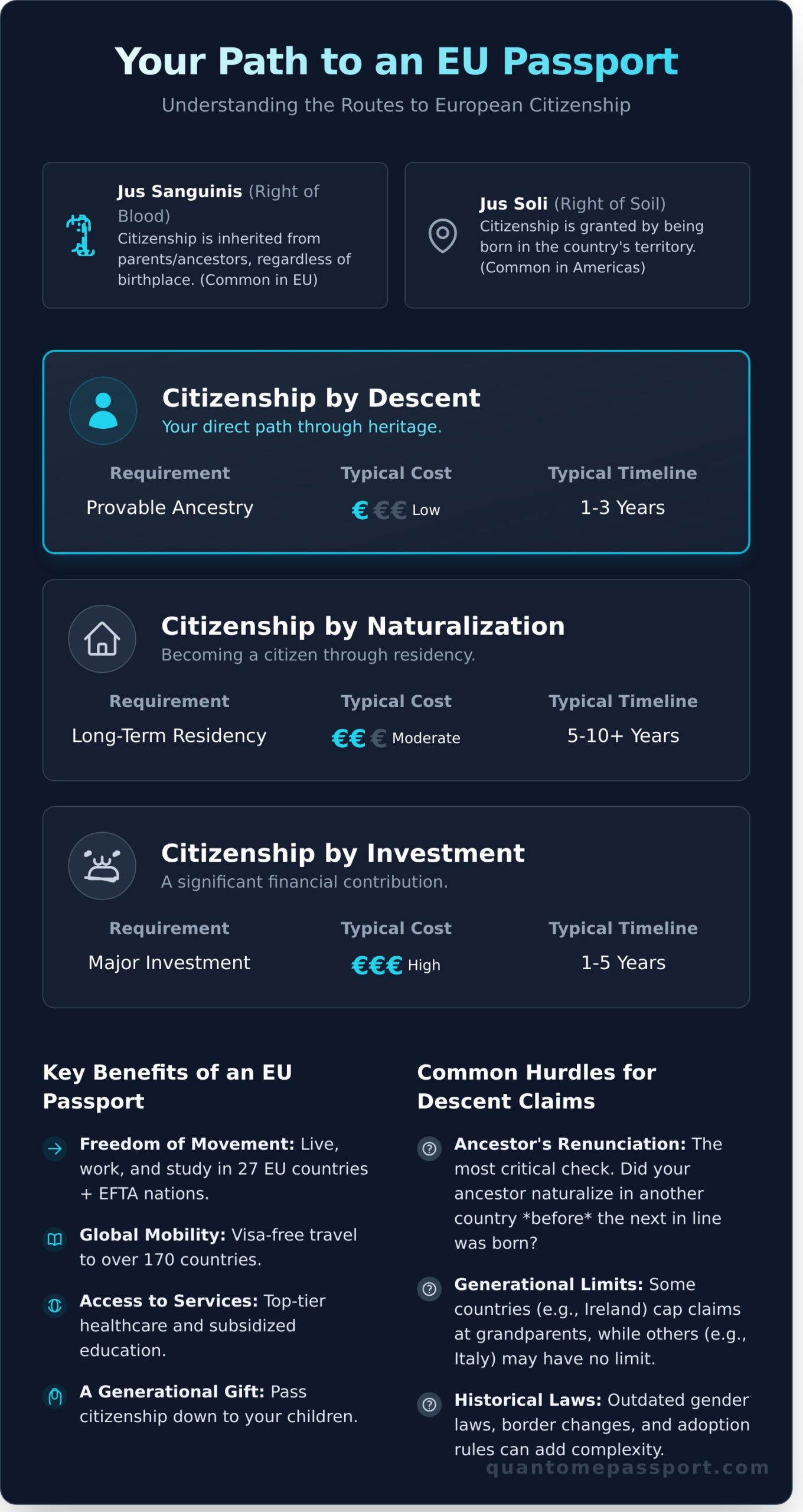
Citizenship laws are primarily built on two concepts. Most European nations favor Jus Sanguinis, where citizenship is inherited from one’s parents or more distant ancestors, regardless of where the child is born. This contrasts with Jus Soli (“right of soil”), common in the Americas, where citizenship is automatically granted to anyone born within the country’s territory. Think of it like this: Jus Sanguinis is a birthright passed down through your family tree, while Jus Soli is a right granted by the location of your birth.
Descent vs. Investment vs. Naturalization: A Quick Comparison
Understanding your options is key. While all three pathways can lead to an EU passport, the requirements, costs, and timelines differ dramatically. The journey to eu citizenship by descent is uniquely focused on your personal history.
- Citizenship by Descent:
- Primary Requirement: Provable genealogical link to an EU ancestor.
- Typical Cost: Low (document retrieval, legal fees).
- Typical Timeline: 1-3 years, depending on the country.
- Citizenship by Naturalization:
- Primary Requirement: Legal residency in the country for a set number of years.
- Typical Cost: Moderate (visa fees, living expenses).
- Typical Timeline: 5-10+ years of continuous residence.
- Citizenship by Investment:
- Primary Requirement: A significant financial contribution or investment.
- Typical Cost: High (hundreds of thousands to millions of Euros).
- Typical Timeline: 1-5 years.
Key Benefits of an EU Passport Through Ancestry
Securing citizenship through your ancestry unlocks a world of opportunities, not just for you but for future generations. Key advantages include:
- Freedom of Movement: The right to live, work, retire, and study in any of the 27 EU member states, plus Iceland, Liechtenstein, Norway, and Switzerland.
- Access to Services: Eligibility for world-class public healthcare and subsidized higher education across the European Union.
- Enhanced Global Mobility: An EU passport is one of the most powerful in the world, granting visa-free or visa-on-arrival access to over 170 countries.
- A Generational Gift: The right to pass down your reclaimed citizenship to your children, securing their European identity and future.
Are You Eligible? Key Factors and Generational Limits
“Do I qualify?” This is the first question on every heritage journey. The answer depends entirely on the specific laws of your ancestor’s home country-there is no single European rule. Eligibility for citizenship by descent hinges on two core principles: the generational distance to your qualifying ancestor and maintaining an “unbroken line” of citizenship from them to you.
Tracing Your Lineage: How Many Generations Back Can You Go?
Some nations, like Italy, often have no generational limit, provided the line of citizenship was never broken. Others are more restrictive. Ireland, for instance, generally allows you to claim citizenship through a grandparent. Many other countries cap eligibility at the parent or grandparent level. It is absolutely critical to research the specific legislation of the country you are targeting to understand its unique generational rules.
The Critical Question: Did Your Ancestor Renounce Their Citizenship?
This is the most common roadblock. If your ancestor voluntarily became a citizen of another country (e.g., the U.S., Canada, Australia) before the birth of their child in that new country, the line of citizenship is typically severed. For example, if your Italian grandfather became a U.S. citizen in 1920 and your father was born in the U.S. in 1922, your father was not born to an Italian citizen, and the claim fails. Naturalization records, often found in national archives, are essential for verifying these dates.
Other Common Eligibility Hurdles
Beyond generational limits and naturalization, several other factors can impact your claim for eu citizenship by descent. Be aware of potential complexities such as:
- Historical Gender Laws: Many countries historically did not permit women to pass citizenship to their children. While courts have overturned many of these laws, they can still complicate applications.
- Border and Name Changes: Your ancestor’s town may have belonged to a different country at the time of their birth.
- Adoption: The laws surrounding citizenship through adoptive parents vary significantly by country.
Fortunately, many nations have modernized their laws, creating new pathways for those who were previously excluded.
Popular Country Pathways for Citizenship by Descent
Many European nations offer routes to citizenship based on ancestry, a direct result of their large global diasporas. For individuals in the US, Canada, and Australia, these programs represent a powerful opportunity to reconnect with their heritage. Understanding the nuances of each country’s laws is the first step in determining your eligibility for eu citizenship by descent.
Ireland: The ‘Foreign Births Register’ and the Granny Rule
Ireland offers one of the most famous ancestry programs, often called the “Granny Rule.” If one of your grandparents was born on the island of Ireland, you may be eligible. The process involves applying to the Foreign Births Register. A crucial consideration: you must be on the register before your own children are born for them to inherit the right. Key documents typically include:
- Your grandparent’s Irish birth certificate.
- Your parent’s birth certificate and marriage certificate.
- Your own birth certificate and supporting identity documents.
Italy: Jure Sanguinis and the ‘Unbroken Line’
Italy’s principle of Jure Sanguinis (“right of blood”) is incredibly generous, with no generational limit. As long as you can prove an unbroken line of descent from an Italian-born ancestor, you may qualify. The main challenge is the “1948 Rule”: if your Italian lineage passes through a woman, her child must have been born on or after January 1, 1948. You must also demonstrate your ancestor had not naturalized in another country before the birth of their child.
Poland & Hungary: Reclaiming Ancestral Ties
Poland’s rules can be complex, especially for ancestors who left before Poland regained independence in 1918. The core requirement is proving your ancestor was a Polish citizen and did not lose that citizenship before passing it down-for example, by serving in a non-allied foreign military. Hungary offers a simplified naturalization path for those who can prove they have Hungarian ancestors, but applicants must demonstrate a basic conversational ability in the Hungarian language.
Spain & Portugal: Sephardic Ancestry and Beyond
While Spain and Portugal’s well-known laws for descendants of Sephardic Jews have largely closed or changed, they remain excellent examples of ancestry-based programs. Today, Portugal offers a popular pathway for grandchildren of Portuguese citizens, provided they can demonstrate effective ties to the Portuguese community. Similarly, Spain provides routes for the children and, in some cases, grandchildren of Spanish citizens, particularly those who may have lost citizenship due to exile.
Your Application Roadmap: From Research to Passport
The path to claiming your EU citizenship by descent can feel like navigating a maze. We’ve broken down the complex journey into three clear phases to demystify the process and guide you from initial curiosity to holding your new passport. Success hinges on two key ingredients: meticulous organization and a healthy dose of patience.
Phase 1: Genealogical Research and Eligibility Verification
Your journey begins at home. Start by interviewing older family members to gather stories, names, and dates. Your goal is to identify the key ancestor whose lineage connects you to an EU country. Focus on collecting vital information for every person in your direct line: full names, dates and places of birth, marriage, and death. This foundational work confirms your eligibility and creates a blueprint for your document search. Feeling lost? A strategy call can create your research roadmap.
Phase 2: The Document Hunt – What You Need and Where to Find It
This is where your research becomes tangible. You’ll need to gather an official paper trail connecting you to your European ancestor. The core documents for an application typically include:
- Birth, marriage, and death certificates for everyone in your direct lineage.
- Your ancestor’s naturalization records (or proof of non-naturalization).
- Your own birth and marriage certificates.
Start with your home country’s vital records offices, then move to archives in the EU. If a document is missing or a name was changed, don’t panic. Alternative sources like census data, ship manifests, and church records can often fill the gaps in your quest for eu citizenship by descent.
Phase 3: Legalization, Translation, and Submission
Once you have all your documents, they must be prepared for official submission. Any document not in the official language of your target country will require a certified translation. Furthermore, documents issued outside the EU will likely need an Apostille-an official certificate that authenticates them for international use. With your complete, translated, and apostilled file, you’ll submit your application at the designated consulate or embassy. Be prepared to wait; processing times can range from several months to a few years.
Why Expert Guidance is Your Most Valuable Asset
The journey to reclaiming your heritage is deeply personal, but the administrative path is notoriously complex. While understanding the steps is crucial, executing them flawlessly is what determines success or failure. This is where the theoretical knowledge of “how-to” meets the practical reality of bureaucratic hurdles, and where professional guidance becomes your single most important investment.
Navigating Common Pitfalls: From Lost Records to Legal Loopholes
The path to eu citizenship by descent is rarely a straight line. Seemingly minor issues can derail an entire application. Our experts specialize in resolving the exact challenges that stop most people in their tracks, such as:
- Document Discrepancies: We trace and legally reconcile name changes and misspellings across generations, like an ancestor “Giuseppe” who became “Joseph” upon arrival.
- Historical Law Changes: We navigate complex legal histories, including outdated laws that once prevented women from passing down their citizenship, to build a valid modern claim.
- Evidence Sourcing: Our teams have extensive experience locating vital records in obscure municipal archives, church logs, and military records that are often inaccessible to the public.
Saving Time, Money, and Avoiding Rejection
A rejected application is more than a disappointment; it represents wasted government fees, expensive translation costs, and often years of lost time. Working with a firm like Quantome Passport transforms this risk into a strategic advantage. We ensure your file is meticulously prepared and “decision-ready” from day one, minimizing delays and maximizing your chances of approval. This professional case management provides not only a faster outcome but also invaluable peace of mind.
Your Path to EU Citizenship Starts Here
At Quantome Passport, we specialize in turning complex ancestry cases into successful citizenship applications. We don’t just provide information; we provide a clear strategy and manage the entire process on your behalf. Before you spend countless hours and resources chasing documents, the most critical first step is to confirm you have a viable case.
Stop guessing and start planning. Let our experts analyze your unique situation and provide a definitive answer on your eligibility. Book a Private Strategy Call to get a clear verdict on your eligibility.
Unlock Your European Heritage and Secure Your Future
The journey to claiming your European ancestry is more than just a legal process; it’s a profound connection to your past. As we’ve explored, understanding the principles of jus sanguinis, navigating specific country requirements, and meticulously preparing your documentation are the foundational steps. The path to eu citizenship by descent is a complex one, paved with intricate laws and generational limits that can be challenging to decipher alone.
This is where expert guidance becomes invaluable. Don’t let confusion or uncertainty halt your progress. Our team provides personalized assessments of your unique family history, leveraging deep expertise in complex EU citizenship laws from our global offices in London and Dubai. Take the definitive next step to confirm your eligibility and build a clear strategy for success.
Verify your ancestry claim with an expert. Book your Private Strategy Call today.
Your European passport could be closer than you think. The story of your ancestors is waiting to be continued by you.
Frequently Asked Questions
How long does the EU citizenship by descent process usually take?
The timeline varies significantly depending on the country and the complexity of your case. For some countries, like Ireland, the process can take 12 to 24 months. For others, such as Italy, wait times at consulates can extend the process to 2-4 years or more. Factors like document retrieval and the specific consulate’s backlog play a major role. A well-prepared application is key to avoiding unnecessary delays and ensuring the smoothest possible journey.
How much does it cost to apply for citizenship by descent?
Costs are comprised of several components. You will have government application fees, which can range from a few hundred to over a thousand euros. Additional expenses include sourcing official documents, certified translations, and legalizations like apostilles, which can add up. Professional assistance fees for managing your case are separate. It’s important to budget for each stage of the process, as costs are not a single, one-time payment but are spread throughout the application timeline.
Do I need to speak the language of my ancestor’s country?
For most citizenship by descent applications, you are not required to speak the language. Countries like Italy, Poland, Hungary, and Ireland grant citizenship based on your bloodline (“jus sanguinis”), not cultural integration. This is a significant advantage over naturalization, which almost always requires passing a language and history exam. Your eligibility is based on proving your lineage, making language proficiency a non-issue for reclaiming your ancestral citizenship.
If I get citizenship, can my spouse and children get it too?
Your minor children (under 18) can typically acquire citizenship along with you or be registered as citizens immediately after you are successful. However, your spouse’s path is different. They do not automatically receive citizenship. After you become an EU citizen, your spouse can usually apply for residency in the EU country and, after several years of marriage and/or residency, may be eligible to apply for citizenship through naturalization, a separate process.
What are the tax implications of becoming a dual EU citizen?
Tax obligations are generally based on residency, not citizenship. Holding an EU passport does not automatically make you a tax resident in that country. You will typically continue to pay taxes in the country where you permanently reside. The main exception is for U.S. citizens, who are taxed on their worldwide income regardless of where they live. We always recommend consulting with a cross-border tax specialist to understand your specific financial situation and obligations.
Can I hold dual citizenship, or will I have to give up my current passport?
Most EU countries permit dual citizenship, allowing you to keep your current passport. The success of your EU citizenship by descent application also depends on your home country’s laws. Nations like the U.S., Canada, the UK, and Australia allow their citizens to hold multiple passports. However, it is crucial to verify the regulations for both countries involved, as some nations have restrictions. In the vast majority of cases, you will not have to renounce your original citizenship.
What happens if my application is rejected?
A rejection is not necessarily the final outcome. You will receive a formal decision outlining the reason for the denial, which is often due to missing documentation or failure to meet a specific legal requirement. Most countries offer an appeals process where you can submit additional evidence or challenge the decision, usually within a strict timeframe. Thoroughly preparing your initial application with expert guidance is the best way to minimize the risk of rejection and ensure a successful outcome.