Dreaming of the emerald rivers and alpine peaks of Slovenia? The excitement of a new life abroad is often paired with a nagging worry: how will I communicate? If you’re wrestling with the fear of being lost in translation or feeling uncertain about legal requirements, you’re not alone. It’s one of the most fundamental questions every future expat asks, and the key to unlocking your new life is understanding what language do they speak in Slovenia.
This guide is designed to put those fears to rest. We’ll go far beyond a simple dictionary answer, giving you a practical look at the country’s linguistic landscape. You’ll discover not only the official language, Slovene, but also just how far you can get with English in daily life. More importantly, we’ll demystify the specific language requirements for residency and citizenship, giving you a clear roadmap for everything from navigating bureaucracy to truly integrating into your new community. Consider this your essential first step towards feeling at home.
Slovene: The Official Language of Slovenia
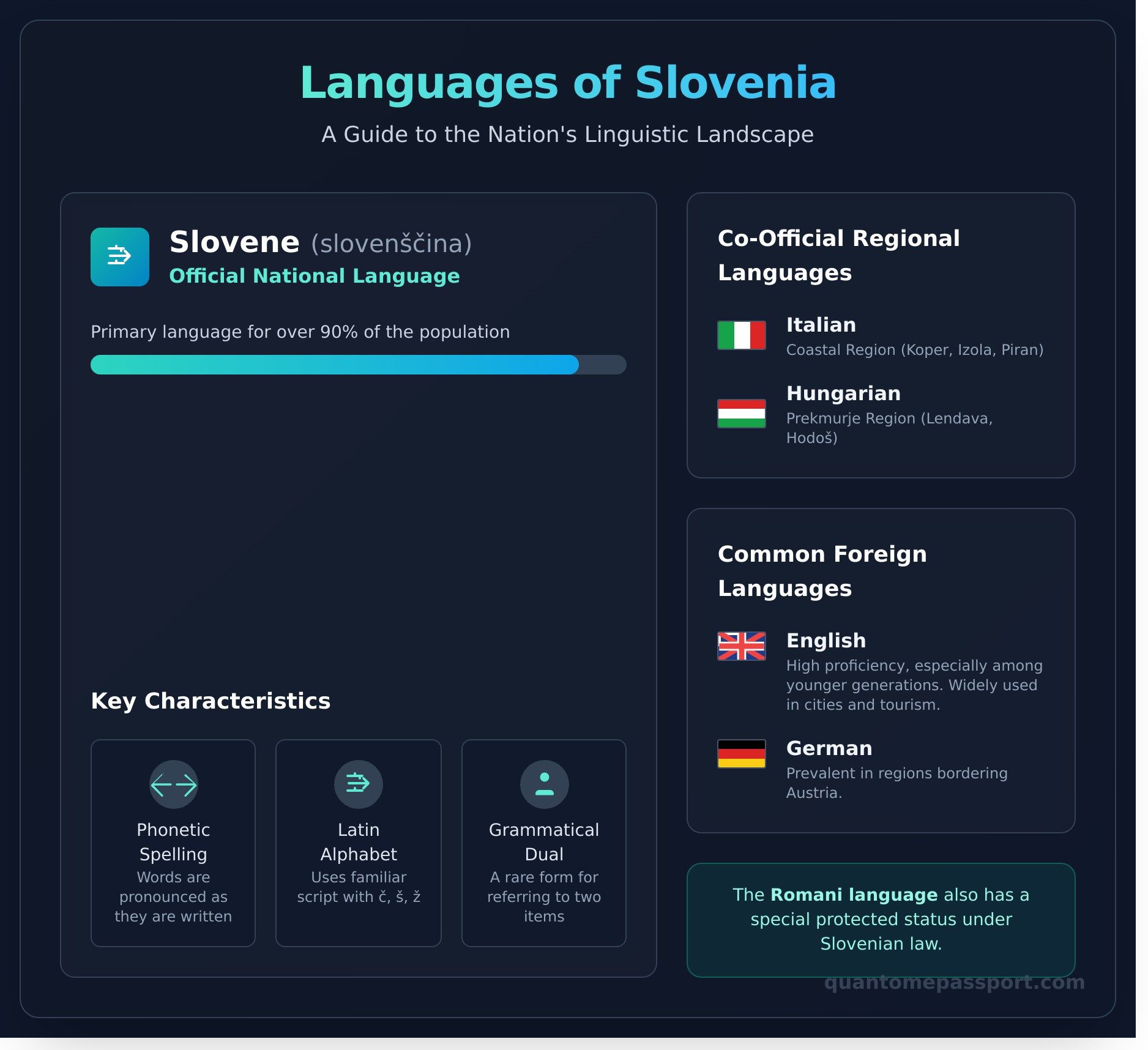
When asking what language do they speak in slovenia, the definitive answer is Slovene (slovenščina). This South Slavic language is the mother tongue for over 90% of the country’s population and holds a central place in the national identity. While it shares roots with Croatian and Serbian, Slovene has evolved with unique characteristics that set it apart from its linguistic relatives.
To get a broader sense of the country’s culture, language, and geography, this video from Geography Now provides an excellent overview:
The Slovene language has been a powerful force for cultural preservation throughout history. It is the official and national language of Slovenia, deeply intertwined with the nation’s art, literature, and identity. One of its most distinctive grammatical features is the dual (dvojina), a rare trait in modern languages used to refer specifically to two people or objects, existing alongside the singular and plural forms. This linguistic complexity highlights its rich heritage.
A quick note on terminology: the term Slovene refers specifically to the language, while Slovenian is the adjective used to describe the people, culture, or things from the country (e.g., a Slovenian citizen, Slovenian food).
Key Characteristics of the Slovene Language
For English speakers, Slovene has several approachable features that make it easier to learn than it might first appear:
- Latin Alphabet: The language uses the familiar Latin script, with the addition of three letters (č, š, ž) to represent specific sounds.
- Phonetic Nature: For the most part, Slovene words are pronounced exactly as they are written, which simplifies reading and speaking.
- Standard vs. Dialects: While Slovenia is known for its vast number of regional dialects, Standard Slovene is used in all official communications, media, and education.
Basic Slovene Phrases for Everyday Life
Locals warmly appreciate any attempt to speak their language. Learning just a few key phrases can go a long way in making connections during your visit.
- Hello: Dober dan (formal) / Živjo (informal)
- Goodbye: Nasvidenje (formal) / Adijo (informal)
- Please: Prosim
- Thank you: Hvala
- I would like…: Rad bi… (if you are male) / Rada bi… (if you are female)
- How much is this?: Koliko stane to?
Recognized Minority & Co-Official Languages
While Slovene is the sole official language at the national level, the answer to what language do they speak in Slovenia becomes more nuanced in certain regions. The country’s constitution provides robust protection for its autochthonous (indigenous) Italian and Hungarian ethnic communities, reflecting Slovenia’s long history as a cultural and linguistic crossroads in Central Europe. This constitutional framework establishes Italian and Hungarian as co-official languages in the specific municipalities where these communities historically reside, ensuring their linguistic rights are upheld in public life.
Italian in the Coastal Region
Along Slovenia’s picturesque Adriatic coast, Italian holds co-official status with Slovene in the municipalities of Koper, Izola, and Piran. This region, known as Slovenian Istria, has deep historical ties to the former Venetian Republic and Italy. Visitors will immediately notice the bilingual landscape: road signs, street names, and official buildings display both languages. Public services, from administration to education, are provided in both Slovene and Italian, ensuring the Italian-speaking community can fully participate in civic life.
Hungarian in the Prekmurje Region
In the northeastern corner of the country, in a region called Prekmurje bordering Hungary, Hungarian is a co-official language. This status is a legacy of the area’s history within the Austro-Hungarian Empire. In municipalities like Lendava and Hodoš, Hungarian is used alongside Slovene in government, media, and the education system. Bilingual schools are common, allowing students to become fluent in both languages and preserving the region’s unique cultural heritage.
Beyond these two prominent examples, Slovenia also recognizes the special status of the Romani language. While not co-official in the same way, it is protected by law, and efforts are made to support its use in education and media. The complex linguistic map shows that to truly understand what language do they speak in Slovenia, one must look beyond the national level to the vibrant, multilingual communities that define its border regions.
The Role of English and Other Foreign Languages
For many travelers, expats, and digital nomads, the most pressing question isn’t just about the official tongue, but rather, “what language do they speak in Slovenia that I can use to get by?” The answer is often a pleasant surprise. Slovenia boasts one of the highest English proficiency rates in Southern Europe, particularly among younger generations who begin learning it in primary school. You will find that English is a widely understood and spoken second language, making communication far easier than in many neighboring countries.
Due to its geographical position, German is also prevalent, especially in the regions bordering Austria, while Italian is commonly spoken along the coast near Italy. However, for most international visitors, English will be the most useful foreign language.
Can You Get By With Only English?
For short-term visits, the answer is a resounding yes. In major cities like Ljubljana and Maribor, and tourist hotspots like Bled and Piran, you can comfortably navigate hotels, restaurants, and shops using only English. It is also sufficient for working within international companies where English is the corporate language. For long-term living, however, relying solely on English will limit your integration. While you can manage day-to-day life, learning at least basic Slovene is essential for truly connecting with the culture and community.
English in Business and Academia
Slovenia has carved out a niche as an attractive hub for skilled professionals and students, largely thanks to the widespread use of English in key sectors. English is the de facto language of the booming tech industry, international business, and scientific research. The country’s strong educational framework, detailed in the official Slovenian Language Policy, underpins this high proficiency. Furthermore, many universities offer entire degree programs in English, particularly at the Master’s and PhD levels, drawing a significant international student body.
When You Will Absolutely Need Slovene
While English opens many doors, some can only be unlocked with Slovene. True integration and self-sufficiency as an expat require learning the local language for several key situations:
- Government and Administration: All official paperwork, from residency permits to taxes, is conducted in Slovene. While you may find helpful English-speaking staff, all documentation will be in the official language.
- Healthcare: Outside of private clinics in Ljubljana, you should expect medical appointments with doctors, nurses, and specialists to be in Slovene.
- Rural Life: In smaller towns and villages, English proficiency drops significantly. Daily tasks like grocery shopping or asking for directions will require Slovene.
- Deep Social Connections: Building genuine friendships and understanding the local humor and culture is nearly impossible without speaking the language.
Planning a move? Navigating the linguistic landscape is a key step. Find more expert guidance for your journey at quantomepassport.com.
Language Requirements for Residency and Citizenship in Slovenia
Moving to Slovenia is an exciting prospect, but transitioning from a visitor to a resident involves more than just paperwork. For those planning to make Slovenia their long-term home, understanding the official language requirements is a critical step. While knowing what language do they speak in Slovenia is useful for daily life, proving your proficiency in Slovene becomes a legal necessity for permanent residency and citizenship, demonstrating your commitment to integrating into Slovenian society.
Language for Temporary and Permanent Residency
For most initial temporary residence permits, such as those for work or study, you generally will not be required to pass a Slovene language test. The focus is on the primary purpose of your stay. However, the requirements change significantly when you apply for permanent residency. To secure this status, you must demonstrate a basic command of the language by passing a state-administered exam at the A2 level on the Common European Framework of Reference for Languages (CEFR).
An A2 level proficiency means you can:
- Understand sentences and frequently used expressions related to everyday life.
- Communicate in simple, routine tasks requiring a direct exchange of information.
- Describe in simple terms aspects of your background and immediate environment.
The Slovene Language Test for Citizenship
The path to Slovenian citizenship through naturalization requires a higher level of language skill. Applicants must pass a more comprehensive exam, typically at the B1 level. This test is designed to assess your ability to function independently in most situations that arise while living in the country. It goes beyond basic phrases to test your competence in conversations, expressing opinions, and understanding the main points of clear, standard texts on familiar matters. To help you succeed, there are numerous official, state-recognized language courses available throughout Slovenia designed to prepare you for this specific exam.
Planning Your Path to Citizenship
Viewing language acquisition as a core part of your long-term immigration strategy is a wise investment. Starting your Slovene lessons early in your residency journey not only eases your daily life but also ensures you are well-prepared when it’s time to apply for permanent status or citizenship. This proactive approach turns a legal requirement into a manageable milestone. Navigating the specific documentation and exam registration can be complex, but it doesn’t have to be a barrier. Our experts can guide you through every step of the residency process.
Your Next Chapter in Multilingual Slovenia
As you plan your move, understanding the local culture begins with its language. We’ve seen that the answer to what language do they speak in slovenia is layered: Slovene is the official language, but regional recognition of Italian and Hungarian showcases the nation’s diversity. Furthermore, the widespread use of English, particularly in business and tourism, provides a comfortable landing for many expats, easing the initial transition.
While learning some Slovene is a rewarding endeavor, navigating the residency process requires a different kind of fluency. That’s where expert guidance on EU residency and citizenship becomes invaluable. We develop personalized strategies for investors and families, offering a clear and secure path to your new life in Europe. Considering Slovenia as your new home? Learn about our expert-led residency programs.
Embrace the journey ahead. With the right preparation and support, your dream of living in beautiful Slovenia is well within reach.
Frequently Asked Questions About the Language in Slovenia
Is Slovene a difficult language for English speakers to learn?
Slovene is considered challenging for native English speakers. The U.S. Foreign Service Institute places it in Category IV, requiring significant study. Its complexity comes from a dual grammatical number (in addition to singular and plural), six noun cases, and gendered nouns. While its Latin-based alphabet is phonetic and relatively easy to grasp, mastering the intricate grammar is the biggest hurdle for learners, demanding consistent effort and practice to achieve fluency.
Is Slovenian similar to Russian or other Slavic languages?
As a South Slavic language, Slovenian shares the most similarities with Croatian and Serbian, and speakers can often understand each other to a degree. While it belongs to the same broad family as Russian (an East Slavic language), they are not mutually intelligible. The relationship is similar to that of English and German; they share ancient roots and some cognates, but a speaker of one cannot automatically understand the other without dedicated study.
Do they speak German in Slovenia?
While not an official language, German is widely understood, particularly among the older generation and in regions bordering Austria, such as Styria and Upper Carniola. Due to historical connections and geographic proximity, German is a common second language taught in schools. In business environments and major tourist destinations like Ljubljana and Bled, you will frequently encounter locals who are proficient in German, in addition to English and Slovene.
What is the best way to start learning Slovene before moving?
A blended approach is most effective. Begin with language apps like Duolingo or Memrise to build a foundational vocabulary and practice pronunciation. For more structured learning, consider online resources like the “Slonline” course or find a virtual tutor on a platform like iTalki. Listening to Slovenian music and podcasts is also an excellent way to familiarize yourself with the natural cadence and flow of the language before you arrive in the country.
Can I work in Slovenia if I only speak English?
It is possible to find work speaking only English, especially within specific industries. International corporations, the tech sector, and tourism-related businesses, particularly in Ljubljana, often use English as the primary language of communication. However, for most other professions and for smoother daily integration, learning Slovene is highly advantageous. Acknowledging what language do they speak in slovenia and making an effort to learn it will significantly broaden your career opportunities.
How do you say ‘hello’ and ‘thank you’ in Slovenian?
For a casual ‘hello’, you can say “Živjo” (pronounced ZHEEV-yo). A more formal greeting for ‘good day’ is “Dober dan” (DOH-ber dahn). To say ‘thank you’, the essential word is “Hvala” (HVAH-lah). If you want to be more emphatic and say ‘thank you very much’, you would use the phrase “Hvala lepa” (HVAH-lah LEH-pah). Learning these basic phrases is a great way to be polite and connect with locals.