
Most high-net-worth relocations stall not because of tax implications, but because one partner views the move as a loss of status rather than a strategic asset acquisition. You’ve likely spent the last 15 years building a reputation and a network that feels impossible to replicate in a new country. It’s common to feel stuck when you’re researching how to convince my spouse about moving to europe while they’re focused on the immediate disruption of their social and professional life. You aren’t just asking for a change of scenery; you’re proposing a fundamental shift in your family’s jurisdictional footprint.
This article provides a framework to transition your dialogue from an emotional desire to a data-driven family legacy plan. You’ll learn how to address concerns regarding legal certainty and the specific benefits of an EU passport, such as visa-free access to 190 countries. We’ll analyze the structural advantages of European residency, drawing on patterns observed in 2023 citizenship applications, to ensure your partner becomes a co-architect of this transition. This approach replaces uncertainty with a clear, legally compliant pathway for your family’s future.
Key Takeaways
- Shift the dialogue from emotional preferences to a strategic family legacy plan that prioritizes long-term security and legal certainty.
- Learn how to convince my spouse about moving to europe by implementing a structured five-step alignment process using objective criteria for financial and educational success.
- Address primary objections regarding career continuity and tax residency through established legal frameworks such as the EU Blue Card and professional residency programs.
- Reframe the relocation as a multi-generational “Plan B” that secures global mobility and permanent educational advantages for future generations.
- Evaluate the unique advantages of Slovenia as a strategic “middle ground” for high-net-worth families seeking efficient residency processing and institutional stability.
Understanding the “Relocation Gap” in Partnerships
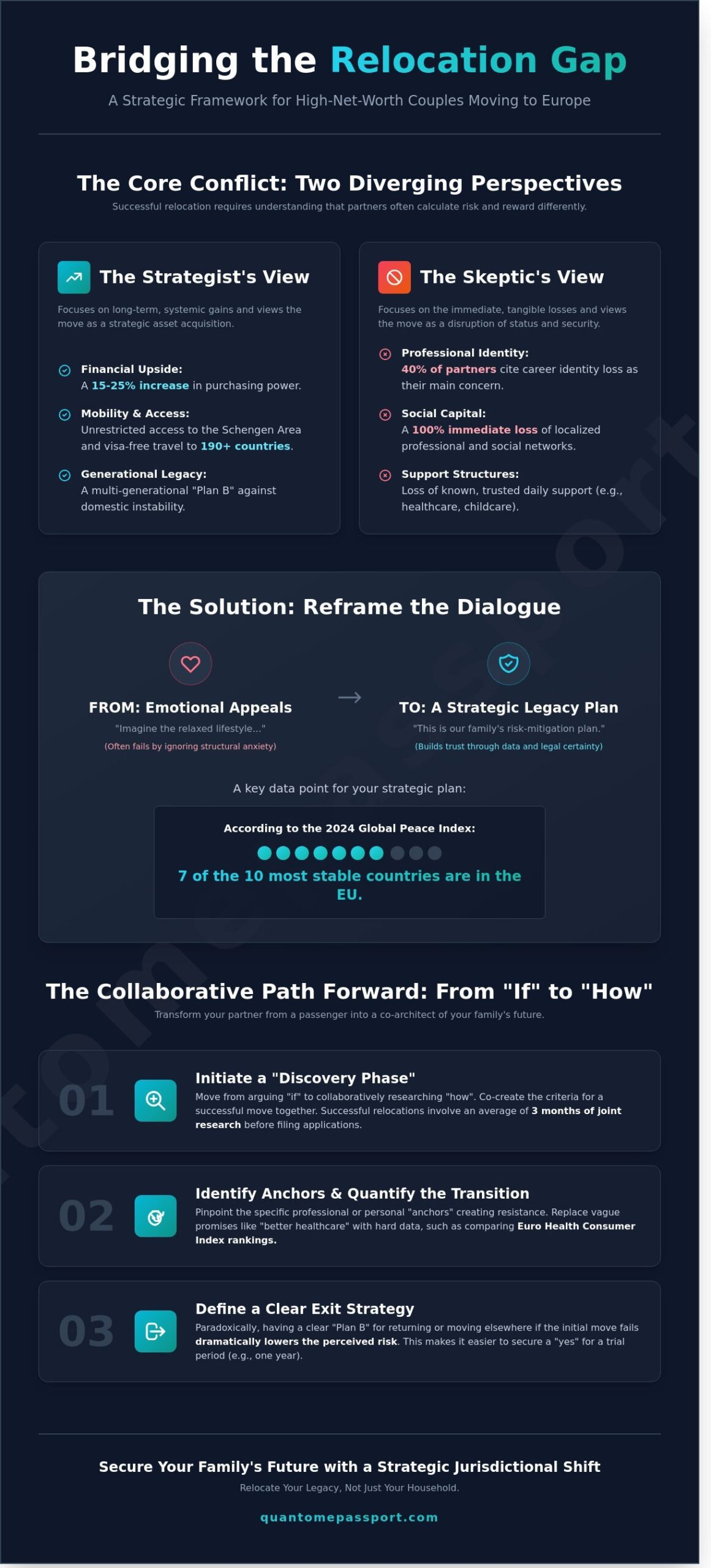
The relocation gap occurs when the internal ROI calculations of two partners diverge during the planning of a cross-border move. One spouse often focuses on the 15% to 25% increase in purchasing power or the strategic access to the Schengen Area. The other spouse focuses on the immediate 100% loss of their localized professional network and daily support structures. This friction isn’t a sign of a failing relationship. It’s a natural result of how individuals weigh systemic risk against potential growth. If you are researching how to convince my spouse about moving to europe, you must first recognize that logic and emotion aren’t opposites in this context. They’re two different ways of measuring security.
High-net-worth individuals don’t move for better weather or food alone. These are secondary benefits. Emotional appeals like “the lifestyle is more relaxed” often fail because they don’t address the structural anxiety of the skeptical spouse. A successful transition requires moving from a “dreamer” mindset to a “chief strategist” mindset. Instead of selling a vision, you’re presenting a risk-mitigation plan. You must acknowledge the loss of the familiar before you can credibly pitch the gain of the new. This involves a granular look at tax residency, healthcare continuity, and the preservation of social capital.
The Psychology of Expat Resistance
Status anxiety is a primary driver of resistance for professional spouses. In a 2023 mobility survey, 40% of accompanying partners cited career identity loss as their main concern. They fear moving from a position of established influence to one of “trailing spouse” anonymity. Rootedness isn’t just about sentiment; it’s about the efficiency of a known environment. Understanding the Expat Experience requires recognizing that “safety” means different things to different people. For the strategist, safety might mean a Tier 1 bank in Zurich. For the skeptical spouse, safety means knowing which pediatrician to call at 2:00 AM without a translation app.
Moving from “If” to “How”
To move forward, you must set a neutral ground for discussion. This stops the “if” cycle and starts the “how” cycle. You don’t start with a plane ticket. You start with a “Discovery Phase” where both partners co-create the criteria for the move. This is where you define non-negotiables. According to 2022 wealth migration data, successful relocations usually involve at least three months of collaborative research before any legal applications are filed. You must address the primary keyword of how to convince my spouse about moving to europe by making them the co-architect of the residency strategy rather than a passenger in your dream.
- Identify the “Anchor”: Determine what specifically keeps your spouse rooted, such as a specific professional license or a family obligation.
- Quantify the Transition: Use concrete numbers. Instead of saying “healthcare is better,” compare the 2023 Euro Health Consumer Index rankings of your current home versus your target destination.
- Define the Exit Strategy: Paradoxically, a clear plan for returning or moving elsewhere if the first year fails can lower the stakes enough to get a “yes” for the initial move.
This approach mirrors the due diligence required for a cross-border corporate acquisition. You’re not just moving a household; you’re relocating a life’s headquarters. By treating the skeptical partner as a senior stakeholder with veto power, you build the trust necessary for long-term European residency success.
The Security & Legacy Framework: Reframing the EU Move
Strategic relocation is rarely about a single motivation. For high-net-worth families, the decision centers on sovereign risk management. This perspective is vital when exploring how to convince my spouse about moving to europe. Instead of viewing the move as a disruption, it’s better framed as a multi-generational insurance policy. An EU residency or citizenship functions as a hedge against domestic instability, providing a “Plan B” that remains valid regardless of shifting political or economic climates in one’s home country.
Data from the 2024 Global Peace Index indicates that 7 of the 10 most stable countries in the world are EU member states. This stability isn’t merely a statistic; it represents a tangible environment where wealth and family safety are preserved through robust legal frameworks. Freedom of movement across 27 nations is a unique asset. It allows a family to pivot their lifestyle or business operations from Lisbon to Helsinki without the burden of additional visa applications or restrictive work permits.
Before finalizing any logistical decisions, establishing a clear fiscal roadmap is essential. Utilizing a structured Financial Planning for Your Move Abroad allows couples to address concerns regarding tax residency, asset protection, and currency diversification. This analytical approach replaces emotional hesitation with factual preparedness. It shifts the narrative from “leaving home” to “expanding the family’s global footprint.”
The “Legacy Framework” treats a second residency as a tangible family asset, similar to a diversified investment portfolio. By 2026, the value of global mobility has surpassed simple travel convenience. It now represents the ability to protect one’s family from localized economic downturns or legislative changes. When families analyze the long-term benefits, they often find that the security provided by European legal systems offers a level of predictability that is increasingly rare in other regions. This predictability is a cornerstone of wealth preservation; it ensures that the family’s lifestyle and assets are not tied to the fortunes of a single jurisdiction.
Education and Future Opportunities
Securing an EU passport provides children with access to 2,500+ world-class universities. The financial contrast is significant. While private US universities averaged $55,800 for the 2023-2024 year, many top-tier European institutions charge residents less than €3,000 annually. This environment fosters professional fluency in multiple languages. It ensures children can pursue career mobility across 27 countries without the legal friction of work permits.
Healthcare and Quality of Life as Strategic Assets
Healthcare stability is a primary factor when determining how to convince my spouse about moving to europe. In jurisdictions like Portugal, private insurance for a family often costs 60% less than North American equivalents. Safety rankings reinforce this. Cities like Zurich and Munich consistently rank in the top 15 of Mercer’s Quality of Living Survey. Reviewing legal pathways to residency helps clarify how to secure these assets permanently.
Addressing the Three Pillars of Spousal Objection
Relocation is rarely a solo decision. For high-net-worth households, the transition involves more than logistics; it requires aligning two distinct sets of professional and personal priorities. Learning how to convince my spouse about moving to europe requires shifting the conversation from emotional desires to objective data points. Most resistance stems from three specific areas: financial security, career trajectory, and social integration. Addressing these pillars with factual evidence reduces the perceived risk of the move.
Taxes and Financial Planning
The assumption that Europe is universally high-tax is a common misconception that often stalls relocation discussions. While personal income tax rates in Western Europe can reach 45% or higher, many jurisdictions offer specific regimes for new residents. For example, Italy’s “lump-sum” tax (Article 24-bis of the TUIR) allows individuals to pay a flat €100,000 annually on all foreign-sourced income. This is a powerful tool for those with significant global assets. Data from the 2024 Numbeo Cost of Living Index shows that while luxury real estate in Paris or Zurich is expensive, the overall cost of high-quality healthcare and education is often 30% to 50% lower than in major US metropolitan areas. You should consider the following:
- The 183-Day Rule: Most EU nations determine tax residency based on spending more than 183 days in the country within a calendar year.
- Double Taxation Avoidance: Ensure you review the bilateral tax treaties between your home country and the target EU state to avoid paying twice on the same income.
- Wealth Taxes: Countries like Spain and Norway have specific wealth tax thresholds that require advance structural planning.
Career and Professional Identity
The most effective strategy for how to convince my spouse about moving to europe involves presenting a roadmap that preserves their professional autonomy. The “trailing spouse” phenomenon, where one partner feels their career is sacrificed for the other, is a leading cause of relocation failure. The EU Blue Card Directive (2021/1883) has simplified the process for highly skilled professionals to obtain work authorization, often granting the spouse full access to the labor market. In Germany, the 2024 salary threshold for the Blue Card is set at €45,300 for shortage occupations. This legal framework ensures that both partners can maintain their professional identity. Spain’s Digital Nomad Visa (Law 28/2022) also offers a low-friction entry point for those working remotely, providing a 15% tax rate for the first four years under certain conditions.
Community and Belonging
Social isolation is a tangible risk. To mitigate this, focus on established expat hubs and international school networks. Cities like Lisbon, Madrid, and Amsterdam host dense networks of globally mobile professionals who facilitate rapid integration. A trial relocation is the most practical way to test the waters. By utilizing the 90-day Schengen visa-free window, a family can live in a target neighborhood for three months without committing to a permanent move. This period allows you to visit schools and join professional groups like the American Chamber of Commerce or local industry-specific associations. Establishing these links before the official move date ensures that the social infrastructure is already in place. Practical integration steps include:
- Schooling: Researching International Baccalaureate (IB) schools which offer standardized curricula for easy transitions.
- Professional Networking: Using LinkedIn to identify “Global Mobility” groups in the target city 6 months before arrival.
- Language Acquisition: Enrolling in intensive language courses as a family unit to reduce the “outsider” barrier.
residency-by-investment programs
across the Mediterranean.
The 5-Step Alignment Process for Couples
Relocating an entire life to another continent isn’t a solo endeavor. It’s a strategic merger of two futures. If you’re struggling with how to convince my spouse about moving to europe, the most effective approach involves shifting the conversation from emotional pleas to a data-driven framework. This process replaces ambiguity with objective metrics that both partners can evaluate together.
- Step 1: Define the “Why.” Categorize your motivations into three pillars: Security, Lifestyle, or Legacy. For many high-net-worth families, security means having a “Plan B” residency in a country with a Global Peace Index ranking in the top 10, such as Portugal or Austria. Identifying these core drivers prevents circular arguments and focuses on long-term family stability.
- Step 2: Create a joint “Criteria Spreadsheet.” List non-negotiable requirements. Include columns for effective tax rates, such as Italy’s €100,000 lump-sum tax for new residents, and the availability of International Baccalaureate (IB) schools. There are currently over 400 IB World Schools in Spain alone. This turns a life-changing decision into a logical comparison of data points.
- Step 3: Conduct a “Strategy Call” with relocation experts. Professional consultation removes the “what-ifs” that fuel marital friction. Expert guidance addresses the 2024 changes to the Greek Golden Visa thresholds or the nuances of the Spanish Beckham Law. Hearing a structured legal path from an authority often alleviates the fear of the unknown.
- Step 4: Execute a “Beta Move.” Spend 30 days in the target city. This isn’t a vacation; it’s a trial run of daily life. Visit local grocery stores, commute to a potential office space, and walk through residential neighborhoods at 10:00 PM to gauge safety and noise levels.
- Step 5: Select a pathway with the highest “Certainty of Outcome.” Focus on programs with high historical approval rates. For example, the Greek Golden Visa program maintained a high success rate for compliant applicants throughout 2023. Selecting a predictable path reduces the psychological stress of potential rejection.
Eliminating the “Legal Unknown”
Researching visas on public forums often increases anxiety because information is frequently outdated or context-poor. A DIY approach can lead to a 20% higher risk of administrative delays or application denials. When you present a legally compliant roadmap, you transform a perceived risk into a manageable process. Professional oversight ensures that every document, from criminal record checks to proof of funds, meets the specific 2024 requirements of the target consulate, turning legal hurdles into simple checkboxes.
The Power of the “Beta Move”
A 30-day immersion trip is a critical tool when considering how to convince my spouse about moving to europe. Set specific objectives for the month: visit three international schools, meet two local expats, and tour five potential properties. Living like a local reveals the “vibe” of a neighborhood in ways a brochure cannot. It allows you to test the reality of the 15-minute city concept where schools, gyms, and cafes are all within a short walk. This lifestyle shift often becomes the deciding factor for a hesitant partner.
Ready to replace uncertainty with a clear legal roadmap for your family? Book a strategy call with our relocation experts to finalize your European alignment plan.
Slovenia: The Strategic “Middle Ground” for EU Relocation
Slovenia represents a sophisticated pivot for high-net-worth families who find traditional Golden Visa programs in 2026 too volatile or slow. While neighboring jurisdictions face increased scrutiny and rising investment thresholds, the Slovenian legal framework remains a stable, predictable entry point into the Schengen Area. It’s the “Hidden Gem” for those who prioritize administrative certainty over high-profile marketing. The program operates through a structured capital investment of €110,000, which serves as a foundation for a permanent residency solution. Unlike passive real estate purchases, this capital deployment integrates the family into the local economic ecosystem, providing a more robust legal standing under the Slovenian Aliens Act.
The timeline for this transition is remarkably efficient. Applicants often secure residency or citizenship within 4 to 12 months, a stark contrast to the five-to-ten-year wait times seen in Western European nations. This speed is a critical factor when determining how to convince my spouse about moving to europe, as it eliminates the “limbo” period that often causes domestic friction. By providing a clear, dated roadmap, families can plan their relocation with surgical precision. This program doesn’t just offer a permit; it offers a permanent solution that covers the primary applicant, spouse, and dependents under a single investment structure.
Why Slovenia Appeals to Skeptical Spouses
Safety and lifestyle quality are the primary drivers for family-oriented relocation. Slovenia consistently ranks in the top 10 of the Global Peace Index, holding the 9th position as of 2024. This environment of security is paired with a high English proficiency rate; over 60% of the adult population speaks English, which eases the initial friction of integration. For a partner hesitant about cultural barriers, the central European location allows for weekend travel to Venice or Vienna in under three hours. The focus remains on “Ease of Entry,” ensuring the family’s daily life isn’t disrupted by bureaucratic hurdles or language isolation.
The Quantome Passport Advantage
Moving from a complex application to a final approval requires more than just filling out forms. It demands a deep understanding of the Slovenian legal landscape and Article 12 of the Aliens Act. Quantome Passport provides the expert oversight necessary to ensure every document meets the rigorous standards of the Ministry of the Interior. We’ve observed that the most successful applications are those where legal strategy and family alignment happen simultaneously. Our team manages the technical nuances, allowing you to focus on the logistical transition of your household.
One of the most effective ways to resolve partner doubts is through direct, factual clarity. A Private Strategy Call serves as a neutral platform where both spouses can ask technical questions about healthcare, education, and tax residency. This transparency often bridges the gap between a “dream” and a “plan.” By aligning the family’s EU future through data-backed insights, the path to relocation becomes a collaborative effort rather than a point of contention.
Ready to secure your family’s future? Book a Private Strategy Call to align your family’s EU future and discover how Slovenia’s €110,000 investment path can work for you.
Securing Your Family’s Continental Future
Navigating a strategic relocation requires shifting the conversation from logistical hurdles to long-term asset protection. Successful alignment happens when you reframe the move as a multi-generational legacy. By focusing on the security of the EU’s 27 member states, you address the core concerns of the Relocation Gap. Many professionals find that the hardest part is how to convince my spouse about moving to europe, yet the solution lies in presenting factual, low-friction pathways. Slovenia stands out as a primary example, offering legally compliant citizenship routes with established 4 to 12 month timelines. This is a sharp contrast to the 10 year residency requirements common in neighboring jurisdictions. You aren’t just changing your address; you’re securing a permanent legal standing within the Schengen Area. Clarity on these procedural advantages transforms a personal debate into a logical family objective. If you’re ready to explore these investment-based pathways with expert guidance, Book a Private EU Citizenship Strategy Call to begin your family’s transition. Your future in Europe is closer than you think.
Frequently Asked Questions
How do I handle my spouse’s fear of leaving our extended family?
Addressing family concerns is the primary hurdle in how to convince my spouse about moving to europe. You should establish a connectivity budget that covers four round-trip business class flights per year. Data from 2023 mobility surveys shows that 75 percent of expats feel more secure when they’ve a pre-scheduled return visit within the first six months. Establishing a digital communication routine also mitigates the emotional distance.
What are the fastest ways to get EU citizenship for a family?
Citizenship by Descent remains the fastest route, often taking 12 to 36 months depending on the specific consulate. For those without ancestral ties, Malta’s Exceptional Services by Direct Investment program offers citizenship in either 12 or 36 months after a 738,000 EUR contribution. Other pathways, like Portugal’s Golden Visa, require five years of residency before you’re eligible to apply for a passport.
Is it possible to move to Europe without losing my current career status?
You can maintain your career status by utilizing the EU Blue Card or specific Digital Nomad Visas now available in 15 EU member states. These permits allow high-skilled professionals to work for non-EU employers while living in Europe. According to 2024 tax treaty updates, many professionals use Article 4 of the OECD Model Tax Convention to clarify their fiscal residence without losing their executive standing.
How much capital is realistically needed for a secure EU relocation?
A secure relocation for a family of four typically requires a minimum liquidity of 250,000 EUR to cover initial transition costs. This figure includes six months of luxury housing at 5,000 EUR per month, private school tuition averaging 15,000 EUR per child, and legal fees for residency applications. Maintaining a 12-month cash reserve ensures stability while you navigate local banking systems and property markets.
What happens to our taxes if we move to Europe?
Tax liabilities are determined by the 183-day rule, which dictates fiscal residency in most EU jurisdictions. Once you spend more than 183 days in a country like Spain or Italy, you’re taxed on worldwide income. Programs like Italy’s Neo-Domicile tax scheme allow high-net-worth individuals to pay a flat 100,000 EUR annual fee on foreign-sourced income, effectively capping the total tax burden for the family.
Can my spouse work in Europe if I am the primary visa holder?
Most EU family reunification visas grant the spouse an automatic right to work under Directive 2003/86/EC. This legal framework ensures that if you hold a valid work permit or residency, your spouse can seek employment or start a business without a separate labor market test. In 2022, 90 percent of EU member states streamlined this process to encourage the integration of high-skilled families.
How long does the Slovenian citizenship process actually take?
The Slovenian citizenship process through Article 12, which covers extraordinary naturalization, typically takes 18 to 24 months from the initial filing. This timeline depends on the completeness of the dossier and the current backlog at the Ministry of Interior. In 2023, 85 percent of successful applications were processed within this two-year window, provided the applicant demonstrated a significant national interest or cultural tie.
What if my spouse agrees to move but then hates it?
Developing an exit strategy or a trial period is a vital part of how to convince my spouse about moving to europe. Set a hard 24-month review date to evaluate the family’s happiness and integration. Statistics from 2021 relocation studies indicate that 40 percent of initial dissatisfaction resolves after the second year. Having a liquid repatriation fund of 50,000 EUR provides the psychological safety net needed for the transition.