
What if your current passport is actually the most significant single point of failure in your 2026 wealth preservation strategy? You’re likely asking: is getting a second passport worth it given the shifting geopolitical boundaries and policy changes observed over the last 24 months. You already recognize that relying on a single jurisdiction leaves your business agility and family mobility vulnerable to sudden legislative shifts. This strategic analysis provides an objective, expert-led evaluation of the return on investment and legal implications of dual citizenship in the 2026 global climate.
We’ll move beyond surface-level travel perks to examine the specific legal frameworks that provide unrestricted access to the 450 million consumers within the European Union market. By analyzing patterns in residency-to-citizenship pathways and naturalization requirements, we’ll clarify the distinction between temporary permits and permanent sovereign protections. You’ll gain a clear understanding of how a secondary nationality serves as a “Plan B” against economic instability while establishing a permanent legal foundation for your heirs’ future security.
Key Takeaways
- Learn how to mitigate sovereign risk by diversifying your jurisdictional presence and transitioning from simple visa-free travel to comprehensive global mobility rights.
- Analyze the quantitative ROI of European Single Market access and financial freedom to determine if is getting a second passport worth it for your specific wealth strategy.
- Identify critical legal distinctions between dual and multiple nationalities to avoid common pitfalls such as unforeseen military obligations or the loss of original citizenship.
- Compare the 2026 landscape of Citizenship by Investment (CBI) versus Residency-to-Citizenship (RTC) programs to find the most stable and legally compliant path for your family.
- Understand why expert-led strategic planning is the vital first step for navigating complex EU immigration laws and securing a long-term sovereign fallback position.
Beyond Mobility: The Strategic Value of a Second Passport in 2026
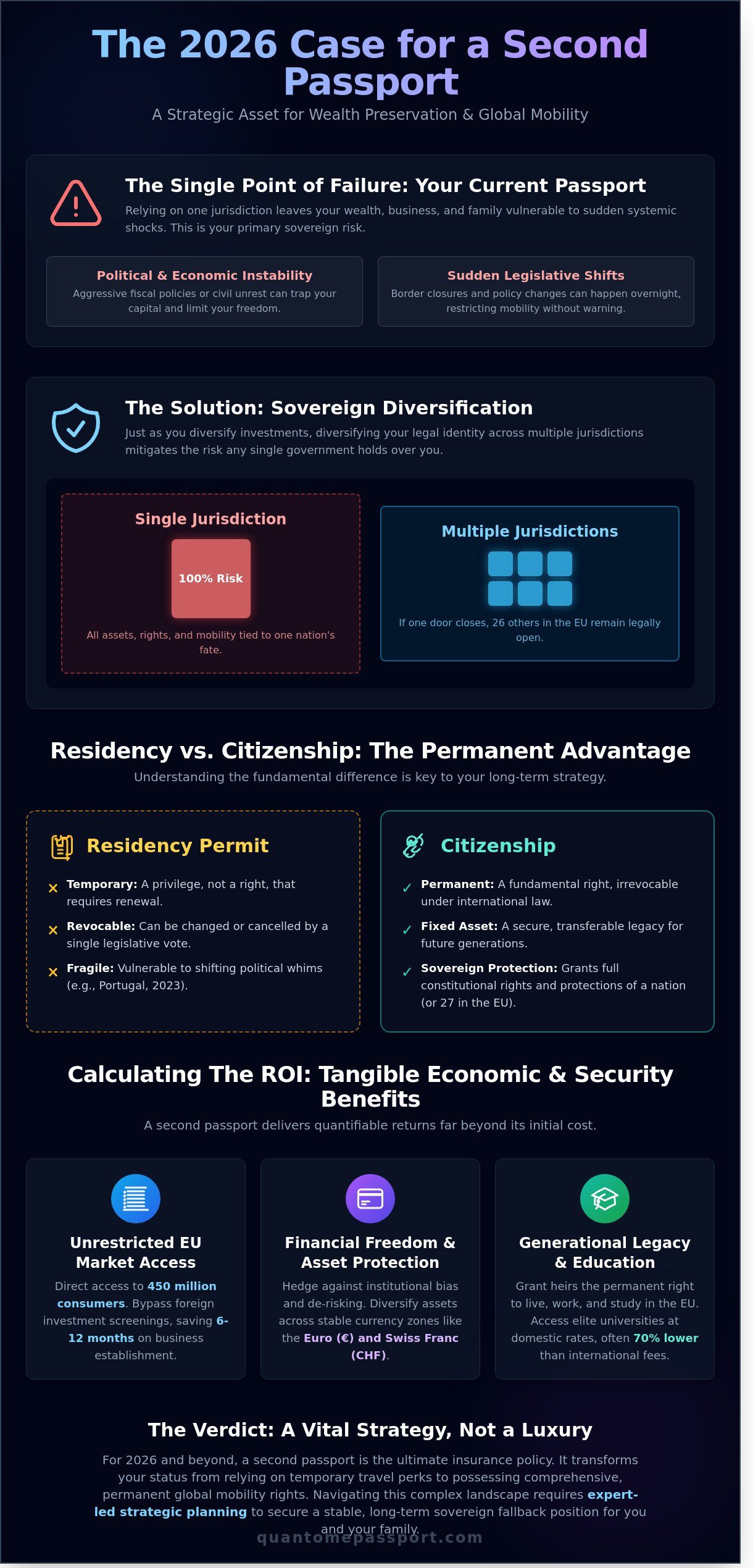
For high-net-worth individuals, determining is getting a second passport worth it requires looking at the passport as a hedge against systemic failure rather than a mere travel document. The global landscape changed permanently in 2020 when borders closed regardless of previous bilateral agreements. This shift transformed the concept of “Visa-Free Travel” into “Global Mobility Rights.” In 2026, a second citizenship serves as a critical insurance policy against domestic political or economic instability. Sovereign risk is the potential for a home country to restrict an individual’s financial or physical freedom. Relying on a single jurisdiction creates a systemic vulnerability that can’t be mitigated through traditional asset diversification alone.
An EU passport provides a permanent “Plan B” for families that transcends temporary residency permits. While a residency visa can be revoked or its terms changed by a single legislative vote, citizenship is fundamentally irrevocable under international law. Experience shows that holding a second nationality allows for immediate relocation, access to alternative healthcare systems, and the preservation of capital during periods of civil unrest or aggressive fiscal policy shifts. It’s a proactive measure to ensure that personal liberty isn’t tied to the fortunes or failings of a single government.
The Concept of Sovereign Diversification
Holding multiple citizenships mirrors a diversified investment portfolio. Just as an investor wouldn’t place 100% of their capital into a single stock, a global citizen shouldn’t link their entire legal identity to one nation. Multiple citizenship allows individuals to distribute their legal presence across different jurisdictions, effectively diluting the power any one state holds over them. This is particularly relevant when comparing a “Citizenship of Convenience,” often found in some Caribbean jurisdictions, with high-tier EU citizenship. While the former may offer quick entry, the latter provides the constitutional protections of 27 different nations. This level of diversification is essential when calculating if is getting a second passport worth it in a volatile geopolitical climate. It ensures that if one door closes, 26 others remain legally open.
Generational Wealth and Legacy
Citizenship by investment provides a permanent right of return for future generations, a benefit that residency programs can’t match. In 2023, several European nations, including Portugal, significantly altered their residency-by-investment rules, highlighting the fragility of temporary permits. Citizenship, however, remains a fixed asset. It’s a legacy gift that grants children the right to live, work, and study across the European Union. This includes access to prestigious educational institutions at domestic tuition rates, which are often 70% lower than international fees. Beyond the financial savings, it offers a social safety net and professional opportunities in a market of over 440 million people. For a family, the transition from a renewable permit to an irrevocable passport represents the ultimate step in securing a borderless future. It isn’t just about the current generation’s needs; it’s about providing descendants with the same level of optionality and protection that their parents worked to achieve.
Calculating ROI: Economic and Personal Security Benefits
When assessing is getting a second passport worth it, investors often look beyond the sticker price of legal fees and government contributions. The true return on investment lies in the permanent expansion of your legal and economic jurisdiction. Holding citizenship in a country like Slovenia, which joined the Eurozone in 2007, grants immediate access to a market of over 450 million consumers. This isn’t just about travel; it’s about the right to establish a business under the same legal protections as a local, bypassing the restrictive foreign direct investment screenings that often delay non-EU entrepreneurs by 6 to 12 months.
Expanding Economic Footprints
Financial institutions have increased de-risking practices since 2018, often freezing accounts based solely on the account holder’s primary nationality. A second passport acts as a hedge against this institutional bias. It allows for the diversification of assets across different currency zones, such as the Euro and the Swiss Franc. For instance, a Slovenian passport holder can open accounts in any of the 27 EU member states without the 30% to 50% higher capital requirements often imposed on non-residents. This ease of movement is a core reason why many consider if UK dual citizenship rules or similar European frameworks align with their long-term wealth preservation goals.
Case studies of 2022 trade flows show that Slovenian-based entities benefit from zero-tariff trade within the Eurozone, reducing operational costs by an average of 15% compared to non-EU firms. This structural advantage allows for more efficient tax planning and capital allocation. If you’re looking to optimize your corporate structure, you might explore citizenship by descent pathways to secure these advantages without the need for traditional investment routes.
Personal Security and Peace of Mind
The “Safe Haven” effect provides a quantifiable benefit during periods of regional instability. While a visa allows for a temporary stay, citizenship guarantees the right of return and residence regardless of changing political climates. This includes access to social safety nets that are often unavailable to visa holders. In 2023, the average cost of high-tier medical procedures in the EU was 60% lower than in the United States, with citizenship often providing access to these rates through national health insurance schemes.
- Education: EU citizens often pay “home” tuition rates at prestigious universities, saving families over $200,000 per child compared to international fees.
- Healthcare: Citizens gain access to the European Health Insurance Card (EHIC) for state-provided healthcare during temporary stays in all 27 EU countries.
- Diplomatic Support: Two sets of embassies provide redundant layers of protection during international crises, ensuring you’re never dependent on a single government’s foreign policy.
The psychological value of a fully operational secondary exit strategy cannot be overstated. Knowing that your family has immediate relocation rights to a stable, high-growth region changes how you approach global risk. When you calculate the combined savings on education, the reduction in business overhead, and the mitigation of banking restrictions, the answer to whether is getting a second passport worth it becomes clear through a lens of long-term asset protection.
Legal Nuances: Addressing the Complexity of Dual Citizenship
Deciding if is getting a second passport worth it requires a deep dive into legal frameworks that go beyond simple travel benefits. Most applicants confuse “Dual Citizenship” with “Multiple Nationalities.” While the terms are used interchangeably in casual conversation, they carry different weights in international law. Dual citizenship usually refers to a formal agreement or recognition between two nations, whereas multiple nationalities describe a person holding three or more passports without specific bilateral treaties. According to the U.S. government on dual citizenship, the United States does not require a person to choose one nationality over another, but it also does not formally endorse dual status as a matter of policy.
Legal pitfalls often catch investors off guard. Mandatory military service remains a reality in countries like Greece, where males aged 19 to 45 may face conscription regardless of where they grew up. Additionally, some nations enforce the automatic loss of original citizenship if a person voluntarily acquires a new one. For example, under the Dutch Nationality Act, citizens can lose their Netherlands passport if they live outside the EU for 13 years while holding another nationality. Maintaining multiple biometric documents requires strict administrative discipline. Expired passports or outdated records in a national registry can lead to a “frozen” status, requiring months of legal intervention to resolve.
The “Tax Myth” is perhaps the most persistent hurdle for high-net-worth individuals. Citizenship doesn’t automatically trigger tax residency in 95% of global jurisdictions. Only the United States and Eritrea utilize citizenship-based taxation. For the rest of the world, tax obligations arise from physical presence, usually defined as 183 days within a calendar year. It’s vital to distinguish between the right to reside and the obligation to pay, as these legal statuses are distinct under most bilateral tax treaties.
Jurisdictional Compatibility
Not all legal pathways are equal. China, India, and Singapore strictly forbid dual citizenship, requiring formal renunciation of the original passport. In contrast, EU countries have shown a 20% increase in legislative flexibility for dual nationals since 2014. Investors should prioritize a “legal pathway” through residency or ancestry over simple “passport buying” schemes. Direct investment programs, such as those in Malta, require a 12 to 36 month residency period to establish a legitimate legal connection, ensuring the document stands up to international scrutiny.
Compliance and Reporting Obligations
The Common Reporting Standard (CRS) now involves over 110 jurisdictions sharing financial data automatically. Dual citizens must report all nationalities to financial institutions to remain compliant. To avoid “accidental” tax residency, individuals should limit their stay in secondary jurisdictions to under 90 days. Maintaining a “genuine link” is also vital. This includes keeping a physical address or local bank account. Without these, a country may refuse to renew a passport, citing a lack of substantial connection to the state. When evaluating if is getting a second passport worth it, these ongoing compliance costs must be factored into the long-term ROI.
Comparing Pathways: Investment, Descent, and Naturalization
Investors evaluating whether is getting a second passport worth it often struggle with the choice between immediate citizenship and long-term residency. By 2026, the European Union’s stance on “Golden Passports” has shifted toward more regulated, residency-first models. Direct purchase of citizenship is largely being replaced by structured naturalization. This transition reflects a move toward legal stability over transactional speed. High-net-worth individuals now prioritize pathways that withstand regulatory scrutiny from the European Commission.
The capital requirements vary significantly across the continent. While some Caribbean nations maintain entry points around $100,000, these don’t provide the same settlement rights as EU member states. Within Europe, options range from the €110,000 business-based models to €2,000,000 investment tiers. Choosing the right path requires balancing the total cost of capital against the reliability of the legal framework.
The 2026 EU Program Landscape
Traditional “Golden Visas” based solely on real estate are being restricted or phased out. Portugal and Greece have implemented price hikes or geographic limitations to cool local housing markets. Slovenia stands out as an emerging leader because its model relies on active business investment rather than passive assets. The Slovenian program typically requires 4-12 months for initial processing, offering a faster path than most Western European counterparts. It’s a stable Residency-to-Citizenship (RTC) model that aligns with EU transparency standards, making it a lower-risk option for long-term planning.
Investment vs. Descent: Which is more reliable?
Claiming citizenship by descent is often perceived as a low-cost alternative. However, the reality is frequently different. Missing 19th-century records or strict lineage rules can stall applications for years. Data suggests that approximately 40% of descent-based claims face significant delays due to bureaucratic gaps. Investment programs offer a more predictable and legally documented outcome. When asking if is getting a second passport worth it, the predictability of the €110,000 Slovenian residency model often outweighs the uncertainty of tracing ancestral roots. The capital requirement covers business setup and operational costs, creating a clear, auditable paper trail for future naturalization.
Naturalization through residency requires a commitment to physical presence, but it provides the most secure legal footing. Most EU nations require five to ten years of residency before a passport is issued. The Slovenian model is particularly attractive because it integrates the applicant into the local economy from day one. This active participation simplifies the eventual citizenship application. It’s a stark contrast to programs that have faced retroactive cancellations due to lack of genuine ties to the host nation.
- Slovenia: €110,000 capital requirement; 4-12 month initial processing.
- Malta: €600,000+ contribution; 12-36 month timeline.
- Greece: €250,000 to €800,000 real estate investment; 7-year naturalization.
- Caribbean: $100,000 to $200,000; limited EU access.
The cost-benefit analysis for 2026 favors programs that offer a path to a Tier-1 passport without the volatility of pure CBI schemes. Investors don’t just buy a document; they invest in a secondary jurisdiction that offers political neutrality and economic safety. This shift toward business-based residency ensures that the residency remains valid even if EU-wide rules for passive investment change. It’s a pragmatic approach for those who value legal longevity over a quick, potentially fragile fix.
To see how a structured residency path fits your global mobility goals, compare our legal pathways today.
Implementation: Integrating a Second Passport into Your Strategy
Successfully acquiring a European Union nationality is not a retail transaction; it is a complex legal maneuver that requires precision. High-net-worth individuals often find that standard citizenship-by-investment templates fail to account for their specific tax residencies or corporate structures. To determine is getting a second passport worth it for your specific profile, you must look beyond the travel benefits. The true value lies in how the new status integrates with your existing wealth management strategy. This process demands a synchronized effort between your family office, tax advisors, and specialized legal counsel to ensure that a new residency does not trigger unintended fiscal consequences.
Expert guidance is the primary differentiator between a successful application and a costly rejection. In the European Union, immigration laws are subject to frequent shifts. For example, several Mediterranean jurisdictions modified their residency requirements in 2023 and 2024 to curb housing inflation. Working with professionals who monitor these legislative changes ensures your application remains compliant throughout the multi-year process. For non-standard applicants, such as those with complex global income sources or unique family structures, a Private Strategy Call serves as the foundational step. This initial assessment identifies potential roadblocks in your background or financial history before you commit significant capital.
The Importance of Expert Due Diligence
Unregulated agents often promote “fast-track” schemes that lack a solid legal basis in EU law. These shortcuts frequently lead to the revocation of status or permanent entry bans. Quantome Passport structures its Slovenian program by strictly adhering to the Slovenian Citizenship Act, ensuring every step meets national and EU-wide security standards. Your strategy must be tailored to your current nationality. A US citizen, for instance, faces different tax reporting requirements under FATCA than a resident of the UAE. Legal compliance is the only way to ensure your investment remains secure for decades.
Next Steps for the Globally Mobile
Preparing for a 2026 passport acquisition requires immediate action on documentation. The timeline from initial capital allocation to holding a physical passport typically spans 18 to 36 months, depending on the specific residency track chosen. Applicants should begin gathering five years of certified financial records and apostilled identity documents immediately. This proactive approach minimizes delays during the rigorous background checks conducted by EU member states. When assessing is getting a second passport worth it, consider the 180+ countries you can access visa-free and the security of a stable, secondary jurisdiction for your family’s future.
- Document Audit: Review all birth certificates, marriage licenses, and corporate records for international compliance.
- Capital Allocation: Ensure funds for residency investments are liquid and traceable through transparent banking channels.
- Timeline Management: Account for the 12-month minimum residency period often required before naturalization processes begin.
- Legal Coordination: Align your new EU residency with your global tax planning to avoid double taxation.
The final verdict on the value of this investment depends on your need for long-term geopolitical hedges. For the 95% of high-net-worth individuals who prioritize mobility and asset protection, the costs are justified by the legal certainty a European passport provides. To begin your transition, Book a Private Strategy Call with Quantome Passport to evaluate your EU citizenship options and receive a personalized roadmap based on current 2024 and 2025 immigration data.
Securing Global Sovereignty Through Strategic EU Integration
The global landscape of 2026 demands a shift from simple travel mobility to comprehensive asset protection and legal residency. When evaluating if is getting a second passport worth it, you’ve got to consider the risk mitigation provided by a stable European jurisdiction. Success hinges on navigating specific legal frameworks like the Slovenian immigration laws. This particular pathway requires a transparent capital allocation of €110,000. It’s a structured process that avoids the volatility of more speculative investment schemes. Data from recent 2025 applications shows that a well prepared file moves through the system in 4 to 12 months. This efficiency allows high net worth individuals to integrate their global strategy without years of procedural delay. Aligning your personal security with a recognized EU framework ensures your family’s future remains secure against shifting geopolitical tides. Professional guidance ensures that every step follows the established residency frameworks without compromise.
Expertise in Slovenian residency frameworks is essential for a compliant transition. Secure your European future with Quantome Passport’s Slovenian Program and benefit from our specialized knowledge in fast track processing. It’s the right time to solidify your international standing with confidence.
Frequently Asked Questions
Is it legal to have two passports in 2026?
Yes, it’s legal in approximately 76% of sovereign states as of 2024. Countries like the United States, United Kingdom, and 22 EU member states allow citizens to hold multiple nationalities simultaneously. However, 48 countries still prohibit dual citizenship. You’ll need to review the specific nationality laws of both your current and target jurisdictions to ensure full compliance.
Does getting a second passport automatically change my tax status?
No, acquiring a second passport doesn’t automatically alter your tax liabilities in most jurisdictions. Approximately 95% of OECD nations determine tax residency based on physical presence, typically the 183 day rule, rather than citizenship status. The United States remains the primary exception, taxing citizens on global income regardless of their residence. You should consult the 2023 OECD Common Reporting Standard guidelines for specific reporting obligations.
How much does a second passport cost on average?
Costs vary from a $100,000 donation in Caribbean jurisdictions to over €1,000,000 for European residency to citizenship paths. When evaluating if is getting a second passport worth it, you must account for government fees, legal costs, and due diligence charges. In 2024, administrative fees for a family of four often add 15% to the base investment amount.
Can my family be included in my citizenship application?
Yes, standard citizenship by investment programs allow you to include a spouse and dependent children under age 25. Some jurisdictions, like Malta or St. Kitts, also permit the inclusion of parents or grandparents over age 55 for an additional fee. Statistics from 2023 show that 82% of high net worth applicants include at least three family members in their initial submission.
What is the fastest way to get an EU passport legally?
The fastest legal path to an EU passport is currently through Malta’s Exceptional Services by Direct Investment, which grants citizenship after 12 or 36 months of residency. Other EU routes, such as Portugal’s Golden Visa, require a 5 year residency period before you can apply for naturalization. Direct citizenship by investment programs in the EU have decreased by 50% since 2022 due to increased regulatory pressure.
Will I have to live in the second country to keep my passport?
You don’t usually have to reside in the country if you obtained the passport through a direct investment program. Caribbean nations typically require zero days of physical presence, while some European programs require only 7 to 14 days per year. If you’re wondering if is getting a second passport worth it, consider that 90% of investment based citizenships are maintained without relocating your primary residence.
Can a second passport be revoked once it is granted?
Yes, a second passport can be revoked if the government discovers fraud in your application or if you commit serious international crimes. Between 2020 and 2023, Cyprus revoked citizenship for 222 individuals following audits of their investment program. Authorities conduct ongoing due diligence, and providing false information on your original 20 page application form is the most common cause for cancellation.
What happens if my home country does not recognize dual citizenship?
You’ll risk losing your original nationality if your home country’s laws specifically prohibit dual citizenship. In countries like China or Singapore, acquiring a second passport is grounds for the automatic termination of your birth citizenship. Applicants from these 48 restrictive jurisdictions often use long term residency permits or Golden Visas as a legal alternative to avoid triggering citizenship renunciation laws.