
As of August 2024, Greece’s Golden Visa investment threshold has officially doubled to €800,000 in high-demand areas, a stark reminder of how quickly the landscape can change. It’s no wonder you feel like the goalposts for European residency are constantly shifting. You find a program that seems perfect for your family, only to discover that regulations have tightened overnight, hidden property taxes are eating into your budget, and visa processing times are stretching from months into years. The search for a stable, predictable path can feel overwhelming.
That’s why we’ve created this definitive 2026 forecast. We’ll give you a clear, data-driven comparison of the true minimum investment for eu residency, moving beyond headline figures to reveal the all-in costs and realistic timelines for both passive and active investment routes. In this analysis, we’ll compare the most resilient programs, clarify which pathways best secure your family’s future, and map out the most predictable routes to potential EU citizenship.
Key Takeaways
- Learn why the cheapest EU residency programs face the most regulatory risk in 2026 and how to select a secure, long-term pathway.
- Discover the true minimum investment for eu residency by comparing popular options in the €100k-€250k range to see where your capital delivers the most value.
- Uncover the hidden fees, VAT, and transfer taxes that can significantly inflate the advertised price of a residency program before you commit.
- Understand why business-based residency is emerging as the safest and most legally robust option under tightening EU regulations.
Defining the Minimum Investment for EU Residency in 2026
The concept of a “golden visa” has fundamentally changed. As we enter 2026, the strategy isn’t just about finding the lowest number; it’s about understanding the type of investment the European Union now values. First, let’s clarify a critical difference. Residency-by-Investment (RBI) grants you the right to live, work, and travel within the EU, eventually leading to permanent residency or citizenship after a set period (typically 5-10 years). Citizenship-by-Investment (CBI), which grants a passport almost immediately, has been effectively eliminated within the EU following intense regulatory pressure. Our focus here is on RBI, a more sustainable and strategic path. These various RBI and CBI routes are often grouped under the umbrella of immigrant investor programs, but their legal standing and requirements are vastly different.
To better understand the new landscape of affordable residency, this analysis provides a crucial overview:
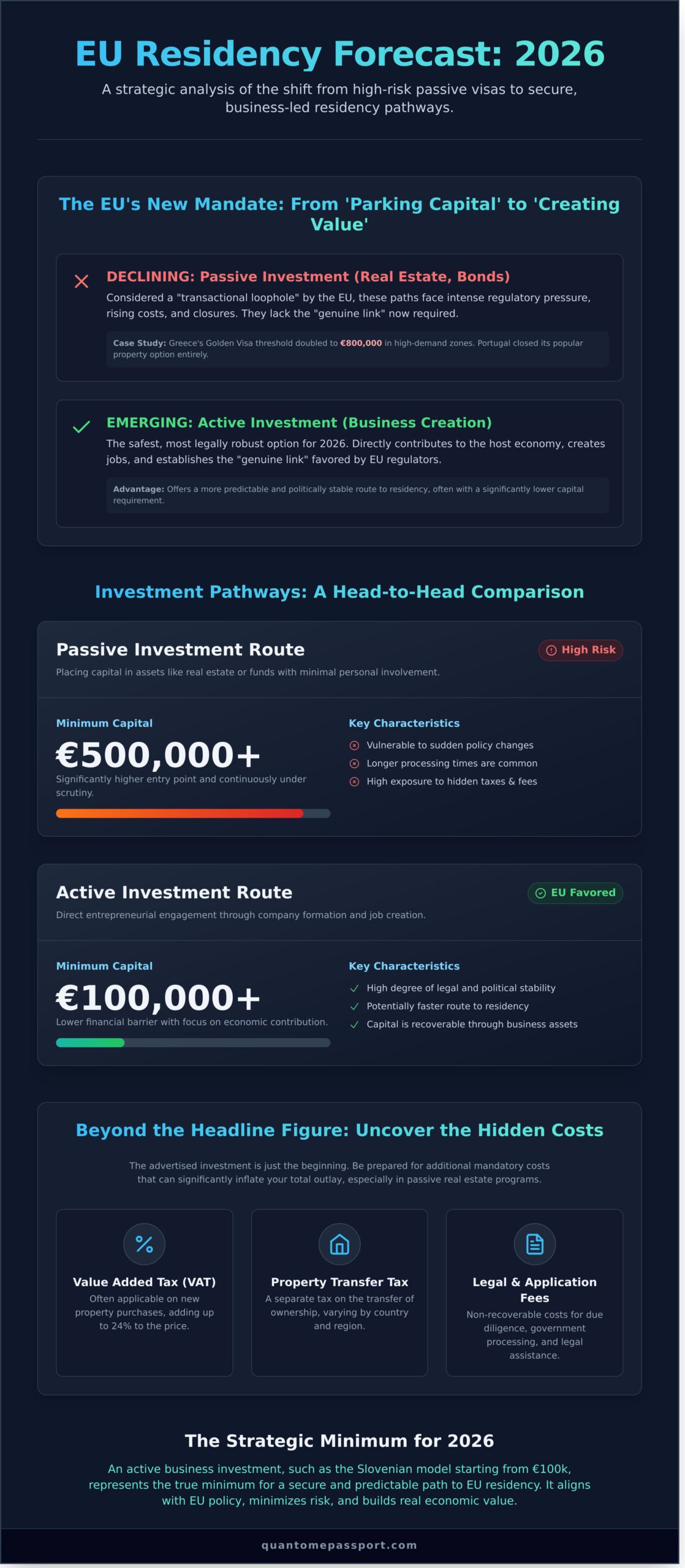
The 2026 regulatory environment is a direct result of the European Commission’s 2022 proposal to rein in programs perceived as security risks. Consequently, “cheap” passive investment routes are disappearing. The EU’s message is clear: residency is for those who contribute actively to the economy, not for those who simply park capital. This is why a €150,000 business investment that creates jobs is now viewed as far more secure and politically stable than a €500,000 real estate purchase. The former demonstrates a “genuine link” to the country, a key requirement the EU is enforcing, while the latter is seen as a transactional loophole that member states are being pressured to close.
The Evolution of EU Investment Thresholds
The “minimum” entry point for EU residency was redefined after 2024. The trend began with Ireland closing its Immigrant Investor Programme in February 2023 and Portugal ending its popular real estate investment option in October 2023. This domino effect reflects a seismic shift from “buying property” to “building economic value.” The EU Commission’s stance is that large, passive investments without direct economic integration pose risks, pushing member states to favor active business participation instead.
Active vs. Passive Investment: A Critical Distinction
Understanding the two primary investment models is essential to finding the true minimum investment for eu residency that aligns with 2026 regulations. Each path has vastly different capital requirements, obligations, and long-term security.
- Passive Investment: This involves placing capital with minimal personal involvement. Options include government bonds, real estate, or venture capital funds. By 2026, minimums for these routes (where they still exist) start at €500,000 and are under continuous scrutiny, making them a higher-risk choice from a policy perspective.
- Active Investment: This requires direct entrepreneurial engagement. It means forming a new company, injecting capital into an existing business, and, most importantly, creating local jobs. These pathways can have a capital requirement as low as €100,000. Active investments are strongly favored and often provide a more secure and sometimes faster route to permanent residency because they prove an ongoing, tangible contribution to the host nation’s economy.
Comparative Analysis of EU Residency Investment Thresholds
The financial entry points for EU residency aren’t uniform; they represent a spectrum of economic commitment and strategic goals. At one end, you have Tier 1 nations like Germany and France, which don’t offer passive “golden visa” programs. Instead, they require active, substantial business investment, often with undefined upper limits and a rigorous business plan review, making them accessible primarily to established corporations or high-net-worth entrepreneurs.
At the other end are Tier 2 nations that have structured residency-by-investment programs. As of 2026, countries like Greece (with a real estate threshold starting at €250,000 in some regions), Hungary (new program details pending but expected in the €250,000-€500,000 range), and Slovenia offer more defined pathways. The core difference lies in the investment model. Most programs now focus on “recoverable capital”—an investment in real estate, business assets, or funds that you retain ownership of and can potentially liquidate after a set period. This contrasts sharply with the “donation” model, a non-refundable contribution to a state fund, which has been largely phased out due to EU scrutiny.
The Sweet Spot: €100,000 to €200,000 Entry Points
This bracket is rapidly becoming the most sought-after path for global entrepreneurs. It hits a strategic balance, being substantial enough to demonstrate serious intent without requiring the liquidation of major personal assets. Slovenia’s model is a prime example. Its pathway requires a €50,000 share capital injection plus a tangible asset investment of at least €60,000 into the new company. This total €110,000 commitment is not a fee; it’s working capital for your business, funding its growth and securing your residency through genuine economic activity. This approach provides a tangible ROI beyond the visa itself.
High-Capital Pathways: When is €500k+ Justified?
So why would an investor opt for a program requiring €500,000 or more? The justification in 2026 hinges on three factors: speed, simplicity, and tax advantages. While processing times have standardized across the EU due to enhanced due diligence protocols advocated by groups like the Investment Migration Council, higher-tier passive investments (like real estate) often involve less complex business planning and reporting. For investors prioritizing a hands-off approach, the premium is for convenience. Furthermore, establishing significant economic ties can offer a clearer path to favorable tax residency. The primary risk, however, is “program sunsetting.” We saw this with Portugal’s Golden Visa changes in 2023; high-demand, high-capital programs are often the first to be altered or closed by political pressure, making timing a critical risk factor.
Ultimately, the lowest minimum investment for EU residency doesn’t always equal the best value. A €110,000 active business investment in Slovenia that builds a profitable asset can offer a far greater long-term return than a €250,000 passive real estate purchase in a saturated market. The key is aligning the investment type with your personal and financial goals, and our residency planning team can help you model these outcomes.
The Hidden Costs of “Cheap” EU Residency Programs
The advertised figure for the minimum investment for EU residency is often just a starting point. It’s a powerful marketing number designed to capture your attention, but it rarely reflects the total capital outlay required to secure and maintain your status. A savvy investor looks beyond this “sticker price” to calculate the Total Cost of Investment (TCI), which includes a variety of mandatory fees, taxes, and ongoing expenses that can inflate the initial number by 15-25% or more.
Consider a real estate investment of €300,000 in a country like Greece. Before you even receive your residency card, you’ll face additional costs. Greece imposes a property transfer tax of 3.09%, adding €9,270 to your bill. If the property is a new development (built after January 1, 2006), a 24% VAT may apply instead, though it’s often suspended. Add to this notary fees, land registry fees, and legal counsel, and your initial €300,000 investment quickly approaches €325,000. These are not optional; they are fundamental components of the transaction.
The financial commitment doesn’t end with the initial purchase. Programs requiring physical presence create significant recurring costs. Even a lenient requirement of seven days per year means annual flights, accommodation, and local expenses. For a family of four, this can easily amount to €5,000-€8,000 annually, a cost that repeats for the five years leading to permanent residency or citizenship eligibility. This is the opportunity cost of time, a factor often overlooked in a purely financial calculation.
Tax Implications of EU Residency
Your tax liability is perhaps the most significant hidden cost. Spending over 183 days in a country typically makes you a tax resident, subjecting your worldwide income to local taxation. Countries like Spain, for example, not only tax global income but also impose a wealth tax (Patrimonio) on worldwide assets above a regional threshold, which can be as low as €500,000. Understanding these fiscal consequences is vital, as confirmed by a detailed IMF analysis of residency by investment which explores the deep economic drivers behind these programs. Failing to plan for this can erode your capital far more than any application fee.
Maintenance and Renewals
Every EU residency permit requires renewal, typically after one or two years, and again before the five-year mark. Each renewal involves legal fees, government charges, and updated documentation, often costing between €2,500 and €7,000 per cycle for a family. Furthermore, the nature of your investment dictates ongoing costs. Maintaining a property incurs annual taxes (like Portugal’s IMI at ~0.4%), insurance, and upkeep. A business investment, conversely, requires accounting services, corporate filings, and potential social security contributions, which can easily exceed €10,000 per year, even for a dormant company.
Finally, don’t underestimate the accumulation of smaller expenses. A typical application dossier contains dozens of documents requiring certified translation and apostilles. With translation costs averaging €40 per page and apostilles costing more, these “minor” administrative hurdles can add another €1,500-€3,000 to your budget. Calculating the true minimum investment for EU residency requires a comprehensive five-year financial plan, not just a glance at a program’s brochure.
Legal Nuance: Why the “Business Purpose” is the Ultimate Safe Haven
The landscape of EU residency by investment is undergoing a seismic shift. Passive investments, particularly in real estate, are facing unprecedented scrutiny from Brussels. The anticipated EU Directive 2026/115 aims to standardize due diligence and penalize member states offering “high-risk” passive residency schemes. This regulatory pressure reveals a critical truth: the safest, most sustainable path to European residency is through active business investment. It isn’t just about meeting a capital threshold; it’s about creating a defensible, long-term legal footprint in Europe.
Unlike a property purchase, which can be politically targeted as a cause of housing inflation, a genuine business is an asset to the host country. It creates jobs, pays taxes, and integrates directly into the local economy. This makes your residency status politically resilient. While programs in Cyprus (terminated November 2020) and Portugal (real estate option removed October 2023) demonstrated the volatility of passive routes, business-based programs have remained stable. They are built on economic contribution, not just capital injection.
Establishing a Genuine Economic Link
EU authorities are increasingly focused on the “Genuine Economic Link” test for both residency renewal and future citizenship applications. A passive real estate holding often fails this test. A substantive business presence, however, builds an undeniable case. This typically requires:
- Tangible Operations: Leasing a physical office, not just a virtual address.
- Local Employment: Hiring at least 2-3 full-time local employees, contributing to social security.
- Verifiable Revenue: Generating and reporting annual turnover within the EU, proving the business is active and not a shell company.
This active involvement transforms your investment from a simple transaction into a long-term commitment, which is precisely what immigration authorities want to see. Your corporate tax returns and employment records become the foundation of your future naturalization application.
Mitigating Regulatory Risk
The core weakness of past “Golden Visa” programs was their transactional nature. You paid a fee, you got a permit. This model is dying. The new paradigm, enforced by directives like the EU’s 6th Anti-Money Laundering Directive (AMLD6), demands complete transparency and proven economic value. The focus on the minimum investment for eu residency is shifting from the amount to the purpose of the funds.
Due diligence is now forensic. Expect authorities to demand a 7-year audited history of your source of funds, cross-referenced with international financial databases. A business investment inherently provides a clearer, more justifiable narrative for your capital. You aren’t just parking money; you are deploying it for growth. This proactive stance significantly de-risks your application and protects you from the sudden regulatory changes that have plagued passive investment routes.
Ultimately, creating a business isn’t just about securing a visa. It’s about building a legal fortress around your residency status that can withstand political shifts and evolving EU regulations. Our legal team can structure a business investment that meets the EU’s strict “Genuine Economic Link” criteria from day one. Explore our corporate residency solutions.
The Slovenian Model: A Strategic Minimum for 2026
While other EU nations focus on high-value passive investments, Slovenia offers a distinct, business-centric pathway. For 2026, its model represents the benchmark for efficiency. It’s not about finding the cheapest option; it’s about securing a strategic foothold in the Schengen Area through active economic participation. The process is clear, the timeline is predictable, and the outcome is full EU residency with a tangible business asset.
Unlike programs that can stretch for years, the Slovenian process delivers results within 4 to 12 months from the initial application. This accelerated timeline means you and your family can begin your new life in Central Europe far sooner. The initial temporary residence permit allows for family reunification, granting your spouse and dependent children the same rights to live, work, and study within the EU. After five years of continuous temporary residency, you become eligible for permanent residency, which then opens the door to Slovenian citizenship and a full EU passport after an additional five years.
Slovenian Residency Mechanism
The core of this program is company formation, not a passive real estate purchase. The pathway requires a total capital commitment starting around €110,000 in the first year. This isn’t a simple donation; it’s a structured investment into your own Slovenian company. The breakdown typically includes:
- €7,500 in minimum share capital to establish your D.O.O. (LLC).
- €50,000 invested into fixed company assets, such as real estate, vehicles, or equipment.
- Sufficient funds for first-year operational costs, including a salary for at least one employee (often yourself), social security contributions, and taxes.
Slovenia’s physical presence requirements are more involved than a typical “Golden Visa.” While not mandating 365-day residency, authorities expect you to demonstrate genuine ties, often aligning with the 183-day rule for tax residency. This ensures the program attracts individuals serious about contributing to Slovenia’s robust economy, which benefits from a strategic location bordering Italy, Austria, Hungary, and Croatia.
Securing Your EU Future
For high-net-worth individuals, Slovenia is an ideal “Plan B” or a primary “Plan A” for relocation. It provides a secure and stable base within the EU, backed by a high quality of life—Slovenia ranked 11th on the 2024 Global Peace Index. This program provides one of the most direct options for a minimum investment for eu residency that is tied to a real, operational business. The legal framework, however, demands precision. From drafting a viable business plan to navigating the administrative unit (Upravna Enota) application, the process has zero tolerance for error.
Expert guidance isn’t just a benefit; it’s a necessity to ensure your application is structured for approval from day one. A misstep in corporate filings or a poorly justified business case can lead to costly delays or outright rejection. To understand how this strategic pathway can be tailored to your specific personal and business objectives, we invite you to Book a Private Strategy Call to evaluate your eligibility and build your roadmap to EU residency.
Secure Your EU Residency: Your Strategic Move for 2026
Navigating the EU residency landscape for 2026 means looking past the headline numbers. The lowest advertised investment often conceals significant hidden costs and legal risks. The most resilient strategies, particularly the Slovenian business residency model, are built on a foundation of genuine economic purpose, not passive investment. This approach provides a durable and compliant pathway, sidestepping the regulatory scrutiny facing many “golden visa” programs.
Determining the true minimum investment for EU residency for your specific goals is the critical first step. Don’t leave your future to chance. Our team specializes in HNW mobility solutions and provides expert guidance on Slovenian capital requirements, navigating a process with our proven track record of 4-12 month processing timelines. Ready to build a concrete plan? Book a Private EU Citizenship Strategy Call today.
Your journey to European freedom starts with one clear, strategic decision. Let’s make it the right one.
Frequently Asked Questions About EU Residency by Investment
What is the absolute minimum investment for EU residency in 2026?
The absolute lowest capital outlay is typically Latvia’s business investment option. As of 2024 regulations, this requires a €50,000 investment into the equity capital of a Latvian company, plus a one-time €10,000 state budget fee. While this represents the smallest initial investment, it involves active business requirements. This path offers the most affordable minimum investment for EU residency, but always evaluate all associated costs and obligations before committing.
Can I get EU residency by buying real estate for €100,000?
No, a €100,000 real estate purchase doesn’t meet the minimum investment for EU residency in any member state. The most accessible real estate options start significantly higher. For example, Greece’s Golden Visa requires a minimum property purchase of €250,000, and this threshold increased to €500,000 in high-demand areas in August 2024. Spain’s popular program has a consistent €500,000 minimum real estate investment requirement.
Which EU country has the fastest residency-by-investment process?
Malta’s Permanent Residence Programme (MPRP) generally offers the fastest processing timeline. Following the submission of a complete and accurate application, authorities typically issue a decision within 4 to 6 months. This efficiency makes it a top choice for investors seeking a quick path to securing EU residency. Other popular programs, such as those in Greece or Spain, can often take between 8 and 12 months for initial approval.
Does EU residency automatically lead to an EU passport?
No, holding an investment-based residence permit isn’t an automatic route to an EU passport. Residency is the first step toward potential citizenship through naturalization. To qualify for a passport, you must meet strict country-specific requirements. These almost always include a minimum period of legal residency (e.g., 7 years in Greece), passing a language proficiency test (like Portugal’s A2 level exam), and demonstrating social integration.
What are the physical presence requirements for investment-based residency?
Physical presence rules differ dramatically between programs, ranging from virtually none to several months annually. For instance, the Greek Golden Visa has no stay requirement to maintain the residence permit. In sharp contrast, to renew residency and qualify for future citizenship in Portugal, you must spend an average of at least 7 days per year in the country. It’s critical to distinguish between requirements for renewal and those for eventual naturalization.
Are these residency programs legal under EU law?
Yes, residency-by-investment (RBI) programs, often called “Golden Visas,” are legal. They are established under the national laws of individual EU member states, which retain the sovereign right to determine their own immigration policies. While the European Commission has scrutinized these programs and successfully pressured countries like Cyprus to end its direct citizenship program in 2020, residency programs themselves remain a legitimate pathway operated by national governments.
Can my family be included in the residency application?
Yes, almost every EU investment residency program allows the main applicant to include immediate family members. A typical application covers a spouse or legal partner and dependent children under the age of 18. Many programs, including those in Greece and Spain, extend eligibility to unmarried, financially dependent children up to age 24 and even to the dependent parents of both the main applicant and their spouse, though additional fees usually apply.
What happens if the residency program rules change after I invest?
Most countries provide a “grandfather clause” that protects applicants who have already submitted a complete application before new rules take effect. For example, when Portugal amended its Golden Visa laws in October 2023 to remove the real estate option, applications already in the system were processed under the previous regulations. However, this protection isn’t guaranteed, making it wise to complete your application promptly once you’ve made a decision.