
Does your current passport feel more like a barrier than a gateway to the world you want to explore? The dream of living, working, and traveling freely across Europe is a powerful one, but the journey can feel blocked by a maze of complex bureaucracy and the fear of making a costly mistake. It’s easy to feel overwhelmed, wondering which path you even qualify for. The good news is that a clear, strategic approach exists, and finding the right European citizenship solution is the key to unlocking your future.
This 2026 guide is your definitive map. We will demystify the entire process, breaking down the top legal pathways-from ancestry and naturalization to investment-into actionable steps. You will gain a crystal-clear understanding of the requirements, timelines, and costs involved with each option, empowering you to choose the route best suited to your unique goals. Your journey to securing greater freedom, opportunity, and a new quality of life for your family starts right here.
As you begin this journey, it’s helpful to have a broad overview of your options. Online resources like Where Can I Live are designed to assist individuals and families planning a move abroad by providing clear, accessible information on various destinations and pathways.
Key Takeaways
- Your family heritage could be a direct pathway to an EU passport; learn how descent can be a powerful European citizenship solution.
- Discover the key differences between securing a European citizenship solution through long-term residency versus strategic investment.
- A clear assessment of your ancestry, timeline, and finances is key to choosing the right European citizenship solution, as there is no single best European citizenship solution for everyone.
- An EU passport is the ultimate goal of any European citizenship solution, providing more than visa-free travel by unlocking rights to live, work, and study across 27 member nations.
Why an EU Passport is the Ultimate Global Mobility Solution
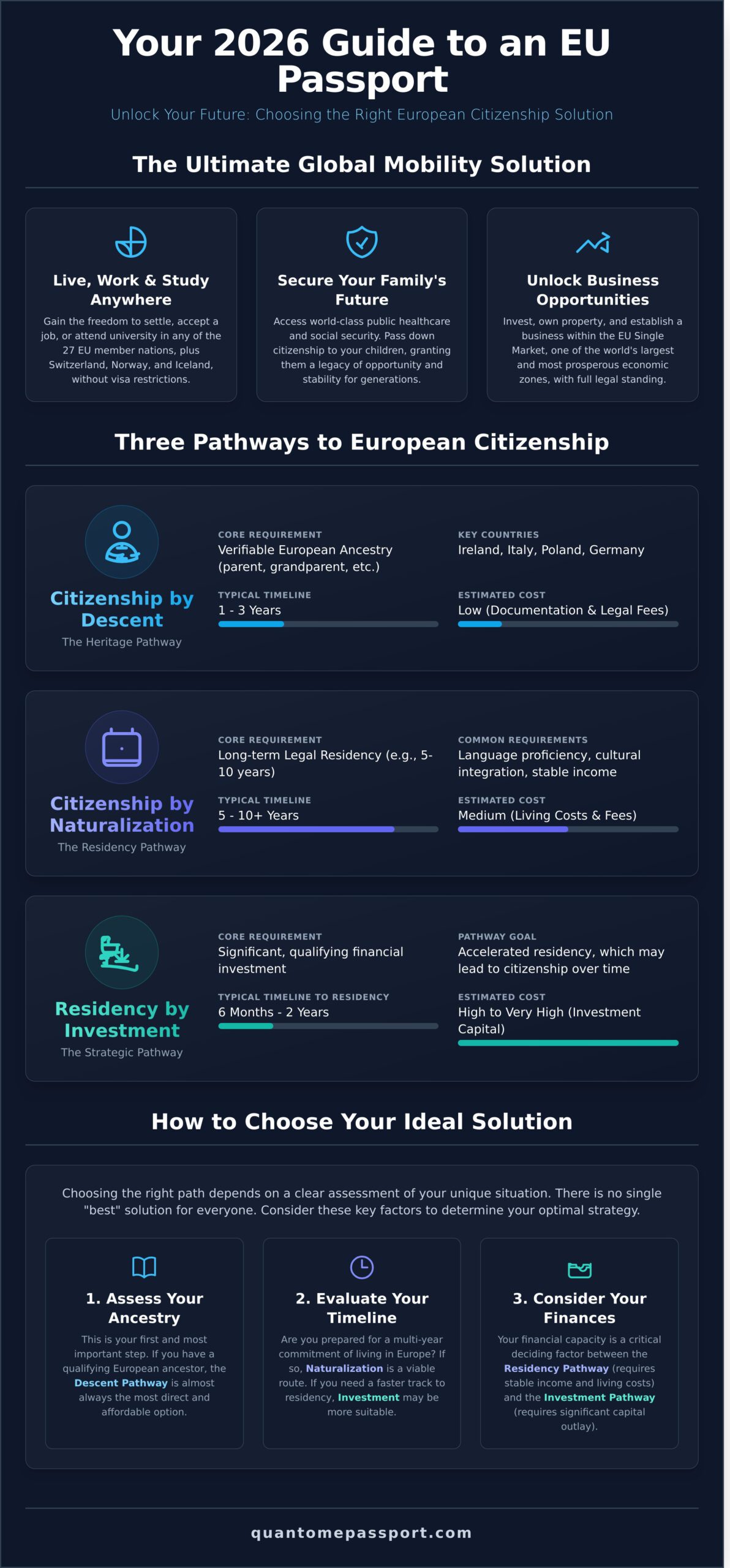
An EU passport is far more than a travel document; it represents a fundamental shift in your global status. At its core, Citizenship of the European Union grants you the rights, freedoms, and protections afforded to individuals across all 27 member states. It is not merely about visa-free travel but about unlocking a new life of unparalleled opportunity, stability, and security. For those seeking a comprehensive European citizenship solution, understanding this profound value is the first and most critical step.
To better understand the pathways and benefits available in the coming years, this video offers a clear overview:
Live, Work, and Study Across 27+ Countries
The cornerstone of EU citizenship is the freedom of movement. This right empowers you to live, work, and study anywhere within the European Union and associated countries like Switzerland, Norway, and Iceland. Imagine settling in Paris, accepting a job in Berlin, or retiring on the sunny coast of Portugal-all without the bureaucratic hurdle of applying for a work visa. Furthermore, you and your children gain access to world-class universities, often paying the same subsidized tuition fees as local students, opening doors to top-tier education at a fraction of the typical international cost.
Secure Your Family’s Future with Top-Tier Benefits
An EU passport is an investment in your family’s long-term well-being. As a citizen, you gain access to some of the world’s most comprehensive public healthcare and social security systems, ensuring peace of mind. This is more than a personal advantage; it’s an inheritable asset. In most cases, EU citizenship can be passed down to your children, granting them the same profound freedoms and high standard of living. It’s a powerful legacy that secures opportunities for generations to come.
Unlock Business and Investment Opportunities
For entrepreneurs and investors, EU citizenship is a gateway to the EU Single Market-one of the largest and most prosperous economic zones in the world. You gain the right to establish a business, own property, and invest anywhere in the bloc with the same legal standing as a native-born citizen. Beyond business, it provides a unique layer of global security: if you find yourself in a country without an embassy from your own EU nation, you are entitled to consular protection from any other EU member state’s embassy or consulate.
Solution 1: Citizenship by Descent (The Heritage Pathway)
For many aspiring Europeans, the most direct path to an EU passport lies hidden in their family history. This is the principle of Jus Sanguinis, or ‘right of blood,’ a legal framework where citizenship is passed down through generations. If you have a European parent, grandparent, or in some cases, even a great-grandparent, you may already be eligible. This heritage pathway is often the most affordable and straightforward European citizenship solution, unlocking all the rights and freedoms detailed in the European Commission’s official guide to EU citizenship.
Could You Qualify Through Your Ancestry?
Your journey begins by mapping your family tree. Start with what you know-your parents and grandparents-and work backward to identify a qualifying ancestor. The key is to establish an unbroken line to a citizen of an EU country who did not renounce that citizenship before the next in line was born. Your entire claim must be supported by official government-issued documents, such as birth certificates, marriage records, and death certificates, which create a verifiable paper trail for the authorities.
Key Countries with Favourable Descent Laws
While many EU nations recognize citizenship by descent, some have particularly accessible programs. Ireland, Italy, and Poland are popular options, often with generous generational limits. Italy, for example, has no legal limit on generations, provided the ancestral line is unbroken. Germany has also recently updated its laws to be more inclusive, addressing historical injustices and making it easier for descendants to reclaim citizenship. It’s crucial to understand that each country has unique and complex requirements.
The Process and Required Documentation
The application process typically involves meticulously gathering ancestral and personal documents and submitting them to the relevant country’s consulate in your home nation. While specifics vary, your document portfolio will generally need to include:
- Your ancestor’s birth and marriage certificates from their European home country.
- Evidence they did not naturalize elsewhere before the birth of their child (e.g., naturalization papers with specific dates).
- All “linking” vital records connecting you directly to that ancestor.
- Official translations and apostilles for all documents not in the country’s official language.
This documentary evidence is the absolute foundation of your application, making accuracy and official certification non-negotiable for this European citizenship solution.
Solution 2: Citizenship by Naturalization (The Residency Pathway)
For many aspiring Europeans without ancestral ties, the most accessible European citizenship solution is naturalization. This is the most common method for obtaining citizenship globally, built on a straightforward principle: you first become a legal resident of an EU country, and after a set period, you earn the right to apply for citizenship. This pathway is not a quick transaction but a long-term commitment to integrating into a new home country, its culture, and its society.
The Path from Legal Resident to Citizen
The journey begins by securing a long-term residence permit. EU countries offer various routes to legal residency, with the most common being work visas for skilled professionals, student visas for those enrolled in recognized institutions, or self-sufficiency visas for individuals who can prove they have the financial means to support themselves without working. Crucially, this path requires your sustained physical presence in the country; you must genuinely live there to qualify for naturalization.
Typical Timelines and Requirements
Patience is key. Most EU nations require you to maintain legal residency for a continuous period, typically ranging from 5 to 10 years, before you are eligible to apply for citizenship. Beyond the timeline, you will need to meet several standard criteria, including:
- A clean criminal record in both your home country and your country of residence.
- Proof of financial stability and self-sufficiency.
- Demonstrated integration, often proven through language proficiency tests and exams on the country’s history, culture, and civic structure.
Is Naturalization the Right Solution for You?
This pathway is ideal for those who genuinely wish to relocate and build a life in a specific European country. While it demands a significant time investment and deep personal integration, naturalization is often less capital-intensive upfront than investment-based options. It offers a structured and reliable route for individuals and families committed to the journey, making it a powerful and achievable path to an EU passport.
Solution 3: Residency by Investment (The Strategic Pathway)
For entrepreneurs, investors, and high-net-worth individuals, the Residency by Investment (RBI) route offers a strategic and accelerated pathway into Europe. Unlike traditional immigration processes that can take years, RBI programs provide a direct route to legal residency based on a qualifying economic contribution. This isn’t an instant passport; rather, it’s a structured journey where residency is the crucial first step, eventually leading to the option of applying for full citizenship.
This approach establishes a secure foothold in the EU, opening doors to business, travel, and a higher quality of life far more quickly than other methods.
How ‘Golden Visa’ Programs Pave the Way
Often called ‘Golden Visas,’ these programs are straightforward: an applicant makes a significant, qualifying investment in a country’s economy in exchange for a residence permit. One of the most compelling benefits is the ability to include immediate family members in the same application. Common investment options include:
- Real Estate Purchase: Acquiring residential or commercial property.
- Business Investment: Creating a new company or investing in an existing one, often creating local jobs.
- Capital Transfer: Investing in government bonds or a national development fund.
Case Study: The Slovenian Program as an Efficient EU Solution
Slovenia offers a prime example of a clear and efficient European citizenship solution for business-minded individuals. By establishing a company with a minimum capital investment of €110,000, applicants can secure a residence permit. This not only grants immediate access to the entire Schengen Area for business and travel but also places you on a structured, five-year path to permanent residency, followed by the opportunity for citizenship.
Key Considerations for Investment-Based Routes
While powerful, investment routes demand careful planning. It is crucial to conduct thorough due diligence on any program to ensure its legitimacy and stability. Applicants must also understand the full scope of costs, including legal fees and government charges, and the realistic timeline to citizenship. Navigating these complexities with expert guidance is key to a successful outcome.
Ready to explore a strategic investment pathway? See if you qualify for the Slovenian residency program.
How to Choose Your Ideal European Citizenship Solution
You’ve explored the pathways, benefits, and complexities of securing an EU passport. Now comes the most critical part: choosing the right strategy for your unique circumstances. The ideal European citizenship solution is not one-size-fits-all; it’s a tailored plan based on your heritage, finances, and long-term goals. This final section will help you synthesize the information and take the most logical next step.
Comparing the Top 3 Solutions: At a Glance
To simplify your decision, we’ve compared the most common routes to an EU passport. This table provides a clear overview to help you identify which path aligns best with your profile.
| Pathway | Ideal Candidate | Avg. Timeline | Est. Cost |
|---|---|---|---|
| Ancestry (Descent) | Individuals with a verifiable parent, grandparent, or great-grandparent from an EU country. | 1 – 3 years | Low (Primarily legal & document fees) |
| Naturalization (Residency) | Those willing to relocate and physically reside in an EU country for a set period. | 5 – 10+ years | Medium (Living costs & visa fees) |
| Investment (RBI/CBI) | High-net-worth individuals seeking an expedited residency or citizenship path. | 1 – 5 years | High (Significant investment + fees) |
A Quick Self-Assessment Checklist
Answering these fundamental questions will bring immediate clarity to your options. Your responses are the foundation of your personal citizenship strategy.
- Ancestry: Do you have any known parents, grandparents, or even great-grandparents born in a European country like Italy, Ireland, Poland, or Spain?
- Budget: What is your financial capacity for this process? Are you looking for a low-cost documentation route or prepared for a significant capital investment?
- Timeline: How quickly do you need to secure residency or citizenship? Is this a long-term goal or a more immediate need?
- Relocation: Are you willing and able to physically relocate and live in one country for five or more years to meet residency requirements?
Your Next Step: Planning Your Journey to EU Citizenship
The first and most crucial step is a detailed eligibility assessment. Navigating the intricate legal and bureaucratic requirements of any EU country alone is a significant risk. Simple mistakes in paperwork or procedure can lead to costly delays, wasted resources, and even outright rejection. Engaging with an expert provides a clear roadmap and ensures every action you take is correct and strategic.
Let us help you build a clear, actionable plan. We can assess your unique profile against current regulations to identify the most viable and efficient European citizenship solution for you and your family. Your journey to an EU passport begins with one conversation.
Book a private strategy call to discuss your personal solution.
Your European Future Awaits: Find Your Path Today
As we have explored, the dream of holding an EU passport is more accessible than many realize. Whether through your family heritage, long-term residency, or a strategic investment, a pathway exists to match your unique circumstances and ambitions. The key is understanding these distinct routes to identify the ideal European citizenship solution for you and your family.
Navigating this journey requires expert guidance. We pride ourselves on a clear, transparent process with predictable timelines. Our team offers personalized guidance for individuals and families, leveraging specialized expertise in programs like the sought-after Slovenian residency pathway to ensure your application is seamless and successful.
The life of freedom and opportunity you desire is within reach. Don’t let uncertainty hold you back from your future in Europe.
Ready to find your path to Europe? Book a private strategy call with our experts.
Frequently Asked Questions About European Citizenship
Can I have dual citizenship with my home country and an EU country?
Whether you can hold dual citizenship depends on the laws of both your home country and your chosen EU nation. Many EU countries, such as Portugal, Ireland, and Italy, permit dual citizenship without restrictions. However, others like Germany and Spain have stricter rules, often requiring you to renounce your original citizenship. It is crucial to verify the regulations for both countries involved before beginning your application process to avoid any unforeseen complications with your nationality.
What is the difference between EU residency and EU citizenship?
EU residency grants you the legal right to live, work, study, and travel within a specific EU country. It’s often temporary and must be renewed. EU citizenship, on the other hand, is permanent and makes you a citizen of the European Union. It grants you an EU passport, the right to vote, and the freedom to live, work, and retire in any of the 27 EU member states without a visa or permit.
Which is the easiest or fastest country to get EU citizenship?
The “easiest” path depends entirely on your personal circumstances. If you have European ancestry, countries like Ireland or Italy offer fast-track citizenship by descent. For those pursuing naturalization through residency, Portugal is a popular option with a relatively short five-year residency requirement. The most effective European citizenship solution is one that aligns with your background, financial situation, and long-term goals, as there is no single “fastest” route that fits everyone.
How much does it cost to get European citizenship?
The cost varies dramatically depending on the path you take. Standard naturalization involves government application fees, which can range from a few hundred to a couple of thousand euros, plus legal assistance costs. In contrast, residency by investment programs, which can lead to citizenship, require a significant capital outlay, often starting from €250,000 and going into the millions. The most common routes through residency and work are significantly more affordable than investment-based options.
Do I have to speak the language to become a citizen?
For most citizenship-by-naturalization routes, yes, you must demonstrate a basic proficiency in the national language. The required level varies; for example, Portugal requires an A2 (basic) level, while Germany typically requires a B1 (intermediate) level. Some pathways, such as citizenship by descent, may not have a language requirement. However, learning the language is always beneficial for integrating into your new home country and successfully navigating the application process.
Can my family get citizenship with me?
Yes, in most cases, your immediate family can obtain citizenship with you or after you. Typically, your spouse and minor children (under 18) are eligible to apply through family reunification once you become a citizen. The specific rules, processing times, and requirements for dependents vary by country. A comprehensive European citizenship solution will include a clear strategy for ensuring your entire family can successfully join you on your journey to becoming EU citizens.