
Does a story about your great-grandfather from Portugal or a faded birth certificate from Ireland mean you could hold an EU passport? For many, the answer is a resounding yes, but the path from family lore to European citizenship often feels like a maze of confusing laws and bureaucratic hurdles. The dream of living, working, and traveling freely across Europe can seem just out of reach, tangled in questions about eligibility and historical paperwork. This is where the powerful principle of EU nationality by descent or repatriation comes in, offering a direct link between your heritage and a European future.
This comprehensive 2026 guide is your roadmap. We will demystify complex legal terms, show you precisely how to determine if your ancestry qualifies, and provide actionable strategies for locating the documents you need. Forget the overwhelm; by the end of this article, you will have a clear, step-by-step plan to confidently navigate the process. Your family history is more than just a story-it could be your key to unlocking the European Union.
Key Takeaways
- Understand the critical differences between the two main pathways to EU nationality by descent or repatriation to determine which applies to your family history.
- Discover which specific EU countries offer EU nationality by descent or repatriation and learn the unique eligibility rules for each program.
- Follow a clear, step-by-step roadmap for securing EU nationality by descent or repatriation, from initial research to final passport application.
- Learn how to overcome common challenges when applying for EU nationality by descent or repatriation, like missing documents and complex legal requirements, to avoid costly delays.
- Explore alternative pathways to an EU passport in case your ancestry doesn’t meet the strict criteria for EU nationality by descent or repatriation.
Understanding Ancestry-Based EU Citizenship: Descent vs. Repatriation
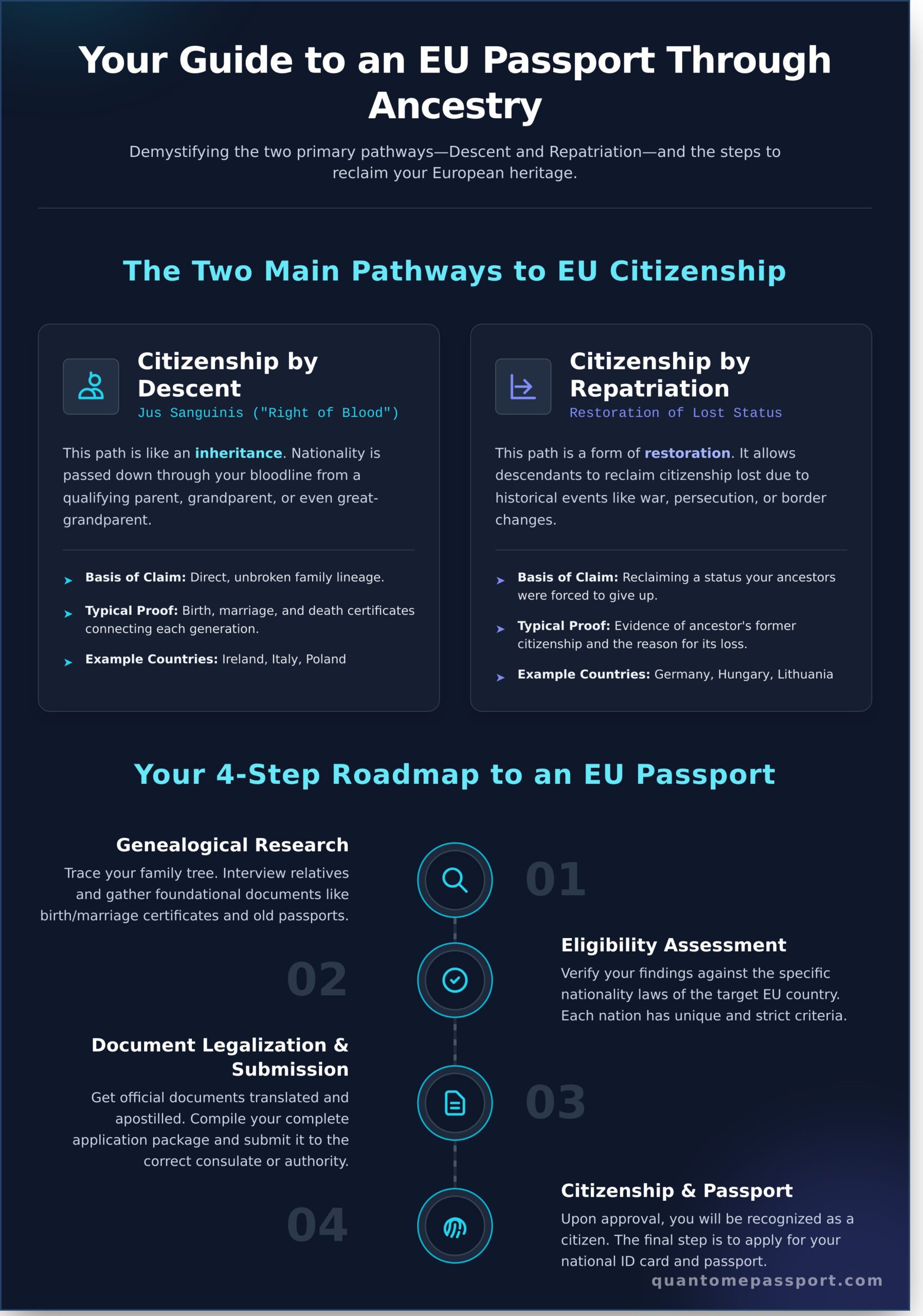
Exploring your European roots can open the door to a second passport, but the journey starts with understanding the two primary pathways: descent and repatriation. While often discussed together, these routes to EU nationality by descent or repatriation have distinct legal and historical foundations. The simplest way to differentiate them is with an analogy: citizenship by descent is like an inheritance passed down through your bloodline, while repatriation is a form of restoration-reclaiming a status that was lost. Ultimately, your eligibility for either path is governed by the specific laws of each member state, which collectively set the rules for acquiring European Union citizenship.
To better understand the concept of descent-based citizenship, this video provides a helpful overview:
What is Citizenship by Descent (Jus Sanguinis)?
Jus Sanguinis, a Latin term meaning ‘right of blood,’ is the most common form of ancestry-based citizenship. This legal principle allows you to inherit nationality directly from a parent, grandparent, or in some cases, a great-grandparent who was a citizen of an EU country. Your claim is based entirely on a direct, unbroken lineage, proving you are the descendant of a qualifying ancestor. Countries like Ireland, Italy, and Poland have well-established programs based on this principle.
What is Citizenship by Repatriation?
Repatriation provides a path for individuals to reclaim citizenship for a ‘homeland’ their ancestors were forced to leave. This route is typically available to descendants of those who lost their nationality due to specific historical events, such as war, political persecution, or shifting national borders. It is a legal mechanism for righting historical wrongs. Prominent examples include programs in Germany, Hungary, and Lithuania, which have specific provisions for the descendants of former citizens affected by past events.
Key Differences at a Glance
| Feature | Citizenship by Descent | Citizenship by Repatriation |
|---|---|---|
| Basis of Claim | Direct bloodline (Jus Sanguinis) | Restoration of lost citizenship |
| Historical Context | Continuous family lineage | Specific historical events (e.g., persecution, border changes) |
| Typical Proof | Birth, marriage, and death certificates connecting generations | Proof of ancestor’s former citizenship and reason for loss |
The Step-by-Step Process: From Family Tree to EU Passport
Embarking on the path to an EU passport through ancestry is a marathon, not a sprint. This detailed roadmap demystifies the process, breaking down the complex journey into four manageable stages. Following these steps carefully is your best strategy for success, ultimately leading to the full benefits that come with official EU citizenship rights and the freedom of movement within the European Union. Precision and patience are your most valuable assets.
Step 1: Genealogical Research – Tracing Your European Roots
Your investigation begins at home. Start by interviewing older relatives to gather names, dates, and places of birth or marriage. Use this foundational information to hunt for key documents that form the bedrock of your claim, such as:
- Birth, marriage, and death certificates
- Your ancestor’s original passport or travel documents
- Ship manifests or naturalization papers
Online resources like Ancestry.com can be invaluable, but consider hiring a professional genealogist if you hit a dead end or need to access foreign archives.
Step 2: Gathering Essential Documentation
Once you’ve identified your qualifying ancestor, you must build an undeniable paper trail. Governments require official, certified copies of all vital records-photocopies are never accepted. Depending on the country, these documents will also need an apostille for international validation and certified translations into the country’s official language. You can typically request these records directly from the relevant state or municipal archives where the event occurred.
Step 3: Verifying Eligibility and Legal Nuances
This is a critical checkpoint. You must confirm that the line of citizenship was never legally broken. A common ‘break’ occurs if your ancestor naturalized in another country before their child (your next link in the chain) was born. It is crucial to research the specific country’s citizenship laws as they existed at the time of your ancestors’ births, as rules regarding gender and military service have changed significantly. Verifying these details is essential before investing in a full application for EU nationality by descent or repatriation.
Step 4: Submitting Your Application
With your evidence compiled, you will submit your application package to the appropriate embassy or consulate. This involves accurately completing official forms and providing all your certified, apostilled, and translated documents. Some consulates require an in-person interview to review your case. Be prepared for a lengthy wait; processing times for claims of EU nationality by descent or repatriation can often take from one to three years, or sometimes longer.
Which EU Countries Offer Citizenship by Ancestry?
Dozens of countries in the European Union offer a path to citizenship based on ancestry, but the rules vary dramatically. Understanding which route applies to you is the first step. Below, we explore the most common programs, from direct “right of blood” laws to specific historical restitution acts. This overview will help you identify potential pathways to securing EU nationality by descent or repatriation.
Popular ‘Right of Blood’ Countries: Ireland, Italy, and Poland
These nations have some of the most sought-after citizenship by descent programs, based on the principle of jus sanguinis (right of blood). Their rules generally focus on direct lineage.
- Ireland: If one of your grandparents was born on the island of Ireland, you can claim citizenship. You must first register your birth on the Foreign Births Register before applying for a passport.
- Italy: Italy has one of the most generous policies with no generational limit. However, a key complexity is the “1948 Rule,” which can impact lineage traced through a female ancestor born before January 1, 1948.
- Poland: You may be eligible if you have an ancestor who was a Polish citizen after 1920 and did not lose their citizenship (e.g., by serving in a foreign army) before you were born.
Countries with Strong Repatriation Programs: Germany, Hungary, Lithuania
Distinct from direct descent, these repatriation programs are designed to restore citizenship to descendants of specific groups. Proving ethnic or national identity is often a key part of the application for an EU nationality by descent or repatriation through these routes.
- Germany: Article 116 of the Basic Law allows for the restoration of citizenship to former German citizens (and their descendants) who were deprived of their nationality on political, racial, or religious grounds between 1933 and 1945.
- Hungary: A simplified naturalization process is available for individuals who can prove they have Hungarian ancestors and demonstrate a basic knowledge of the Hungarian language.
- Lithuania: Descendants of individuals who were citizens of Lithuania between 1918 and 1940 and who left the country may be eligible to have their citizenship restored.
Unique Pathways: Spain and Portugal
Both Spain and Portugal enacted specific laws to grant citizenship to descendants of Sephardic Jews expelled from the Iberian Peninsula during the Inquisition. These programs require extensive documentation, such as genealogical reports from recognized Jewish communities. It’s crucial to note that Spain’s program has closed to new applicants, and Portugal’s has undergone significant changes, making it much more restrictive.
Citizenship laws are complex and subject to frequent amendments. This guide provides a general overview, but you must consult the official consulate or embassy of the specific country for the most current requirements and procedures.
Common Challenges and How to Overcome Them
While the dream of an EU passport is compelling, the path to claiming it is often paved with unforeseen challenges. The process of securing EU nationality by descent or repatriation requires more than just a compelling family story; it demands meticulous documentation, historical context, and a deep understanding of complex laws that have changed over decades. Acknowledging potential obstacles is the first step toward building a successful, stress-free application. Let’s explore the most common hurdles and how to clear them.
Problem: Missing or Destroyed Records
It’s a common fear: what if the key document-a birth certificate, a marriage license-is gone forever? Gaps in your family’s paper trail are a frequent issue, especially when dealing with records lost to war, fires, or simple disorganization over the last century. Don’t let this stop you. Creative and persistent research is key.
- Search for alternative evidence: Expand your search to include ship manifests, census data, military records, or religious documents like baptismal or marriage certificates, which often serve as powerful secondary evidence.
- Obtain official statements: If a vital record is confirmed to not exist, you can request an official “letter of no record” from the relevant archive. This demonstrates due diligence to the consulate.
- Explore reconstruction: Some jurisdictions have legal procedures to officially reconstruct a lost vital record based on a collection of secondary evidence.
Problem: Complex Legal Rules and ‘Breaks’ in Lineage
Citizenship laws are not static; they are a complex web of historical rules that can invalidate a claim unexpectedly. A common and critical “break” in lineage occurs when an ancestor naturalized in another country (e.g., the U.S. or Canada) before their child was born, severing the citizenship link for future generations. Furthermore, shifting European borders can create confusion over which country’s laws even apply to your ancestor. The success of your entire application can hinge on a single date, making expert interpretation essential for navigating these legal minefields.
Problem: Navigating Bureaucracy and Long Timelines
Be prepared: this is a marathon, not a sprint. Government agencies and consulates operate on their own schedules, and applications can take months or even years to process. Setting realistic expectations from the start will save you immense frustration. To communicate effectively, always be organized, polite, and persistent. Have all your documents perfectly translated and apostilled before making contact, and keep a clear record of every interaction. If the complexity feels overwhelming and the risk of a mistake seems high, professional guidance can provide a clear roadmap and manage the administrative burden for you. Book a Private Strategy Call to get a clear plan for your unique case.
Is Ancestry Not an Option? Alternative Pathways to EU Citizenship
While securing EU nationality by descent or repatriation is the most direct route for those with European roots, it’s not a viable path for everyone. If your genealogical search has reached a dead end, don’t be discouraged. The dream of European Union citizenship is still within reach through several alternative, strategic pathways. This isn’t about starting over; it’s about pivoting to a different, equally valid route to your goal.
Citizenship by Naturalization (Residency)
The most traditional alternative is citizenship through naturalization. This process involves establishing legal, long-term residency in an EU country for a set period, typically between five and ten years. You will need to demonstrate integration by passing language exams, proving financial stability, and maintaining a clean criminal record. While it is a well-trodden path, it represents a significant time commitment before citizenship can be granted.
Citizenship by Investment or Special Programs
For those seeking a more accelerated and predictable route, residency-by-investment programs offer a powerful alternative. These government-sanctioned programs grant residency rights in exchange for a significant capital contribution to a country’s economy, such as a real estate purchase or business investment. The benefits are compelling:
- Speed and Efficiency: Gain residency in months, not years, setting you on a much faster track to citizenship.
- Clear Requirements: The process is based on a defined investment, removing the ambiguity of typical immigration routes.
- Family Inclusion: Most programs allow you to include your spouse, dependent children, and sometimes even parents in a single application.
A Strategic Example: The Slovenian Residency Program
A prime example of a strategic pathway is the Slovenian Business Residency Program. This program allows you to gain an EU residence permit by establishing a company with a capital investment of €50,000. This not only secures your footing in the EU but also creates a vehicle for business activity within the Schengen Area. This initial residency is your first step on a clear path toward permanent residency and eventual citizenship, offering a proactive and accessible route to achieving your European ambitions. Explore if a residency program is a better fit for your goals.
Your European Heritage: The Key to Your Future
The journey to claiming your European roots is a profound one, blending personal history with future opportunity. As we’ve explored, understanding the crucial differences between citizenship by descent and repatriation is the first step. While the path involves meticulous documentation and navigating bureaucratic hurdles, it is an achievable goal. Securing EU nationality by descent or repatriation is a life-changing endeavor that opens a continent of possibilities for you and your family.
The complexity of these pathways often requires expert navigation. You don’t have to decipher complex immigration laws alone. Our team provides deep knowledge of European residency and citizenship programs, creating personalized strategies to guide you through every stage. We specialize in turning ancestral ties into tangible futures. Are you ready to transform your heritage into a passport?
Book a Private Strategy Call to map your personal path to EU citizenship. Your European story is waiting to be written.
Frequently Asked Questions
How long does it take to get EU citizenship by descent?
The processing time for EU citizenship by descent varies dramatically by country. Some applications, like those for Ireland, might be processed in 1-2 years. Others, such as complex Italian or Polish cases, can take anywhere from 2 to 5 years or even longer. Timelines depend on the specific consulate’s workload, the complexity of your lineage, and the time required to gather all necessary vital records. It is essential to set realistic expectations from the start.
Do I need to speak the language of my ancestor’s country for a descent application?
This depends entirely on the country’s specific laws. For many popular descent routes, such as those for Italy, Ireland, and Poland, there is generally no language requirement. However, some countries may require basic language skills if the claim is more complex or falls under specific legal articles. Always verify the rules for your ancestor’s specific country, as regulations can change and may differ from standard naturalization requirements where language proficiency is almost always mandatory.
What is the difference between an EU citizen and an EU permanent resident?
An EU citizen holds a passport from a member country, granting them the freedom to live, work, study, and retire in any other EU/EEA nation. A permanent resident, however, only has the right to live indefinitely in the specific country that granted them residency. They do not hold an EU passport and lack the automatic right to move freely and work across the entire bloc, making citizenship a far more powerful and flexible status.
Can my children and spouse also get citizenship if my application is successful?
Once your application for EU nationality by descent or repatriation is successful, your minor children can typically acquire citizenship as well, often through a simpler registration process. Your spouse, however, does not automatically become a citizen. They must usually qualify separately through a naturalization process, which often requires a period of legal residency in the EU country and meeting other criteria, depending on national laws.
What are the main costs involved in applying for citizenship by descent?
The primary costs include government application fees, which vary by country. You must also budget for acquiring official vital records (birth, marriage, death certificates) for your entire line of ancestry. Additional costs include fees for apostilles or legalizations, certified translations of all non-official language documents, and international courier services. Professional legal assistance to manage the process is another key cost to consider for a smooth and successful application.
What happens if my application for citizenship by ancestry is rejected?
If your application is rejected, you will receive an official decision outlining the specific reasons for the denial. Most EU countries provide a legal pathway to appeal this decision within a set timeframe. This is a critical stage where professional assistance is highly recommended. An expert can help you understand the legal basis for the rejection, gather supplementary evidence, and build a strong case for your appeal to overturn the initial negative outcome.