
Dreaming of a life in Europe-the historic cities, the vibrant culture, the boundless opportunities-but feeling lost in a maze of legal terms? The path to your new life often begins with one crucial decision, a choice that can feel overwhelming when comparing EU residency vs. citizenship. It’s a question that brings up valid concerns. Do you have to renounce your current passport? Which status truly aligns with your long-term goals for your family and career? How complicated and long is the journey ahead?
This guide is here to replace that uncertainty with clarity. We will break down everything you need to know, comparing the rights, benefits, and distinct pathways for both statuses in simple, straightforward language. By the end, you won’t just understand the options; you’ll have a clear framework to decide which path is right for you, understand the practical steps involved, and feel confident in starting the process toward building your European future.
Key Takeaways
- Understand that EU residency is your foundational permit, granting you rights to live and work within one specific EU country.
- Discover how EU citizenship offers the ultimate freedom to live, work, study, and vote in any of the 27 member states.
- Clarify the core differences in the eu residency vs citizenship debate to strategically choose the path that best fits your long-term goals.
- Learn how residency often serves as the necessary pathway to citizenship, and what the general naturalization journey entails.
What is EU Residency? Your Permit to Live in Europe
Before diving into the full eu residency vs citizenship comparison, it’s essential to understand the foundation: residency. An EU residency permit is a legal authorization that allows a non-EU national to live in a specific European Union member state. It is not a blanket permission to live anywhere in the EU. For most individuals from outside the bloc, obtaining a residency permit is the crucial first step on their journey to living in Europe long-term.
To better understand the pathways and possibilities, this video offers some valuable insights:
Common Types of Residency Permits
EU countries offer various pathways to residency, typically tied to a specific purpose. These permits are initially temporary and require renewal. Common routes include work-based permits like the EU Blue Card for highly skilled professionals, family-based permits for joining a spouse or relative, and investment-based programs, often called ‘Golden Visas’. Other popular options include student visas for those enrolled in an educational institution or non-lucrative visas for individuals with sufficient passive income.
The Rights and Limitations of an EU Resident
Holding a residency permit grants you significant rights within your host country, but it comes with clear limitations compared to citizenship. These are critical distinctions in the eu residency vs citizenship debate.
- Rights: You can legally live, work, and study in the specific country that issued your permit. You also gain access to that nation’s healthcare and social security systems, much like a citizen.
- Limitations: You cannot vote in national elections. Your freedom of movement is generally limited to traveling within the Schengen Area as a tourist for up to 90 days in any 180-day period, not to live or work in other member states.
Understanding Permanent Residency (PR)
After legally and continuously living in an EU country for a set period, typically five years, you can often apply for permanent residency. This is a more secure, long-term status that reduces administrative hurdles, as renewals are less frequent or not required at all. The legal framework for this is based on the EU’s Long-term resident (European Union) directive, which aims to give non-EU nationals a uniform set of rights. However, it’s crucial to remember that even permanent residency is not citizenship; you remain a citizen of your home country, holding a permit to live indefinitely in another.
What is EU Citizenship? Your Membership in the European Union
While residency grants you the right to live in a specific country, EU citizenship is the ultimate legal status, conferring full membership in the entire European Union. This is a critical distinction in the eu residency vs citizenship debate. Becoming a citizen of any single EU member state-be it Spain, Ireland, or Portugal-automatically makes you an EU citizen.
This status is permanent and cannot be easily revoked, providing a lifetime of security and opportunity. The most tangible symbol of this status is holding an EU passport, consistently ranked among the most powerful in the world for global mobility.
The Unmatched Rights of an EU Citizen
Citizenship unlocks a suite of rights that go far beyond what a residence permit can offer. As an EU citizen, you are entitled to:
- Full Freedom of Movement: You can live, work, study, and retire in any of the 27 EU member states, plus Iceland, Liechtenstein, Norway, and Switzerland (EEA/EFTA), without restrictions. The official Free movement and residence rights of EU citizens are foundational to the Union, granting unparalleled mobility.
- Political Participation: You gain the right to vote and stand as a candidate in municipal and European Parliament elections in whichever EU country you reside.
- Consular Protection: If you are outside the EU in a country where your home nation has no embassy, you are entitled to protection from the embassy or consulate of any other EU member state.
- Unrestricted Market Access: You can access the entire EU job market without ever needing a work permit, opening up professional opportunities across the continent.
Primary Pathways to Acquiring EU Citizenship
The journey to becoming an EU citizen varies, but most individuals follow one of several established routes. Understanding these pathways is key when evaluating eu residency vs citizenship for your long-term goals.
- Naturalization: The most common method, achieved after legally residing in an EU country for a specific number of years (typically 5-10), demonstrating integration and language proficiency.
- Descent (Jus Sanguinis): If you have a parent, grandparent, or sometimes even a more distant ancestor from an EU country, you may be eligible to claim citizenship by “right of blood.”
- Birth (Jus Soli): Less common in the EU, this grants citizenship to individuals born on the soil of an EU country, often with additional requirements, such as a parent having legal residency.
- Exceptional Circumstances: This includes routes like Citizenship by Investment (CBI) programs, which grant citizenship in exchange for a significant economic contribution, though these are becoming rarer.
Head-to-Head: EU Residency vs. Citizenship at a Glance
When considering a move to Europe, the distinction between residency and citizenship is the most critical factor to understand. While both offer a new life on the continent, their legal foundations, rights, and long-term implications are vastly different. To clarify the core of the eu residency vs citizenship debate, we’ve broken down the key differences in a simple format.
This side-by-side comparison provides a quick reference for the most important distinctions, helping you see clearly which path aligns with your personal and professional goals.
Comparison Table: Key Differences
| Feature | EU Residency | EU Citizenship |
|---|---|---|
| Travel Document | National passport + EU residence permit card | EU member state passport |
| Right to Vote | Limited to local elections in some countries | Full voting rights in national and EU elections |
| Work Rights | Right to work only in the issuing country | Right to work and establish a business in any EU country |
| EU Mobility | Visa-free travel within the Schengen Area (up to 90 days) | Full freedom of movement to live, work, and retire in any EU state |
| Permanence | Conditional; can be lost due to long absences or other factors | Lifelong and irrevocable; passed down to future generations |
Mobility: Schengen Travel vs. Full Freedom of Movement
An EU residence permit is a powerful tool, granting you visa-free travel throughout the 27-country Schengen Area. However, this is fundamentally a visitor’s privilege. You can travel for short stays, but you cannot settle down in another EU country. Citizenship elevates this entirely. It grants you the absolute right to live, work, study, and retire in any EU member state without conditions. Think of it as being a ‘guest’ in Europe with residency versus being a full ‘family member’ with citizenship.
Permanence and Security: Conditional vs. For Life
Residency, even when “permanent,” is often conditional. You must maintain your connection to the host country, and long absences can put your status at risk. It is a status that can be lost. Citizenship, on the other hand, is for life. It is the ultimate form of security, anchoring you and your family to Europe permanently. This lifelong status is protected by a framework of fundamental Rights of EU citizens, which are not afforded to residents. Crucially, this status can typically be passed down to your children, securing their future as Europeans for generations to come.
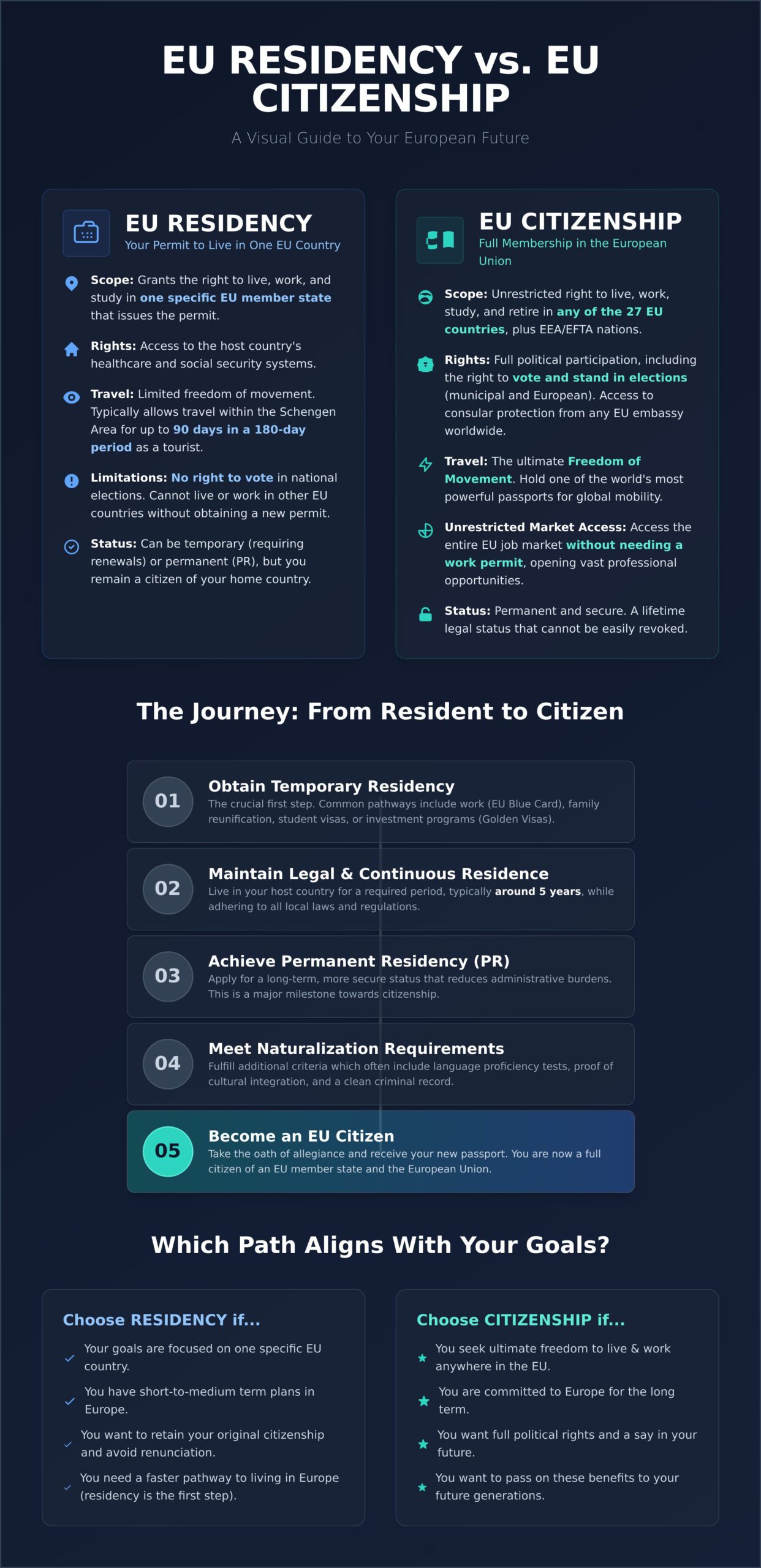
The Journey from Resident to Citizen: The Naturalization Path
For many, achieving EU residency is the first major milestone. However, the ultimate goal is often full citizenship. The legal process for this transition is called naturalization, and it represents the final step in the eu residency vs citizenship journey. It’s crucial to view this as a long-term commitment-a path that requires patience, preparation, and a deep connection to your new home country. While the specifics vary, the fundamental principles of naturalization are consistent across the European Union.
Typical Naturalization Requirements
Before you can apply for a European passport, you must meet several stringent criteria. While each member state sets its own rules, most naturalization processes include:
- Minimum Residency Period: You must have lived legally and continuously in the country for a set number of years, typically ranging from 5 in countries like Portugal to 10 in Austria.
- Civic and Language Integration: Expect to prove your proficiency in the national language and pass a test on the country’s history, laws, and values.
- Financial Stability & Good Character: Applicants must demonstrate they can support themselves without relying on social welfare and have a clean criminal record.
- Oath of Allegiance: Most countries require a formal pledge of loyalty to the state and its constitution.
The Critical Question of Dual Citizenship
A common concern for applicants is whether they must renounce their original citizenship. The answer depends entirely on the country, as the EU has no single policy on this matter. For instance, countries like Ireland, Italy, and Portugal are known for being permissive of dual nationality. In contrast, others like Spain or the Netherlands often have stricter rules that may require renunciation, although specific exceptions for certain nationalities or circumstances can apply. It is vital to research the specific laws of your target country.
Accelerated Paths: Is It Possible to Speed It Up?
While standard naturalization can take many years, some pathways can shorten the timeline. Marrying an EU citizen is a common example, often reducing the residency requirement significantly. Another strategic option is residency by investment. These government-approved programs provide a clear, legal framework for high-net-worth individuals to gain residency, which then leads to a more predictable citizenship timeline. For those who qualify, it can be the most efficient route. Discover if an investment program could be your fast-track to Europe.
How to Choose: Aligning Your Goals with the Right Status
Understanding the technical definitions is the first step, but the real decision comes from introspection. The debate over eu residency vs citizenship is not about which is universally “better,” but which is fundamentally right for you. Your personal, professional, and family ambitions will ultimately illuminate the correct path forward. To help clarify your vision, consider which of these common scenarios best reflects your own goals.
Scenario 1: The Expat Career
Your dream is to build a life and career in a specific European hub, like Berlin or Lisbon. You plan to work for a local company, integrate into the community, and enjoy the stability of a long-term home base. For this focused objective, Permanent Residency is often the ideal solution. It grants you the right to live, work, and access social services indefinitely in your chosen country, providing deep-rooted security without the more complex requirements of naturalization.
Scenario 2: The Pan-European Entrepreneur
You see Europe not as a collection of countries, but as a single, dynamic market. Your business plan requires the freedom to open an office in Paris, hire a team in Amsterdam, and live in Rome-all without bureaucratic friction. In this case, only EU Citizenship will unlock this ultimate level of mobility. A residency permit from one nation does not grant you the right to work or establish a business in another. Citizenship makes you a citizen of the entire Union, with unrestricted freedom of movement and establishment.
Scenario 3: The Family Legacy Builder
Your vision extends beyond your own lifetime. You want to provide your children and grandchildren with a permanent connection to Europe, securing their future access to world-class education, opportunities, and global mobility. For this generational goal, Citizenship is the only answer. It is a gift that can be passed down by descent, creating a lasting legacy. While residency can often be extended to immediate family, it is not a permanent, inheritable status.
Ultimately, choosing your status is one of the most significant strategic decisions you will make. The path is complex, with unique laws and timelines in each member state. Navigating the nuances of eu residency vs citizenship requires a clear, personalized strategy. To ensure your journey aligns perfectly with your ambitions, seeking expert guidance is an invaluable investment.
Charting Your Course: Making the Right European Choice
The journey to Europe presents two distinct opportunities. As we’ve explored, residency acts as your permit to live and work within a specific EU nation, while citizenship grants you the full spectrum of rights across the entire bloc. Ultimately, the choice in the eu residency vs citizenship debate depends entirely on your long-term goals-whether you seek a foothold in one country or complete integration into the European community.
This is a life-changing decision, but you don’t have to make it alone. Our team offers expert guidance on complex residency and citizenship pathways, backed by specialized knowledge in EU investment programs. With global offices in London and Dubai ready to serve you, we are equipped to turn your European dream into a reality. Your European future is complex. Let our experts simplify it. Book your private strategy call today.
Frequently Asked Questions
Can I work in any EU country with a residency permit from one member state?
Generally, no. A national residency permit from one EU country, such as Spain, only grants you the right to live and work in that specific country. To work in another member state like Germany, you would typically need to apply for a separate work permit. An EU Long-Term Resident Permit offers more mobility, but you must still follow specific procedures to live and work in a different EU nation, which is not an automatic right.
Is EU permanent residency the same as citizenship?
No, they are fundamentally different. Permanent residency allows you to live, work, and study indefinitely in the issuing country with many of the same social rights as citizens. However, you cannot vote in national elections or hold that country’s passport. Citizenship grants you full political rights, an EU passport, and the unrestricted freedom to live and work in any EU member state without needing any additional permits or visas, a key distinction in the EU residency vs citizenship debate.
Do I have to give up my original citizenship to become an EU citizen?
This depends on the laws of both your home country and the EU country where you are naturalizing. Some EU nations, like Spain and the Netherlands, have strict rules against dual citizenship and may require you to renounce your previous nationality. In contrast, countries such as Ireland, Italy, and Portugal generally permit dual citizenship. It is essential to research the specific regulations of both countries involved before beginning the naturalization process.
What is the fastest way to get EU citizenship?
The quickest routes to EU citizenship are typically through ancestry (jus sanguinis) or investment. If you can prove recent lineage from an EU country like Ireland, Poland, or Italy, you may be able to claim citizenship directly, often within 1-2 years. Malta offers a “citizenship by naturalization for exceptional services by direct investment” pathway, which requires a significant financial contribution but provides a faster track to a passport compared to traditional residency-based naturalization.
How long does it take to get citizenship through naturalization?
The standard timeline for naturalization through residency varies significantly across the EU, usually taking between 5 and 10 years. For instance, you must legally reside in Portugal for 5 years before applying, whereas Spain and Austria generally require 10 years of continuous residency. This period only covers the residency requirement; the actual citizenship application processing can add another one to two years to the total time frame, depending on the country.
Do I lose my permanent residency if I am outside the EU for too long?
Yes, your permanent residency status can be revoked due to prolonged absence. If you hold an EU Long-Term Resident Permit, you risk losing it if you are away from the territory of the European Union for more than 12 consecutive months. National permanent residency permits often have even stricter rules, with some countries revoking status after just six months of absence. Always verify the specific continuous residency requirements of the country that issued your permit.