
Does the dream of living, working, and traveling freely across Europe feel buried under a mountain of complex paperwork and confusing legal jargon? You’re not alone. For many, the journey toward securing EU citizenship seems like an overwhelming maze, filled with uncertainty about eligibility, fear of making critical mistakes, and frustratingly dense official information. The promise of a European future can feel just out of reach, lost in the bureaucratic fog.
This guide is your clear, straightforward map for 2026. We are here to cut through the complexity and illuminate the legitimate pathways to your European passport. We will break down the core options-from ancestry and naturalization to investment programs-in simple terms you can actually use. By the end of this article, you will understand the profound benefits of holding an EU passport and have the clarity to identify the best strategy for you and your family, paving the way for a future of global mobility and security.
What is EU Citizenship? Understanding the Fundamentals
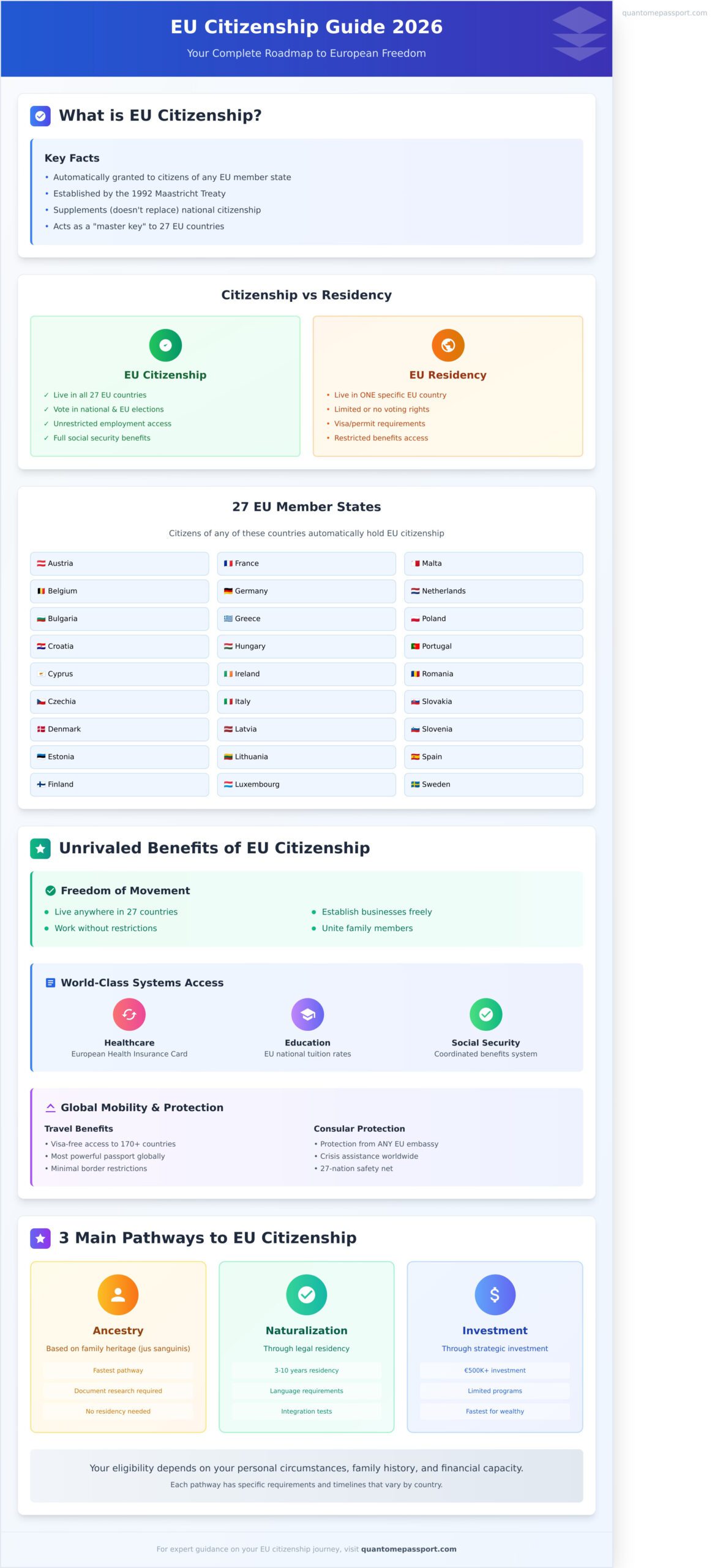
Many people dream of living and working in Europe, but the concept of eu citizenship can often be misunderstood. It’s crucial to know that it is not a standalone nationality you can apply for directly. Instead, EU citizenship is a unique legal status that is automatically granted to anyone who holds citizenship of a European Union member state. First established by the 1992 Maastricht Treaty, this status supplements-it does not replace-your national citizenship. The legal framework of the Citizenship of the European Union grants a wide range of powerful rights to individuals across the entire bloc.
To better understand the powerful benefits this status unlocks, watch this helpful video:
Think of it like this: your national passport (from France, Ireland, or Poland, for example) is your primary identity. Your EU citizenship is the ‘master key’ that comes with it, unlocking the freedom to live, work, study, and retire in all 27 member countries with minimal hassle and bureaucracy.
EU Citizenship vs. EU Residency: A Crucial Distinction
It’s vital not to confuse citizenship with residency. EU residency grants you the right to live in one specific EU country, often through a visa for work, study, or family reunification. While residency is often the necessary first step toward naturalization, it comes with limitations. Citizenship, on the other hand, grants you the fundamental freedom of movement across the entire EU. Citizens can vote in national and European elections, a right typically not extended to residents, and enjoy unrestricted access to employment markets and social security systems across the Union.
Who Qualifies as an EU Citizen?
The only way to become an EU citizen is to first become a citizen of an EU member state. Each country sets its own rules for acquiring nationality, most commonly through ancestry (jus sanguinis), birth on the territory (jus soli), or naturalization after a period of legal residency. If you hold a passport from any of the following 27 countries, you are already an EU citizen:
- Austria
- Belgium
- Bulgaria
- Croatia
- Cyprus
- Czechia
- Denmark
- Estonia
- Finland
- France
- Germany
- Greece
- Hungary
- Ireland
- Italy
- Latvia
- Lithuania
- Luxembourg
- Malta
- Netherlands
- Poland
- Portugal
- Romania
- Slovakia
- Slovenia
- Spain
- Sweden
The Unrivaled Benefits of Holding an EU Passport
Beyond its rich cultural tapestry and economic stability, the European Union offers its citizens a collection of rights and privileges that are unparalleled globally. While the journey to eu citizenship often involves a dedicated process, such as the pathways detailed in studies on Citizenship via Naturalization, the rewards fundamentally reshape your future. It’s not just about a new passport; it’s about unlocking a new dimension of freedom, opportunity, and security.
Freedom of Movement: Live, Work, and Retire Anywhere
The cornerstone of EU citizenship is the profound freedom to move. This right empowers you to choose your ideal life within any of the 27 member states without the bureaucratic hurdles non-citizens face. Imagine relocating to Paris for a career opportunity, retiring to the sunny coasts of Spain, or launching a startup in Berlin-all without needing a visa or work permit. This freedom includes:
- The right to live anywhere: Settle in any EU country for any reason, from career to lifestyle.
- The right to work without restrictions: Apply for jobs and compete on an equal footing with local nationals.
- The right to establish a business: Launch and operate a company under the same conditions as any EU citizen.
- The right to unite your family: Your close family members, even if they are non-EU citizens, can often join you.
Access to World-Class Systems: Healthcare, Education, and Social Security
As an EU citizen, you gain access to some of the world’s most advanced and comprehensive social systems. You can receive medical treatment in any member state under the same conditions as insured locals, often with just the European Health Insurance Card (EHIC). For students, this means the ability to enroll in prestigious European universities at substantially lower tuition fees reserved for EU nationals. Furthermore, the EU coordinates social security systems, ensuring your contributions to pensions and unemployment benefits are protected as you move between countries.
Global Mobility and Consular Protection
An EU passport is one of the most powerful travel documents in the world, granting visa-free or visa-on-arrival access to a vast number of countries. But the protection extends far beyond border crossings. As an EU citizen, you are entitled to consular protection from any EU member state’s embassy or consulate. Imagine you’re in a crisis in a country where your home nation has no diplomatic presence. You can walk into the German, Swedish, or any other EU embassy and receive the same urgent assistance as one of their own nationals-a powerful safety net wherever you are in the world.
The 3 Main Pathways to Acquiring EU Citizenship
Understanding your options is the first step toward securing your future in Europe. While the dream of living, working, or retiring in the EU is common, the route to get there is highly personal. Your eligibility for EU citizenship largely depends on three distinct pathways: your ancestry, your willingness to reside in and integrate into a country, or your capacity for strategic investment. Below, we provide a comparative overview to help you identify which path aligns with your circumstances.
Path 1: Citizenship by Descent (Jus Sanguinis)
Often the most direct route, “jus sanguinis” (right of blood) allows you to claim citizenship based on your heritage. If you have a parent, grandparent, or even a great-grandparent from an EU country, you may be eligible. Nations like Ireland, Italy, Poland, and Spain have well-established programs for descendants. The process involves extensive genealogical research and gathering vital records like birth and marriage certificates to prove your lineage.
- Typical Timeline: 1-4 years, depending on the country and case complexity.
- Best for: Individuals with documented and proven European ancestry.
Path 2: Citizenship by Naturalization
For those without European roots, naturalization is the most common pathway. This process involves legally residing in an EU country for a specific period (typically 5-10 years) until you become eligible to apply for citizenship. Applicants must demonstrate integration, which often includes passing language and civic exams, proving financial stability, and maintaining a clean criminal record. This path requires a deep commitment to your new home, culminating in the full suite of EU Citizenship Rights and responsibilities.
- Typical Timeline: 5-12 years, including the initial residency period.
- Best for: Individuals prepared to live, work, and integrate into a specific EU country long-term.
Path 3: Residency by Investment Leading to Citizenship
This pathway offers an accelerated route to residency for those who can make a significant economic contribution. Often called “Golden Visa” programs, they are not a direct purchase of a passport. Instead, a qualifying investment-in real estate, a business, or government bonds-grants you and your family legal residency. This residency status then serves as the foundation for a future naturalization application, often on a more predictable timeline. It is a strategic option for achieving EU citizenship over time.
- Typical Timeline: 5-10 years to citizenship, though residency is often granted in under a year.
- Best for: High-net-worth individuals seeking an efficient and strategic path to European residency and eventual citizenship.
A Closer Look: Residency by Investment (The Golden Visa Pathway)
For individuals and families seeking a more direct route, Residency by Investment (RBI) programs, often called ‘Golden Visas’, offer a strategic alternative to traditional immigration. This pathway leverages a significant financial contribution to fast-track the acquisition of a residence permit in a European nation, placing you on a clear and structured timeline toward full eu citizenship.
How ‘Golden Visa’ Programs Work
At its core, an RBI program involves making a qualifying investment into a country’s economy. In exchange, the government grants the investor and their dependent family members long-term residency status. While each country has unique requirements, the most common investment options include:
- Real Estate Acquisition: Purchasing residential or commercial property above a certain value threshold.
- Business Investment: Creating a new company that generates local jobs or investing in an existing enterprise.
- Capital Investment: Buying government bonds or making a significant capital transfer to a national development fund.
Successfully securing a residence permit through this route is the crucial first step on the pathway to eventual citizenship.
Slovenia’s Program: A Strategic Gateway to the EU
While countries like Portugal and Greece are well-known, Slovenia offers a highly attractive and often-overlooked business investment route. Located centrally in Europe, it provides a stable economic and political environment. The program requires a minimum capital investment of €110,000 to establish and operate a Slovenian company. This active investment not only creates a business asset but also qualifies you for a residence permit, which after several years of continuous legal residency, opens the pathway to a citizenship application.
Why Expert Guidance is Non-Negotiable
The landscape of investment migration is complex, governed by intricate laws and demanding extensive documentation. Attempting to navigate this process alone carries significant risks, from simple administrative errors causing long delays to outright application rejection and the potential loss of your investment. An experienced immigration consultant acts as your strategic partner, ensuring every requirement is met meticulously. They provide the expertise needed to navigate the bureaucracy, mitigate risks, and ensure your application is positioned for success from day one.
Understanding the nuances of a specific program is key to making an informed decision. Schedule a private call to assess your eligibility for the Slovenian program.
Navigating Common Challenges and Misconceptions
The journey to securing eu citizenship is rewarding, but it’s often clouded by myths and unrealistic expectations. Understanding the genuine challenges and separating fact from fiction is the first step toward a successful application. Here, we address the most common hurdles and misconceptions you may encounter.
Myth: ‘You Can Instantly Buy an EU Passport’
Let’s be unequivocally clear: there is no such thing as an instant EU passport for sale. All legitimate programs are legal processes, not transactions. So-called ‘golden passport’ or Citizenship by Investment programs grant residency first. An applicant must then fulfill specific requirements-such as maintaining the investment and demonstrating ties to the country-before they can apply for citizenship, a process that still involves rigorous due diligence and takes years. Be wary of any service promising immediate citizenship, as these are often scams.
Challenge: The Reality of Timelines
Patience is a critical asset in this process. Even the most streamlined pathways are not overnight solutions. While timelines vary significantly between countries and application types, you should prepare for a multi-year commitment.
- Naturalization: This is the most common route and typically requires 5 to 10 years of legal, continuous residency before you are eligible to apply.
- Descent: While often faster than naturalization, proving your ancestry can involve extensive document retrieval and bureaucratic delays, often taking 2 years or more to process.
Challenge: Dual Citizenship Rules
Holding two passports is a significant advantage, but it’s not universally permitted. The legality of dual citizenship depends entirely on the laws of both your home country and your target EU nation. Some EU countries, like Spain or Austria, have strict limitations, while others, like Ireland and Italy, are more accommodating. Failing to verify this can lead to the unintended loss of your original citizenship. Navigating these complex international laws is where expert guidance becomes essential to protect your status.
Embark on Your Journey to EU Citizenship
As we have explored, the dream of holding a European passport is an attainable goal, opening a world of unparalleled freedom and opportunity. Understanding the core pathways-whether through ancestry, naturalization, or strategic investment-is the first crucial step. While the journey to eu citizenship requires careful planning to navigate potential complexities, the life-changing rewards make the effort worthwhile.
This path can seem complex, but you don’t have to walk it alone. Quantome Passport provides expert guidance, creating personalized strategies for non-EU citizens. With deep expertise in programs like the Slovenian residency-to-citizenship pathway and offices in London and Dubai serving a global clientele, our team is uniquely positioned to simplify your process. Are you ready to take the definitive next step?
Book a Private Strategy Call to explore your EU citizenship options. Your future as a global citizen awaits.
Frequently Asked Questions
What is the difference between EU citizenship and Schengen Area membership?
EU citizenship grants the political and economic rights of a national in any of the 27 EU member states, including the right to live, work, and vote. The Schengen Area is a separate travel agreement that eliminates internal border controls between 29 European countries, including some non-EU nations like Switzerland and Norway. While most EU countries are in Schengen, some, like Ireland, are not. EU citizenship provides far broader rights than just visa-free travel.
Can my EU citizenship be revoked?
Yes, but it is extremely rare and happens only under specific circumstances. Citizenship can be revoked if it was acquired through fraudulent means, such as a sham marriage, falsified documents, or concealing crucial information. In some countries, it can also be revoked for serious crimes against the state, like terrorism or treason. The process is not arbitrary and is subject to strict legal oversight to protect individual rights.
Do I have to pay taxes in every EU country if I am a citizen?
No. Your tax obligations are determined by your tax residency, not your citizenship. You are typically considered a tax resident in the country where you live for more than 183 days a year, and you will pay taxes on your worldwide income to that nation. The EU has double taxation agreements between member states to ensure you are not taxed twice on the same income earned in another country. Citizenship simply gives you the right to establish residency anywhere.
Which EU countries are generally considered the most difficult to gain citizenship in?
Austria is often considered one of the most difficult, as it requires ten years of residency and generally does not permit dual citizenship. Denmark and the Netherlands are also known for their challenging and comprehensive language and civic integration exams. Countries with longer residency requirements or more stringent assimilation policies typically present a more difficult path to citizenship through naturalization than those with more straightforward programs, such as Portugal or Ireland.
How does Brexit affect UK citizens who want to get EU citizenship?
Since Brexit, UK citizens are now third-country nationals and have lost their automatic freedom of movement in the EU. To get EU citizenship, they must qualify through a standard pathway like any other non-EU applicant, such as through residency, marriage, or investment. Many UK citizens have successfully pursued citizenship by descent, particularly through Irish, Italian, or Polish ancestry, as this provides the most direct route to reclaiming their status as EU citizens.
Can my children automatically become EU citizens if I do?
It depends on timing and the specific country’s laws. If your children are born after you have acquired citizenship, they will almost always become citizens automatically by descent. If you naturalize while they are still minors, they can often acquire citizenship with you, but it may not be automatic and could require a separate application. This process, known as derivation, varies greatly between member states, so it is crucial to check the specific national rules.
Do I need to speak a new language to become an EU citizen through investment or descent?
For citizenship by descent, a language requirement is extremely rare, as your eligibility is based on your bloodline, not integration. Similarly, citizenship by investment programs focus primarily on your financial contribution. While some may require you to spend a small amount of time in the country, they almost never mandate a language test. This is a key difference from the naturalization process, where language proficiency is a standard and mandatory requirement.