
Does the thought of a second passport spark a sense of possibility, only to be followed by a wave of complex questions? You’re not alone. The fear of losing your original citizenship, navigating tangled rules, or facing unexpected obligations like taxes can make the dream of global mobility feel out of reach. It’s easy to feel stuck when you don’t know where to start. But what if you had a clear, trusted roadmap to confidently explore the world’s best dual citizenship countries without the confusion?
This is your definitive guide for 2026. We are here to demystify the entire process and turn your uncertainty into action. In this article, you’ll find a comprehensive list of nations that welcome dual nationals, understand the powerful benefits of holding a second passport, and learn the primary pathways-from ancestry to investment-to securing one. Get ready to build your family’s ultimate ‘Plan B’ and unlock a new world of freedom to travel, live, and work on your own terms.
What is Dual Citizenship and Why is it a Powerful Asset?
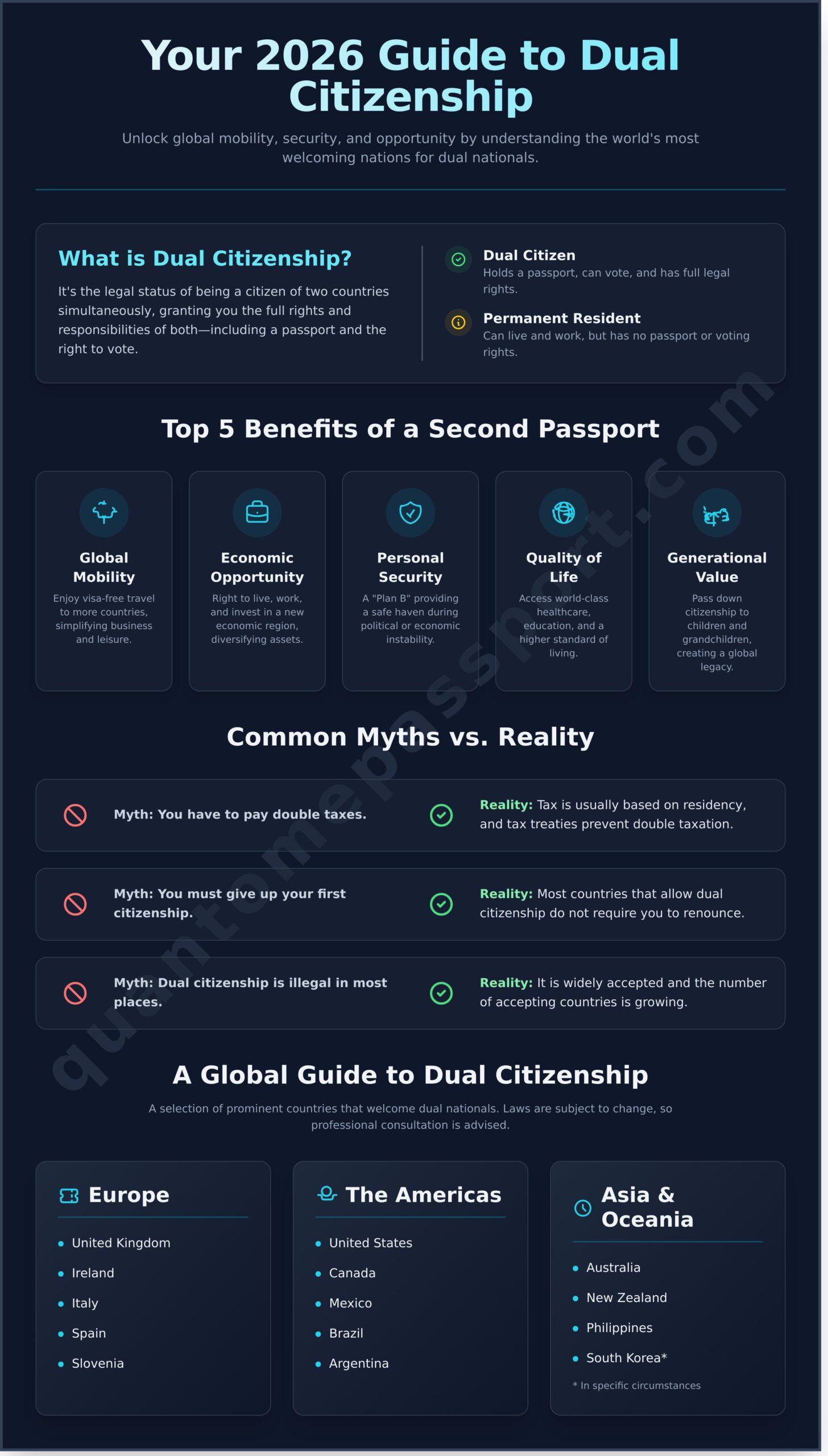
In our increasingly interconnected world, the concept of holding more than one nationality is no longer a rarity-it’s a strategic advantage. Dual citizenship is the legal status of being a citizen of two countries simultaneously, granting you the rights and responsibilities of both. For a comprehensive overview of the legal history, you can explore What is Dual Citizenship? on Wikipedia. This status is distinct from permanent residency, which allows you to live and work in a country but doesn’t provide a passport or voting rights.
For a visual breakdown of how this works, especially for U.S. nationals, the video below offers a clear explanation.
The Top 5 Benefits of Holding a Second Passport
Acquiring a second passport unlocks a world of possibilities that extend far beyond simply having another travel document. It’s a powerful tool for personal and financial freedom.
- Global Mobility: Enjoy visa-free or visa-on-arrival travel to a wider range of countries, simplifying international business and leisure trips.
- Economic Opportunity: Gain the right to live, work, and invest in a new economic region, diversifying your assets and tapping into new markets.
- Personal Security: A second citizenship acts as a “Plan B,” providing a safe haven for you and your family during times of political or economic instability in your home country.
- Quality of Life: Access world-class healthcare, education systems, and a higher standard of living for yourself and future generations.
- Generational Value: In many cases, citizenship can be passed down to your children and grandchildren, creating a legacy of global access and opportunity.
Common Myths About Dual Nationality
Misconceptions often surround dual citizenship. Let’s clarify a few common myths:
- Myth: You automatically have to pay double taxes. Most tax obligations are based on residency, not citizenship. Many nations have tax treaties in place to prevent double taxation, ensuring you don’t pay tax on the same income twice.
- Myth: It’s illegal in most places. While some countries restrict it, the number of dual citizenship countries is growing. It is a widely accepted and legally recognized status across much of the world.
- Myth: You must give up your first citizenship. This is rarely the case. Most countries that allow for dual nationality do not require you to renounce your original citizenship to acquire a new one.
Countries That Allow Dual Citizenship: A Global Guide
Navigating the global landscape of citizenship can be complex, as each nation sets its own rules. The list below offers a guide to some of the most prominent dual citizenship countries, organized by continent to help you explore your options. It is important to remember that this is not an exhaustive list, and immigration laws are subject to change. For a more detailed, country-by-country overview, this global list of dual citizenship countries provides an excellent reference. Before pursuing any path, we strongly advise consulting with an immigration professional to verify your eligibility and understand the specific requirements involved.
Dual Citizenship in Europe
Europe offers a wide array of options for second citizenship, many of which are rooted in ancestry or long-term residence. Holding a passport from an EU member state grants significant freedom of movement and work across the bloc.
- United Kingdom: Generally permits dual nationality without restrictions, allowing its citizens to hold other passports freely.
- Ireland: A highly sought-after option, particularly for those with Irish parents or grandparents, thanks to its robust citizenship by descent program.
- Italy & Spain: Both nations have strong pathways to citizenship through ancestry (jure sanguinis), making them popular choices for those with European heritage.
- Slovenia: An attractive EU entry point that allows dual citizenship in most cases, though some restrictions may apply if naturalizing.
Dual Citizenship in the Americas
From North to South, the Americas are generally very open to dual nationality, with many countries recognizing citizenship based on birth within their territory (jus soli) or parentage.
- United States & Canada: Both North American nations fully permit their citizens to hold multiple citizenships without needing to renounce their original one.
- Mexico: Actively allows dual nationality. Individuals born to a Mexican parent, even abroad, are generally considered Mexican nationals from birth.
- Brazil & Argentina: These South American countries have historically permissive policies, generally allowing citizens to acquire other nationalities without issue.
Dual Citizenship in Asia and Oceania
While policies in this region can be more varied, several key countries embrace dual citizenship, offering pathways through descent, marriage, or reacquisition for former citizens.
- Australia & New Zealand: Both nations have liberal dual citizenship laws, allowing their citizens to become citizens of other countries without losing their original status.
- Philippines: Through the Citizenship Retention and Re-acquisition Act, former natural-born citizens can reclaim their Filipino nationality.
- South Korea: While historically restrictive, South Korea now permits dual citizenship in specific circumstances, such as for individuals who gain it through marriage or for talented professionals.
The Main Pathways to Securing a Second Citizenship
Securing a second citizenship is a strategic move for global families, but the path you take is highly personal. Your ancestry, financial resources, and long-term goals will determine the most viable option. Generally, there are three primary legal routes to a second passport: descent, naturalization, and investment. Each pathway has unique requirements, timelines, and costs, making it crucial to understand which one aligns with your circumstances among the many dual citizenship countries. Understanding these core pathways is the first step in building a strategy for global mobility and security.
Citizenship by Descent (Jus Sanguinis)
Often called “right of blood,” this pathway allows you to claim citizenship based on your ancestry. If you have parents, grandparents, or even great-grandparents from countries like Ireland, Italy, Poland, or Hungary, you may be eligible. This is often the most cost-effective route, but it demands meticulous and extensive documentation to prove your lineage. Success hinges on your ability to trace and verify your family tree with official records like birth and marriage certificates.
Citizenship by Naturalization
Naturalization is the process of becoming a citizen after legally residing in a country for a specified number of years. This is the most traditional path and is available in most nations. The journey typically involves maintaining a valid residency permit, demonstrating proficiency in the local language, passing a civics or history test, and showing proof of integration into society. While straightforward, it is often the longest and most demanding route to a second passport.
Citizenship by Investment (CBI)
For individuals with the necessary capital, Citizenship by Investment (CBI) programs provide a fast-tracked route to a second passport. This pathway involves making a significant economic contribution-such as a real estate investment or a donation to a government fund-in exchange for citizenship. It is frequently the most efficient method for acquiring an EU passport. Many dual citizenship countries in Europe offer residency-by-investment programs that serve as a direct stepping stone to full citizenship. Explore your options for an EU passport through investment.
Key Obligations and Considerations for Dual Nationals
Becoming a dual national is more than just acquiring a second passport; it’s about embracing the role of a responsible global citizen. While the benefits are significant, they are accompanied by a unique set of legal obligations. Understanding the laws of both countries is not just advisable-it is essential for navigating your life without legal or financial complications. Proactive planning ensures you can fully enjoy the freedoms of dual citizenship.
Taxation Rules for Dual Citizens
Tax obligations can become significantly more complex with a second citizenship. While many nations have double taxation treaties to prevent you from paying tax on the same income twice, some countries have unique rules. The United States, for example, taxes its citizens on their worldwide income, regardless of where they reside. It is crucial to consult with a tax professional who understands the specific agreements between your two countries of citizenship.
Mandatory Military Service
A critical consideration, especially for families, is compulsory military service. Several nations may require citizens-even those living abroad-to enlist. Key examples include:
- Israel
- Switzerland
- South Korea
- Greece
- Turkey
Exemptions for non-residents often exist, but the rules are strict and vary widely. Failing to understand your obligations can have serious consequences, so thorough research is vital before pursuing a second citizenship for yourself or your children.
Passport Usage and International Travel
Navigating international borders requires a clear strategy. The universal rule is simple: enter and exit a country using its passport. When traveling to the US, use your US passport. When traveling to the UK, use your UK passport. This avoids confusion and potential questioning by immigration officials. Also, be aware that when you are in one of your countries of citizenship, your other country may be limited in its ability to provide consular assistance.
Properly managing your responsibilities is the key to unlocking the full potential of global mobility. The legal landscape of dual citizenship countries is intricate and ever-changing. For expert guidance tailored to your unique situation, explore the bespoke solutions at quantomepassport.com.
Your Global Future Awaits: Final Thoughts on Dual Citizenship
Securing a second passport is more than a travel document; it is a strategic investment in your future freedom, security, and opportunity. This guide has demonstrated that the world of dual citizenship countries is vast and accessible, with diverse pathways-from ancestry to investment-leading to this powerful status. Understanding both the immense benefits and the key obligations is the first step toward making an informed decision for yourself and your family.
Navigating the legal complexities of European citizenship requires expert guidance. At Quantome Passport, we specialize in providing clear, legal pathways to EU citizenship, with proven expertise in options like Slovenian residency. We proudly serve a global clientele seeking to unlock the unparalleled advantages of European access.
If you are ready to take the definitive step towards a more connected and opportunity-rich life, we invite you to Book a Private Strategy Call to explore your personal options. Your journey to becoming a global citizen starts today.
Frequently Asked Questions About Dual Citizenship
Can a person have 3 or more citizenships?
Yes, it is possible to hold citizenship in three or more countries. This is often referred to as multiple or plural citizenship. The ability to do this depends on the laws of all the countries involved. For example, if you are a U.S. citizen, you could also claim Irish citizenship by descent and St. Kitts citizenship by investment, provided that all three countries permit you to hold other nationalities. The key is that none of the countries require you to renounce your other citizenships.
Will I automatically lose my original citizenship if I get a second one?
Not necessarily, but this is a critical point to verify. Your potential loss of citizenship is determined by the laws of your original country. Some nations, such as China or Japan, strictly forbid dual nationality and will automatically revoke your citizenship. Others, like the United States and the United Kingdom, generally permit it. Always consult the nationality laws of your current country before pursuing another passport to avoid unintended renunciation.
Which country is the easiest to get dual citizenship in?
The “easiest” country depends entirely on your personal circumstances, such as ancestry or financial standing. For those with recent European heritage, countries like Ireland or Italy can be straightforward through citizenship by descent. For investors, Caribbean nations like St. Kitts & Nevis offer fast citizenship by investment programs. The comprehensive list of dual citizenship countries shows that pathways vary widely, so the easiest option is unique to each individual’s profile and goals.
Do I have to pay taxes in both countries if I am a dual citizen?
Your tax obligations depend on the specific laws of both countries and any tax treaties between them. The United States, for instance, taxes its citizens on worldwide income, regardless of where they reside. Most other countries base taxation on residency. To avoid double taxation, dual citizens can often use credits and exemptions available through bilateral tax treaties. It is essential to consult with an international tax advisor to ensure full compliance in all jurisdictions.
How long does it typically take to obtain dual citizenship?
The timeline can range from a few months to more than a decade. Citizenship by Investment programs in Caribbean countries are the fastest, often taking just 3 to 6 months. Acquiring citizenship by descent (ancestry) can take 1 to 3 years due to document collection and processing. The longest route is naturalization through residency, which typically requires living in a country for 5 to 10 years, like in Portugal or Spain, before you are eligible to apply.
Is it possible to buy a passport and get citizenship immediately?
No, you cannot instantly “buy” a passport. However, you can legally obtain citizenship through what are known as Citizenship by Investment (CBI) programs. These require a significant financial contribution to a country’s economy, such as a real estate purchase or a donation to a national fund. Even these “fast-track” options involve a strict vetting and application process that takes several months to complete. They do not provide immediate citizenship upon payment.
Does my child automatically become a dual citizen if born abroad?
It depends on the laws of two places: the parents’ country of citizenship and the child’s country of birth. For example, a child born in Canada (which grants citizenship by birth on its soil) to American parents (who can pass down citizenship) would automatically be a dual U.S.-Canadian citizen. However, if that same child were born in Germany, which does not automatically grant citizenship by birth, they would likely only be a U.S. citizen.