Dreaming of an EU passport but find yourself lost in a maze of dense legal documents and scattered online advice? You’re not alone. The path to Slovenian citizenship can feel overwhelmingly complex, leaving you questioning which route you qualify for, what the residency requirements truly are, or if your family roots hold the key to a European future. The frustration of having unclear steps is a major roadblock when the freedom of movement throughout Europe is your ultimate goal.
Consider this guide your definitive roadmap. We’ve cut through the bureaucratic noise to bring you one clear, comprehensive resource. Here, you will discover every legal pathway to a Slovenian passport-from ancestry and long-term residency to special programs for entrepreneurs and those of Slovenian descent. We will break down the exact requirements and provide a step-by-step plan for your application. Prepare to move from uncertainty to action and unlock the door to your life in the European Union.
Why Slovenian Citizenship? The Benefits of an EU Passport
Pursuing slovenian citizenship is about more than acquiring a new passport; it’s about unlocking a future of unparalleled opportunity and stability within the European Union. As a Slovenian citizen, you gain the right to live, work, and study not just in the scenic alpine nation of Slovenia, but across all 27 EU member states. This profound freedom is the cornerstone of its value, offering a gateway to a life of enhanced mobility, security, and prosperity. The entire process and its legal foundations are detailed within the Slovenian Nationality Law, which outlines the pathways to becoming a citizen.
To better understand what this journey entails, watch this helpful overview:
Freedom to Live, Work, and Travel
The most immediate advantage of an EU passport is the freedom of movement. As a Slovenian national, you can settle in Paris, start a business in Berlin, or retire on the coasts of Spain without needing a visa or work permit. This right is enshrined in the Schengen Agreement, which eliminates internal border controls. Furthermore, the Slovenian passport is one of the world’s strongest, granting visa-free or visa-on-arrival access to over 180 countries, a level of global mobility that dramatically surpasses the limitations faced by most non-EU passport holders.
Economic and Social Stability
Slovenia itself offers a remarkable quality of life, characterized by a stable democratic government, a robust economy, and one of the highest safety indexes globally. Citizens benefit from a comprehensive social security system that includes high-quality public healthcare and access to excellent educational institutions. Key advantages include:
- Access to the EU Single Market: Conduct business, invest, and move capital freely within the world’s largest integrated economic area.
- Property Ownership: Purchase real estate without the restrictions and special permits required for many foreign nationals.
- Social Benefits: Gain access to EU-wide social security, healthcare, and educational opportunities, often at significantly lower costs for citizens.
Pathways to Citizenship: Which Route is Right For You?
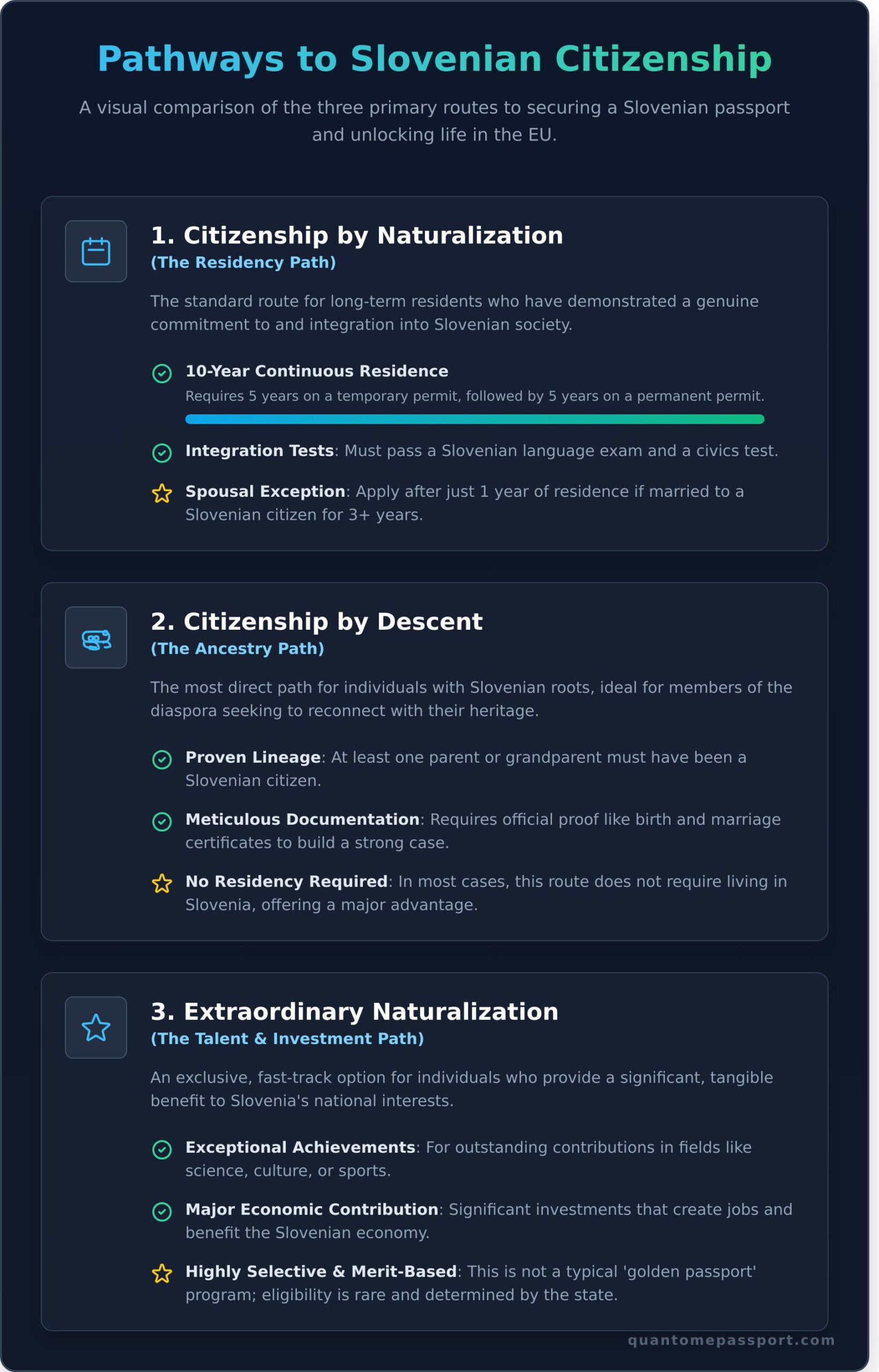
Securing a Slovenian passport opens the door to the European Union, but the path you take depends entirely on your personal circumstances. Slovenia offers three primary routes to citizenship, each with distinct requirements and timelines. Understanding these options is the first critical step in your journey. This guide will help you identify which pathway-residency, ancestry, or exceptional contribution-aligns with your goals.
To help you quickly compare, here is a high-level look at the main options:
- Naturalization (The Residency Path): Best for long-term residents. Requires 10 years of continuous living in Slovenia and passing integration tests.
- Descent (The Ancestry Path): Best for those with Slovenian parents or grandparents. Relies on official proof of lineage, often without a residency requirement.
- Extraordinary Naturalization (The Talent & Investment Path): A fast-track for individuals making significant economic, scientific, or cultural contributions to Slovenia.
Citizenship by Naturalization (The Residency Path)
This is the most common route for foreign nationals who have made Slovenia their home. To qualify for Slovenian citizenship by naturalization, you must demonstrate a deep connection to the country through 10 years of continuous legal residence. This period can be shortened in specific cases, such as for spouses of Slovenian citizens. This path requires passing a Slovenian language exam and a civics test, proving your successful integration into society.
Citizenship by Descent (The Ancestry Path)
If you have Slovenian roots, this is often the most direct path. You may be eligible if at least one of your parents or grandparents was a Slovenian citizen. Unlike naturalization, this route demands meticulous documentation to prove your lineage. As detailed in the official U.S. Embassy guide to Slovenian citizenship, gathering birth certificates, marriage records, and other vital documents is the cornerstone of a successful application. This path is perfect for the diaspora seeking to reconnect with their heritage.
Extraordinary Naturalization (The Investment & Talent Path)
This is a fast-track option reserved for individuals who can provide a significant benefit to Slovenia’s national interests. This isn’t a typical ‘golden passport’ program but rather a merit-based pathway. Eligibility is granted for exceptional achievements in fields like science, culture, sports, or through major economic investments that create jobs. It is the most exclusive route, designed for high-profile individuals whose talents or capital can advance Slovenia on the world stage.
Citizenship by Naturalization: The Standard Path to a Slovenian Passport
For most foreign nationals, acquiring a Slovenian passport is achieved through naturalization. This pathway is designed for individuals who have made Slovenia their long-term home, demonstrating a genuine commitment to the country through residency and integration. The process is rigorous and hinges on the legal concept of ‘continuous residence,’ which requires you to maintain an uninterrupted registered address in Slovenia, with only short absences permitted for reasons like tourism or urgent family matters.
Residency Requirements: The 10-Year Rule
The standard route to slovenian citizenship requires a total of 10 years of continuous residence. This is typically broken down into two stages: five years living in Slovenia on a temporary residence permit, followed by an additional five consecutive years on a permanent residence permit. Certain conditions can shorten this timeline. For instance, individuals married to a Slovenian citizen for at least three years may be eligible to apply after just one year of continuous residence in Slovenia.
Integration Requirements: Language and Culture
Slovenia expects applicants to demonstrate successful integration into society. This goes beyond simply living in the country and involves proving you are part of its civic and cultural fabric. Key requirements include:
- Passing a Slovenian language examination at a basic proficiency level (A2 or B1, depending on the case).
- Passing a test of civic knowledge covering Slovenian history, culture, and its constitutional system.
- Proving financial self-sufficiency with a stable and regular source of income.
- Maintaining a clean criminal record both in Slovenia and your home country.
Key Documentation for Naturalization
A successful naturalization application depends on meticulous and accurate documentation. You must submit a comprehensive file to the local administrative unit (upravna enota). While the exact list may vary, essential documents always include:
- Your valid permanent residence permit.
- The completed citizenship application form.
- Proof of continuous residence and a registered address.
- Evidence of stable income (e.g., employment contracts, tax returns).
- An original, apostilled birth certificate.
- A valid passport from your country of origin.
Crucially, all documents not originally in Slovenian must be officially translated by a certified court translator to be accepted.
Citizenship by Descent: Reclaiming Your Slovenian Heritage
For individuals with Slovenian roots, the most direct path to an EU passport is through ancestry. Slovenia follows the principle of jus sanguinis, or “right of blood,” meaning citizenship is passed down through parentage rather than by place of birth. This route allows you to reclaim your heritage, but the rules are specific and depend on your age and how many generations separate you from your Slovenian ancestor. Securing Slovenian citizenship by descent is possible for children and grandchildren, and in some cases, great-grandchildren of original emigrants.
Proving Your Lineage: The Documentation Trail
Success hinges on providing an unbroken chain of official documents connecting you to your Slovenian ancestor. You must prove every link in the generational chain with vital records. These documents are typically sourced from Slovenian state archives or local administrative units (upravna enota).
- Your ancestor’s Slovenian birth certificate (rojstni list)
- Your ancestor’s marriage certificate (poročni list), if applicable
- Proof of your ancestor’s citizenship status (e.g., old passports, naturalization records from their new country)
- Birth and marriage certificates for each subsequent generation, including your own
All non-Slovenian documents must be officially translated and certified with an apostille.
Application for Persons Aged 18-36
If you are between 18 and 36 years old and are a second-generation descendant (i.e., your parent was born abroad to a Slovenian citizen), you must submit your application before your 36th birthday. A critical requirement for this group is demonstrating an “active tie” to the Republic of Slovenia. This is more than just a genetic link; it involves proving a genuine, ongoing relationship with the country, its culture, or its diaspora communities. Examples include participation in Slovenian clubs, language proficiency, or frequent visits to the country.
Application for Minors (Under 18)
The process is significantly simpler for minors. If at least one parent is a Slovenian citizen at the time of the child’s birth, the child can be registered for Slovenian citizenship. This registration must be completed at a Slovenian embassy or consulate abroad before the child turns 18. This is not an application but a registration of a right they already possess. Missing this deadline means the individual will later have to apply under the more demanding rules for adults aged 18-36.
Extraordinary Naturalization: The Fast-Track for Investors & Professionals
For high-net-worth individuals, accomplished professionals, and strategic investors, Slovenia offers a unique and accelerated path to citizenship. While not a standard Citizenship by Investment (CBI) program with a fixed donation amount, Article 12 of the Citizenship Act allows for naturalization based on “exceptional merit” that serves the national interest. This discretionary process is the fastest route to an EU passport for those who can make a significant contribution to Slovenia’s economic, scientific, cultural, or sporting landscape. Navigating this nuanced pathway is the core specialty of Quantome Passport.
The Economic Interest Path
The most direct route for investors involves making a substantial contribution to the Slovenian economy. This is not a passive investment; it requires active participation that generates tangible value. Examples include forming a new Slovenian company, creating jobs for local citizens, or making a strategic investment in a key industry like technology, green energy, or tourism. A common pathway involves establishing a business with a minimum share capital of €110,000, which serves as a foundation to demonstrate your long-term economic commitment to the nation.
Building a Case for ‘National Interest’
Successfully securing Slovenian citizenship through this route depends on building a compelling and evidence-based case. Your application must prove that your presence and contribution are of exceptional value to Slovenia. This involves securing a positive opinion from the relevant government ministry, which will champion your application. The process is highly subjective and requires meticulous documentation and strategic positioning. Expert guidance is essential to articulate your value proposition effectively and navigate the governmental review process. Book a Private Strategy Call to assess your investment pathway.
Benefits of the Extraordinary Path
For qualified applicants, the advantages of the national interest pathway are significant and directly address the challenges of standard naturalization. It offers the most efficient timeline available.
- Reduced Residency: The standard 10-year residency requirement is reduced to just one year of continuous residence in Slovenia before the application can be approved.
- Language Test Waiver: The demanding Slovenian language proficiency test may be waived, removing a significant barrier for many applicants.
- Speed: It is unequivocally the fastest and most streamlined route to a Slovenian passport for those who meet the high standards of contribution.
The Application Process: A Step-by-Step Overview
Navigating the path to an EU passport can seem complex, but the application for slovenian citizenship is a structured journey. By breaking it down into clear, sequential steps, you can approach it with confidence and clarity. Meticulous preparation is the cornerstone of a successful application; every document and detail matters.
Step 1: Document Gathering and Preparation
This is the most time-intensive phase, and we advise starting several months before you plan to apply. Your goal is to compile a flawless dossier. While specific requirements vary based on your eligibility path, a master checklist of common documents includes:
- Original birth certificate
- Valid passport and other forms of identification
- Marriage or divorce certificates (if applicable)
- Proof of address in Slovenia (for naturalization)
- A clean criminal record certificate from your country of origin
- Proof of sufficient financial means
Crucially, documents issued outside Slovenia must be officially authenticated (usually with an apostille) and then translated into Slovene by a certified court translator.
Step 2: Submitting Your Application
With your complete and translated dossier in hand, you will formally submit your application. This is typically done in person at the relevant Administrative Unit (Upravna enota) in Slovenia. If you are applying from abroad based on descent, you can usually submit your application at a Slovenian embassy or consulate. Be prepared to pay the non-refundable administrative processing fees at this time.
Step 3: The Waiting Period and Decision
Patience is key during this stage. Official processing times can range from 6 to 12 months, and sometimes longer, depending on the complexity of your case and the specific path you are on. Upon approval, you will receive a formal decision (odločba) and an invitation to attend a ceremony to take an oath of allegiance. With your new certificate of citizenship, you can then apply for your Slovenian ID card and, finally, your powerful EU passport.
While the process is detailed, each step is a concrete move toward your goal. Ensuring every form is correct and every document is properly authenticated is non-negotiable for a smooth journey. For personalized guidance through every stage of the application, explore our dedicated citizenship services.
Your Journey to Slovenian Citizenship Begins Here
Embarking on the path to an EU passport via Slovenia is a journey filled with immense opportunity. As we’ve detailed, the benefits extend far beyond a travel document; they represent the freedom to live, work, and study anywhere across the European Union. We’ve explored the primary routes available-whether you are reclaiming your heritage through descent, have established residency through naturalization, or qualify for the fast-track economic interest program. Understanding these options is the first critical step toward securing your future and obtaining slovenian citizenship.
While the process is well-defined, navigating the legal intricacies requires precision and expertise. You don’t have to undertake this journey alone. Our team offers expert guidance on all legal pathways and specializes in the nuanced economic interest program for investors and professionals. We are committed to providing confidential, personalized strategy sessions to build the strongest possible application on your behalf.
Are you ready to take the next step? Discover if you qualify for Slovenian Citizenship and contact our experts today. The door to your European future is open-let us help you walk through it.
Frequently Asked Questions About Slovenian Citizenship
Does Slovenia allow dual citizenship?
Generally, Slovenia requires applicants for naturalization to renounce their previous citizenship. However, significant exceptions exist. The most common exception is for those acquiring citizenship by descent (through Slovenian ancestry), who can typically retain their original nationality. Dual citizenship may also be permitted if your country of origin does not allow for renunciation or under other specific circumstances defined by law. It’s crucial to verify your eligibility based on your personal situation.
How long does the Slovenian citizenship process take in total?
The processing time for Slovenian citizenship varies widely depending on the application path. For naturalization, after fulfilling the 10-year residency requirement, the administrative procedure itself typically takes between 6 to 12 months. Applications based on descent can be faster, sometimes processed within six months, but this depends heavily on the complexity of your case and the completeness of your ancestral documentation. Thorough preparation is key to minimizing delays.
What is the Slovenian language requirement for citizenship?
Applicants for citizenship via naturalization must demonstrate a basic command of the Slovenian language. This is typically confirmed by passing a state-certified language exam at the A2 level on the Common European Framework of Reference for Languages (CEFR). This test evaluates your ability to handle simple, routine conversations and understand common expressions. Exemptions may apply, for instance, if you have completed your primary or secondary education in Slovenia.
Can my family get citizenship with me?
Yes, your family members can often acquire citizenship, but their applications are processed individually. For example, a spouse of a Slovenian citizen may apply after three years of marriage and at least one year of continuous residence in Slovenia. Minor children can typically be included in a parent’s naturalization application. However, each family member must meet their own specific eligibility criteria, so it is not an automatic group approval.
What are the main reasons for an application to be rejected?
The most common reasons for rejection are incomplete documentation, failure to meet the strict residency requirements, or not passing the language proficiency test. An application can also be denied due to a criminal record in any country, posing a threat to national security, or having unresolved tax obligations in Slovenia. Meticulous preparation and ensuring you meet every legal requirement for Slovenian citizenship are essential for a successful outcome.
Is it possible to buy Slovenian citizenship directly?
No, Slovenia does not have a “citizenship by investment” or “golden passport” program that allows you to purchase citizenship. The legal pathways are based on criteria such as ancestry (descent), long-term residency (naturalization), or for exceptional contributions to the country in fields like science, sports, or culture. Be cautious of any service that claims to offer Slovenian citizenship in exchange for a direct investment, as these are not legitimate routes.
Do I need to live in Slovenia to get citizenship by descent?
No, one of the primary benefits of applying for citizenship by descent is that there is generally no residency requirement. If you can prove your Slovenian ancestry through a parent or grandparent, you can typically submit your application from your current country of residence via a Slovenian embassy or consulate. This pathway is based entirely on your heritage, not on your physical presence or integration into Slovenian society.